Topics (384k) Articles (398k) Users (410) Discussions (242) Comments (383) Files (13k) New article
An impulsive quantum kick is the limit of a pulse with finite integrated Hamiltonian operator, rather than a bounded finite step. For a bounded self-adjoint operator with units of action, a rectangular pulse lasting has exact unitary time evolution for every . In the limiting notation , is the Dirac delta function andThe integral estimate for quantum state continuity at a finite Hamiltonian step no longer tends to zero: the pulse height diverges. A bounded background Hamiltonian operator contributes vanishing evolution during this limit. A more general pulse with noncommuting generators can require time ordering; integrated area alone then need not specify the result.
For example, , with a Pauli matrix, sends a qubit in to . At , the Born rule predicts with probability one, however short the regularized pulse is. Its finite rotation is precisely what a bounded finite step cannot accomplish at the switching instant.
The -qubit Dicke state with excitations is the normalized equal superpositionwhere is the Hamming weight in the computational basis. The binomial coefficient counts the mutually orthogonal summands, proving normalization. Every permutation of the qubits leaves the vector unchanged. Splitting the sum according to the first bit and using givesTerms with zero coefficient are omitted at the endpoints. This recursion is useful for partial traces and for distributing a logical qubit among many symmetric physical qubits.
Encode signs by the unit Bloch vector . Perform the requested Pauli measurement and interpret a positive outcome as zero. Every input and index has success . To prove optimality, write each binary-measurement difference as , where positivity gives . Averaging over all eight inputs cancels the terms. For any encoding vectors of norm at most one, the average success is at most . The Cauchy-Schwarz inequality bounds the sum by , proving the optimum even for mixed encodings and general binary measurements. The constant-success construction also maximizes worst-case success.
A concrete quantum quench experiment loaded a Bose-Einstein condensate of chemical atoms from a magnetic field trap into an optical lattice: three orthogonal laser standing waves, with approximately beam waists. An loading ramp preceded a increase in lattice depth. This suppressed quantum tunnelling while retaining each well's vibrational ground state. The switch preserved atom-number populations rather than freezing every motional degree of freedom.[ref]
Collapse and revival of the matter wave field of a Bose-Einstein condensate by Markus Greiner and others. Greiner and others, manuscript pp. 3–4: preparation and switching; p. 7, Methods: wavelength, beam waists and lattice geometry
After variable hold times, releasing the traps and taking photon absorption images after of flight revealed disappearance and return of interference peaks. Background-subtracted peak counts supplied a coherent fraction. Varying final depth tested the predicted revival period ; varying initial depth tested the collapse's sensitivity to atom-number statistics. Peak broadening outside counting windows and spatial variation of limited later signals.[ref]
Collapse and revival of the matter wave field of a Bose-Einstein condensate by Markus Greiner and others. Manuscript p. 4 and figure 2 caption on p. 11: flight and image extraction; figure 3 caption on p. 12: readout limitations; figures 4–5 captions on pp. 13–14: final-depth and initial-depth comparisons
Here is the on-site interaction energy. The approximate isolated-well Hamiltonian operator , with number operator , gives different quantum phases to its number states, which later rephase. This is a many-level realization of the distinction between fixed populations and changing quantum phases.[ref]
Collapse and revival of the matter wave field of a Bose-Einstein condensate by Markus Greiner and others. Manuscript pp. 2–3, equations (1)–(2): isolated-well Hamiltonian and number-state phase evolution
Take an isolated two-level system, or a spin one-half qubit, with Pauli matrices . Let and . The initial and final Hamiltonian operators areThe energy gaps are . Prepare the initial ground state , with energy eigenvalue . A final orthonormal eigenbasis isDirect matrix multiplication gives and . The unchanged initial quantum state is . Its new probability amplitudes are the inner products ; the Born rule gives . The angle between the real amplitude vectors is , whereas the Hamiltonian axis on the Bloch sphere rotates through .
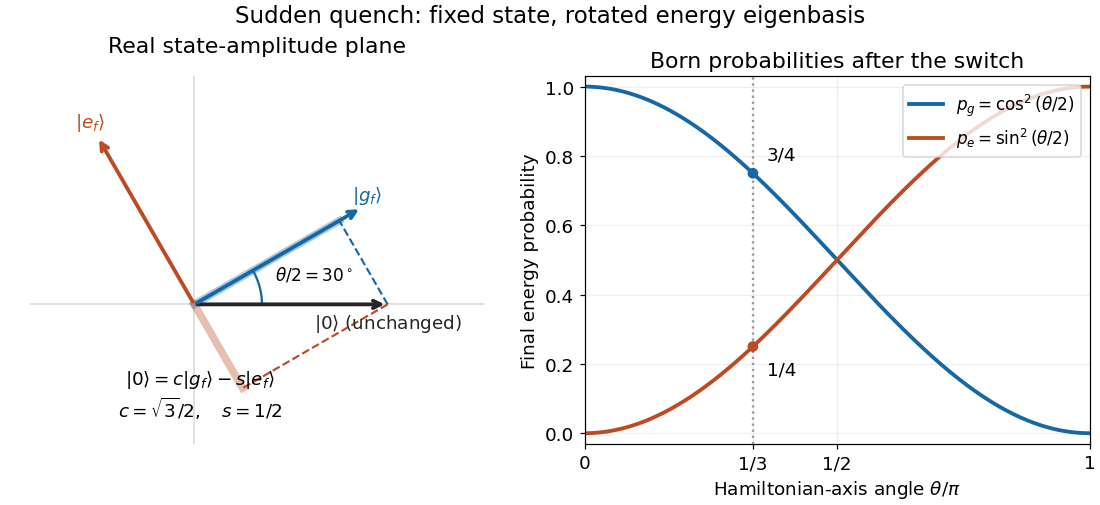
At , and , so the final energy measurement gives with probability and with probability . At the initial ground state remains the final ground state; at it is the final excited energy eigenstate. These statements are about the new energy labels, not an instantaneous physical rotation of the quantum state.
For , define a vector space with basis , , , and product . Bilinearity of the exponent verifies associativity. This constructs the algebra and proves the basis independently of its presentation. It localizes the quantum plane at powers of and gives a quotient witness for noncommutativity and noncocommutativity of the coordinate Hopf algebra of quantum SL2.
Quantum enveloping algebra action on the quantum plane by  Codex 0 Created 2026-10-14 Updated 2026-11-05
For with and , the quantum enveloping algebra of sl2 acts by , and . Negative exponents here have zero coefficients and are omitted. The quantum integer identity verifies the commutator. These operations preserve total degree and make the quantum plane a module algebra.
For the phase gate , apply powers to a uniform quantum superposition on qubits. Binary positional weights multiply the phases into on basis vector . The inverse quantum Fourier transform returns exactly, by orthogonality of roots of unity. Preparing the powers by repeated applications uses copies of ; this does not claim a number of gate calls polynomial in . If is odd, its powers generate the entire set of dyadic phase gates because has a modular inverse modulo .
For a unitary operator eigenphase , an -qubit quantum phase estimation register of size has output probability amplitudeChoose the nearest integer label to , with labels understood modulo , and put , taking the representative . The finite geometric series gives . For , concavity of sine gives , while . Thus the probability of the nearest label is at least . At it is exactly one. If two labels tie for nearest, each satisfies the bound.
For a -dimensional unitary operator , a maximally mixed state on its target is the equal mixture of these orthonormal eigenvectors. Therefore quantum phase estimation with register size produces label with probabilityThis follows by linearity of unitary time evolution and the Born rule on the spectral mixture. If every eigenphase has an exact -grid label, that label has probability equal to its multiplicity divided by . Otherwise the exact distribution has tails, and the nearest labels are guaranteed only the nearest-integer success bound for quantum phase estimation weighted by the corresponding spectral probabilities.
Use CNOT gates to encode one logical qubit and zero ancillas into the repetition subspace spanned by . Apply the phase gate in parallel to all physical qubits, then undo the encoding. The logical phase is multiplied by in one oracle-time layer. This copies computational-basis labels coherently rather than cloning an arbitrary quantum state. Blocks of sizes prepare a dyadic Fourier phase state using parallel oracle applications.
For register size and eigenphase , the amplitude of decoded label is . The finite geometric series gives . If , this is . Thus the nearest exactly representable phase is returned with probability near one, not with certainty unless the offset vanishes.
// Target: quantum-error-correction.bigb
Let , let be the nearest label to , and let . The exact quantum phase estimation amplitude is . The sine bound on circular distances gives probability at most , where is the centered distance from to . At label distance from , , with at most two labels for each . Since , the tail telescopes to the displayed bound. Adding control qubits beyond desired phase bits gives circular accuracy below with failure probability at most .
For and order , multiplication by modulo is a unitary operator. On the orbit of one it cyclically permutes basis states. The displayed orthonormal eigenstates have eigenvalues , and . Thus quantum phase estimation on this efficiently prepared state samples a uniform without knowing . Controlled powers are implemented by quantum modular exponentiation. Sufficient phase resolution allows continued-fraction recovery in quantum order finding; the reduced denominator equals only when is coprime to .
Gradient ascent pulse engineering parametrizes each control by time-slice amplitudes and optimizes a differentiable quantum-control objective. Forward products of slice unitary operators and backward adjoint propagation give derivatives with respect to every amplitude. For , the exact derivative is . Updating all slice amplitudes along these derivatives is gradient ascent for a fidelity, or gradient descent for its negative.
Parametrize a reproducible pulse by a finite vector and evaluate its objective experimentally on freshly prepared systems. Repeatedly update the pulse from measured objective values or finite-difference derivatives, including penalties for resources. This is closed-loop control across experimental runs, even when each pulse is open-loop control within a run. It reduces reliance on an inaccurate dynamical model but still requires preparation reproducibility, sufficient measurement statistics and stability of the experimental conditions.
The Cauchy-Schwarz inequality for the Hilbert-Schmidt inner product gives for -dimensional unitary operators. Equality holds exactly when . When absolute gate phase matters, use the phase-sensitive Hilbert-Schmidt distance instead.
For and , enforce the state equation with . Variation gives the same Schrödinger equation for the costate, propagated backward from . Control variation gives the displayed real gradient. Forward state propagation, backward costate propagation, and a constrained gradient update form direct-adjoint looping. These are necessary stationarity equations, not a guarantee of a global optimum.
For a real quantum optimal control objective , first variation gives the state equation, the adjoint equation, , and . The adjoint is taken for the Hilbert-Schmidt inner product. With dissipation it is essential to use , not silently the same generator as the forward state. These are necessary stationarity equations; they do not establish global optimality.
Give Alice the first qubit and Bob the second . Compare the Bell state with a preparation that tosses a fair classical bit and gives both parties its value. Their density operators, written in the computational basis ordered , areThey have identical diagonal quantum state populations. The off-diagonal entries of the Bell state retain quantum coherence between and ; the classical mixture has none in this basis.
If both parties perform a Pauli measurement of , the Born rule gives and for both preparations. Perfect agreement here therefore cannot establish entanglement: an ordinary shared random bit already explains it.
Now both measure , whose normalized eigenstates are and . Changing basis givesThe Bell state again has matching outcomes, each with probability . For either product state or , each of the four outcome pairs has probability , so their classical mixture does too. Equivalently, the Pauli correlator is one for the Bell state and zero for this mixture, while is one for both.
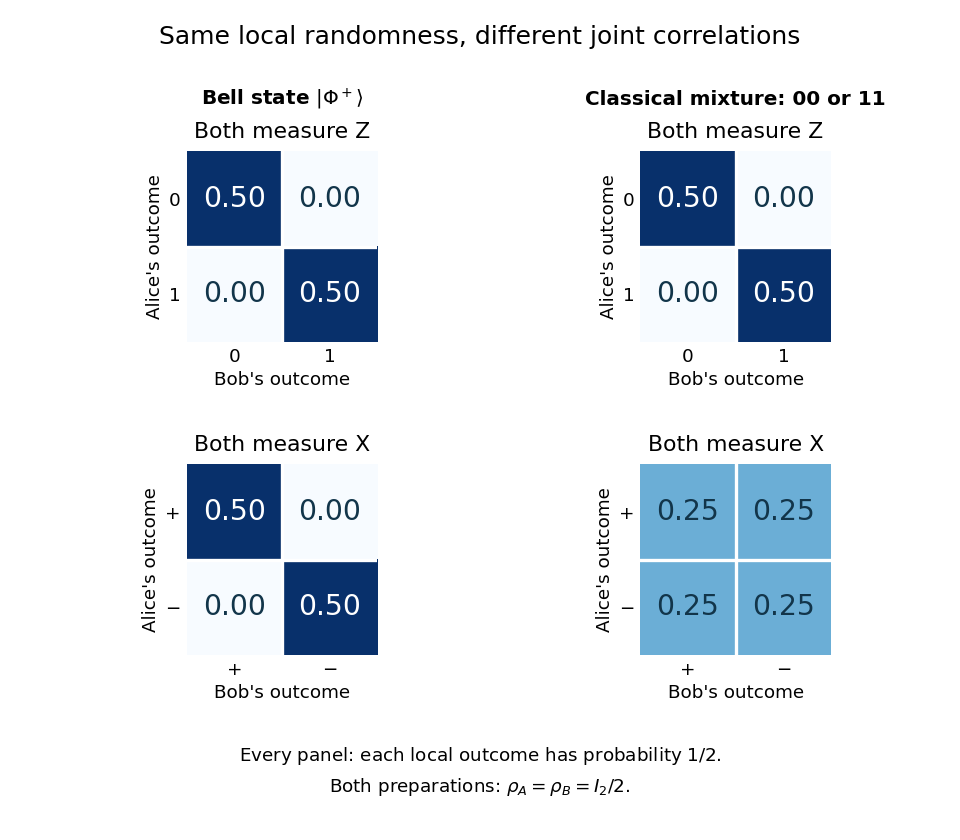
Joint measurement probabilities distinguish a Bell state from a classical mixture while every local outcome remains uniformly random
. Details. Taking a partial trace gives for both preparations. Thus every measurement confined to Alice's system has the same statistics in the two cases, and so does every measurement confined to Bob's. They reveal the difference by comparing records through classical communication. Conditional on Alice's result, Bob can predict a matching result for the Bell state; without that result, his outcomes remain evenly split. An uncommunicated local quantum channel, including a measurement with its outcome discarded, leaves his reduced density matrix unchanged. This is quantum no-signalling, even when conditional states change. [ref]
https://jhwatrous.github.io/TQI.2.pdf. Watrous, Basic notions of quantum information, sections 2.1.3 and 2.2.1, on reductions and channels
The Von Neumann entropy makes the joint-versus-local distinction numerical. With base-two logarithms, the Bell state has eigenvalues , giving , whereas the mixture has , giving . Both have . Their quantum mutual information is consequently two and one bits, respectively. The value two is not two readable classical bits in either local qubit: the matching records have ordinary mutual information one bit in both cases. Random records can come from a globally pure state. [ref]
https://jhwatrous.github.io/TQI.5.pdf. Watrous, Quantum entropy and source coding, on Von Neumann entropy and quantum mutual information
These two matching-axis measurements distinguish the specified preparations; they alone are not a test of a Bell inequality. A local hidden-variable theory could assign shared random answers separately to these two axes. Bell theorem concerns incompatible correlations across a suitable larger collection of measurement settings. Bell's 1964 paper established the obstruction for local hidden-variable descriptions of the predicted correlations. [ref]
https://journals.aps.org/ppf/pdf/10.1103/PhysicsPhysiqueFizika.1.195. Bell, On the Einstein Podolsky Rosen paradox, 1964
Pinned article: Introduction to the OurBigBook Project
Welcome to the OurBigBook Project! Our goal is to create the perfect publishing platform for STEM subjects, and get university-level students to write the best free STEM tutorials ever.
Everyone is welcome to create an account and play with the site: ourbigbook.com/go/register. We belive that students themselves can write amazing tutorials, but teachers are welcome too. You can write about anything you want, it doesn't have to be STEM or even educational. Silly test content is very welcome and you won't be penalized in any way. Just keep it legal!
Intro to OurBigBook
. Source. We have two killer features:
- topics: topics group articles by different users with the same title, e.g. here is the topic for the "Fundamental Theorem of Calculus" ourbigbook.com/go/topic/fundamental-theorem-of-calculusArticles of different users are sorted by upvote within each article page. This feature is a bit like:
- a Wikipedia where each user can have their own version of each article
- a Q&A website like Stack Overflow, where multiple people can give their views on a given topic, and the best ones are sorted by upvote. Except you don't need to wait for someone to ask first, and any topic goes, no matter how narrow or broad
This feature makes it possible for readers to find better explanations of any topic created by other writers. And it allows writers to create an explanation in a place that readers might actually find it.
Figure 1. Screenshot of the "Derivative" topic page. View it live at: ourbigbook.com/go/topic/derivativeVideo 2. OurBigBook Web topics demo. Source. - local editing: you can store all your personal knowledge base content locally in a plaintext markup format that can be edited locally and published either:This way you can be sure that even if OurBigBook.com were to go down one day (which we have no plans to do as it is quite cheap to host!), your content will still be perfectly readable as a static site.
- to OurBigBook.com to get awesome multi-user features like topics and likes
- as HTML files to a static website, which you can host yourself for free on many external providers like GitHub Pages, and remain in full control

Figure 2. You can publish local OurBigBook lightweight markup files to either OurBigBook.com or as a static website.
Figure 3. Visual Studio Code extension installation.
Figure 5. . You can also edit articles on the Web editor without installing anything locally. Video 3. Edit locally and publish demo. Source. This shows editing OurBigBook Markup and publishing it using the Visual Studio Code extension. 
- Infinitely deep tables of contents:




All our software is open source and hosted at: github.com/ourbigbook/ourbigbook
Further documentation can be found at: docs.ourbigbook.com
Feel free to reach our to us for any help or suggestions: docs.ourbigbook.com/#contact