Topics (384k) Articles (398k) Users (410) Discussions (242) Comments (383) Files (13k) New article

An infinite descent rules out a nonempty set of positive integer solutions by constructing from any solution another with a strictly smaller positive integer measure. Choosing a solution of minimal measure gives a contradiction. Common measures are a hypotenuse, a denominator, or the size of a primitive solution.
For a number field and fixed nonzero coefficients , the equationhas finitely many solutions in the unit group of its ring of integers. The coefficients remain fixed; varying them gives a different finiteness problem.
Here is the logarithmic-form mechanism. The Dirichlet unit theorem writes each unit as a root of unity times a product of fixed fundamental units with integer exponents. If the unit rank is zero there are already only finitely many possibilities. Otherwise set to the maximum of and the absolute values of their exponents. The logarithmic embedding and the product formula imply that a unit with a large exponent vector is exponentially small at some archimedean place, after possibly interchanging and .
At that place, makes the other term exponentially close to one. A nonzero logarithm of that term is a linear form in logarithms of algebraic numbers, including a suitable multiple of when complex logarithm branches are adjusted. Its integer coefficients are . The Baker lower bound for a homogeneous linear form in logarithms bounds its nonzero size below by for fixed data, contradicting an exponentially small upper bound when grows. The logarithm cannot vanish, since then the other term would be exactly one and the remaining nonzero term zero. Thus the exponent vectors are bounded, leaving finitely many solutions. A finite torsion subgroup and finitely many archimedean places allow uniform constants.
An irreducible integral binary form of degree at least three has only finitely many integral solutions at a fixed nonzero value. Factor the form in a splitting field. Each linear factor generates an ideal dividing a fixed ideal, so it is one of finitely many chosen factors times a unit. The linear relation among any three distinct factors gives a unit equation over a number field, hence finitely many ratios and finitely many rational directions. Homogeneity and the fixed nonzero value then bound the scale on each direction. The same argument works for a binary form with at least three distinct projective roots, even without irreducibility.
For every , the abc conjecture asserts that there is a constant such that all coprime positive integers satisfyThe radical of an integer is the product of its distinct prime factors. The condition makes the three entries pairwise coprime. Repeated prime powers enlarge a number without enlarging its radical in the same way, so the conjecture constrains how often addition can relate unusually concentrated prime factorizations.
The example has and is an abc-hit. Such examples are compatible with the conjecture: its bound includes both the constant and the exponent . Conditional applications include the primitive Fermat bound from abc and the Catalan power bound from abc.
More generally, fix positive integers , a nonzero integer , and positive integers satisfying . Put , which divides . Applying the conjecture to the normalized positive triple formed from , and gives, for ,Indeed, the largest normalized entry is at least a fixed multiple of , while the radical is at most . Taking makes the exponent at least for , bounding uniformly; if , it also bounds . The separate case can satisfy the equation for every when .
There are no positive integer solutions to the displayed equation when the exponent is an integer greater than two. Homogeneity means that any hypothetical solution would give infinitely many common multiples; statements bounding solutions by arithmetic height must therefore first distinguish primitive solutions from their multiples.
A Diophantine equation is soluble at a place of a number field if it has a solution over the corresponding completion of a valued field. It is locally soluble everywhere if this holds at all finite and infinite places. Over the rational numbers, these are the real field and all p-adic fields. Local solubility is necessary for a rational point, but the local-to-global gap in isogeny descent shows it need not suffice.
For a fixed polynomial with at least two distinct complex roots, integer solutions with and have an effectively bounded exponent. Factorization over a splitting field and the fixed differences between distinct roots control common ideal divisors. Outside a fixed set of primes, each factor's valuation is divisible by , where is its root multiplicity. The generalized power-equation estimates from linear forms in logarithms of algebraic numbers, including unit and exceptional-prime factors, give the exponent bound. A single-root polynomial and the values cannot be included: , and for , give infinite exponent families.
Let be a number field of degree , and let be linear forms in variables with coefficients in and projective height at most . There is a nonzero satisfying every andFor , this follows by applying the pigeonhole principle to the images of the integer box under . Expanding coefficients in a rational basis of gives the factor in the general count.
For every irrational number and positive integer , there are integers with such thatThe proof applies the pigeonhole principle to the fractional parts of .
Transcendence theory proves that particular numbers are not algebraic numbers, or that several numbers satisfy no nonzero polynomial relation with algebraic coefficients. A recurring method constructs an auxiliary expression which is simultaneously too small analytically and too large arithmetically if the proposed values were algebraic.
The zero-mode dimensional reduction on a flat -torus splits a massless p-form gauge field by the number of spacetime indices. Each sector has copies and local polarizations per copy. Comparing coefficients in gives , proving polarization matching. Four-dimensional three- and four-form potentials contribute no local propagating states.
// Target: supersymmetry.bigb
On a star-shaped neighbourhood of , a smooth function satisfiesThe fundamental theorem of calculus along the segment proves the identity, and differentiation under the integral sign proves smoothness of the coefficients.
A formal pseudodifferential operator is a series in integer powers of , bounded above but possibly infinite towards negative powers. Its coefficients are smooth functions. Multiplication uses the formal pseudodifferential composition rule. Negative powers are formal inverses, not globally defined integration operators on all smooth functions. Every coefficient in a product is a finite sum, so multiplication is defined without analytic convergence.
For a commutative -algebra , a relative differential operator is a -linear endomorphism. Set , and define order at most by for every , where means multiplication by . Order zero is multiplication by an element of . The finite-order operators form the ring under composition. Specifying the base is essential: absolute operators on a complex polynomial ring include derivations of the coefficient field and need not be complex-linear.
Suitable curvature functions determine a regular Frenet curve up to a Euclidean rigid motion. In the plane one signed curvature suffices; in three dimensions positive curvature and torsion determine a unit-speed curve, as in the fundamental theorem of regular space curves. The result is local on the parameter interval and assumes the regularity needed by the frame equations.
The Dirichlet energy of a differentiable scalar function is one half the integral of its squared gradient. On a Euclidean domain it is ; the Dirichlet energy on a Riemannian manifold uses its metric and volume measure. Its stationary functions satisfy the Laplace equation with fixed boundary values.
Hodge theory connects de Rham cohomology with harmonic differential forms through the Hodge Laplacian on a compact Riemannian manifold. The Hodge decomposition theorem supplies a unique harmonic representative of each cohomology class. On a compact Kähler manifold, the decomposition additionally respects the complex bidegrees of differential forms.
On a graded nilpotent Lie group whose first layer generates its Lie algebra, a horizontal curve obeys for a control in the first layer. The displayed infimum is over horizontal curves with prescribed endpoints. The distance is left invariant and homogeneous under the graded dilations. On a free nilpotent Lie group it measures the least Euclidean length of a path realizing a prescribed truncated path signature.
Calibrated geometry constructs volume-minimizing submanifolds through closed differential forms with a tangent-plane bound. It gives an algebraic sufficient condition for solving the nonlinear minimal surface problem.
Imagine folding a sheet along its horizontal axis by the smooth map , . The inputs and have the same output. Along , horizontal motion still changes the output, but vertical motion produces no first-order change: . These inputs are critical points of a smooth map even though their differential is not the zero linear map. The missing direction in the target tangent space is what matters.
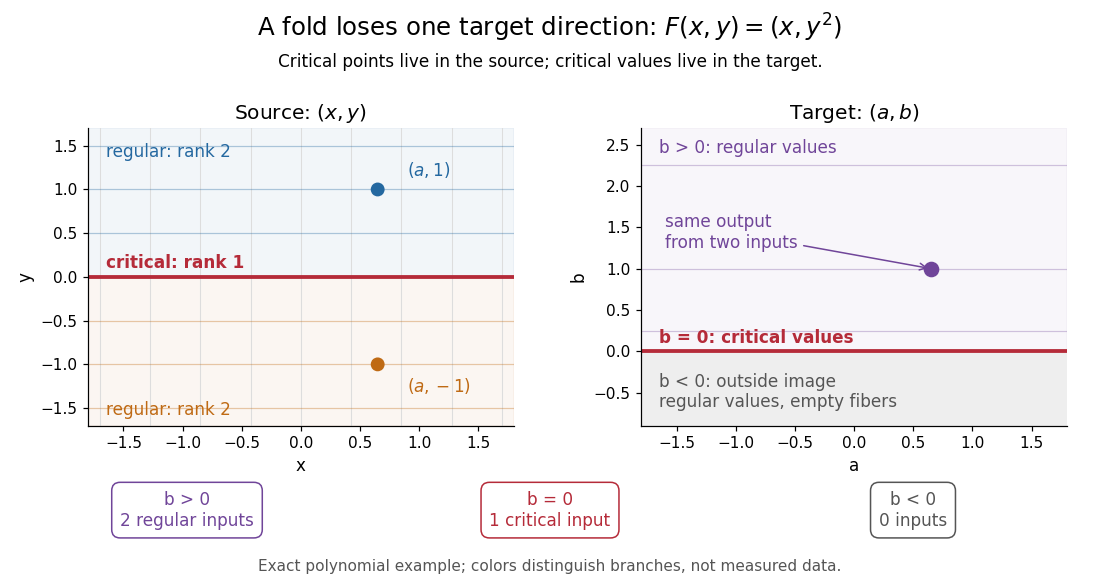
Precisely, let be a smooth map between smooth manifolds without boundary. An input is a critical point of a smooth map when its differentialis not surjective, equivalently when its rank of a linear map is less than . An input where it is surjective is a regular point; a map with no critical points of a smooth map is a submersion. The threshold is the target dimension, not . In manifold charts, compute the matrix rank of the Jacobian matrix; changes of charts preserve that matrix rank. [ref]
For the fold,Thus its set of critical points of a smooth map is the entire horizontal axis. Away from that axis, its differential can produce every infinitesimal target displacement. At the axis, it can produce only horizontal ones. This diagnoses where the two inverse branches in the picture merge.
For a scalar smooth function , the target dimension is one. A linear map to fails to be surjective exactly when it is zero, so here a critical point of a smooth map means . In Euclidean space this is precisely the familiar critical point condition : every first partial derivative vanishes. On a Riemannian manifold, it is equivalently for the chosen Riemannian metric; the Riemannian gradient depends on that metric, but whether it vanishes does not. See Loring W. Tu, An Introduction to Manifolds, Proposition 8.23 for the scalar coordinate criterion. The scalar smooth function has a critical point at zero without a local maximum or local minimum.
A source of lower dimension gives a different warning. For the smooth map , , the Jacobian matrix is the column , of matrix rank one at every input. Every input is a critical point of a smooth map, since the target dimension is two, even though this parametric curve has nonzero velocity everywhere and is an immersion. More generally, if , no differential can be surjective, so every input is critical. The terminology measures the ability to fill target directions, rather than whether the parametrized curve looks smooth.
Pinned article: Introduction to the OurBigBook Project
Welcome to the OurBigBook Project! Our goal is to create the perfect publishing platform for STEM subjects, and get university-level students to write the best free STEM tutorials ever.
Everyone is welcome to create an account and play with the site: ourbigbook.com/go/register. We belive that students themselves can write amazing tutorials, but teachers are welcome too. You can write about anything you want, it doesn't have to be STEM or even educational. Silly test content is very welcome and you won't be penalized in any way. Just keep it legal!
Intro to OurBigBook
. Source. We have two killer features:
- topics: topics group articles by different users with the same title, e.g. here is the topic for the "Fundamental Theorem of Calculus" ourbigbook.com/go/topic/fundamental-theorem-of-calculusArticles of different users are sorted by upvote within each article page. This feature is a bit like:
- a Wikipedia where each user can have their own version of each article
- a Q&A website like Stack Overflow, where multiple people can give their views on a given topic, and the best ones are sorted by upvote. Except you don't need to wait for someone to ask first, and any topic goes, no matter how narrow or broad
This feature makes it possible for readers to find better explanations of any topic created by other writers. And it allows writers to create an explanation in a place that readers might actually find it.
Figure 1. Screenshot of the "Derivative" topic page. View it live at: ourbigbook.com/go/topic/derivativeVideo 2. OurBigBook Web topics demo. Source. - local editing: you can store all your personal knowledge base content locally in a plaintext markup format that can be edited locally and published either:This way you can be sure that even if OurBigBook.com were to go down one day (which we have no plans to do as it is quite cheap to host!), your content will still be perfectly readable as a static site.
- to OurBigBook.com to get awesome multi-user features like topics and likes
- as HTML files to a static website, which you can host yourself for free on many external providers like GitHub Pages, and remain in full control

Figure 2. You can publish local OurBigBook lightweight markup files to either OurBigBook.com or as a static website.
Figure 3. Visual Studio Code extension installation.
Figure 5. . You can also edit articles on the Web editor without installing anything locally. Video 3. Edit locally and publish demo. Source. This shows editing OurBigBook Markup and publishing it using the Visual Studio Code extension. 
- Infinitely deep tables of contents:



All our software is open source and hosted at: github.com/ourbigbook/ourbigbook
Further documentation can be found at: docs.ourbigbook.com
Feel free to reach our to us for any help or suggestions: docs.ourbigbook.com/#contact