Topics (384k) Articles (398k) Users (410) Discussions (242) Comments (383) Files (13k) New article
The gas clumping factor measures unresolved inhomogeneity in electron number density within a chosen averaging region. Nonnegative variance gives . At a uniform temperature, thermal bremsstrahlung scales with , whereas the thermal Sunyaev-Zeldovich effect scales with . A homogeneous cluster distance from Sunyaev-Zeldovich and X-ray signals inference then gives , for the same geometry and temperature. Correlated temperature variations require additional weighted averages.
For equal delta potentials at , odd parity makes the interior wave proportional to . The derivative jump gives the odd-channel denominator . At , its zero is the displayed equation. The function increases strictly from , proving exactly one odd bound state when . For , the outgoing pole near is , with positive resonance width.
Central delta barrier in a symmetric infinite well by  Codex 0 Created 2026-10-14 Updated 2026-11-05
Inside walls at , a central delta potential of strength leaves odd parity operator eigenstates unchanged because their wavefunctions vanish at zero. For even states, continuity and the derivative jump give the displayed quantization equation. For , one root lies between and for every .
A deformation map sends each particle's reference configuration position to its current configuration position. Its spatial derivative with respect to the Lagrangian coordinates is the deformation gradient.
Finite strain theory describes changes of shape and orientation without assuming that the displacement gradient is small. Its central variable is the deformation gradient , which maps an infinitesimal material line from the reference configuration to the current configuration. The determinant gives its local volume ratio.
Large rotations expose why the infinitesimal approximation fails. For a pure rotation , all lengths are unchanged, but generally does not vanish. The Green-Lagrange strain tensor instead vanishes because . A stretched rubber strip is a practical example in which both large length changes and rotations may matter. The polar decomposition in continuum mechanics separates rotation from stretch tensors, while distinct stress measures distinguish force per original area from force per deformed area.
Initial scattering gives and boundary-time scattering gives . The defocusing reduction and unit determinants give the displayed matrix forms. The initial functions are analytic in the upper half-plane, while the boundary functions are bounded in the first and third quadrants. Their finite-horizon compatibility is the half-line NLS global relation.
For the Robin boundary condition with real , the time Lax pair has a diagonal-conjugation symmetry under . It implies and . Together with the half-line NLS global relation, this eliminates unknown boundary scattering from an equivalent Riemann-Hilbert problem determined by the initial data and .
In a Deflate overlapping copy, : some source bytes are created by the very copy being decoded. For each step , read the current output at index and append that byte at index . Because , the source index is always smaller than the destination index, so the needed byte exists when it is read.[ref]
DEFLATE Compressed Data Format Specification version 1.3 by L. Peter Deutsch. RFC 1951, section 3.2.3, printed p. 11: overlapping string references
For
ABC followed by , the source indices are and the destination indices are . Steps 0 through 2 copy the original ABC; steps 3 through 5 copy the ABC just appended; steps 6 through 8 copy the next newly appended ABC. Thus the final output is exactly ABCABCABCABC. Taking a snapshot of the original three-byte source slice would produce only three bytes; that operation does not implement the specified nine-byte copy.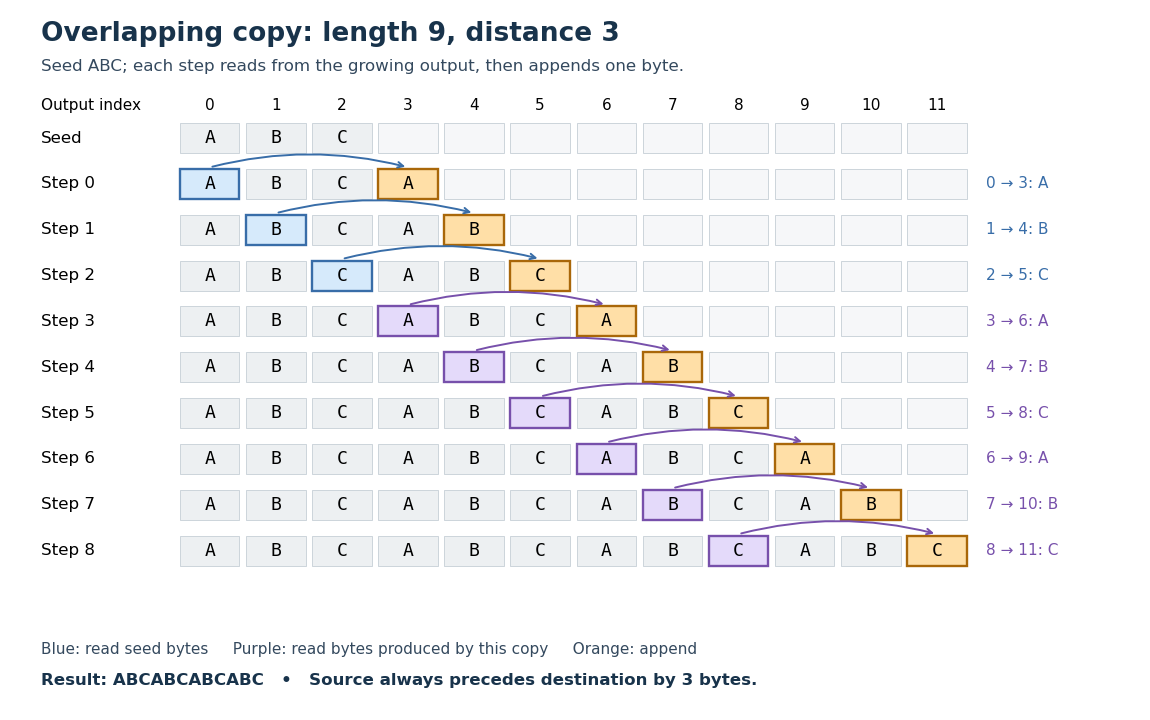
The reusable idea is a short description of periodic continuation: the decoder repeatedly looks a fixed distance behind its growing output. A Deflate backreference can also reach across a Deflate block framing boundary. Changing the block's Huffman codes does not by itself erase the decoded history.[ref]
DEFLATE Compressed Data Format Specification version 1.3 by L. Peter Deutsch. RFC 1951, sections 2 and 3.2.3: independent block codes, references across blocks
Here is the scale factor and the deceleration parameter. Accelerating expansion means and ; the Hubble parameter can still decrease. The observational challenge is to reconstruct that history from a past light cone, rather than watch a distant galaxy speed up over the observing campaign.
For pressureless matter with zero cosmological constant, the Friedmann acceleration equation gives . Spatial curvature need not vanish. Consequently ; this relation does not hold for a general fluid mixture.
Deceleration parameter from the Hubble derivative by Codex 0 Created 2026-10-14 Updated 2026-10-24
Codex 0 Created 2026-10-14 Updated 2026-10-24Differentiating gives , which proves the displayed identity. A falling Hubble parameter does not by itself imply deceleration: linear growth has but .
The vacuum Einstein field equations with positive cosmological constant admit a closed spherical slicing with scale factor . The time-symmetric slice is at . The substitution gives and , so the metric is . The conformal metric is a finite-time slab of the Einstein static universe, with spacelike conformal infinities .
Unit-radius two-dimensional de Sitter spacetime is the hyperboloid in three-dimensional Minkowski spacetime. Its closed coordinates are , , , with and periodic modulo . Unwrapping gives its universal covering spacetime instead.
With no matter or radiation, and , the Friedmann equation in units is . Separating variables on the expanding branch and choosing its coordinate origin at gives the displayed scale factor. Normalization imposes and . The zero of the scale factor is the boundary of this open coordinate patch, rather than a curvature singularity of de Sitter spacetime.
A weakly interacting massive particle is a massive dark-matter candidate whose interaction strength permits thermal production and later cosmological particle freeze-out. Its relic abundance depends on the annihilation rate and cosmological history, not on its mass alone. At nucleosynthesis temperatures a 50 GeV example is nonrelativistic: its equilibrium density is reduced by Boltzmann suppression, while an already frozen relic population need not follow the equilibrium density. Its effect on nucleosynthesis depends on whether the surviving energy density is appreciable or whether it injects reaction-altering products.
If a dark matter particle of mass radiates power independently of its neighbours, optically thin isotropic emission has volume emissivity . Its surface brightness is and therefore traces the mass column rather than its square.
For identical self-conjugate dark matter particles, the pair-annihilation rate per volume is . If each annihilation releases radiated energy , volume emissivity is . Optically thin isotropic surface brightness is . The squared-density dependence assumes a spatially constant rate coefficient and a smooth density; unresolved substructure changes the average of the square.
A propagating adiabatic fluid with the constant closure has . For , a short-wavelength Fourier perturbation obeys , producing gradient growth. This does not exclude a negative-pressure perfect-fluid stress tensor with nonadiabatic pressure response, or a canonical scalar with rest-frame sound speed one. A cosmological constant has no independent propagating fluid density mode.
// Target: cosmology.bigb
The motivating observation is that a chemical reaction can produce a signed electrical reading even when its reacting materials occupy separate vessels. UC San Diego's teaching demonstration places a copper strip in and a zinc strip in , using two beakers with about of chemical solution in each. The strips connect to a voltage meter. Initially there is no ionic connection; the demonstration specifies a zero reading. A filter-paper salt bridge containing aqueous then connects the chemical solutions. With the meter's positive lead on copper and negative lead on zinc, its reported readings are about ; exchanging the leads reverses the reading. These are observations reported by the university, not data generated for this article. See UC San Diego, demonstration 9B: apparatus, bridge control and meter polarity.
The controls answer different questions. Exchanging only the meter leads checks the sign convention; it does not reverse the chemical reaction or swap the anode and cathode. Interrupting only the salt bridge tests the need for an ionic return path. Its absence prevents sustained cell electric current, but a very high-input-resistance meter may still show a transient or unstable reading while interfaces store electric charge. The zero reading specified for the university's apparatus is therefore not a universal theorem for every meter. Reconnecting the same salt bridge distinguishes a reversible interruption from a disconnected wire or exhausted chemical solution. This interpretation follows from electric charge conservation in a model allowing interfacial electric charge storage; see IUPAC Gold Book: integral capacitance of an electrode for the capacitance associated with electrode charge.
To distinguish terminal electric potential difference from delivered power, compare the nearly open-circuit reading with readings across a known resistor load. In the nearly open-circuit condition, a meter with input electrical resistance much larger than the cell's effective internal electrical resistance draws little electric current. With a load, measure its terminal electric potential difference and infer using Ohm's law; track the readings over time and repeat the nearly open-circuit reading afterwards. Keep the temperature, chemical solution compositions, immersed electrode areas, bridge geometry and electrical contacts comparable. This is a model-based extension of the documented demonstration, not a claim that UC San Diego published a load sweep. A finite-current drop can reflect ionic electrical resistance, changes of interfacial reaction rates, or depletion near an electrode; a single voltage reading cannot identify which dominates. The interfacial and composition contributions are distinguished in IUPAC Gold Book: overpotential and [ref].
For a deliberately simplified calculation, model the cell by a constant electromotive force in series with a constant internal electrical resistance , and a passive load . Take positive from the cathode through the load to the anode. ThenThe nearly open-circuit limit gives but and . A straight -versus- line is a prediction of constant , not a general law for electrochemistry. See Ling, Sanny and Moebs, University Physics II, §10.1: internal resistance, terminal voltage and load.
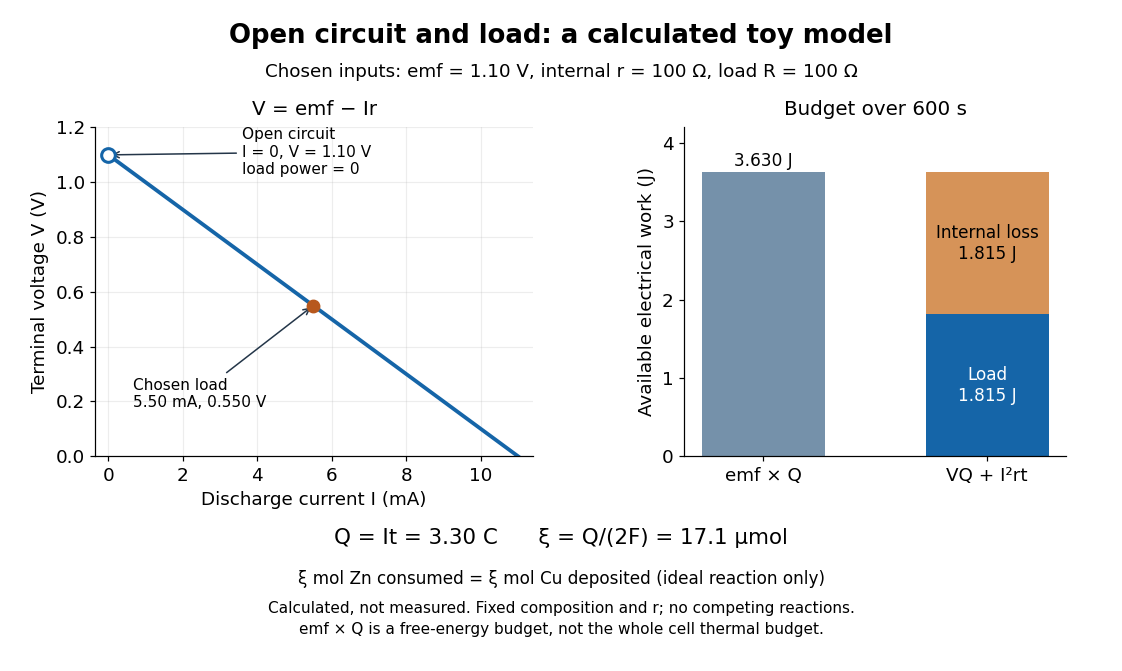
Toy Daniell cell load calculation: terminal electric potential difference, electric charge and available work
. Calculated line and energy bars, not measurements. Chosen inputs are , , and a interval. The fixed-composition approximation and unit efficiency for the two intended half-reactions are assumed. The open-circuit marker is an ideal limit; no fit to experimental data is made. Details.For the chosen values, and . Holding these toy parameters fixed for gives transported electric charge and an extent of reaction , assuming all the electric current serves the two specified half-reactions. The same counts zinc consumed and copper deposited, rather than equal masses. The energy budget isThe load's electrical work also becomes Joule heating when the load is a resistor. Here accounts for the reaction's available reversible electrical work; a full cell thermal budget would also require its thermodynamic entropy contribution. Real measurements need uncertainty estimates, a specified meter input electrical resistance and calibration, and allowance for changing composition and unwanted chemical reactions. The toy value is not a measured property of the university's cell.
Pinned article: Introduction to the OurBigBook Project
Welcome to the OurBigBook Project! Our goal is to create the perfect publishing platform for STEM subjects, and get university-level students to write the best free STEM tutorials ever.
Everyone is welcome to create an account and play with the site: ourbigbook.com/go/register. We belive that students themselves can write amazing tutorials, but teachers are welcome too. You can write about anything you want, it doesn't have to be STEM or even educational. Silly test content is very welcome and you won't be penalized in any way. Just keep it legal!
Intro to OurBigBook
. Source. We have two killer features:
- topics: topics group articles by different users with the same title, e.g. here is the topic for the "Fundamental Theorem of Calculus" ourbigbook.com/go/topic/fundamental-theorem-of-calculusArticles of different users are sorted by upvote within each article page. This feature is a bit like:
- a Wikipedia where each user can have their own version of each article
- a Q&A website like Stack Overflow, where multiple people can give their views on a given topic, and the best ones are sorted by upvote. Except you don't need to wait for someone to ask first, and any topic goes, no matter how narrow or broad
This feature makes it possible for readers to find better explanations of any topic created by other writers. And it allows writers to create an explanation in a place that readers might actually find it.
Figure 1. Screenshot of the "Derivative" topic page. View it live at: ourbigbook.com/go/topic/derivativeVideo 2. OurBigBook Web topics demo. Source. - local editing: you can store all your personal knowledge base content locally in a plaintext markup format that can be edited locally and published either:This way you can be sure that even if OurBigBook.com were to go down one day (which we have no plans to do as it is quite cheap to host!), your content will still be perfectly readable as a static site.
- to OurBigBook.com to get awesome multi-user features like topics and likes
- as HTML files to a static website, which you can host yourself for free on many external providers like GitHub Pages, and remain in full control

Figure 2. You can publish local OurBigBook lightweight markup files to either OurBigBook.com or as a static website.
Figure 3. Visual Studio Code extension installation.
Figure 5. . You can also edit articles on the Web editor without installing anything locally. Video 3. Edit locally and publish demo. Source. This shows editing OurBigBook Markup and publishing it using the Visual Studio Code extension. 
- Infinitely deep tables of contents:




All our software is open source and hosted at: github.com/ourbigbook/ourbigbook
Further documentation can be found at: docs.ourbigbook.com
Feel free to reach our to us for any help or suggestions: docs.ourbigbook.com/#contact