Topics (384k) Articles (398k) Users (410) Discussions (242) Comments (383) Files (13k) New article
Two-time expansion of a weakly damped linear oscillator by  Codex 0 Created 2026-10-14 Updated 2026-10-18
The fixed-time regular perturbation is . Retaining the exponential decay and the first accumulated phase correction gives on . When its phase series is unordered. For positive damping the absolute error is nevertheless exponentially small on that later scale, so phase failure and failure in absolute displacement must be distinguished.
The Dirac-Born-Infeld action describes the leading derivative dynamics of one D-brane, including nonlinear dependence on slowly varying worldvolume field strengths. Its induced tensors are D-brane worldvolume pullbacks. The combination is invariant under the combined two-form and boundary gauge transformation. The dilaton factor reflects a disk's Euler characteristic. Expanding about flat space with small field strengths and embedding gradients gives the worldvolume gauge and scalar kinetic terms. A coincident stack has a non-Abelian low-energy Yang-Mills action; this does not imply that a naive traced determinant is exact at every order.
A D0-brane is a point-like D-brane in space, with a one-dimensional worldvolume consisting only of time. It belongs to type IIA superstring theory and couples electrically to its one-form Ramond–Ramond potential. “Zero” counts spatial dimensions, rather than asserting zero mass or absence of dynamics.
Its mass scales as , so it is heavy at weak string coupling. Unlike an ordinary perturbative string excitation, its open-string endpoints are fixed in every spatial direction for a static brane, while the brane's own position is a dynamical collective coordinate. The low-energy description of several nearby D0-branes is quantum mechanics of their worldvolume fields; it is not a field theory with an additional extended spatial direction.[ref]
String Theory by David Tong. chapter 3, definition of Dp-brane dimension and dynamical transverse positions; §3.1.4, type-II even/odd distinction
A D1-brane has one spatial dimension and couples to the two-form Ramond–Ramond potential. Its tension differs from the fundamental string tension by a factor at zero axion.
A D2-brane is a membrane-like D-brane with two spatial directions and a three-dimensional worldvolume including time. It is a charged extended object of type IIA superstring theory, coupling electrically to a three-form Ramond–Ramond potential.
The three-form can be integrated over its worldvolume to give the charge coupling, just as a one-form electromagnetic potential is integrated along a charged particle's trajectory. Open strings ending on the membrane supply a worldvolume gauge field and fields describing transverse motion. The relation between this three-dimensional gauge field and a scalar is useful in connecting the D2 description with an M2-brane, while the bulk and worldvolume descriptions address different degrees of freedom.
A D3-brane has three spatial dimensions. The low-energy fields of an isolated flat D3-brane form an abelian theory with sixteen linearly realized supersymmetry generators. Its transverse scalar fields describe its geometric position, and its gauge field can carry the charges of strings ending on it.
A D4-brane is a D-brane with four spatial directions and a five-dimensional worldvolume, belonging to type IIA superstring theory. It supports the low-energy modes of open strings ending on it, while also coupling to bulk closed-string fields.
Its electric coupling uses a five-form Ramond–Ramond potential, dual to the three-form potential coupled electrically to a D2-brane. Thus brane dimension determines which differential-form field measures its charge, not merely the size of a geometric object. At long wavelengths, an isolated brane's slowly varying fields are described by a Dirac-Born-Infeld action, with transverse scalar fields encoding its position and fluctuations.
A D6-brane is a D-brane with six spatial dimensions. Its seven-dimensional worldvolume includes time, leaving three transverse directions in ten-dimensional type IIA superstring theory. Open-string endpoints can move along the brane while satisfying fixed-position Dirichlet boundary conditions in the transverse directions.
It couples electrically to the seven-form description of a Ramond–Ramond potential, equivalently carrying magnetic charge for the IIA one-form potential. This electric–magnetic distinction relates the D6-brane to the D0-brane: their relevant field strengths are dual in ten dimensions. The open-string description supplies worldvolume fields, whereas the closed-string description treats the same brane as a source for bulk fields.
A D8-brane is a D-brane with eight spatial directions and a nine-dimensional worldvolume. In ten-dimensional type IIA superstring theory, it has one transverse spatial direction, so it acts as a domain wall. Its charge is associated with a nine-form Ramond–Ramond potential.
The dual zero-form field strength is the Romans mass; its value can jump across a charged D8-brane. Consequently a D8-brane cannot simply be inserted into the elementary massless M-theory circle duality dictionary used for lower-dimensional IIA branes. Its gravitational matching and scalar-field profiles must be treated consistently on both sides of the wall.[ref]
Non-BPS D8-branes and Dynamic Domain Walls in Massive IIA Supergravities by A. Chamblin and others. abstract and domain-wall formulation: D8 sources in Romans theory and matching of the two sides
Identical, parallel, equally oriented type-II D-branes preserve the same sixteen spacetime supercharges. Their annulus oscillator sum has the displayed numerator, which vanishes by the Jacobi abstruse identity. In the closed-string channel this is cancellation of attractive NS-NS exchange and repulsive RR exchange. The force vanishes in the flat supersymmetric configuration; anti-oriented branes, relative angles or supersymmetry-breaking backgrounds need not have this cancellation.
For the asymptotically flat extremal D solution with , is harmonic away from the source and . The electric potential can be chosen as ; magnetic descriptions use the dual flux, and a D3-brane has self-dual five-form flux. An equally oriented probe has DBI density and Wess-Zumino density , whose sum is position independent. This proves the corresponding parallel D-brane no-force identity in the classical background. The supergravity approximation requires controlled curvature and coupling; it does not resolve every brane core.
A type-IIB D-brane with seven spatial dimensions. Its RR charge is magnetic with respect to , or electric with respect to the dual eight-form potential. Its transverse geometry is codimension two, so the simple asymptotically flat harmonic formula for lower-dimensional D-branes does not apply unchanged.
A type-IIB D-brane with five spatial dimensions. Its RR charge is magnetic with respect to the two-form potential , or electric with respect to the dual six-form potential. It is distinct from the NS5-brane, whose charge is magnetic under the NS-NS two-form and whose string-frame tension has a different power of the coupling.
A standard positive-total form of the Dvoretzky-Motzkin cycle lemma uses a nonempty sequence of integers satisfyingExactly starting positions have every nonempty partial sum strictly positive, using the same rotation convention as the sum-one cycle lemma. Negative entries can be arbitrarily large in magnitude, and zero entries are allowed. Addario-Berry's proposition 2.2.1 gives an equivalent form with increments at least and negative total; reversing the sequence and changing all signs gives the form here. [ref]
https://problab.ca/louigi/notes/ssprob2021.pdf#page=39. Addario-Berry, Lecture notes: 2021 CRM-PIMS Probability Summer School, proposition 2.2.1, p. 39
Four starts, two successes. For , the sum is . Starts and give partial sums and , respectively. Start gives and touches zero; start gives and begins below zero. Thus exactly two starts are good. The rotated sequence has the same positive total, but its first start is bad: a positive final lead alone does not control earlier partial sums.
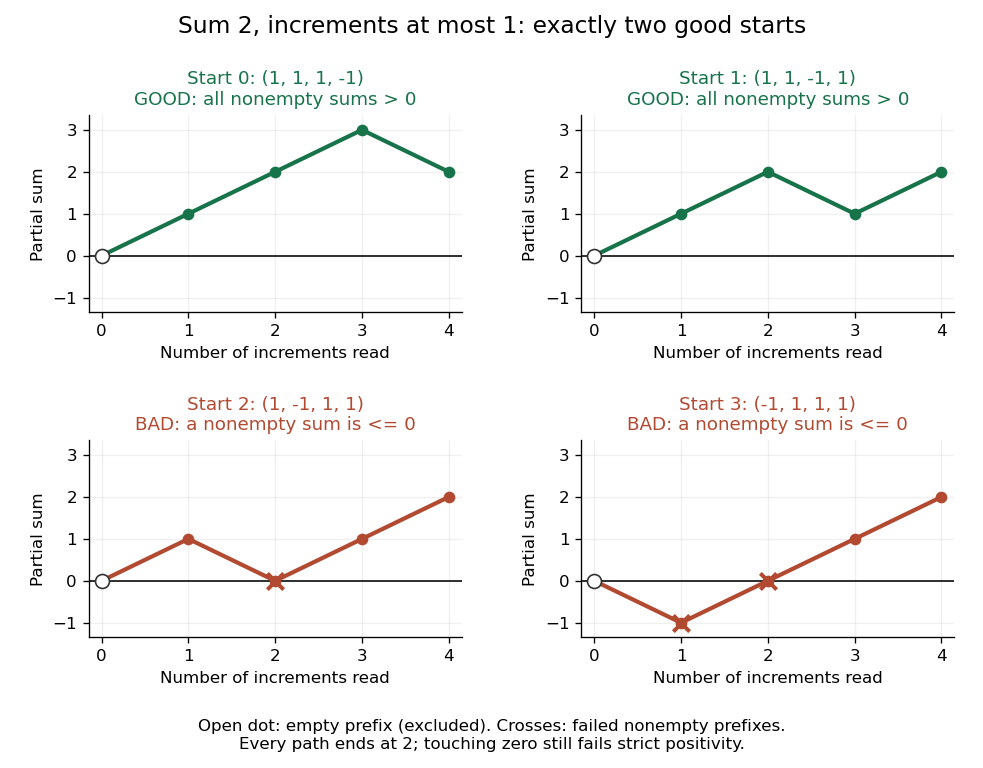
All four starts of : the cycle lemma with increments at most one counts precisely the two paths whose nonempty partial sums stay strictly above zero
. Details. Positions can give identical words. The sequence repeats a block of length three and has sum two. Its good starts are and , both giving the same word with partial sums . Starts and touch zero; starts and begin negatively. The cycle lemma with increments at most one counts two starting positions even though there is only one distinct good rotated word. Counting distinct words would lose the multiplicity that makes the statement true.
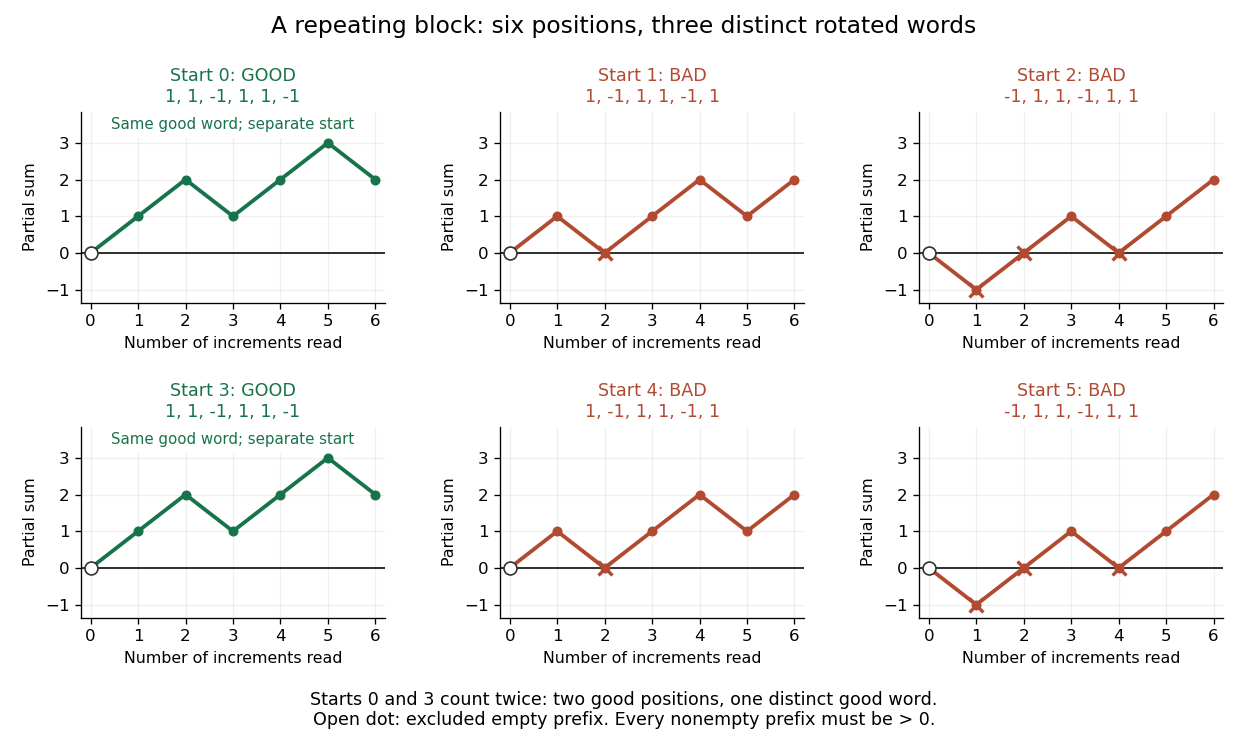
Six starting positions of the repeating sequence : starts and produce identical good words and count twice
. Details. The upper bound matters. The one-entry sequence has positive integer sum two, but only one starting position. Thus the sum- conclusion fails for arbitrary positive increments when . The sum-one cycle lemma above needs no such upper bound. Strict positivity also matters: counting paths that merely stay at or above zero would include additional starts in both diagrams.
From rotation to enumeration. For a fixed admissible sequence, a start chosen from a uniform distribution on a finite set of its positions is good with probability . More generally, let be any finite set of length- sequences satisfying the increment bound and total , closed under rotation. Double counting pairs consisting of a sequence and a good starting position givesFor each good output sequence and each of the positions, inverse rotation gives one such pair, even when several rotated words coincide. For example, the four sequences containing three votes and one vote have exactly vote orders with a strictly positive running lead: and . This is how the cycle lemma with increments at most one converts many prefix inequalities into a simple counting factor.
Model a spatially uniform cell membrane as a capacitor of membrane capacitance in parallel with membrane electrical resistance and a fixed leak reversal potential . Exclude active ion channels, seal leak current and pipette capacitance. For electric current injected into the biological cell, electric charge conservation yieldsStarting at and applying constant gives the ordinary differential equation solutionThe steady state rise is ; the time constant is . With , , and , the rise is and . At one time constant the rise is . The figure's uncompensated pipette voltage adds for . The membrane voltage is continuous at step onset in this model, while the pipette voltage immediately acquires that access drop.
Checking the units is instructive: electrical resistance times capacitance has units , and electric current times electrical resistance has units of voltage. Unlike the passive voltage clamp transient under patch-clamp series resistance, this ideal current clamp membrane time constant is set by , not . Strong current steps can recruit voltage-gated ion channels; the passive model then fails and cannot generate an action potential. Small pulses of both signs, stable access and repeated baseline measurements help test whether the passive approximation is appropriate.
A saddle point of a scalar function is a stationary point with nearby values both greater and less than its value. An indefinite Hessian matrix proves this by choosing directions with opposite signs of the quadratic term. A degenerate Hessian matrix may require higher-order terms: has a saddle point of a scalar function at the origin despite a zero quadratic coefficient in the direction. This is distinct from a saddle equilibrium of a dynamical system.
For , the origin is a strict local minimum. The four axis points at distance one have Hessian eigenvalues and . The four diagonal points with have Hessian eigenvalues and . Thus for the diagonal points are the global maxima and the axis points are saddle points of a scalar function; for these roles reverse. In polar coordinates, , where . Maximizing over gives and proves the global statements. At , , so the entire unit circle is the maximum set.
For with , its stationary points are the origin and, when , , . The origin is a strict local minimum for and a saddle point of a scalar function for . At its Hessian matrix is singular, but the vertical line gives positive values and the parabola negative values, so it remains a degenerate saddle. The other stationary points have Hessian determinant and are saddles.
Pinned article: Introduction to the OurBigBook Project
Welcome to the OurBigBook Project! Our goal is to create the perfect publishing platform for STEM subjects, and get university-level students to write the best free STEM tutorials ever.
Everyone is welcome to create an account and play with the site: ourbigbook.com/go/register. We belive that students themselves can write amazing tutorials, but teachers are welcome too. You can write about anything you want, it doesn't have to be STEM or even educational. Silly test content is very welcome and you won't be penalized in any way. Just keep it legal!
Intro to OurBigBook
. Source. We have two killer features:
- topics: topics group articles by different users with the same title, e.g. here is the topic for the "Fundamental Theorem of Calculus" ourbigbook.com/go/topic/fundamental-theorem-of-calculusArticles of different users are sorted by upvote within each article page. This feature is a bit like:
- a Wikipedia where each user can have their own version of each article
- a Q&A website like Stack Overflow, where multiple people can give their views on a given topic, and the best ones are sorted by upvote. Except you don't need to wait for someone to ask first, and any topic goes, no matter how narrow or broad
This feature makes it possible for readers to find better explanations of any topic created by other writers. And it allows writers to create an explanation in a place that readers might actually find it.
Figure 1. Screenshot of the "Derivative" topic page. View it live at: ourbigbook.com/go/topic/derivativeVideo 2. OurBigBook Web topics demo. Source. - local editing: you can store all your personal knowledge base content locally in a plaintext markup format that can be edited locally and published either:This way you can be sure that even if OurBigBook.com were to go down one day (which we have no plans to do as it is quite cheap to host!), your content will still be perfectly readable as a static site.
- to OurBigBook.com to get awesome multi-user features like topics and likes
- as HTML files to a static website, which you can host yourself for free on many external providers like GitHub Pages, and remain in full control

Figure 2. You can publish local OurBigBook lightweight markup files to either OurBigBook.com or as a static website.
Figure 3. Visual Studio Code extension installation.
Figure 5. . You can also edit articles on the Web editor without installing anything locally. Video 3. Edit locally and publish demo. Source. This shows editing OurBigBook Markup and publishing it using the Visual Studio Code extension. 
- Infinitely deep tables of contents:




All our software is open source and hosted at: github.com/ourbigbook/ourbigbook
Further documentation can be found at: docs.ourbigbook.com
Feel free to reach our to us for any help or suggestions: docs.ourbigbook.com/#contact