Topics (384k) Articles (398k) Users (410) Discussions (242) Comments (383) Files (13k) New article

An hour circle is a great circle through both reference celestial poles and a chosen direction. Its two halves have right ascensions differing by ; choose the half containing the direction when measuring declination. The observer's celestial meridian is the particular hour circle through the zenith. [ref]
https://www.astro.uvic.ca/~tatum/celmechs/celm6.pdf. Jeremy Tatum: Section 6.3, hour circles and declination circles
.An astronomical epoch is a reference instant for astronomical data. A catalogue's position astronomical epoch says when the listed source direction applies; proper motion advances that direction to another instant. The reference date for an equatorial coordinate system's axes need not equal the position astronomical epoch. ESA's Gaia documentation explicitly associates both right ascension and declination with its reference-epoch field. [ref]
https://gea.esac.esa.int/archive/documentation/GDR3/Gaia_archive/chap_datamodel/sec_dm_main_source_catalogue/ssec_dm_gaia_source.html. ESA Gaia DR3: Reference epoch and its associated coordinate and proper-motion fields
.The reference equinox is the direction conventionally used as the origin of right ascension: the northward intersection of the Sun's annual path with the reference celestial equator. Its mean or true convention and reference date specify which direction is intended. Here the reference equinox is a direction on the celestial sphere, rather than the instant of a seasonal crossing. [ref]
https://aa.usno.navy.mil/faq/asa_glossary. US Naval Observatory: Equinox and mean versus true reference directions
.A mathematical identity is an equation that holds for every assignment in a specified domain of a function. For example, the distributive property gives for every real number . An identity can replace one mathematical expression by another without imposing a new restriction on that domain.
The domain remains essential. The equality holds for every real , but its left side is undefined at . Cancelling a factor does not retrospectively define the original mathematical expression at the excluded input. An identity is different from an identity element of an algebraic operation or an identity function, which are separate concepts despite sharing a name.
An extraneous solution satisfies a transformed equation but fails the original equation or its restrictions. The term describes a candidate generated during the calculation, rather than a true solution that can be kept in the final solution set.
Consider the real equationThe square root requires . Because the square root is nonnegative, any solution must also have , so . Squaring givesThe squared equation has candidates and . At , the original equality is . At , it is , which fails: this candidate is an extraneous solution. Thus the original solution set is exactly .
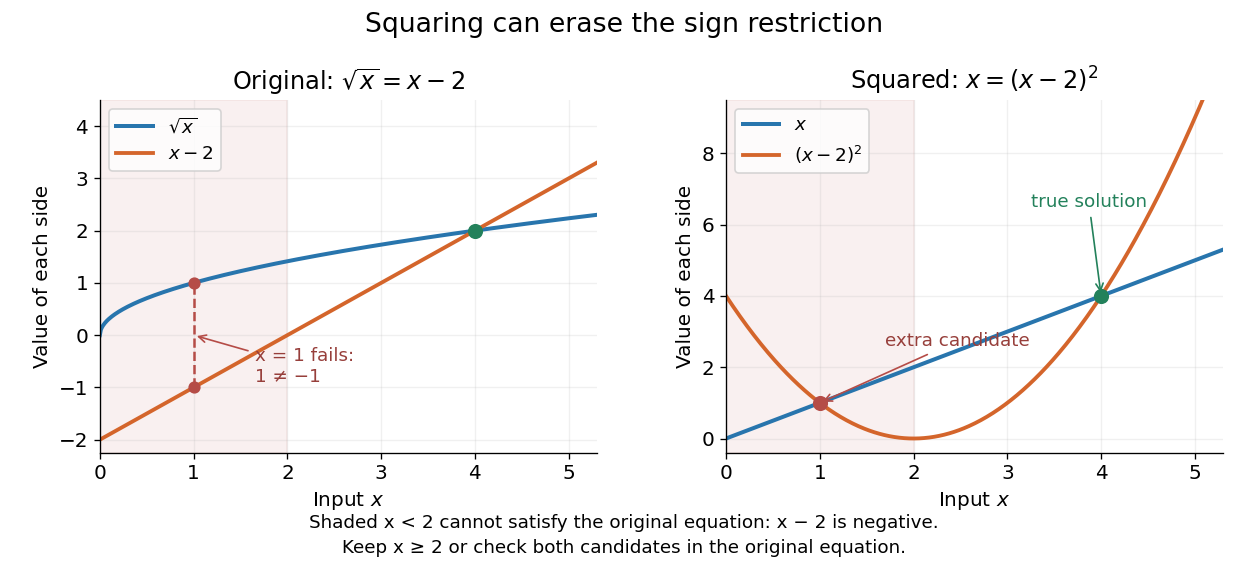
Squaring removes a sign distinction and creates a second intersection at , which fails the original equation
. Details. On the restricted domain of a function , both original sides are nonnegative, so squaring is reversible there and the two equations are equivalent. Retaining the sign restriction or checking every candidate in the original equation achieves the same final solution set. The general need to check candidates after raising both sides to a power is explained in College Algebra 2e, §2.6: Solving Radical Equations.
Two equations are equivalent on a specified domain of a function if they have the same solution set. Adding the same defined mathematical expression to both sides is reversible. Multiplying or dividing both sides by a mathematical expression is reversible only where that expression is nonzero and invertible in the arithmetic being used. In a field, every nonzero scalar is invertible; a general ring needs an additional check.
For example, and are equivalent equations over the real numbers, by the distributive property. Concluding or additionally uses the absence of zero divisors. The modular example in algebra shows why that extra inference can fail in a ring with zero divisors.
Michaelis-Menten kinetics models substrate binding to an enzyme, complex dissociation and product formation. Under the relevant quasi-steady-state regime, its initial-rate law is the saturating relation given by the following equation.
An enzyme may bind one molecule of a substrate to form , then a second to form , with product-release reactions and . The law of mass action gives conservation laws and . Scaling substrate by , complexes by and time by exposes the small ratio : the substrate evolves on the slow scale while the complex equations have the form . This is a starting point for quasi-steady-state approximation when .
Covering a finite board with specified tiles without gaps or overlaps. Counting board tilings connects local placement rules to a recurrence relation and a generating function.
A parameter-dependent generalization which recovers a familiar object at a specified value or limit of the parameter. In enumerative combinatorics, a generating function can refine an ordinary count by retaining a statistic; Gaussian binomial coefficients are one example.
An averaged amplitude equation describes the slow evolution of a periodic orbit's amplitude under a weak perturbation. If unperturbed energy is with , divide the mean energy drift over one fast period by . Simple zeros identify attracting or repelling persistent periodic orbits according to the derivative of this drift; this approximation is local to an appropriate perturbative amplitude range.
Endosymbiotic gene transfer moves genetic material from an endosymbiont or its descendant organelle into the host genome, notably the nuclear genome. A transferred DNA segment can remain silent. For a transferred gene to replace an organelle-encoded function, nuclear gene expression must work and its protein must reach the right compartment through organelle protein import. Transfer of DNA and transport of proteins are distinct processes in opposite directions. [ref]
Experimental Reconstruction of Functional Gene Transfer from the Tobacco Plastid Genome to the Nucleus by Sandra Stegemann and Ralph Bock. Introduction, p. 2869, and Discussion, p. 2875: transferred sequences and the additional targeting problem
Gene loss and endosymbiotic gene transfer are different: absence from an organelle genome does not by itself show that a functional nuclear copy exists. Conversely, an imported protein may derive from a host gene rather than a transferred gene. The surviving organelle genome is therefore a partial record, not a complete inventory of either ancestral bacteria or the modern organelle's machinery. [ref]
Origin and Evolution of Plastids and Photosynthesis in Eukaryotes by Geoffrey I. McFadden. “How to tame your symbiont”: losses, transfers, host recruitment and repatriation of proteins
Resemblance is a clue, not sufficient evidence of common descent. A small size, two surrounding membranes, division, retained DNA or bacterial-looking ribosomes does not uniquely identify an ancestor. Internal membranes exist outside these organelles, and a similar function can favor similar structures. The stronger question is whether independently examined molecular characters support the same historical relationship.
A concrete genomic observation is the mitochondrial sequence reported in 1997 for Reclinomonas americana: base pairs containing 97 identified genes, including four for a bacterial-type multisubunit RNA polymerase. This is a reported genome inventory, not a calculation from the pictured shape of a mitochondrion. Retention of such bacterial features strengthens the ancestry argument; a living Reclinomonas americana is not itself an ancestral eukaryote. The inspected abstract supplies these observations but not the detailed sequencing protocol or contamination controls, so those details are not attributed to this report here. [ref]
An ancestral mitochondrial DNA resembling a eubacterial genome in miniature by B. Franz Lang and others. Abstract, Nature 387 (1997), pp. 493–497: genome length, gene inventory and bacterial-type RNA polymerase
A sequence-based investigation obtains nucleotide sequences by DNA sequencing, identifies comparable genes, makes a sequence alignment and uses phylogenetics to infer relationships. The readout is a proposed relationship with support and uncertainty, not a photograph of an ancient encounter. Comparisons of plastid sequences with bacterial sequences support cyanobacterial ancestry, while the exact closest sampled cyanobacterial group has depended on the chosen data and inference. A bacterial affinity in one gene is weaker than coherent evidence across several genes and cellular systems. [ref]
Origin and Evolution of Plastids and Photosynthesis in Eukaryotes by Geoffrey I. McFadden. “The endosymbiont: when and who?”: alternative phylogenetic placements and lateral gene transfer
For such an analysis, useful checks include distinguishing organelle DNA from bacterial contamination, verifying sequence quality, comparing corresponding rather than unrelated genes, sampling several bacterial groups and testing sensitivity to the sequence alignment and evolutionary mathematical model. These are methodological requirements, not a claim that this article has rerun a particular published analysis. Horizontal gene transfer, gene loss and unequal evolutionary change can make an individual gene's history differ from a whole organism's history. A supported bacterial origin therefore need not identify an extant donor species, an exact date or the original mode of entry. [ref]
Origin and Evolution of Plastids and Photosynthesis in Eukaryotes by Geoffrey I. McFadden. “The endosymbiont: when and who?”: ancient origin and confounding lateral transfer
A state with a stationary electric charge distribution and no net drift of mobile charge driven by the electric field. A conductor in electrostatic equilibrium has zero interior electric field, while bound charges in an insulating material need not move to eliminate its interior field.
Faraday's ice pail experiment distinguishes redistribution of electric charge by electrostatic induction from transfer of electric charge by contact. Lower a charged body into an initially neutral isolated metal pail: an externally connected electrometer responds even though the body never touches the metal. Withdraw the body without contact and the response disappears. Repeat with conductive contact before withdrawal and a residual response can remain. The striking point is that an exterior response does not establish that the pail has gained net electric charge.
Apparatus and readout. A modern implementation uses two concentric wire-mesh cylinders: a 10 cm diameter, 15 cm high inner pail on insulating rods and a grounded outer shield. Connect the electrometer's signal lead to the inner pail and its reference lead to the shield. Momentarily ground and zero the signal assembly, then isolate it; the shield remains grounded. A charged disk on an insulating handle goes into the lower half without touching. The electrometer measures electric potential difference in volts, with sign determined by the lead connections. It does not directly measure electric charge in coulombs.[ref]
Basic Electrostatics System (ES-9080B), Instruction Manual 012-07227G by Cecilia Hernandez. Basic Electrostatics System, instruction manual 012-07227G, printed pp. 9–10, 13–15, Figure 1.1 and Procedure 1A
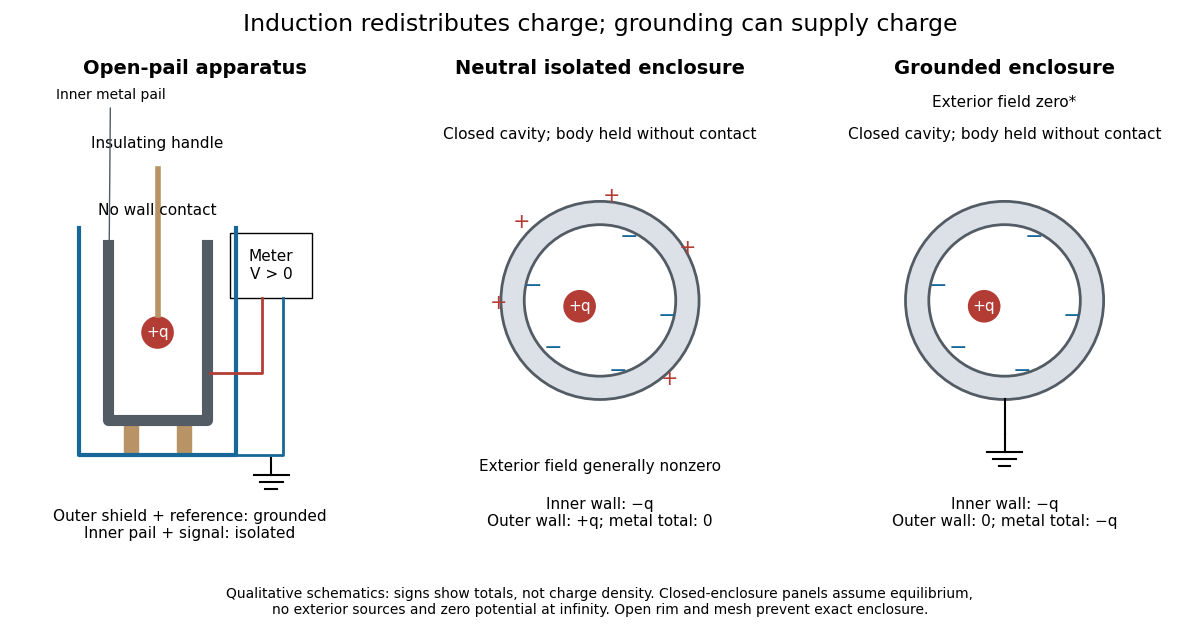
Faraday's ice pail experiment: apparatus and isolated versus grounded electric charge accounting
. Original qualitative schematics. The open pail approximates enclosure; the two closed cavity in a conductor panels stipulate exact enclosure, electrostatic equilibrium, no exterior sources and zero electric potential at infinity. Signs denote total electric charges, not a measured or uniform surface charge density. Details.A charge ledger before contact. To separate exact reasoning from the open apparatus, first idealize the pail as a closed cavity in a conductor with one internal body of total electric charge . Let the isolated metal have total electric charge . The metal's electric field is zero at electrostatic equilibrium.[ref]
Ideal Conductors. Richard Fitzpatrick, Ideal Conductors, equations 2.124–2.126: zero field and constant potential in metal
A Gaussian surface enclosing the cavity in a conductor but lying wholly in the metal therefore has zero electric flux. Gauss's law and charge conservation giveFor and , the inner-wall total is and the outer-wall total is : the metal remains neutral. The exterior electric field can therefore be nonzero without any transfer from the body. The connected electrometer and signal cable belong to the same isolated conducting assembly and share its exterior electric charge. The zero-electric field assertion concerns metal, not the occupied cavity in a conductor.This ledger fixes totals, not the local surface charge density. Moving an off-center body changes the inner-wall distribution while its integral remains . With fixed outer geometry, fixed and unchanged exterior sources, Uniqueness of the Dirichlet problem together with the fixed total outer electric charge determines the same exterior solution: the outside cannot reveal the body's position or detailed internal distribution. For example, internal bodies with stipulated electric charges and give the same total exterior response as a single body with . Internal bodies with and can give a null exterior response while retaining a nonzero internal electric field. This is why a null reading cannot establish an empty cavity in a conductor.
Withdrawal is the control. Record a baseline, insert without contact, withdraw, and check return to baseline. After a fresh zero, repeat with the charged disk touching the inner wall, then withdraw and record the residual response. Finally zero the pail and reinsert the disk without contact to test remaining electric charge. Keep the operator grounded, discharge unwanted handle electric charge, and keep the unused charged disk distant. Dirty supports and humidity promote leakage. These controls separate transfer from electrostatic induction and stray coupling.[ref]
Basic Electrostatics System (ES-9080B), Instruction Manual 012-07227G by Cecilia Hernandez. Basic Electrostatics System, instruction manual 012-07227G, printed pp. 4–5 and 14–15, Procedure 1A steps 3–8: handle charge, withdrawal, contact and disk retest
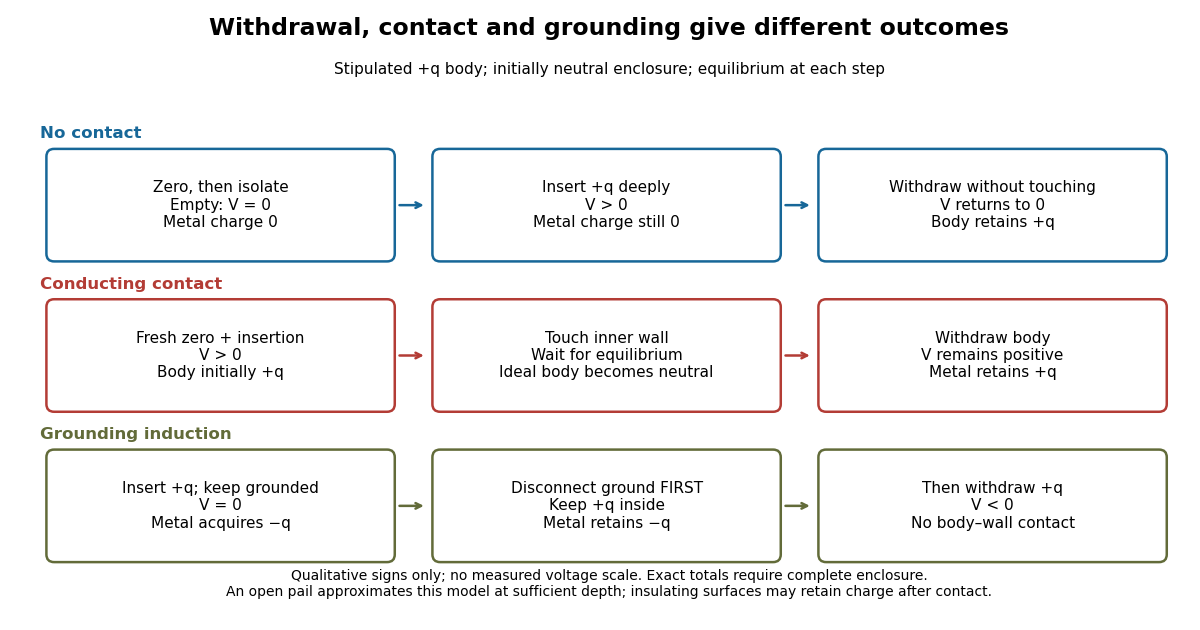
In the ideal contact test, the internal body is itself an electrical conductor and makes a conducting connection to the wall. After charge relaxation, body and enclosure become a single equipotential; the remaining charge-free void has zero electric field. The body then carries no excess electric charge on surfaces facing that void. Withdrawal without subsequent charging leaves total metal electric charge . A coated paddle can retain electric charge on insulating patches, so merely touching it does not guarantee complete transfer. A residual reading establishes some transfer under the controls; the disk retest checks the stronger claim of complete transfer. The ideal argument assumes no leakage and no relevant contact-generated charging.
Grounding changes the ledger. With no exterior sources and zero electric potential at infinity, a closed grounded enclosure has zero exterior electric field, inner-wall electric charge and zero outer-wall electric charge.[ref]
The Feynman Lectures on Physics, Volume II by Richard Feynman and others. II.5, §5–10, final shielding argument: a closed grounded conducting shell separates the two electrostatic problems
Consequently, disconnecting ground before withdrawal retains total metal electric charge , which moves to the exterior after withdrawal. Keeping ground connected during withdrawal instead restores zero electric charge. A lasting opposite-sign response can therefore arise through grounding without body–wall contact.For the real open pail, no Gaussian surface lying wholly in metal closes over the mouth. Increasing insertion depth and seeking a stable response tests whether enclosure is a good approximation; mesh openings, rim proximity and nearby objects limit it. In a fixed-geometry approximation, the positive insertion response obeys , where is the effective capacitance of the pail, shield, cable and electrometer input. Changed geometry changes that conversion. Wait for charge relaxation and instrument settling at each step, while keeping the observation short compared with leakage. The experiment probes settled electrostatics; it does not establish shielding against arbitrary changing electromagnetic fields.
An electron subshell groups the allowed electronic quantum states within an electron shell by their orbital angular momentum quantum number . Labels and mean and , respectively; their capacities are two and six electrons. The leading number in identifies the electron shell, while identifies the electron subshell.
The neutron excess is the number of neutrons minus protons per baryon. A mixture of carbon-12 and oxygen-16 has zero neutron excess, while neon-22 contributes per baryon in that isotope. Thus a neon-22 mass fraction gives . A nonzero excess shifts iron-group ashes from symmetric nickel-56 toward neutron-rich isotopes, even before additional weak reactions occur.
For optically thin lines with local ratio , their integrated observed ratio is . Inverting a uniform-plasma calibration yields an effective diagnostic density. It is generally not the volume mean, nor the density obtained by simply averaging the local densities, because emissivity weighting and the ratio response are nonlinear.
The near and far field distinguish source-dependent electromagnetic field regions. Close to a localized source, reactive fields and induction terms contribute; sufficiently far away, the leading transverse fields decrease as the inverse distance and carry outgoing power. The radiation zone describes this far-field limit.
Relative to a propagation plane, transverse electric polarization has its electric field perpendicular to that plane. For a conducting corrugation independent of the perpendicular coordinate, the scalar electric component obeys the Helmholtz equation with Dirichlet data at the metal surface.
Pinned article: Introduction to the OurBigBook Project
Welcome to the OurBigBook Project! Our goal is to create the perfect publishing platform for STEM subjects, and get university-level students to write the best free STEM tutorials ever.
Everyone is welcome to create an account and play with the site: ourbigbook.com/go/register. We belive that students themselves can write amazing tutorials, but teachers are welcome too. You can write about anything you want, it doesn't have to be STEM or even educational. Silly test content is very welcome and you won't be penalized in any way. Just keep it legal!
Intro to OurBigBook
. Source. We have two killer features:
- topics: topics group articles by different users with the same title, e.g. here is the topic for the "Fundamental Theorem of Calculus" ourbigbook.com/go/topic/fundamental-theorem-of-calculusArticles of different users are sorted by upvote within each article page. This feature is a bit like:
- a Wikipedia where each user can have their own version of each article
- a Q&A website like Stack Overflow, where multiple people can give their views on a given topic, and the best ones are sorted by upvote. Except you don't need to wait for someone to ask first, and any topic goes, no matter how narrow or broad
This feature makes it possible for readers to find better explanations of any topic created by other writers. And it allows writers to create an explanation in a place that readers might actually find it.
Figure 1. Screenshot of the "Derivative" topic page. View it live at: ourbigbook.com/go/topic/derivativeVideo 2. OurBigBook Web topics demo. Source. - local editing: you can store all your personal knowledge base content locally in a plaintext markup format that can be edited locally and published either:This way you can be sure that even if OurBigBook.com were to go down one day (which we have no plans to do as it is quite cheap to host!), your content will still be perfectly readable as a static site.
- to OurBigBook.com to get awesome multi-user features like topics and likes
- as HTML files to a static website, which you can host yourself for free on many external providers like GitHub Pages, and remain in full control

Figure 2. You can publish local OurBigBook lightweight markup files to either OurBigBook.com or as a static website.
Figure 3. Visual Studio Code extension installation.
Figure 5. . You can also edit articles on the Web editor without installing anything locally. Video 3. Edit locally and publish demo. Source. This shows editing OurBigBook Markup and publishing it using the Visual Studio Code extension. 
- Infinitely deep tables of contents:




All our software is open source and hosted at: github.com/ourbigbook/ourbigbook
Further documentation can be found at: docs.ourbigbook.com
Feel free to reach our to us for any help or suggestions: docs.ourbigbook.com/#contact