Topics (384k) Articles (398k) Users (410) Discussions (242) Comments (383) Files (13k) New article
The degree of a projective algebraic variety of dimension is the length, with intersection multiplicities, of its intersection with a sufficiently general linear subspace of complementary codimension. Equivalently, its Hilbert polynomial has leading coefficient . For a projective curve, a general hyperplane section measures this degree.
An abelian variety of dimension has complex multiplication when its rational endomorphism ring contains a commutative semisimple -algebra of dimension . For an elliptic curve in characteristic zero, this means its geometric endomorphism ring of an elliptic curve is an order in an imaginary quadratic field. The resulting rank-one Tate module representations connect torsion points to class field theory.
An algebraic set is a zero locus of polynomial equations, allowing reducible sets. An affine algebraic set uses ordinary polynomial equations; a projective algebraic set uses homogeneous equations in projective coordinates. On affine or projective space, closed sets in the Zariski topology are algebraic sets, and an irreducible algebraic set is an algebraic variety in the classical convention.
Étale cohomology is sheaf cohomology on the site whose objects are étale morphisms and whose coverings are jointly surjective families of such morphisms. It provides cohomological invariants for algebraic varieties over fields of positive characteristic. In Deligne-Lusztig theory, compactly supported groups with -adic coefficients, for different from the field characteristic, give finite-dimensional representations of the finite groups acting on the varieties.
For a projective scheme and a fixed Hilbert polynomial , the Hilbert scheme parametrizes flat families of closed subschemes of with that polynomial. This turns a family of embedded algebraic curves into an algebraic parameter space.
A property holds at a very general point of an irreducible complex algebraic parameter space if it holds outside a countable union of proper Zariski-closed subsets. This permits countably many exceptional conditions. Over that complement is nonempty and dense, for example by the Baire category theorem on a local smooth analytic chart.
For a projective variety over the complex numbers, analytification gives an equivalence between algebraic and analytic coherent sheaves, preserves their cohomology, and is fully faithful on their morphisms. In particular, a holomorphic isomorphism between algebraic line bundles is algebraic. This allows a complex-torus proof of a line-bundle identity to establish the corresponding algebraic identity on a projective elliptic curve.
A Poisson algebra has two compatible products on one vector space: a commutative, associative multiplication and a Lie bracket . Compatibility is the Leibniz ruleThus fixing makes an algebraic derivation. The Lie bracket also satisfies the Jacobi identity; an arbitrary bilinear bracket satisfying antisymmetry of a Lie bracket and the product rule need not do so.[ref]
Lectures on Symplectic Geometry by Ana Cannas da Silva. §18.3, Definition 18.7: the two algebra structures and their Leibniz compatibility
For example, the polynomial ring becomes a Poisson algebra with the canonical Poisson bracketThe partial derivatives give and , illustrating how the Leibniz rule extends the bracket from generators to their products. More generally, smooth functions on a symplectic manifold form a Poisson algebra. A finite-dimensional Lie algebra of moment map components need not be closed under ordinary multiplication: adding all their products normally gives a much larger Poisson algebra.
Consider an idealized planet that is a sphere of radius , illuminated by parallel sunlight of irradiance , measured on a plane perpendicular to the rays. Its intercepting projected area is , whereas its total surface area is . Therefore the incoming power averaged per unit total surface area iswhere is the broadband Bond albedo. The factor four is a sphere geometry result, not an atmospheric transmission factor. Local sunlight still varies over the illuminated hemisphere and vanishes on the dark side.
Now stipulate a single spatially uniform temperature , no atmosphere, no internal heating, and emissivity one for outgoing thermal radiation. This is a thermal blackbody model using the Stefan–Boltzmann law; the prescribed solar-band reflection is treated separately, so the body is not a perfect absorber at all wavelengths. Let be the effective heat capacity per unit surface area, in . Conservation of energy gives the ordinary differential equationHere is net heating per unit surface area, in , and is the Stefan-Boltzmann constant. Use , rounded from the exact constant reported by NIST. [ref]
https://physics.nist.gov/cgi-bin/cuu/Value?sigma%7Csearch_for=stefan+boltzmann. NIST, CODATA value: Stefan-Boltzmann constant
The uniform temperature is a model assumption: generally the surface average of differs from the fourth power of the surface-average temperature.For fixed Bond albedo , radiative equilibrium requires , givingWith the illustrative solar constant , the global incoming average is :
| Fixed Bond albedo | Reflected average () | Absorbed average () | Equilibrium temperature () |
|---|---|---|---|
Doubling albedo here lowers the equilibrium temperature by , rather than halving it: the absorbed fraction changes from to , and thermal radiation scales as . These stipulated Bond albedos are whole-planet examples, not measurements of bare water and ice. The model predicts neither Earth's modern surface temperature nor its response to actual climate change; it omits the greenhouse effect, spatial heat transfer and seasons.
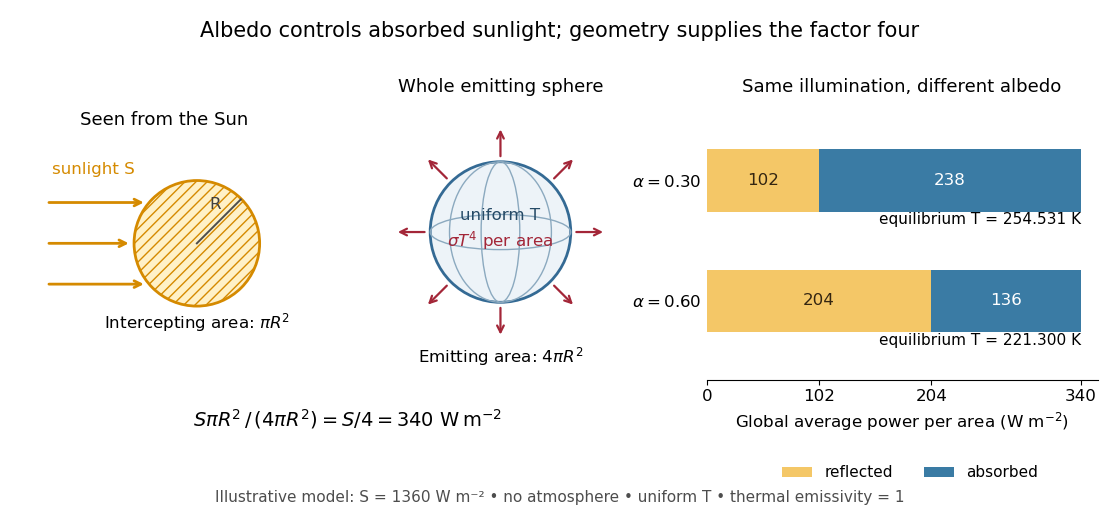
Each fixed-albedo equilibrium is a stable equilibrium: for , the derivative is . A small temperature increase produces net cooling, and a small decrease produces net heating. This is the simplest expression of the stabilizing Planck feedback. Allowing albedo to fall with temperature adds a competing term, as in ice-ocean albedo feedback.
A loss of the approximately attached-flow relation between angle of attack and lift coefficient, associated with substantial flow separation. A stalled airfoil can still produce lift; its behavior must be measured or modeled beyond thin airfoil theory.
A small-disturbance, two-dimensional potential flow model for a thin airfoil, using surface tangency and smooth flow departure at its trailing edge to determine circulation. Its lift coefficient slope is per radian, with camber shifting the zero-lift angle of attack. See airfoil for assumptions, examples and the aerodynamic stall limit.
The signed angle between a lifting surface's chord and its incoming relative flow. Positive incidence in the planar convention used in airfoil raises the leading edge relative to the trailing edge in a horizontal left-to-right flow. It is distinct from orientation relative to the ground; an induced velocity can change the local effective incidence.
A seed-bank population recurrence includes delayed recruitment from seeds that survive more than one season. For , recruitment function with and gives extinction multipliers solving . If is strictly concave, bounded and increasing, a positive fixed point exists uniquely exactly when ; it solves . The dominant extinction multiplier then exceeds one.
The Von Foerster equation transports a population density through age while mortality removes individuals. A birth boundary condition at age zero closes the model; for a prescribed fertility rate it has the form .
Age of a dust universe without a cosmological constant by  Codex 0 Created 2026-10-13 Updated 2026-11-05
For an expanding pressureless matter universe with zero cosmological constant, normalize . Dust relation between deceleration and density and mass conservation give . Integrating from the Big Bang yields the age integral above.
For , set to obtain , with on the expanding branch. For , the corresponding hyperbolic expression is with . The flat-dust and empty Milne universe limits are respectively and .
For positive pressureless matter density, positive cosmological constant, negligible radiation and zero curvature, the Friedmann equation gives . Substituting gives the displayed age of an FLRW universe measured from . Its zero-vacuum limit is ; the pure positive-vacuum flat patch has no finite big-bang age.
A trajectory with a persistent random velocity has . An ensemble with finite velocity variance therefore has displacement variance , contrasting with the linear-in-time variance of diffusion. In an impulsively kicked sinusoidal shear dispersion model with zero transverse diffusivity, the shear phase never changes and repeated identical kicks have this ballistic scaling. Transverse diffusion instead decorrelates the velocity and permits a long-time diffusive limit.
Chaotic advection is complicated, sensitive material motion generated by a smooth velocity field, often even when the Eulerian flow is periodic and simple. Transverse intersections of stable manifolds and unstable manifolds create stretching, folding and lobe transport across former separatrices. Incompressible flow preserves parcel area and advected scalar values in the absence of diffusion, so chaotic motion can create fine filaments without independently producing molecular homogenization.
An address interpreted within an address space, before address translation determines the corresponding physical address.
The multidimensional Szemerédi theorem says that a subset with positive upper density contains a translated positive integer dilate of every finite set . In the finite formulation, for every and finite , all sufficiently large integer boxes have this property for every subset occupying at least an fraction of the box. The one-dimensional case for is the Szemerédi theorem. The general result follows from multiple recurrence for commuting measure-preserving transformations.
Pinned article: Introduction to the OurBigBook Project
Welcome to the OurBigBook Project! Our goal is to create the perfect publishing platform for STEM subjects, and get university-level students to write the best free STEM tutorials ever.
Everyone is welcome to create an account and play with the site: ourbigbook.com/go/register. We belive that students themselves can write amazing tutorials, but teachers are welcome too. You can write about anything you want, it doesn't have to be STEM or even educational. Silly test content is very welcome and you won't be penalized in any way. Just keep it legal!
Intro to OurBigBook
. Source. We have two killer features:
- topics: topics group articles by different users with the same title, e.g. here is the topic for the "Fundamental Theorem of Calculus" ourbigbook.com/go/topic/fundamental-theorem-of-calculusArticles of different users are sorted by upvote within each article page. This feature is a bit like:
- a Wikipedia where each user can have their own version of each article
- a Q&A website like Stack Overflow, where multiple people can give their views on a given topic, and the best ones are sorted by upvote. Except you don't need to wait for someone to ask first, and any topic goes, no matter how narrow or broad
This feature makes it possible for readers to find better explanations of any topic created by other writers. And it allows writers to create an explanation in a place that readers might actually find it.
Figure 1. Screenshot of the "Derivative" topic page. View it live at: ourbigbook.com/go/topic/derivativeVideo 2. OurBigBook Web topics demo. Source. - local editing: you can store all your personal knowledge base content locally in a plaintext markup format that can be edited locally and published either:This way you can be sure that even if OurBigBook.com were to go down one day (which we have no plans to do as it is quite cheap to host!), your content will still be perfectly readable as a static site.
- to OurBigBook.com to get awesome multi-user features like topics and likes
- as HTML files to a static website, which you can host yourself for free on many external providers like GitHub Pages, and remain in full control

Figure 2. You can publish local OurBigBook lightweight markup files to either OurBigBook.com or as a static website.
Figure 3. Visual Studio Code extension installation.
Figure 5. . You can also edit articles on the Web editor without installing anything locally. Video 3. Edit locally and publish demo. Source. This shows editing OurBigBook Markup and publishing it using the Visual Studio Code extension. 
- Infinitely deep tables of contents:



All our software is open source and hosted at: github.com/ourbigbook/ourbigbook
Further documentation can be found at: docs.ourbigbook.com
Feel free to reach our to us for any help or suggestions: docs.ourbigbook.com/#contact