Topics (384k) Articles (398k) Users (410) Discussions (242) Comments (383) Files (13k) New article
An arithmetic function is a multiplicative function when and for all coprime integers , meaning their greatest common divisor is . The condition excludes the identically zero function. This definition makes no assertion about a pair whose greatest common divisor exceeds . [ref]
Floor and arithmetic functions by Darij Grinberg. Darij Grinberg, MIT 18.781 lecture notes, Definition 2.2.1
For the divisor function, the integer divisors of are , those of are , and those of are . HenceHere and are coprime integers. In contrast, , because the integer divisors of are . Thus the divisor function is a multiplicative function but not a completely multiplicative function.
The practical gain is that prime factorization reduces all values to values at prime powers. For distinct prime numbers and positive exponents ,For instance, since and are coprime integers; replacing by additionally requires a completely multiplicative function. The short proof repeatedly applies the defining rule to prime powers belonging to different prime numbers, which are coprime integers.
An arithmetic function is additive when for coprime integers . Equivalently, . This concerns multiplication of integers, and differs from an additive function on a vector space.
Asgard archaea are an archaeal group important in studies of eukaryotic origins. Molecular comparisons connect their genes to the nuclear lineage of eukaryotes, rather than making modern Asgard archaea the direct ancestors of modern animals or plants. See the original analysis cited under two-domain system.
For every , such a scheme returns a feasible solution within relative error and runs in time polynomial in the encoded instance size and in . Dependence polynomial only for each fixed epsilon is the weaker polynomial-time approximation-scheme requirement.
For a nonnegative counting quantity , an FPRAS is a randomized algorithm with the displayed guarantee, running in time polynomial in encoded input length, and . The usual constant-success definition is equivalent by independent repetition and a median. This counting notion differs from a deterministic fully polynomial-time approximation scheme for optimization.
An optical pinhole is a small aperture used to select a narrow part of a beam or approximate an optical point source. Its finite diameter and diffraction limit that approximation; an illuminated optical pinhole at a collimator's optical focus supplies a narrow bundle of nearly parallel light rays.
Cross-reactivity occurs when an antibody also recognizes another antigen beyond the one against which it was raised. This may involve related features, but obvious overall similarity is not required. [ref]
Appendix I. Immunologists' Toolbox. Immunobiology, 5th edition, Appendix I, antiserum generation: cross-reactive antigens and absorption
For an imagined example, a paratope contacts a small surface patch shared by two otherwise different proteins. Both can bind even though their remaining surfaces differ. Increasing antibody concentration can reveal weak binding that was previously undetectable. Conversely, an extra Western blot band need not prove cross-reactivity: the intended protein may occur in multiple forms, or detection reagents may contribute background. The target-deleted and no-primary antibody comparisons under Western blot antibody specificity controls test different explanations.
A concrete comparison used a Biacore T100 with a CM5 chip bearing the target receptor; unused reactive surface groups were blocked. At in a pH 7.4 buffer solution, intact IgG and its Fab fragment were injected for at ; dissociation was monitored for . The optical response tracks changes in refractive index near the surface, rather than counting occupied paratopes directly. A reference surface and blank injections corrected background; association and dissociation responses were fitted with a 1:1 model. The reported intact-IgG detachment was slower than that of the Fab fragment. [ref]
Antibody-Unfolding and Metastable-State Binding in Force Spectroscopy and Recognition Imaging by Parminder Kaur and others. Kaur and others, Materials and Methods, Surface plasmon resonance; Table 1, whole IgG and Fab rows
This comparison supports format-dependent attachment, not an intrinsic single-site antibody affinity for intact IgG. The reference and blanks address background, not two-arm avidity, surface accessibility or delivery by diffusion. The paper's fitted 1:1 constants alone cannot distinguish those mechanisms. Its Fab fragment comparison therefore motivates specifying the binding format before interpreting a dissociation constant; a good fit does not establish a unique molecular model.
Antibody equilibrium occupancy counts occupied antibody binding sites, rather than retained assay label. For an original 1:1 model, let denote an unoccupied site, free antigen bearing one accessible epitope, and their complex. At chemical equilibrium, writeSquare brackets mean concentrations. The dissociation constant here has concentration units. This is the same independent-site calculation as receptor binding occupancy, now applied to an antibody binding site. The last equality follows by substituting into the occupied fraction and cancelling .
Assume identical independent sites, reversible 1:1 binding, dilute chemical solution behavior, fixed temperature and buffer solution, and enough time for chemical equilibrium. Exclude two-arm bridging, cross-reactivity and inaccessible sites from this model. Crucially, is free antigen concentration; substituting the amount supplied per volume requires negligible depletion by binding. Independent IgG arms could obey this model site by site, but it does not describe avidity from bridging a surface.
Stipulate , with . Free antigen concentrations , and give , and . A second stipulated dissociation constant of instead gives at . Both curves approach one at large : a nearly saturated readout can conceal an antibody affinity difference. These are invented values, with no universal threshold for a useful antibody.
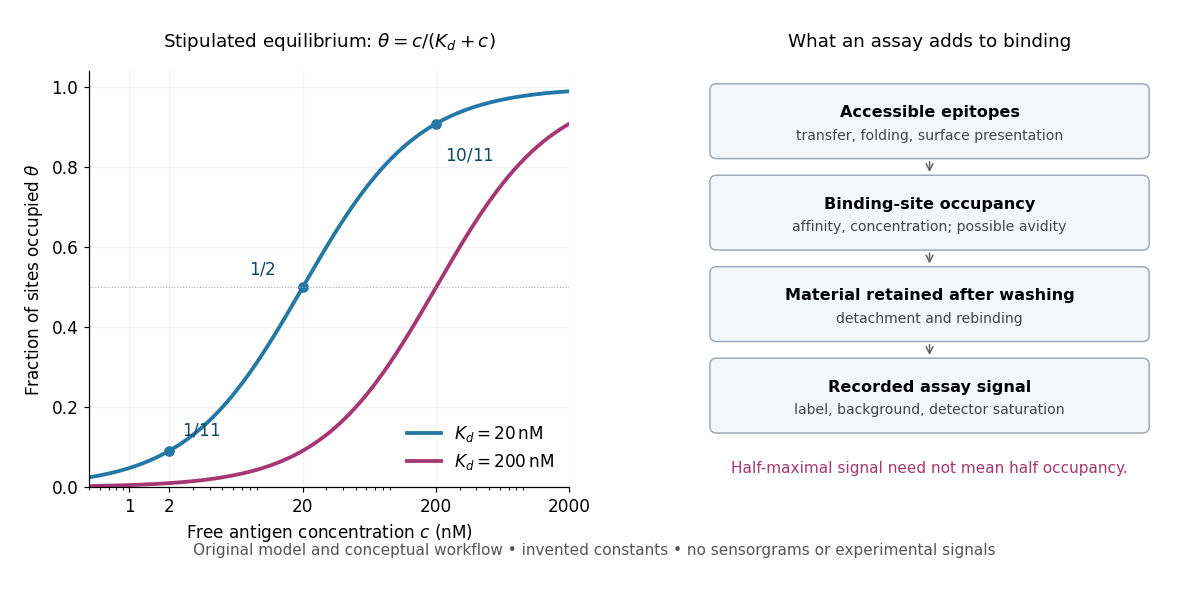
Antibody equilibrium occupancy and the additional steps in an assay readout
. Original analytic curves for stipulated dissociation constants of and ; marked examples belong to the first curve. The adjacent schematic separates epitope accessibility, binding, washing and detection. It contains no measured sensorgrams, fitted assay parameters or experimental signals. A logarithmic scale changes the display, not the independent-site assumptions. Details.A Western blot readout additionally depends on Western blot transfer, accessible epitopes, loss during washing and Western blot antibody detection. Western blot response saturation can flatten the final signal even when binding itself remains responsive. An ELISA also reports retained label through an enzyme readout, rather than automatically reporting . Thus half of an assay's maximum signal need not occur at . Varying free antigen through concentrations near the candidate dissociation constant, while checking depletion and the readout's response, is more informative than comparing a single saturated point.
Associate with . The ambient quadratic form is ; hence the radius- anti-de Sitter quadric is with . The action gives . Its induced bi-invariant pseudo-Riemannian metric is , giving and cosmological constant . The antipodal quotient is ; unwrapping global time gives the universal covering group instead. The connected component is essential in the displayed orthogonal-group isomorphism.
The unit hyperboloid in ambient signature has , , . It gives the displayed metric with and periodic modulo . Its time circles are timelike, so the universal cover, with , removes these closed timelike curves. The metric alone does not prescribe the global identification. Both versions have constant negative curvature and two spatial ends.
For Lorentzian boundary metric and , this Anti-de Sitter spacetime patch has unit curvature radius. Its orthonormal coframe has connection and curvature , giving sectional curvature . The full local isometry algebra is in spacetime dimension . A patch need not support every local Killing flow for all parameter values.
For ambient quadratic form , associate . Its determinant is , so the unit Anti-de Sitter spacetime hyperboloid is the special linear group of real two-by-two matrices. On its tangent space at the identity, the induced bilinear form is . The Killing form is , and left and right matrix multiplication preserve the ambient form. Consequently the induced bi-invariant pseudo-Riemannian metric is . This model has periodic time; its causally unwrapped version is the universal covering Lie group.
Embed radius- Anti-de Sitter spacetime as in signature with two timelike directions. Initial tangent satisfies and . The displayed curve remains on the hyperboloid and has unit timelike tangent; its ambient acceleration is normal, proving it is a geodesic. Every such curve reaches after proper time . On the universal cover, this is a later antipodal event, not a closed causal loop. Global time advances by over a complete ambient period.
Fish is the common grouping of aquatic vertebrates generally possessing gills and fins, with ordinary usage excluding tetrapods. It is therefore not one exclusive clade: tetrapods descend from within the bony-vertebrate radiation. Feeding roles vary with diet and developmental stage, so position in a food web is a separate ecological description.
An amphibian is a member of the vertebrate group containing frogs, salamanders and caecilians. Many have aquatic larvae and terrestrial adults, but life cycles vary. An aquatic-to-terrestrial transition is therefore a useful example rather than a universal definition.
An insect is an arthropod whose typical adult body has a head, thorax and abdomen, with three pairs of thoracic legs. Wings and life-cycle stages vary among groups. Beetles, butterflies and bumblebees exemplify different modifications of that organization.
Spin is intrinsic angular momentum carried by a quantum particle or another effective quantum degree of freedom. It does not require a literal rotating surface. Spin components generate rotations and obey ; a spin- multiplet has projections along a chosen quantization axis.
For spin one-half, the operators are , with outcomes for a component measurement. A Stern-Gerlach experiment resolves discrete magnetic responses to a field gradient, while magnetic-resonance experiments control and observe Larmor precession. Spin differs from orbital angular momentum, which arises from the spatial dependence of a wavefunction. Combining both is necessary for atomic fine structure and coupling the electronic result to nuclear spin gives hyperfine structure.
Axially symmetric quadratic orbital eigenfunction by  Codex 0 Created 2026-10-13 Updated 2026-10-18
Each orbital angular momentum operator annihilates a radial factor and . Direct differentiation gives and . Hence the displayed trace-free quadratic polynomial, times any admissible radial factor, has orbital labels . Its angular dependence is proportional to the spherical harmonic ; subtracting removes the rotational scalar part.
Write each position and velocity as its centre of mass value plus a relative value. Expanding the total angular momentum gives the displayed split into orbital angular momentum of the centre and internal angular momentum about it. The cross terms vanish because .
Pinned article: Introduction to the OurBigBook Project
Welcome to the OurBigBook Project! Our goal is to create the perfect publishing platform for STEM subjects, and get university-level students to write the best free STEM tutorials ever.
Everyone is welcome to create an account and play with the site: ourbigbook.com/go/register. We belive that students themselves can write amazing tutorials, but teachers are welcome too. You can write about anything you want, it doesn't have to be STEM or even educational. Silly test content is very welcome and you won't be penalized in any way. Just keep it legal!
Intro to OurBigBook
. Source. We have two killer features:
- topics: topics group articles by different users with the same title, e.g. here is the topic for the "Fundamental Theorem of Calculus" ourbigbook.com/go/topic/fundamental-theorem-of-calculusArticles of different users are sorted by upvote within each article page. This feature is a bit like:
- a Wikipedia where each user can have their own version of each article
- a Q&A website like Stack Overflow, where multiple people can give their views on a given topic, and the best ones are sorted by upvote. Except you don't need to wait for someone to ask first, and any topic goes, no matter how narrow or broad
This feature makes it possible for readers to find better explanations of any topic created by other writers. And it allows writers to create an explanation in a place that readers might actually find it.
Figure 1. Screenshot of the "Derivative" topic page. View it live at: ourbigbook.com/go/topic/derivativeVideo 2. OurBigBook Web topics demo. Source. - local editing: you can store all your personal knowledge base content locally in a plaintext markup format that can be edited locally and published either:This way you can be sure that even if OurBigBook.com were to go down one day (which we have no plans to do as it is quite cheap to host!), your content will still be perfectly readable as a static site.
- to OurBigBook.com to get awesome multi-user features like topics and likes
- as HTML files to a static website, which you can host yourself for free on many external providers like GitHub Pages, and remain in full control

Figure 2. You can publish local OurBigBook lightweight markup files to either OurBigBook.com or as a static website.
Figure 3. Visual Studio Code extension installation.
Figure 5. . You can also edit articles on the Web editor without installing anything locally. Video 3. Edit locally and publish demo. Source. This shows editing OurBigBook Markup and publishing it using the Visual Studio Code extension. 
- Infinitely deep tables of contents:



All our software is open source and hosted at: github.com/ourbigbook/ourbigbook
Further documentation can be found at: docs.ourbigbook.com
Feel free to reach our to us for any help or suggestions: docs.ourbigbook.com/#contact