Topics (384k) Articles (398k) Users (410) Discussions (242) Comments (383) Files (13k) New article

Arthur Cayley developed the algebraic treatment of matrices in his 1858 memoir. Treating matrix operations as objects of study, rather than merely bookkeeping for equations, helped connect linear transformations with an independent algebraic calculus.[ref]
A Memoir on the Theory of Matrices by Arthur Cayley. author attribution and the described mathematical development

Portrait of Arthur Cayley
. Herbert Beraud (as credited by Commons, 1845–1896); source MacTutor portrait collection; image metadata also credits Smithsonian Libraries. Public domain (Commons life+70 / public-domain photographic reproduction). Source and usage information on the linked Wikimedia file page. Source.Gordan Žitković authored notes introducing stochastic processes. Conditional distributions, filtration and time evolution connect a random-variable model at one instant with a mathematically specified process.[ref]
Lecture notes for Introduction to Stochastic Processes by Gordan Žitković. author attribution and the described mathematical development
Homepage: gordanz.github.io/

Portrait of Gordan Žitković
. External portrait hosted by The University of Texas at Austin, Department of Mathematics. Source.Timothy Gowers authored an explanation of how to use Zorn's lemma. Organizing a construction as a partially ordered collection of compatible partial objects can turn a local extension argument into existence of a maximal object.[ref]
How to use Zorn’s lemma by Timothy Gowers. author attribution and the described mathematical development

Portrait of Timothy Gowers
. Martin Greuel; Oberwolfach Photo Collection, Berlin, 2011. CC BY-SA 2.0, via Wikimedia Commons. Source.Author of teaching material on the development of group theory through historical sources. The project compares early formulations and proofs, helping distinguish modern abstract definitions from their motivating examples.[ref]
Abstract awakenings in algebra: Early group theory in the works of Lagrange, Cauchy, and Cayley by Janet Heine Barnett. author attribution and the named work’s subject
Author of an analysis of kurtosis that challenges its interpretation as peak height. The paper uses counterexamples and inequalities to explain the importance of tail observations in the fourth standardized moment.[ref]
Kurtosis as Peakedness, 1905 – 2014. R.I.P. by Peter H. Westfall. author attribution and the named work’s subject
Nigel Hitchin authored teaching material on the geometry of surfaces. The subject links intrinsic distance and curvature with coordinate descriptions and global geometric structure.[ref]
Geometry of Surfaces by Nigel Hitchin (B3a course 2013). author attribution and the described mathematical development

Portrait of Nigel Hitchin
. Renate Schmid; Oberwolfach Photo Collection, 2004; existing Commons crop by Soerfm. CC BY-SA 2.0, via Wikimedia Commons. Source.Constantin Teleman authored course notes on Riemann surfaces. The notes connect local holomorphic coordinates with the global topology and geometry of complex curves.[ref]
Riemann Surfaces by Constantin Teleman (Lent Term 2003). author attribution and the described mathematical development

Portrait of Constantin Teleman
. George M. Bergman; Berkeley, 2017; uploaded by George Ho. CC BY-SA 4.0, via Wikimedia Commons. Source.Coauthor with Kevin M. Lynch of a textbook on modern robotics, connecting rigid-body geometry with robot mechanics, motion planning and control.[ref]
Modern Robotics: Mechanics, Planning, and Control by Kevin M. Lynch and Frank C. Park. author attribution and the named work’s subject
Coauthor with Frank C. Park of a textbook on modern robotics. Its treatment connects rotation matrices, rigid-body motion, planning and control through a common geometric formulation.[ref]
Modern Robotics: Mechanics, Planning, and Control by Kevin M. Lynch and Frank C. Park. author attribution and the named work’s subject
Coauthor with Simo Särkkä of a textbook on applied stochastic differential equations, developing analytic solutions and computational methods for continuous-time random models.[ref]
Applied Stochastic Differential Equations by Simo Särkkä and Arno Solin. author attribution and the named work’s subject
Coauthor with Arno Solin of a textbook on applied stochastic differential equations. Its examples connect linear stochastic models with transition distributions and stationary covariances.[ref]
Applied Stochastic Differential Equations by Simo Särkkä and Arno Solin. author attribution and the named work’s subject
A credited author of the LAPACK routine DLARTG, which constructs a numerically reliable Givens rotation. Scaling and zero-input cases matter because the elementary square-root formula can otherwise overflow or underflow.[ref]
DLARTG (LAPACK 3.12.1) by Edward Anderson. author attribution and the named work’s subject
Tom M. Apostol contributed mathematical reference material on special functions and number theory, including the zeta function and Dirichlet characters. These topics connect infinite series, integer arithmetic and analytic identities.[ref]
25.6 Integer Arguments. author attribution and the described mathematical development
Official profile, including a portrait: dlmf.nist.gov/about/bio/TMApostol

Portrait of Tom M. Apostol
. Unidentified photographer; Caltech yearbook The Big T 1965; existing Commons portrait extract. Commons PD-US-no-notice claim for US publication without copyright notice during 1931–1977; other jurisdictions may retain protection., via Wikimedia Commons. Source.Allen Hatcher authored a text in algebraic topology. Algebraic invariants such as the fundamental group and homology make global features of spaces accessible to calculation while respecting continuous deformation.[ref]
Algebraic Topology by Allen Hatcher. author attribution and the described mathematical development

Portrait of Allen Hatcher
. George M. Bergman; existing headshot crop of the Berkeley photograph, circa 1980. CC BY-SA 4.0, via Wikimedia Commons. Source.Stéphane Mallat authored a text connecting wavelets with signal processing. Multiscale representations separate features by position and scale, making both the mathematical basis and the computational transform useful for analyzing signals.[ref]
A Wavelet Tour of Signal Processing by Stéphane Mallat. author attribution and the described mathematical development

Portrait of Stéphane Mallat
. Jérémy Barande / Ecole polytechnique Université Paris-Saclay; existing Commons crop by Titlutin. CC BY-SA 2.0, via Wikimedia Commons. Source.Andrew Granville coauthored work on the pretentious approach to multiplicative number theory with Kannan Soundararajan. The approach compares multiplicative functions through quantitative measures of their agreement, revealing structure behind cancellations and mean values.[ref]
Multiplicative number theory: The pretentious approach by Andrew Granville and K. Soundararajan. author attribution and the described mathematical development
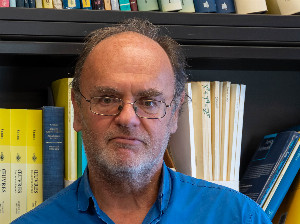
Portrait of Andrew Granville
. External portrait hosted by Université de Montréal. Source. Pinned article: Introduction to the OurBigBook Project
Welcome to the OurBigBook Project! Our goal is to create the perfect publishing platform for STEM subjects, and get university-level students to write the best free STEM tutorials ever.
Everyone is welcome to create an account and play with the site: ourbigbook.com/go/register. We belive that students themselves can write amazing tutorials, but teachers are welcome too. You can write about anything you want, it doesn't have to be STEM or even educational. Silly test content is very welcome and you won't be penalized in any way. Just keep it legal!
Intro to OurBigBook
. Source. We have two killer features:
- topics: topics group articles by different users with the same title, e.g. here is the topic for the "Fundamental Theorem of Calculus" ourbigbook.com/go/topic/fundamental-theorem-of-calculusArticles of different users are sorted by upvote within each article page. This feature is a bit like:
- a Wikipedia where each user can have their own version of each article
- a Q&A website like Stack Overflow, where multiple people can give their views on a given topic, and the best ones are sorted by upvote. Except you don't need to wait for someone to ask first, and any topic goes, no matter how narrow or broad
This feature makes it possible for readers to find better explanations of any topic created by other writers. And it allows writers to create an explanation in a place that readers might actually find it.
Figure 1. Screenshot of the "Derivative" topic page. View it live at: ourbigbook.com/go/topic/derivativeVideo 2. OurBigBook Web topics demo. Source. - local editing: you can store all your personal knowledge base content locally in a plaintext markup format that can be edited locally and published either:This way you can be sure that even if OurBigBook.com were to go down one day (which we have no plans to do as it is quite cheap to host!), your content will still be perfectly readable as a static site.
- to OurBigBook.com to get awesome multi-user features like topics and likes
- as HTML files to a static website, which you can host yourself for free on many external providers like GitHub Pages, and remain in full control

Figure 2. You can publish local OurBigBook lightweight markup files to either OurBigBook.com or as a static website.
Figure 3. Visual Studio Code extension installation.
Figure 5. . You can also edit articles on the Web editor without installing anything locally. Video 3. Edit locally and publish demo. Source. This shows editing OurBigBook Markup and publishing it using the Visual Studio Code extension. 
- Infinitely deep tables of contents:




All our software is open source and hosted at: github.com/ourbigbook/ourbigbook
Further documentation can be found at: docs.ourbigbook.com
Feel free to reach our to us for any help or suggestions: docs.ourbigbook.com/#contact