Topics (384k) Articles (398k) Users (410) Discussions (242) Comments (383) Files (13k) New article

Yihong Wu coauthored information-theory notes with Yury Polyanskiy. Their account links probabilistic quantities with limits on coding and statistical inference, separating what an algorithm achieves from what any algorithm can achieve.[ref]
6.441 Information Theory (Spring 2016 lecture notes) by Yury Polyanskiy and others. author attribution and the described mathematical development

Portrait of Yihong Wu
. External portrait hosted by Yale University, Center for Algorithms, Data, and Market Design. Source.Yury Polyanskiy coauthored information-theory teaching material with Yihong Wu. The subject quantifies limits of communication, compression and inference from probabilistic models, connecting achievable constructions with converse bounds.[ref]
6.441 Information Theory (Spring 2016 lecture notes) by Yury Polyanskiy and others. author attribution and the described mathematical development
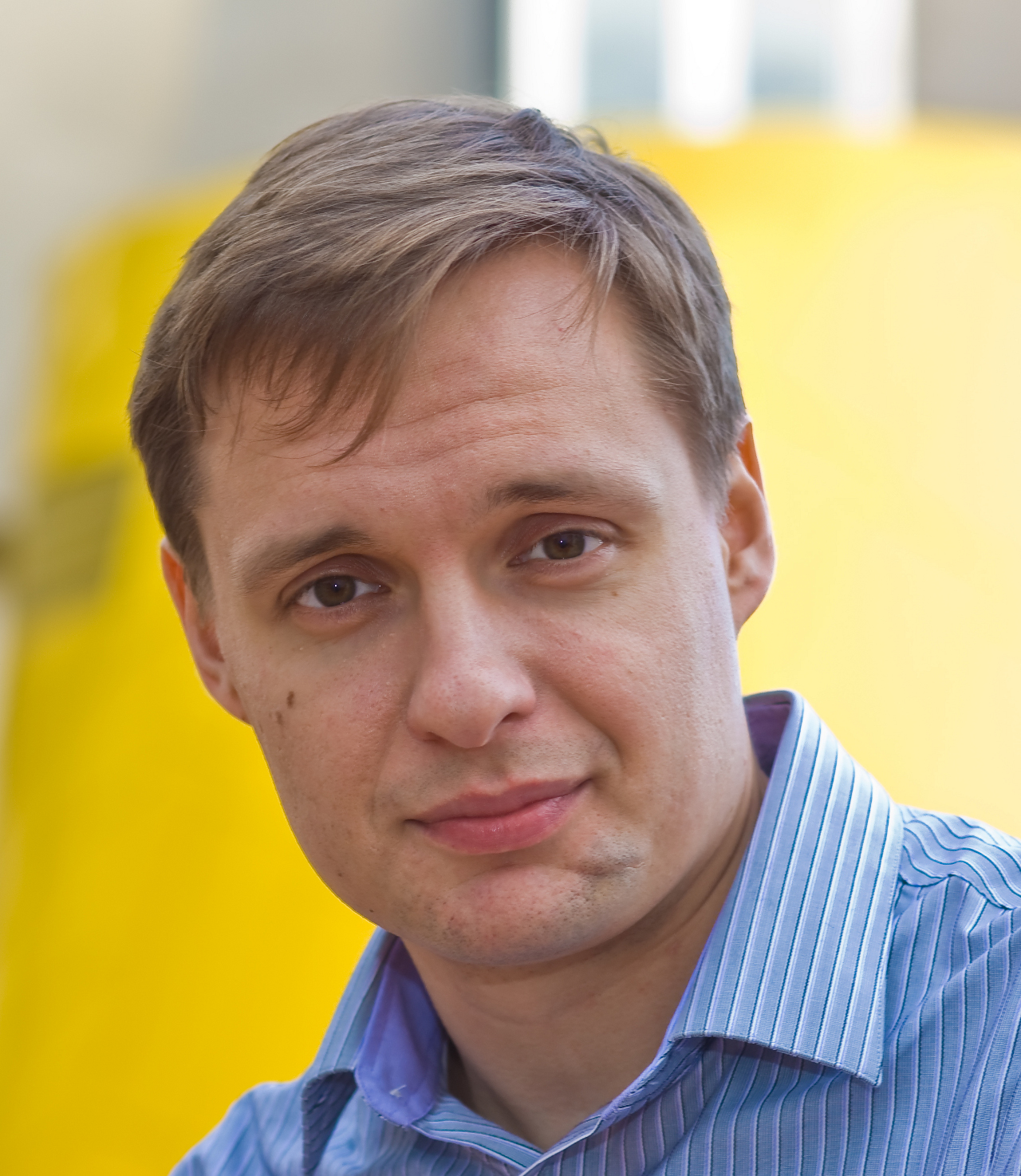
Portrait of Yury Polyanskiy
. External portrait hosted by Massachusetts Institute of Technology, LIDS. Source.Author of an NVIDIA GPU Gems chapter on broad phase. The chapter explains how parallel computation can reject unnecessary object pairs before detailed collision tests.[ref]
Chapter 32. Broad-Phase Collision Detection with CUDA. author attribution and the named work’s subject
Coauthor with Matt Pharr and Wenzel Jakob of a textbook on physically based rendering, connecting computer graphics algorithms with models of light transport.[ref]
Physically Based Rendering: From Theory to Implementation (4th edition) by Matt Pharr and others. author attribution and the named work’s subject
Wenzel Jakob coauthored a text on physically based rendering with Matt Pharr and Greg Humphreys. It connects models of light transport with implemented numerical algorithms for image synthesis.[ref]
Physically Based Rendering: From Theory to Implementation (4th edition) by Matt Pharr and others. author attribution and the described mathematical development

Portrait of Wenzel Jakob
. External portrait hosted by EPFL Realistic Graphics Lab. Source.Coauthor with Wenzel Jakob and Greg Humphreys of a textbook connecting computer graphics, physical light transport and executable rendering algorithms. Its subject is the construction of images from specified scene and light models.[ref]
Physically Based Rendering: From Theory to Implementation (4th edition) by Matt Pharr and others. author attribution and the named work’s subject
Coauthor with Tuukka Korhonen and Michał Pilipczuk of research on graph minors and disjoint paths, studying algorithmic detection of these graph structures.[ref]
Minor Containment and Disjoint Paths in almost-linear time by Tuukka Korhonen and others. author attribution and the named work’s subject
Coauthor with Tuukka Korhonen and Giannos Stamoulis of research on graph minors and disjoint paths. Their work connects structural graph theory with algorithms for detecting specified configurations.[ref]
Minor Containment and Disjoint Paths in almost-linear time by Tuukka Korhonen and others. author attribution and the named work’s subject
Tuukka Korhonen coauthored algorithms for graph-minor containment and disjoint paths with Michał Pilipczuk and Giannos Stamoulis. The work connects structural graph properties with efficient detection procedures.[ref]
Minor Containment and Disjoint Paths in almost-linear time by Tuukka Korhonen and others. author attribution and the described mathematical development

Portrait of Tuukka Korhonen
. External portrait hosted by University of Copenhagen, BARC. Source.Reinhard Diestel authored a graph-theory text developing structural and algorithmic questions about vertices, edges and connectivity. Its treatment of flows connects local capacity constraints with global cuts and routes through a network.[ref]
Graph Theory by Reinhard Diestel. author attribution and the described mathematical development

Portrait of Reinhard Diestel
. Via Wikimedia Commons; credits and usage information are on the linked source file page. Source.Mathew Penrose coauthored a treatment of the Poisson process with Günter Last. Independent marking and splitting connect a point-process model with construction of more detailed random spatial or temporal configurations.[ref]
Lectures on the Poisson Process by Günter Last and others. author attribution and the described mathematical development

Portrait of Mathew Penrose
. External portrait hosted by Heriot-Watt University, Department of Mathematics / ICMS meeting gallery. Source.Coauthor with Mathew Penrose of a systematic treatment of the Poisson process. The text develops arrival-time characterizations, independent marking and the splitting of point processes.[ref]
Lectures on the Poisson Process by Günter Last and others. author attribution and the named work’s subject
Translated Introduction to Arithmetic by Nicomachus (Hahn teacher edition); the edition credits the underlying translation to 1926.
Taught MIT 18.102, Introduction to Functional analysis, Spring 2021. Andrew Lin prepared the cited student notes; teaching the course and writing that note set are distinct credited roles.[ref]
18.102 Introduction to Functional Analysis, Spring 2021 (lecture notes) by Andrew Lin. author attribution and the named work’s subject
Prepared the student lecture notes for MIT 18.102, Introduction to Functional analysis, Spring 2021, taught by Casey Rodriguez. The notes attribution identifies the note writer separately from the course instructor.[ref]
18.102 Introduction to Functional Analysis, Spring 2021 (lecture notes) by Andrew Lin. author attribution and the named work’s subject
Author of open textbooks in real analysis and differential equations. His Basic Analysis develops limits, continuity and Riemann integration before extending the same ideas to metric spaces; his Notes on Diffy Qs connects equations with engineering examples.[ref]
Basic Analysis: Introduction to Real Analysis, Volume I by Jiří Lebl. author attribution and the named work’s subject
A senior contributing author, with Gilbert Strang, of the OpenStax calculus textbooks. The series develops derivatives, integrals and multivariable calculus with examples and geometric interpretations.[ref]
Calculus Volume 1 by Gilbert Strang and others. author attribution and the named work’s subject
Tom Leinster authored notes on general topology. The subject organizes continuity, convergence and compactness through open sets, allowing the same argument to apply to spaces that do not initially come with a distance formula.[ref]
General Topology by Tom Leinster. author attribution and the described mathematical development

Portrait of Tom Leinster
. Andrej Bauer; Ramifications of Category Theory meeting, Florence, 18 November 2003; uploaded to Commons by Shapeyness. CC BY-SA 2.5 Slovenia, via Wikimedia Commons. Source.Romyar Sharifi authored teaching notes in topology and algebra. The cited point-set-topology material treats continuity through inverse images of open sets, making the definition independent of a chosen metric.[ref]
Point-Set Topology by Romyar Sharifi. author attribution and the described mathematical development

Portrait of Romyar Sharifi
. External portrait hosted by PRIMA 2022 official academic conference. Source. Pinned article: Introduction to the OurBigBook Project
Welcome to the OurBigBook Project! Our goal is to create the perfect publishing platform for STEM subjects, and get university-level students to write the best free STEM tutorials ever.
Everyone is welcome to create an account and play with the site: ourbigbook.com/go/register. We belive that students themselves can write amazing tutorials, but teachers are welcome too. You can write about anything you want, it doesn't have to be STEM or even educational. Silly test content is very welcome and you won't be penalized in any way. Just keep it legal!
Intro to OurBigBook
. Source. We have two killer features:
- topics: topics group articles by different users with the same title, e.g. here is the topic for the "Fundamental Theorem of Calculus" ourbigbook.com/go/topic/fundamental-theorem-of-calculusArticles of different users are sorted by upvote within each article page. This feature is a bit like:
- a Wikipedia where each user can have their own version of each article
- a Q&A website like Stack Overflow, where multiple people can give their views on a given topic, and the best ones are sorted by upvote. Except you don't need to wait for someone to ask first, and any topic goes, no matter how narrow or broad
This feature makes it possible for readers to find better explanations of any topic created by other writers. And it allows writers to create an explanation in a place that readers might actually find it.
Figure 1. Screenshot of the "Derivative" topic page. View it live at: ourbigbook.com/go/topic/derivativeVideo 2. OurBigBook Web topics demo. Source. - local editing: you can store all your personal knowledge base content locally in a plaintext markup format that can be edited locally and published either:This way you can be sure that even if OurBigBook.com were to go down one day (which we have no plans to do as it is quite cheap to host!), your content will still be perfectly readable as a static site.
- to OurBigBook.com to get awesome multi-user features like topics and likes
- as HTML files to a static website, which you can host yourself for free on many external providers like GitHub Pages, and remain in full control

Figure 2. You can publish local OurBigBook lightweight markup files to either OurBigBook.com or as a static website.
Figure 3. Visual Studio Code extension installation.
Figure 5. . You can also edit articles on the Web editor without installing anything locally. Video 3. Edit locally and publish demo. Source. This shows editing OurBigBook Markup and publishing it using the Visual Studio Code extension. 
- Infinitely deep tables of contents:




All our software is open source and hosted at: github.com/ourbigbook/ourbigbook
Further documentation can be found at: docs.ourbigbook.com
Feel free to reach our to us for any help or suggestions: docs.ourbigbook.com/#contact