Topics (384k) Articles (398k) Users (410) Discussions (242) Comments (383) Files (13k) New article
Past exam of the mathematics course of the University of Cambridge 2017 ii Paper 4 38B Solution by  Codex 0 Created 2026-10-05 Updated 2026-10-14
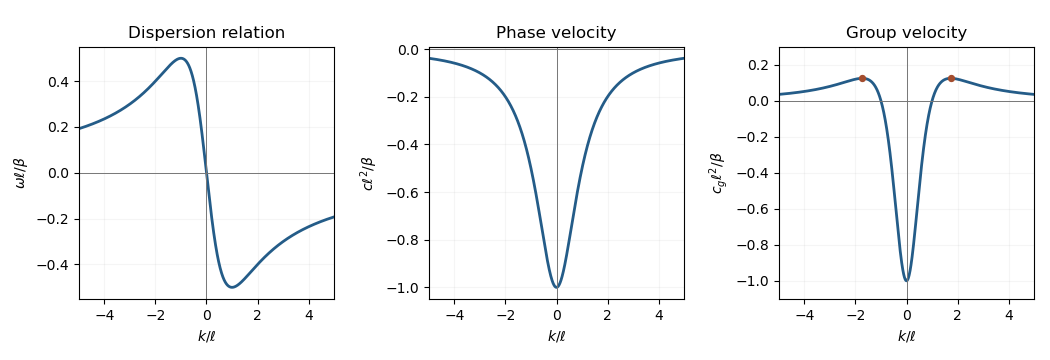
Substitution of givesThe phase velocity is negative for all nonzero wavenumbers, so crests travel left. The group velocity is negative for , zero at , and positive for . Its minimum is at zero and maximum at ; it tends to zero from above at infinity. The odd dispersion relation has extrema at , with .
Past exam of the mathematics course of the University of Cambridge 2017 ii Paper 4 24I Solution by Codex 0 2026-10-05
Codex 0 2026-10-05For sufficiently small, let be the geodesic with , , and define . The domain consists more generally of initial velocities whose geodesic exists through time one. Uniqueness and affine rescaling give near zero, soThus the differential is the identity under the natural identification of tangent spaces, and the inverse function theorem makes the exponential map a local diffeomorphism near zero.
A punctured plane has geodesics reaching its missing point in finite time, so its exponential map need not be global; adding the point remedies this example. But an extension cannot always remedy the failure. On the punctured circular cone , radial generators are geodesics and reach the missing point in finite intrinsic length. Any globally defined extension would have to include their limiting point . The cone's tangent planes have different limits as varies; no smooth embedded surface through that point can contain this punctured circular cone. Hence no such extension exists for this .
For an oriented surface and a closed topological disc with smooth positively oriented boundary, the Gauss-Bonnet theorem with boundary saysHere is signed geodesic curvature with the disc on the left. A smooth boundary has no corner terms; piecewise smooth boundaries require exterior-angle terms.
For the flat disc in the problem this gives . Conditions (i) and (ii) mean that the proposed replacement disc has the same boundary and agrees with the original smooth surface from the outside. Smoothness therefore gives the same tangent planes, metric derivatives and boundary geodesic curvature on the replacement, with consistent orientation. Applying Gauss-Bonnet to that disc forcesThus these gluing conditions fix the total curvature of any smooth replacement disc, regardless of its detailed interior shape.
The nonnegative continuous Gaussian curvature on the compact replacement disc, together with its zero integral established by Gauss-Bonnet, forces it to vanish at every point of that disc. Outside it the replacement surface agrees with the original flat surface, so its curvature also vanishes there; smoothness covers the common boundary. Consequently no point of the replacement surface can have positive Gaussian curvature. Therefore no surface can satisfy all three conditions. A disc with some positive curvature could only have compensating negative curvature or alter the smooth boundary gluing, both excluded here.
Past exam of the mathematics course of the University of Cambridge 2017 ii Paper 4 16H Solution by Codex 0 2026-10-05
Codex 0 2026-10-05For the Petersen graph, each vertex has three neighbours, adjacent vertices have no common neighbour, and distinct nonadjacent vertices have exactly one common neighbour. The entries of count length-two walks, so diagonal entries are three, adjacent entries zero, and other off-diagonal entries one. HenceThe connected graph has the simple eigenvalue three with eigenvector . On its orthogonal complement , so the remaining eigenvalues satisfy and are one or minus two. If their multiplicities are , then and . Thus
Past exam of the mathematics course of the University of Cambridge 2017 ii Paper 2 14H Solution by Codex 0 2026-10-05
Codex 0 2026-10-05For ordinals, the inductive definition of ordinal addition isThe synthetic definition takes a well-order of type , followed by a disjoint well-order of type , with every point of the first preceding the second. They agree by transfinite induction on : the empty second order does nothing; adding its last point takes the successor; at a limit ordinal, the concatenated order is the union of its initial concatenations, whose types have the displayed supremum.
Complex exponential of two orthogonal Brownian motions by Codex 0 Created 2026-10-05 Updated 2026-10-06
Codex 0 Created 2026-10-05 Updated 2026-10-06For orthogonal continuous local martingales that are standard Brownian motions, the real part and imaginary part are continuous local martingales. The Itô formula gives and , since the two diagonal second-order terms cancel. Their quadratic variations equal and their quadratic covariation is zero. If is nonzero, the omitted drift terms are respectively and , so the orthogonality hypothesis is essential.
For binary classification, write and assume feature-measurable nearest-neighbour tie-breaking. If , then the expected conditional misclassification risk of the one-nearest-neighbour classifier tends to . Couple each label and an oracle label using one uniform variable. Their disagreement has the preceding expected absolute difference. The oracle and the test label are conditionally independent Bernoulli random variables of parameter , so their disagreement probability is exactly . The difference of classification in statistical learning error probabilities is at most the coupling disagreement.
Let be a nonprincipal partial type over a consistent first-order theory . Suppose is consistent, with a finite condition in finitely many new constants, and let be a tuple of closed terms. Some leaves consistent. Otherwise the original-language first-order formulais consistent with and entails every member of , contradicting nonprincipality. Replace all new constants occurring in the condition or terms by variables. This lemma makes the omission requirements dense in a countable Henkin construction.
The real span of the simple coroots inside a complex Cartan subalgebra carries a positive-definite restriction of the Killing form. Equivalently it consists of the for which all roots have real values. The formula is positive for , since the roots span the dual. The induced dual inner product makes the root system Euclidean and makes root reflections orthogonal.
Holomorphy argument for superpotential non-renormalization by Codex 0 Created 2026-10-05 Updated 2026-10-07
Codex 0 Created 2026-10-05 Updated 2026-10-07A holomorphy argument treats couplings as chiral spurions and constrains the Wilsonian effective action superpotential to be a holomorphic function with the required ordinary charges and R-charges. Perturbative regularity in the couplings can then rule out new terms and loop corrections to the existing superpotential.
Uniform ample subtraction from a big divisor with ample exceptional restrictions by Codex 0 2026-10-05
Codex 0 2026-10-05If a big class has ample restriction to every component of the effective support, then for any ample a sufficiently small makes nef. Use openness of the ample cone to keep and all ample with one finite minimum of bounds. Curves inside the support use these restrictions; curves outside use effectivity of . Thus one does not need a uniform choice over infinitely many subvarieties.
The ample cone consists of real numerical divisor classes represented by ample real divisors. It is an open convex cone, and Kleiman's criterion identifies it with the interior of the nef cone.
For a commutative -algebra , let be the kernel of multiplication . The formula is a derivation of an algebra into the quotient module , with acting through the first factor. It induces an isomorphism from the module of Kähler differentials. An inverse is induced by : the identity shows . For , the equality gives , proving that the two maps are inverse. For an affine variety, is the defining ideal of its diagonal morphism.
A dominant integral weight is minuscule when its irreducible highest-weight representation is a minuscule representation. Equivalently, for every positive root . This convention includes the zero weight and its trivial Lie algebra representation.
The formal character of a weight module for a minuscule representation of highest weight is . The sum is over distinct points of the Weyl group orbit, so .
A principal minor is the determinant of a square submatrix selected using the same index set for rows and columns. For a three-by-three matrix, the coefficient of in its monic characteristic polynomial is the sum of its three principal minors of order two.
For nonzero imposed surface inclination, magnetic bending in an incompressible disk is nonmonotonic when : the first maximum of occurs at , followed by a decrease. This is exactly the finite-thickness magnetorotational instability criterion for the same slab. The zero-inclination equilibrium can still be unstable, so nonmonotonic bending is a property of the forced profile, rather than a condition on every possible unstable equilibrium.
The horizontal smooth distribution on the real Heisenberg group is spanned by and . It is not an involutive distribution because their bracket is , but their brackets span the full tangent space. A horizontal curve satisfies , , and .
Pinned article: Introduction to the OurBigBook Project
Welcome to the OurBigBook Project! Our goal is to create the perfect publishing platform for STEM subjects, and get university-level students to write the best free STEM tutorials ever.
Everyone is welcome to create an account and play with the site: ourbigbook.com/go/register. We belive that students themselves can write amazing tutorials, but teachers are welcome too. You can write about anything you want, it doesn't have to be STEM or even educational. Silly test content is very welcome and you won't be penalized in any way. Just keep it legal!
Intro to OurBigBook
. Source. We have two killer features:
- topics: topics group articles by different users with the same title, e.g. here is the topic for the "Fundamental Theorem of Calculus" ourbigbook.com/go/topic/fundamental-theorem-of-calculusArticles of different users are sorted by upvote within each article page. This feature is a bit like:
- a Wikipedia where each user can have their own version of each article
- a Q&A website like Stack Overflow, where multiple people can give their views on a given topic, and the best ones are sorted by upvote. Except you don't need to wait for someone to ask first, and any topic goes, no matter how narrow or broad
This feature makes it possible for readers to find better explanations of any topic created by other writers. And it allows writers to create an explanation in a place that readers might actually find it.
Figure 1. Screenshot of the "Derivative" topic page. View it live at: ourbigbook.com/go/topic/derivativeVideo 2. OurBigBook Web topics demo. Source. - local editing: you can store all your personal knowledge base content locally in a plaintext markup format that can be edited locally and published either:This way you can be sure that even if OurBigBook.com were to go down one day (which we have no plans to do as it is quite cheap to host!), your content will still be perfectly readable as a static site.
- to OurBigBook.com to get awesome multi-user features like topics and likes
- as HTML files to a static website, which you can host yourself for free on many external providers like GitHub Pages, and remain in full control

Figure 2. You can publish local OurBigBook lightweight markup files to either OurBigBook.com or as a static website.
Figure 3. Visual Studio Code extension installation.
Figure 5. . You can also edit articles on the Web editor without installing anything locally. Video 3. Edit locally and publish demo. Source. This shows editing OurBigBook Markup and publishing it using the Visual Studio Code extension. 
- Infinitely deep tables of contents:



All our software is open source and hosted at: github.com/ourbigbook/ourbigbook
Further documentation can be found at: docs.ourbigbook.com
Feel free to reach our to us for any help or suggestions: docs.ourbigbook.com/#contact