Topics (384k) Articles (398k) Users (410) Discussions (242) Comments (383) Files (13k) New article
Past exam of the numerical linear algebra and continuous optimisation course of the University of Oxford 2009 B 4 c Solution by  Codex 0 2026-10-31
Choose , fixed , , and repeat for every : compute , choose by the backtracking line search in part (b) with , and set . At a stationary point keep the sequence constant.
Assume has a globally Lipschitz gradient and is bounded below on its initial sublevel set . Then the steepest descent method satisfies . Indeed, the Armijo condition and the uniform lower step bound giveThe objective values decrease and stay in the stated sublevel set. Summing the inequality and using its lower bound yieldswhich proves the limit. Every cluster point is a stationary point by continuity of the gradient. If the initial sublevel set is compact, cluster points exist. This global convergence result guarantees stationarity from arbitrary initial points under these assumptions; it does not, for a general nonconvex objective, guarantee convergence of the whole iterate sequence or a global minimum.
Past exam of the numerical linear algebra and continuous optimisation course of the University of Oxford 2009 B 4 b Solution by Codex 0 2026-10-31
Codex 0 2026-10-31A line search chooses a positive step size giving useful decrease along the chosen direction. Fix and a trial step . The Armijo condition isThe backtracking line search tests and takes the first accepted value. A Lipschitz gradient has with a constant independent of .
Integrating the gradient along a segment gives the descent lemmaFor , every satisfies the Armijo condition. Thus backtracking terminates. If the trial step is accepted, ; otherwise the immediately preceding step failed, so it exceeded . ConsequentlyThe same global Lipschitz constant and fixed search parameters make independent of . If , the zero direction passes the first test. If , the gradient is constant and the first test passes, so take .
Past exam of the numerical linear algebra and continuous optimisation course of the University of Oxford 2009 B 4 a Solution by Codex 0 2026-10-31
Codex 0 2026-10-31A descent direction satisfies , where ; the first-order Taylor expansion then gives for sufficiently small . To compare directions one must fix their scale. Among Euclidean unit vectors, the Cauchy-Schwarz inequality givesThis is the unit steepest descent direction. The conventional unnormalized direction used in the algorithm is the same ray, . Equivalently it is the unique minimizer of . If there is no strict first-order descent direction, and the conventional update is zero.
Past exam of the numerical linear algebra and continuous optimisation course of the University of Oxford 2007 B 8 v Solution by Codex 0 2026-10-31
Codex 0 2026-10-31Along a fixed nonzero branch, and the radial Hessian eigenvalue grows like . The nonzero transverse eigenvalues stay fixed. If is simple, the ratio of the largest to smallest absolute eigenvalue therefore tends to infinity. If it repeats, the Hessian is already singular because of the zero transverse directions; there is no finite spectral condition number to begin with. These conclusions concern the nonzero branches: at the stationary origin , and the same blowup is not implied.
Ill-conditioning does not invalidate barrier minimizers as approximations to the constrained solution. Let . At radius , the smallest possible quadratic value is , so global barrier minimization reduces to minimizing for . For its unique minimizing radius satisfiesThus every limiting unit vector in that eigenspace solves the original problem, with objective . For the barrier minimizer is the origin instead. The increasing condition number concerns the numerical difficulty of small-parameter subproblems, which can call for scaling or a primal-dual interior-point method; it does not prevent the mathematical convergence just established. This is the quadratic-ball barrier eigenvalue branch.
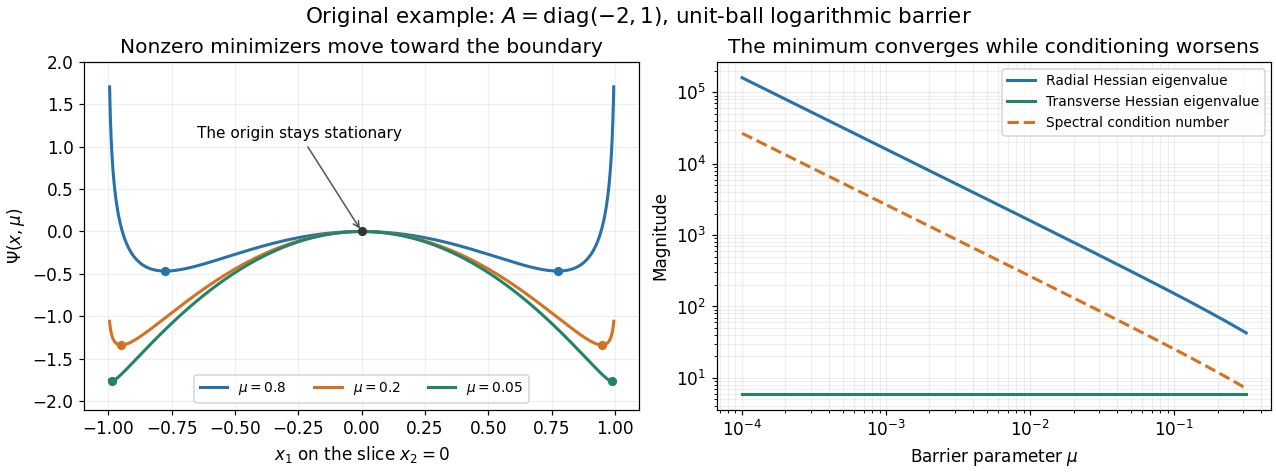
The nonzero barrier minimizers approach the unit sphere while their Hessian condition number grows; the origin remains stationary
. Details. Past exam of the numerical linear algebra and continuous optimisation course of the University of Oxford 2007 B 8 iv Solution by Codex 0 2026-10-31
Codex 0 2026-10-31Put . Differentiating the barrier gradient givesAt a nonzero stationary point on the branch , . Choose an orthonormal eigenbasis of the symmetric matrix whose first vector is . On each of the remaining eigenvectors the rank-one term vanishes, so the corresponding Hessian eigenvalues areAlong , the first two terms cancel and the remaining eigenvalue isIf repeats, a transverse eigenvalue can be zero. If a lower eigenvalue than exists, a transverse eigenvalue is negative, identifying this stationary branch as a saddle rather than a minimum.
Past exam of the numerical linear algebra and continuous optimisation course of the University of Oxford 2007 B 8 iii Solution by Codex 0 2026-10-31
Codex 0 2026-10-31The logarithmic barrier isIts gradient is . Thus every nonzero stationary point satisfiesA fixed negative-eigenvalue branch exists for . The zero point is stationary for every as well, and it is not an eigenvector; at zero the displayed scalar need not be an eigenvalue of . Thus the claimed eigenvalue conclusion requires the nonzero-point qualification. This distinction is essential for the following Hessian analysis.
Past exam of the numerical linear algebra and continuous optimisation course of the University of Oxford 2007 B 8 ii Solution by Codex 0 2026-10-31
Codex 0 2026-10-31Write the constraint as and its multiplier as . The KKT conditions becomeIf is positive definite, is positive definite for every , so is the only critical point.
For indefinite , the origin remains a critical point, contrary to an unqualified reading of the question. Every nonzero critical point is an eigenvector with , so its eigenvalue is nonpositive. A negative-eigenvalue vector must lie on the unit sphere, with multiplier equal to the negative of that eigenvalue. A nonzero vector in may have any norm at most one and has multiplier zero. Positive-eigenvalue directions do not satisfy the multiplier sign condition. These first-order critical points include saddles; the global minimum selects a unit vector in the lowest-eigenvalue eigenspace.
Past exam of the numerical linear algebra and continuous optimisation course of the University of Oxford 2007 B 8 i Solution by Codex 0 2026-10-31
Codex 0 2026-10-31With , the Karush-Kuhn-Tucker conditions areUnder a suitable constraint qualification, such as the linear independence constraint qualification on active constraint gradients, they are necessary for a local minimum. Smoothness alone is insufficient. The sign convention here corresponds to constraints written as and a minus sign in the optimization Lagrangian.
Past exam of the numerical linear algebra and continuous optimisation course of the University of Oxford 2007 B 7 vii Solution by Codex 0 2026-10-31
Codex 0 2026-10-31Two reasons to prefer more advanced methods for smooth, high-accuracy optimization are:
- Slow progress on ill-conditioned problems. On an elongated quadratic level set, successive negative gradients can zigzag across the narrow valley. Convergence can be only linear with a factor close to one, and line search cannot remove the underlying poor scaling.
- Failure to retain curvature information. Each new step again uses only the current gradient. Newton's method and quasi-Newton methods exploit curvature to obtain substantially faster local convergence under suitable hypotheses, often compensating for their more expensive steps.
The question's blanket wording is too strong: the steepest descent method and related gradient algorithms are used in practice, especially when problem size, cheap gradients or simplicity make curvature-based alternatives costly. The objections describe limitations, not universal nonuse.
Past exam of the numerical linear algebra and continuous optimisation course of the University of Oxford 2007 B 7 vi Solution by Codex 0 2026-10-31
Codex 0 2026-10-31Use the uniform lower step bound from part (iv):Thus . This is convergence to stationarity in the usual global convergence theorem for the steepest descent method. It does not itself prove that the iterates converge, or that any stationary limit is a global minimizer of a nonconvex objective.
Past exam of the numerical linear algebra and continuous optimisation course of the University of Oxford 2007 B 7 v Solution by Codex 0 2026-10-31
Codex 0 2026-10-31The Armijo condition with gives . Summing these inequalities telescopes toIf , these partial sums of nonnegative terms are bounded above by . The resulting series converges, so its terms tend to zero: .
Past exam of the numerical linear algebra and continuous optimisation course of the University of Oxford 2007 B 7 iv Solution by Codex 0 2026-10-31
Codex 0 2026-10-31For , part (ii) simplifies to . If the initial step is accepted, . Otherwise the immediately preceding trial failed and hence exceeded . ThereforeThe fixed global Lipschitz constant and search parameters make this lower bound uniform across iterations. At , the zero update passes the first trial and the sequence can be kept stationary.
Past exam of the numerical linear algebra and continuous optimisation course of the University of Oxford 2007 B 7 iii Solution by Codex 0 2026-10-31
Codex 0 2026-10-31The backtracking line search starts with , tests the Armijo condition, and repeatedly replaces a failed step by , with fixed . It accepts the first step that passes. Backtracking makes an overambitious trial step small enough for a local linear model to predict the change reliably; part (ii) ensures finite termination. The Armijo condition guarantees a decrease of at least along a nonzero descent direction. Merely obtaining some decrease without this quantitative lower bound would not provide the convergence estimate in the following parts.
Past exam of the numerical linear algebra and continuous optimisation course of the University of Oxford 2007 B 7 ii Solution by Codex 0 2026-10-31
Codex 0 2026-10-31A Lipschitz gradient with constant gives the descent lemmaFor , this upper bound is at most whenever . Since is a descent direction, the right side is positive. Thus the Armijo condition holds throughoutAt it holds by equality. If the gradient Lipschitz constant can be taken as zero, the objective is affine and every positive step along a descent direction passes this sufficient-decrease test.
Past exam of the numerical linear algebra and continuous optimisation course of the University of Oxford 2007 B 7 i Solution by Codex 0 2026-10-31
Codex 0 2026-10-31For , the unit steepest descent direction is by the Cauchy-Schwarz inequality. The usual unnormalized direction is ; choosing its scale separately as a line-search step gives the same ray. It satisfies , so it is a descent direction. The first-order Taylor expansion then guarantees decrease for sufficiently small positive steps. The subsequent bounds use this unnormalized negative-gradient convention.
Past exam of the numerical linear algebra and continuous optimisation course of the University of Oxford 2007 B 6 v Solution by Codex 0 2026-10-31
Codex 0 2026-10-31Suppress the iteration subscript. From the quadratic subproblem, and . ThereforeWhen , the stated bound on makes . Consequentlyusing positive definiteness of . Thus every nonzero such SQP step is a descent direction for the penalty function. If , the quotient bound is unnecessary and the same conclusion follows for every . A zero step has zero directional derivative and is not a strict descent direction; it corresponds to an already feasible stationary point. This nonzero-step qualification is implicit in the requested conclusion.
Past exam of the numerical linear algebra and continuous optimisation course of the University of Oxford 2007 B 6 iv Solution by Codex 0 2026-10-31
Codex 0 2026-10-31Since is even, differentiating givesAt a stationary point define . Then , precisely the stationarity equation for the optimization Lagrangian. Bounded multipliers giveThus along any subsequence of stationary points with , a further subsequence of bounded multipliers converges to , and continuity yields and . These are the equality-constrained first-order conditions. Bounded multipliers alone do not establish convergence of the primal points; the precise conclusion concerns their finite cluster points. This is the power penalty multiplier limit.
Past exam of the numerical linear algebra and continuous optimisation course of the University of Oxford 2007 B 6 iii Solution by Codex 0 2026-10-31
Codex 0 2026-10-31Stationarity of the equality-constrained quadratic subproblem gives . Together with feasibility, this isMultiplying the bottom block row by gives a symmetric indefinite saddle-point matrix, with right side .
One solution strategy uses the Schur complement. From obtainThis is an positive-definite system when has full row rank; factor and solve with it rather than forming its inverse.
Past exam of the numerical linear algebra and continuous optimisation course of the University of Oxford 2007 B 6 ii Solution by Codex 0 2026-10-31
Codex 0 2026-10-31The sequential quadratic programming step minimizes a quadratic local objective model while enforcing the first-order constraint expansion . When the iterate and multipliers are close to a regular solution and approximates the Lagrangian Hessian, the resulting correction approximates a Newton step for the nonlinear KKT conditions.
Full row rank of ensures that is solvable for every and that the multiplier of the quadratic subproblem is unique. A positive-definite makes the objective strictly convex and coercive on the affine feasible set, giving a unique global subproblem minimizer. In fact positivity on , rather than on every vector, is enough for uniqueness and boundedness on that set; full positive definiteness is a convenient stronger assumption.
Past exam of the numerical linear algebra and continuous optimisation course of the University of Oxford 2007 B 6 i Solution by Codex 0 2026-10-31
Codex 0 2026-10-31Use the optimization Lagrangian and let be the constraint Jacobian matrix. Under the standard regularity hypothesis , a local constrained minimizer satisfies, for some multiplier ,The second-order necessary condition isRegularity makes each such tangent vector the velocity of a feasible smooth curve. Twice differentiating the objective along that curve and using stationarity and the differentiated constraints gives the displayed nonnegative second derivative.
The regularity hypothesis is needed for these multiplier conditions to be necessary in this form. For example minimizing subject to has the unique feasible minimizer zero, but for every . The question does not explicitly state the qualification, so it must be supplied when using the usual KKT conditions.
Pinned article: Introduction to the OurBigBook Project
Welcome to the OurBigBook Project! Our goal is to create the perfect publishing platform for STEM subjects, and get university-level students to write the best free STEM tutorials ever.
Everyone is welcome to create an account and play with the site: ourbigbook.com/go/register. We belive that students themselves can write amazing tutorials, but teachers are welcome too. You can write about anything you want, it doesn't have to be STEM or even educational. Silly test content is very welcome and you won't be penalized in any way. Just keep it legal!
Intro to OurBigBook
. Source. We have two killer features:
- topics: topics group articles by different users with the same title, e.g. here is the topic for the "Fundamental Theorem of Calculus" ourbigbook.com/go/topic/fundamental-theorem-of-calculusArticles of different users are sorted by upvote within each article page. This feature is a bit like:
- a Wikipedia where each user can have their own version of each article
- a Q&A website like Stack Overflow, where multiple people can give their views on a given topic, and the best ones are sorted by upvote. Except you don't need to wait for someone to ask first, and any topic goes, no matter how narrow or broad
This feature makes it possible for readers to find better explanations of any topic created by other writers. And it allows writers to create an explanation in a place that readers might actually find it.
Figure 1. Screenshot of the "Derivative" topic page. View it live at: ourbigbook.com/go/topic/derivativeVideo 2. OurBigBook Web topics demo. Source. - local editing: you can store all your personal knowledge base content locally in a plaintext markup format that can be edited locally and published either:This way you can be sure that even if OurBigBook.com were to go down one day (which we have no plans to do as it is quite cheap to host!), your content will still be perfectly readable as a static site.
- to OurBigBook.com to get awesome multi-user features like topics and likes
- as HTML files to a static website, which you can host yourself for free on many external providers like GitHub Pages, and remain in full control

Figure 2. You can publish local OurBigBook lightweight markup files to either OurBigBook.com or as a static website.
Figure 3. Visual Studio Code extension installation.
Figure 5. . You can also edit articles on the Web editor without installing anything locally. Video 3. Edit locally and publish demo. Source. This shows editing OurBigBook Markup and publishing it using the Visual Studio Code extension. 
- Infinitely deep tables of contents:



All our software is open source and hosted at: github.com/ourbigbook/ourbigbook
Further documentation can be found at: docs.ourbigbook.com
Feel free to reach our to us for any help or suggestions: docs.ourbigbook.com/#contact