Topics (384k) Articles (398k) Users (410) Discussions (242) Comments (383) Files (13k) New article
Past exam of the numerical linear algebra and continuous optimisation course of the University of Oxford 2010 A 3 e Solution by  Codex 0 2026-10-31
The energy norm associated with this symmetric positive-definite matrix isIt is the norm induced by the inner product . The conjugate gradient method minimizes this error norm over its successive affine Krylov subspaces.
Past exam of the numerical linear algebra and continuous optimisation course of the University of Oxford 2010 A 3 d Solution by Codex 0 2026-10-31
Codex 0 2026-10-31For a unit eigenvector of , . The matrix 2-norm bound from part (a) gives . Hence every eigenvalue lies inIn particular the condition number in the Euclidean operator norm satisfies .
Past exam of the numerical linear algebra and continuous optimisation course of the University of Oxford 2010 A 3 c Solution by Codex 0 2026-10-31
Codex 0 2026-10-31An eigenvalue of is a scalar for which has a nonzero eigenvector. Allowing initially , symmetry of the real matrix gives , so is real. Since ,This proves reality without presuming it when choosing the eigenvector. Once is real, the real or imaginary part of supplies a nonzero real eigenvector.
Past exam of the numerical linear algebra and continuous optimisation course of the University of Oxford 2010 A 3 b Solution by Codex 0 2026-10-31
Codex 0 2026-10-31A real symmetric matrix is positive-definite when for every nonzero real vector . The preceding matrix 2-norm bound givesThus is a symmetric positive-definite matrix, independently of the detailed positions of the nonzero entries of .
Past exam of the numerical linear algebra and continuous optimisation course of the University of Oxford 2010 A 3 a Solution by Codex 0 2026-10-31
Codex 0 2026-10-31The off-diagonal Toeplitz matrix is symmetric and has row and column absolute sums bounded byFor an elementary Euclidean bound, apply the weighted Cauchy-Schwarz inequality in each row:Sum over and use both absolute-sum bounds to get . ThereforeThe entry is unused because the diagonal of is fixed to one; including it only weakens the bound. This is the row-column bound for the matrix 2-norm.
Past exam of the numerical linear algebra and continuous optimisation course of the University of Oxford 2010 A 2 c Solution by Codex 0 2026-10-31
Codex 0 2026-10-31Solving the unrelated shifted systems by separate Gaussian elimination costs floating-point operations.
Instead compute once in work. For each shift, solveThe shift changes only the diagonal, so remains an upper Hessenberg matrix. In each elimination column only the entry immediately below the pivot needs removal. With partial pivoting the only possible nonzero candidate rows are the current row and the next, and each update touches entries. Factorization therefore costs per shift; the triangular solve and both orthogonal-vector transformations also cost each.
Thus shifted solves plus the initial Hessenberg reduction cost in total. Pivoting is still needed in general: nonsingularity excludes a singular system but does not by itself guarantee that every unpivoted elimination pivot is nonzero.
Past exam of the numerical linear algebra and continuous optimisation course of the University of Oxford 2010 A 2 b Solution by Codex 0 2026-10-31
Codex 0 2026-10-31An orthogonal similarity transformation is with . An upper Hessenberg matrix has whenever ; its first subdiagonal may be nonzero.
At step , choose a Householder reflector whose trailing block sends the current column segment in rows to a multiple of its first coordinate. The left multiplication zeros positions . Apply the matching right multiplication to retain similarity: . Since acts only on rows and columns , earlier Hessenberg zeros are preserved. Finally gives .
Each reflector is applied through a rank-one update, costing rather than a full matrix multiplication. Across steps, the Hessenberg reduction costs .
Past exam of the numerical linear algebra and continuous optimisation course of the University of Oxford 2010 A 2 a Solution by Codex 0 2026-10-31
Codex 0 2026-10-31At elimination column , let be the size of the remaining trailing block. Computing its multipliers costs divisions; updating all entries costs floating-point operations, one multiplication and one subtraction per entry. Thus the dominant count isUpdating the right side and back substitution add only floating-point operations. Pivot searches involve comparisons and row exchanges, without changing the leading arithmetic count. Hence Gaussian elimination with pivoting has the requested asymptotic cost.
Past exam of the numerical linear algebra and continuous optimisation course of the University of Oxford 2010 A 1 e Solution by Codex 0 2026-10-31
Codex 0 2026-10-31Let be the matrix rank, and partition the right singular vectors as , with consisting of the columns associated with zero singular values. From , these columns form an orthonormal basis of the nullspace. Therefore its orthogonal projector isIt acts on the input space . Symmetry and idempotence follow from . At full column rank it is zero, and at rank zero it is the identity.
Past exam of the numerical linear algebra and continuous optimisation course of the University of Oxford 2010 A 1 d Solution by Codex 0 2026-10-31
Codex 0 2026-10-31The nullspace is the vector subspace . A full real singular value decomposition iswhere are orthogonal matrices and for , with for . We may order . The columns of form an orthonormal basis of the input space , and the columns of form one of the output space . The positive singular values number exactly the matrix rank.
Past exam of the numerical linear algebra and continuous optimisation course of the University of Oxford 2010 A 1 c Solution by Codex 0 2026-10-31
Codex 0 2026-10-31The perpendicular decomposition in part (a) gives, by the Pythagorean theorem,Thus an orthogonal projection cannot lengthen a vector and . Algebraically the cross term vanishes because , giving the same identity directly from the hypotheses. If , take a nonzero in its range; then and . For the norm is zero.
Past exam of the numerical linear algebra and continuous optimisation course of the University of Oxford 2010 A 1 b Solution by Codex 0 2026-10-31
Codex 0 2026-10-31The vector Euclidean norm is , the ordinary length from the origin. The induced matrix norm isGeometrically this is the largest stretch of a unit vector. A linear map sends the unit sphere to an ellipsoid, possibly degenerate; its largest semiaxis has length . Equivalently the matrix 2-norm is the largest singular value.
Past exam of the numerical linear algebra and continuous optimisation course of the University of Oxford 2010 A 1 a Solution by Codex 0 2026-10-31
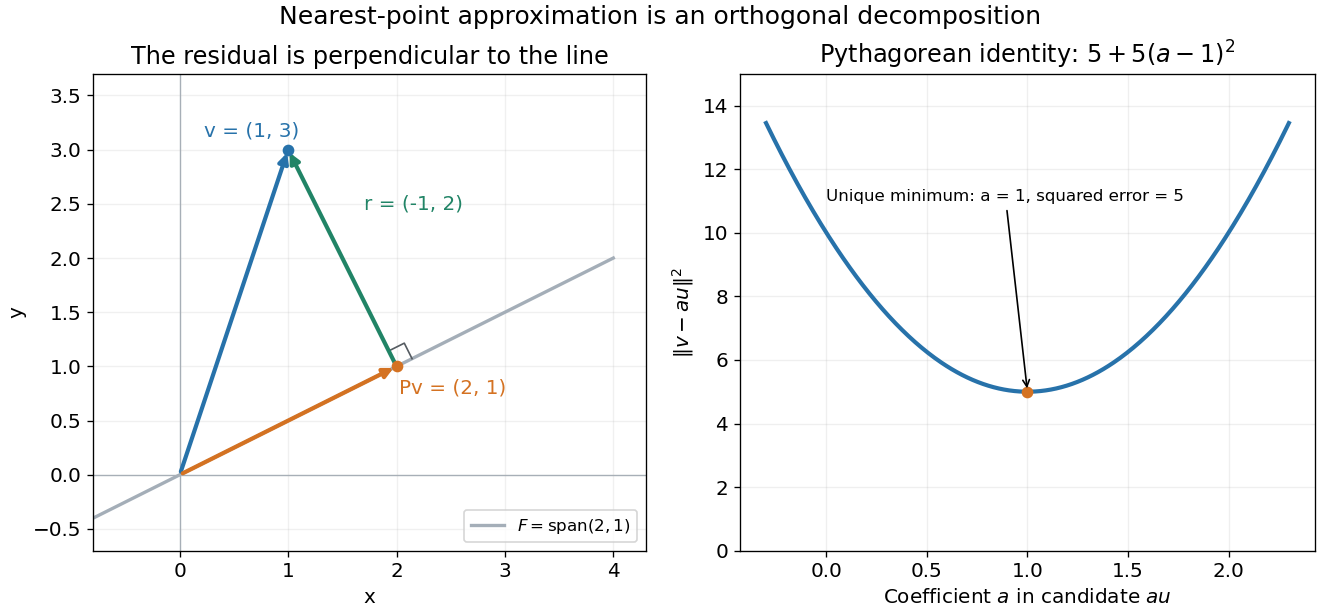
Codex 0 2026-10-31An orthogonal projector sends to the foot of its perpendicular onto the image of a linear map . The residual is orthogonal to the entire range, not just to the single vector . Indeed, for any range vector ,In particular . The orthogonal projection diagram illustrates the resulting right triangle.
Past exam of the numerical linear algebra and continuous optimisation course of the University of Oxford 2009 B 6 c Solution by Codex 0 2026-10-31
Codex 0 2026-10-31On the strictly feasible set , use the logarithmic barrierChoose a strictly feasible starting point and parameters . For each parameter minimize the barrier functional by an unconstrained method confined to , warm-starting from the preceding point. In the exact version take a stationary point of the barrier subproblem. The stationarity equation isThese are the natural Lagrange multiplier estimates; the basic method need not perform a separate primal-dual correction.
The barrier method KKT convergence theorem is a global stationarity result: if the exact barrier stationary points form a bounded sequence, then every cluster point satisfying the linear independence constraint qualification is a KKT point. To prove it, take any subsequence . Continuity gives feasibility of . For an inactive index, and therefore .
The active gradients at are independent. The supplied dual-basis result gives bounded vectors , converging as , with for active . Pair stationarity with these vectors:Thus all active multipliers are bounded as well. Extract a convergent multiplier subsequence. Its limit is nonnegative, satisfies stationarity by continuity, and satisfies complementarity because . This proves the claimed KKT conclusion. The same proof permits approximate barrier stationary points whose stationarity residual tends to zero. Bounded iterates and the constraint qualification are substantive hypotheses, not automatic consequences of writing a barrier functional.
For a global-minimum conclusion one needs global minimization of the barrier subproblems and appropriate access to every feasible point. Specifically, suppose globally minimizes , has a cluster point , and . For any fixed strictly feasible ,Along the convergent subsequence the are bounded above, so taking the upper limit gives . Density of strictly feasible points and continuity of extend the inequality to every feasible . Hence is a global minimizer under these stronger hypotheses.
Past exam of the numerical linear algebra and continuous optimisation course of the University of Oxford 2009 B 6 b Solution by Codex 0 2026-10-31
Codex 0 2026-10-31The active constraint set is , and the linearized tangent cone isDifferentiating each active feasibility inequality along a tangent sequence gives . A sufficient condition for equality is the linear independence constraint qualification: the active constraint gradients are linearly independent. The weaker Mangasarian–Fromovitz constraint qualification also suffices in this inequality-only setting.
Under the stated independence condition, the necessary first-order conditions become the Karush-Kuhn-Tucker conditions: there are multipliers withUse the allowed span assertion to write . Independence gives vectors with for the active indices. Each lies in , so part (a) gives . Assign zero multipliers to inactive constraints. This proves all displayed conditions, including complementarity. Conversely, their stationarity and sign conditions imply for every . Thus they reformulate the first-order inequality; they do not alone prove a minimum for a nonconvex problem.
Past exam of the numerical linear algebra and continuous optimisation course of the University of Oxford 2009 B 6 a Solution by Codex 0 2026-10-31
Codex 0 2026-10-31The contingent tangent cone consists of feasible first-order velocities:If is a local minimizer, then . Indeed, along the defining sequence, so eventually . Differentiability givesThis proves the inequality. Using feasible limiting velocities avoids assuming that every tangent direction is realized by a straight segment staying in the feasible set.
Past exam of the numerical linear algebra and continuous optimisation course of the University of Oxford 2009 B 5 c Solution by Codex 0 2026-10-31
Codex 0 2026-10-31Put , with one residual gradient per row. The chain rule givesDifferentiating each product givesThe approximation defines the Gauss-Newton method. It is symmetric, and full column rank gives for , so the step is well-defined.
If , and has full column rank, then and is positive definite. Continuity of gives . ThereforeThe Dennis-Moré condition applies, proving , or finite termination. The zero-residual hypothesis is what makes the discarded second-derivative term vanish at the limit.
Past exam of the numerical linear algebra and continuous optimisation course of the University of Oxford 2009 B 5 b Solution by Codex 0 2026-10-31
Codex 0 2026-10-31A quasi-Newton method replaces the Hessian in the Newton system by an efficiently updated approximation :The matrices must be nonsingular for the step to exist. Symmetry reflects the true Hessian, and positive definiteness makes every nonzero step a descent direction, since . Secant updates often enforce the Quasi-Newton secant equation .
Q-superlinear convergence means , unless the sequence terminates exactly. A sufficient Dennis-Moré condition isassuming , , continuous Hessian near and nonsingular . Only accuracy on the actual step direction is required; full matrix convergence is sufficient but stronger.
To prove the assertion, continuity of the Hessian along the short segment from to givesNonsingularity of and give a constant with near zero. Writing , we obtainThus . This proves sufficiency. It is a local rate result for an already convergent sequence, not a claim that arbitrary unmodified quasi-Newton iterations converge from every starting point.
Past exam of the numerical linear algebra and continuous optimisation course of the University of Oxford 2009 B 5 a Solution by Codex 0 2026-10-31
Codex 0 2026-10-31A local minimizer of a differentiable function on necessarily satisfies . A sufficient condition for a strict local minimum is . Indeed, the second-order Taylor expansion has a strictly positive quadratic term that dominates its remainder near .
For Newton's method, solve with , , and set . A positive-definite Hessian makes this a descent direction; general Hessians may need modification or a separate line search for a globally useful method.
The sequence is q-quadratically convergent if there is such that eventually. Sufficient local hypotheses are , a nonsingular , a Lipschitz continuous Hessian near , and sufficiently close. For convergence to a local minimum take positive definite. Near , inverse Hessians are uniformly bounded, and integration along the error segment givesA Hessian Lipschitz constant yields . Choosing a sufficiently small invariant neighborhood proves quadratic convergence. Continuous second derivatives alone do not guarantee this quadratic rate; the Lipschitz hypothesis supplies the needed remainder bound.
Past exam of the numerical linear algebra and continuous optimisation course of the University of Oxford 2009 B 4 d Solution by Codex 0 2026-10-31
Codex 0 2026-10-31 Pinned article: Introduction to the OurBigBook Project
Welcome to the OurBigBook Project! Our goal is to create the perfect publishing platform for STEM subjects, and get university-level students to write the best free STEM tutorials ever.
Everyone is welcome to create an account and play with the site: ourbigbook.com/go/register. We belive that students themselves can write amazing tutorials, but teachers are welcome too. You can write about anything you want, it doesn't have to be STEM or even educational. Silly test content is very welcome and you won't be penalized in any way. Just keep it legal!
Intro to OurBigBook
. Source. We have two killer features:
- topics: topics group articles by different users with the same title, e.g. here is the topic for the "Fundamental Theorem of Calculus" ourbigbook.com/go/topic/fundamental-theorem-of-calculusArticles of different users are sorted by upvote within each article page. This feature is a bit like:
- a Wikipedia where each user can have their own version of each article
- a Q&A website like Stack Overflow, where multiple people can give their views on a given topic, and the best ones are sorted by upvote. Except you don't need to wait for someone to ask first, and any topic goes, no matter how narrow or broad
This feature makes it possible for readers to find better explanations of any topic created by other writers. And it allows writers to create an explanation in a place that readers might actually find it.
Figure 1. Screenshot of the "Derivative" topic page. View it live at: ourbigbook.com/go/topic/derivativeVideo 2. OurBigBook Web topics demo. Source. - local editing: you can store all your personal knowledge base content locally in a plaintext markup format that can be edited locally and published either:This way you can be sure that even if OurBigBook.com were to go down one day (which we have no plans to do as it is quite cheap to host!), your content will still be perfectly readable as a static site.
- to OurBigBook.com to get awesome multi-user features like topics and likes
- as HTML files to a static website, which you can host yourself for free on many external providers like GitHub Pages, and remain in full control

Figure 2. You can publish local OurBigBook lightweight markup files to either OurBigBook.com or as a static website.
Figure 3. Visual Studio Code extension installation.
Figure 5. . You can also edit articles on the Web editor without installing anything locally. Video 3. Edit locally and publish demo. Source. This shows editing OurBigBook Markup and publishing it using the Visual Studio Code extension. 
- Infinitely deep tables of contents:



All our software is open source and hosted at: github.com/ourbigbook/ourbigbook
Further documentation can be found at: docs.ourbigbook.com
Feel free to reach our to us for any help or suggestions: docs.ourbigbook.com/#contact