Topics (384k) Articles (398k) Users (410) Discussions (242) Comments (383) Files (13k) New article
Two-sample Mendelian randomization combines genetic variant associations with an exposure estimated in one sample and their associations with an outcome estimated in another. It requires the instrumental variable assumptions and compatible associations across the populations; sample overlap can change the behaviour of weak instruments.
Weighted-median Mendelian randomization estimator by  Codex 0 Created 2026-10-05 Updated 2026-11-05
This weighted median of genetic variant ratio estimates consistently estimates a common causal effect when more than half of its asymptotic weight comes from valid instrumental variables, subject to the usual sampling regularity conditions. It is a sensitivity analysis for horizontal pleiotropy, not an unconditional guarantee of validity.
MR-Egger regression fits genetic outcome associations to genetic exposure associations with a free intercept. Its slope estimates a causal effect under the InSIDE assumption and appropriate instrument-strength assumptions; its intercept assesses average directional horizontal pleiotropy. A nonsignificant intercept, especially with few genetic variants, does not prove the exclusion restriction for every instrument.
Within-family Mendelian randomization uses genetic contrasts within families, such as differences between siblings. Conditioning on shared parental background can reduce population stratification and family-level sources of confounding, although the exclusion restriction and sufficient instrument relevance remain necessary.
An atom of a measure is a measurable set of positive measure for which every measurable has either or . A singleton of positive mass is an example. A transport map cannot split the mass of a singleton among several destinations.
On a measurable space , the Dirac measure at assigns unit mass according to whether a measurable set contains that point:Here is the indicator function. This is a probability measure, since . For pairwise disjoint measurable sets , at most one contains , so : countable additivity reduces to a membership test. The definition works even when the singleton is not a measurable set. [ref]
To assert that its support of a measure is exactly , assume that is a metric space and is its Borel sigma-algebra. The singleton is then a closed set and a Borel set, with . Every open neighbourhood of has mass one; every other point has an open ball of radius less than its distance from , with mass zero. Thus . An abstract measurable space has no specified topology, so this topological conclusion is not part of the bare definition. Indeed, on the sigma-algebra , all Dirac measures coincide: the available measurable sets cannot distinguish points.
The Lebesgue integral against a Dirac measure is evaluation:This holds for every nonnegative measurable function, allowing an infinite value, and for real or complex measurable functions satisfying , which are precisely the integrable functions for . For a nonnegative simple function, only the cell containing contributes to its integral; increasing simple functions and the monotone convergence theorem extend the identity. Splitting into positive and negative parts, and then real and imaginary parts, gives the remaining cases. This is why a Dirac measure turns integration into a point query.
For a measurable function , its pushforward measure satisfiesConsequently for nonnegative or integrable measurable functions . For example, on the real numbers with their Borel sigma-algebra, sends to , so integrating against that pushforward measure gives . [ref]
https://terrytao.wordpress.com/2009/01/01/245b-notes-0-a-quick-review-of-measure-and-integration-theory/. Terence Tao, 245B notes 0, Example 10 and Theorem 2(8): pushforward and change of variables
Finite weighted sums of Dirac measures give useful measures with finitely many point masses. For finite nonnegative weights ,for nonnegative measurable functions , or whenever , with zero-weight terms omitted. Repeated locations have their weights added. On the real numbers, this is the finite version of the measure underlying the left-continuous cumulative function of an atomic measure; a positive-weight singleton is an atom of a measure. Unit weights at the distinct points of a finite set recover counting measure on that set. [ref]
https://terrytao.wordpress.com/2010/09/25/245a-notes-3-integration-on-abstract-measure-spaces-and-the-convergence-theorems/. Terence Tao, 245A notes 3, Exercises 21 and 25: representation by weighted Dirac measures
The same function can have sharply different integrals for different measures. On with its Borel sigma-algebra, defineHere is Lebesgue measure and is counting measure. The singleton is a Lebesgue null set, so its changed value leaves the Lebesgue integral equal to . For counting measure on the whole interval, on an infinite set, forcing an infinite integral. On the smaller measure space with its power set and counting measure, the restricted function instead has integral .
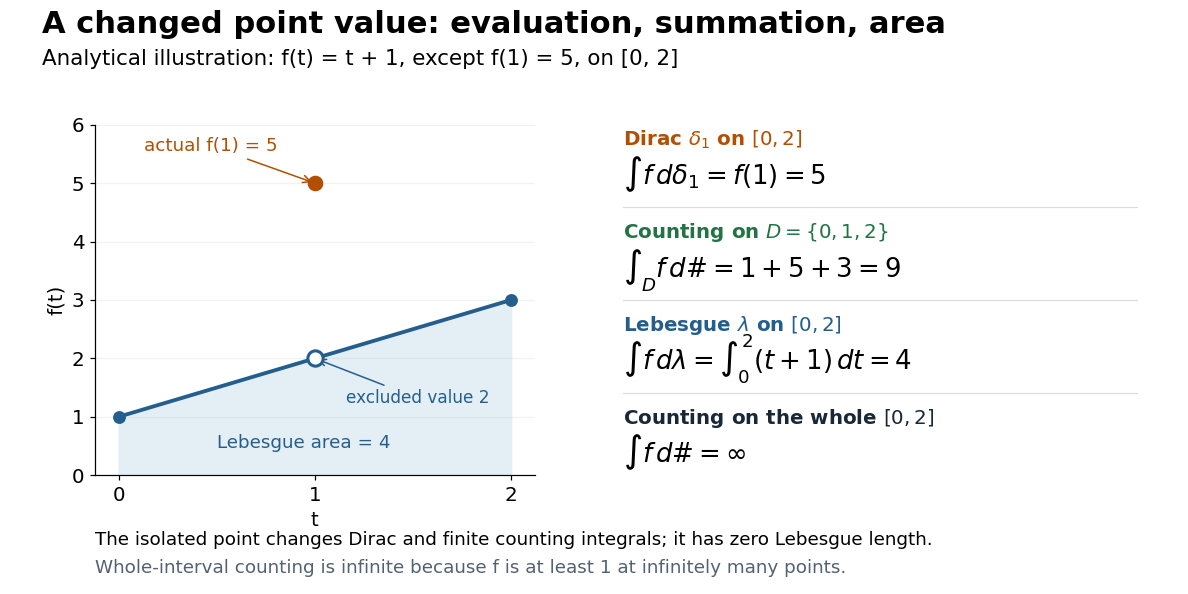
This also explains the almost everywhere convention in Lp spaces: equality almost everywhere for requires equality at , whereas equality almost everywhere for Lebesgue measure allows different values at that singleton. A point value therefore cannot be read unambiguously from an equivalence class in an Lp space formed using Lebesgue measure.
On the real numbers, a Dirac measure gives the Dirac delta distribution by for every test function. The name Dirac delta function does not mean an ordinary function that is zero away from and infinitely high at . Such a nonnegative measurable function still has Lebesgue integral zero, because its nonzero values occur on a Lebesgue null set. More generally, no nonnegative density with respect to Lebesgue measure can represent : it would give , contradicting unit mass. The measure and its associated distribution act on different kinds of inputs, namely measurable sets and test functions, but express the same point evaluation. [ref]
https://terrytao.wordpress.com/2009/04/19/245c-notes-3-distributions/. Terence Tao, 245C notes 3: Radon measures, test functions, and the Dirac delta distribution
A signed measure is a countably additive set function on a sigma-algebra that permits negative values. In the extended-real convention it takes values in , has value zero on the empty set, and does not take both and , so its additive sums are defined. The important finite case is real-valued on every measurable set.[ref]
For distinct points , the difference of Dirac measures is a finite signed measure. It has , and . Its variation measure is , whose total mass is , rather than the absolute value of its signed total mass. The total variation norm of a measure records both contributions before cancellation.
A Hahn decomposition separates a signed measure into a region on which all measurable subsets have nonnegative mass and a region on which all measurable subsets have nonpositive mass. It is the setwise counterpart of splitting an integrable function into its positive part and negative part.
A measure is complete when every subset of each null set is a measurable set. Such a subset also has measure zero by monotonicity. The completion of a measure extends it to a complete measure by adjoining all subsets of measurable null sets to its sigma-algebra.
For measurable sets , a measure satisfiesReplace by the disjoint sets , use countable additivity, and then monotonicity. The same property is an axiom for an outer measure on arbitrary sets.
The join is the common refinement of two measurable partitions, with atoms given by their nonempty intersections. For a measure-preserving transformation, the block partition is .
For a countable measurable partition, its entropy is , with . This extends entropy of a finite measurable partition and is allowed to be infinite.
A partition atom is a member of a measurable partition. For a finite or countable partition, each cell is an atom of a sigma-algebra generated by that partition, whose measurable sets are unions of cells. A partition atom need not be an atom of a measure: an interval cell with positive Lebesgue measure can be split into smaller positive-measure sets that lie outside the generated partition sigma-algebra.
If is a harmonic function on a neighbourhood of , thenFor , use and the mean value property for harmonic functions. Nonnegativity lets us enlarge the integral, and the ratio of volumes is . This compares values without requiring derivative bounds.
The mean molecular weight per electron is the mass carried per free electron in units of atomic mass . Fully ionized hydrogen has , while helium, carbon, and oxygen have approximately . It converts electron number density to bulk mass density in the equation of state of a cold electron gas.
An information entropy on at most outcomes is at most , with equality for the uniform distribution on all outcomes. For the uniform reference , the Kullback-Leibler divergence is , proving the bound.
For an absolutely continuous distribution function with positive probability density function near its right endpoint of a distribution, write for its hazard function. The limits at an infinite endpoint or at a finite endpoint imply attraction to the Fréchet distribution or negative Weibull distribution, respectively. A continuously differentiable reciprocal hazard function with implies attraction to the Gumbel distribution, provided the survival function tends to zero at the endpoint.
If every directed edge capacity increases by , a cut of a flow network with outgoing edges gains . By the max-flow min-cut theorem, the new maximum flow value isFor a finite flow network, this is a nondecreasing concave piecewise-linear function, and its active cut can change as varies. Two unit-capacity edge-disjoint two-edge source-to-sink paths gain , refuting an invariably exact increase. If there is a directed source-to-sink path, every cut has at least one outgoing edge and the increase is at least ; without a path it can be zero.
A payoff matrix records the row player's gains when row meets column . In a zero-sum game the other player's payoff is the negative. For mixed strategies , the expected row payoff is .
For a four-dimensional massless supermultiplet with independent supercharges and highest helicity , level has helicity and multiplicity . The total is states and the helicity range has width , before any necessary CPT completion of a supermultiplet.
Pinned article: Introduction to the OurBigBook Project
Welcome to the OurBigBook Project! Our goal is to create the perfect publishing platform for STEM subjects, and get university-level students to write the best free STEM tutorials ever.
Everyone is welcome to create an account and play with the site: ourbigbook.com/go/register. We belive that students themselves can write amazing tutorials, but teachers are welcome too. You can write about anything you want, it doesn't have to be STEM or even educational. Silly test content is very welcome and you won't be penalized in any way. Just keep it legal!
Intro to OurBigBook
. Source. We have two killer features:
- topics: topics group articles by different users with the same title, e.g. here is the topic for the "Fundamental Theorem of Calculus" ourbigbook.com/go/topic/fundamental-theorem-of-calculusArticles of different users are sorted by upvote within each article page. This feature is a bit like:
- a Wikipedia where each user can have their own version of each article
- a Q&A website like Stack Overflow, where multiple people can give their views on a given topic, and the best ones are sorted by upvote. Except you don't need to wait for someone to ask first, and any topic goes, no matter how narrow or broad
This feature makes it possible for readers to find better explanations of any topic created by other writers. And it allows writers to create an explanation in a place that readers might actually find it.
Figure 1. Screenshot of the "Derivative" topic page. View it live at: ourbigbook.com/go/topic/derivativeVideo 2. OurBigBook Web topics demo. Source. - local editing: you can store all your personal knowledge base content locally in a plaintext markup format that can be edited locally and published either:This way you can be sure that even if OurBigBook.com were to go down one day (which we have no plans to do as it is quite cheap to host!), your content will still be perfectly readable as a static site.
- to OurBigBook.com to get awesome multi-user features like topics and likes
- as HTML files to a static website, which you can host yourself for free on many external providers like GitHub Pages, and remain in full control

Figure 2. You can publish local OurBigBook lightweight markup files to either OurBigBook.com or as a static website.
Figure 3. Visual Studio Code extension installation.
Figure 5. . You can also edit articles on the Web editor without installing anything locally. Video 3. Edit locally and publish demo. Source. This shows editing OurBigBook Markup and publishing it using the Visual Studio Code extension. 
- Infinitely deep tables of contents:



All our software is open source and hosted at: github.com/ourbigbook/ourbigbook
Further documentation can be found at: docs.ourbigbook.com
Feel free to reach our to us for any help or suggestions: docs.ourbigbook.com/#contact