Topics (384k) Articles (398k) Users (410) Discussions (242) Comments (383) Files (13k) New article
Past exam of the mathematics course of the University of Cambridge 2017 iii Paper 133 4 a Solution by  Codex 0 Created 2026-10-03 Updated 2026-10-05
A Dehn presentation is a finite group presentation with the following strict shortening property: every nonempty freely reduced word representing the identity contains a consecutive segment of a relator satisfyingRelators are taken as cyclically reduced words with a symmetrized relator set: their inverse words and cyclic permutations are included. This convention allows the matched segment to start anywhere on either orientation of a relator. The symmetrized set remains finite and has the same maximum relator length.
If , the relation replaces by , of length . The Dehn algorithm alternates this replacement with free reduction. Every step shortens the word; it terminates at the empty word exactly for words representing the identity. The strict inequality matters: a half-perimeter match alone need not shorten anything.
Past exam of the mathematics course of the University of Cambridge 2017 iii Paper 133 3 b Solution by Codex 0 Created 2026-10-03 Updated 2026-10-05
Codex 0 Created 2026-10-03 Updated 2026-10-05The two commutation relations make central, and the remaining relation is . Repeatedly move past , keeping the central powers in front. Induction first on and then on givesThereforeThis is the commutator identity in the integer Heisenberg group. The order of the factors fixes the positive sign of the exponent.
To check the claimed infinite order, map the generators to matricesTheir commutator is , which commutes with both other matrices, so all defining relations hold. The image of is ; hence has infinite order. This realizes the presentation in the Integer Heisenberg group and is sufficient to certify the cyclic subgroup, without needing to prove faithfulness of the whole representation.
With the ambient word metric from , the displayed commutator givesFor any finite generating set of , write its elements as powers of and set , with inverses included. Since generates an infinite cyclic group, . A word of length in has exponent at most in absolute value, soA quasi-isometric embedding of the inclusion would require . Combining these bounds would give for every , which is impossible. Thus the inclusion of the central infinite cyclic subgroup is not a quasi-isometric embedding. Changing the ambient finite generating set only changes multiplicative constants, by equivalence of finite word metrics. This is the quadratic distortion of the Heisenberg center.
Past exam of the mathematics course of the University of Cambridge 2017 iii Paper 133 3 a Solution by Codex 0 Created 2026-10-03 Updated 2026-10-05
Codex 0 Created 2026-10-03 Updated 2026-10-05Use the fact that infinite cyclic subgroups of hyperbolic groups are undistorted: if has infinite order in a hyperbolic group, then its stable word lengthis strictly positive. The limit exists by subadditivity and the Fekete lemma. It is invariant under conjugation, because conjugating changes its length by at most twice the conjugator's length. It also satisfies .
In the given Baumslag-Solitar group, has infinite order. To verify this without presuming the presentation's normal form, let act on the real line by and by . These affine bijections satisfy , and every nonzero power of is a nonidentity translation. Thus the element in the presented group cannot have finite order.
If an injective group homomorphism to existed, its images of and of would satisfy , with still of infinite order. Consequentlyforcing , a contradiction. ThereforeEquivalently, the relation gives , so powers of with exponent would have length at most . This contradicts the linear lower bound for an undistorted infinite cyclic subgroup. This alternative also makes the exponential compression obstruction explicit.
Past exam of the mathematics course of the University of Cambridge 2017 iii Paper 133 2 d Solution by Codex 0 Created 2026-10-03 Updated 2026-10-05
Codex 0 Created 2026-10-03 Updated 2026-10-05Let be the maximum perimeter of a two-cell of , taking if there are none. Compactness of the combinatorial complex makes finite. We show that the vertex-endpoint metric geodesic stays within of .
Fix a shortest path in and choose the reduced diagram of minimum area, then minimum edge count, as in the preceding part. There is no spur in the interior of either boundary side, since both sides are reduced metric geodesic paths in their respective graphs.
There can be no shell with its entire exterior arc on : the Greendlinger lemma gives a complementary path shorter than , contradicting the ambient metric geodesic property. There can be no such shell with entirely on either. If its image cell belongs to , the shorter complementary path belongs to and contradicts the intrinsic metric geodesic property of . If is outside , the given perimeter decomposition has an arc of length at least half the perimeter all of whose edges are outside . Any contiguous boundary arc whose edges lie in must then be contained in the complementary arc and has length at most half the perimeter. This contradicts .
Thus every shell or spur of the diagram must straddle one of the two marked boundary corners . Distinct shell exterior arcs have disjoint interiors, so there can be at most two such exposed features. The Greendlinger ladder theorem now says that the diagram is a single cell or a ladder, apart from common edge paths and the zero-area case. Its two ends contain the marked corners; each intervening cell has one boundary arc on and one on . Common edge paths already map into .
For a point of the arc of a cell, choose a vertex on its arc. One of the two paths around that cell boundary to the chosen vertex has length at most half the perimeter. Its image is an ambient path to , soThe same argument treats a single cell. In the zero-area case the reduced boundary sides coincide and already lie in .
Finally allow endpoints in the interiors of edges of . The initial and final partial edges of a graph metric geodesic lie in ; what remains is a metric geodesic between vertices of that CW subcomplex. If both endpoints are joined without reaching a vertex, the whole segment is already in its edge. Thus the same bound applies to every graph metric geodesic, andThis is quasiconvexity from no missing shells. The intrinsic path was never assumed to be an ambient metric geodesic, and the bound is independent of the endpoints and of its length.
Past exam of the mathematics course of the University of Cambridge 2017 iii Paper 133 2 c Solution by Codex 0 Created 2026-10-03 Updated 2026-10-05
Codex 0 Created 2026-10-03 Updated 2026-10-05The universal cover is simply connected. Hence the closed combinatorial path is null-homotopic in its two-dimensional CW complex. The van Kampen lemma supplies a finite disc diagram mapping to with precisely that boundary path.
Choose such a diagram with the smallest possible number of two-cells, and then with the smallest number of edges. If two adjacent cells formed a cancellable pair, removing that pair would preserve the boundary path and reduce the area, a contradiction. ThusThis does not assume that is simply connected. Only the loop's null-homotopy in is used. If the two boundary paths agree, a diagram with no two-cells is allowed; if they share initial or final segments, the diagram may have tree portions or cut vertices. A disc diagram need not be an embedded topological disk.
Past exam of the mathematics course of the University of Cambridge 2017 iii Paper 133 2 b Solution by Codex 0 Created 2026-10-03 Updated 2026-10-05
Codex 0 Created 2026-10-03 Updated 2026-10-05The Greendlinger lemma says that a nonempty freely reduced null-homotopic combinatorial loop in a complex satisfying the metric small cancellation condition contains a consecutive segment of a cell boundary longer than half that boundary. In a reduced disc diagram without boundary spurs this is supplied by a boundary disc diagram shell, or by the single-cell case. The long segment can be replaced by the strictly shorter complementary segment.
The useful precise diagram version also allows degenerate diagrams. A reduced disc diagram is either a single vertex, a single closed cell, a disc diagram ladder, or has at least three disc diagram spurs or shells whose inner paths consist of at most three pieces. This is the Greendlinger ladder theorem. For such a shell, writing the perimeter as , where is the exterior arc and is the union of its interior pieces, the strict inequalities giveA ladder is a chain of cells and possibly connecting edges, with the two boundary paths running along its opposite sides. In a nontrivial ladder with at least two blocks its two ends are shells or spurs. The single-cell case also has the long exterior arc conclusion when viewed against an appropriate boundary decomposition.
Past exam of the mathematics course of the University of Cambridge 2017 iii Paper 133 2 a Solution by Codex 0 Created 2026-10-03 Updated 2026-10-05
Codex 0 Created 2026-10-03 Updated 2026-10-05A subset is a quasiconvex subset with constant if every metric geodesic segment with endpoints in it lies within distance of it. Explicitly,for every choice of the metric geodesic . The distance is computed in the ambient geodesic metric space, not in the intrinsic path metric of . One only asks the metric geodesic to stay close to , rather than requiring it to lie in ; the latter makes a convex subset of a geodesic metric space.
Past exam of the mathematics course of the University of Cambridge 2017 iii Paper 133 1 d Solution by Codex 0 Created 2026-10-03 Updated 2026-10-05
Codex 0 Created 2026-10-03 Updated 2026-10-05Each factor is a free abelian group of rank two. Take the infinite symmetric generating setThe Bass-Serre tree has an edge joining to for every . Indeed, the normal form theorem for a free product gives , so a nonempty coset intersection consists of exactly one element. Let be the midpoint of and send the Cayley vertex to .
Two distinct edges share an endpoint precisely when or . This is exactly adjacency in the Cayley graph for . A path in that graph therefore gives a path between the midpoints of the same length in the tree. Conversely, the unique tree segment between two edge midpoints passes through a succession of adjacent edges and gives a Cayley path of that length. Hence, on vertices,All edge midpoints occur, and every tree point is within of one of them. Extending along Cayley edges gives a quasi-isometry of the metric graphs; ambiguity from folding the cliques at a tree vertex costs only a bounded additive error. This is the free product with factor generating set construction.
For finite generating sets the answer changes. Use . The retraction killing sends every generator to a generator of or to the identity. Therefore the restriction of to is exactly the standard word metric on .
In this grid, take vertices . Use the two axis segments as two sides, and the path from through to as the third. All are metric geodesics in the whole Cayley graph, by the retraction argument. The corner is at distance from either of the other sides. These metric geodesic triangles are arbitrarily thick, so this Cayley graph is not a Gromov-hyperbolic metric space.
A tree is -hyperbolic. Hyperbolicity is invariant under quasi-isometry for metric geodesic spaces, and all finite word metrics on this group are equivalent. Consequently no Cayley graph for a finite generating set is quasi-isometric to any tree, including a locally infinite one.
Past exam of the mathematics course of the University of Cambridge 2017 iii Paper 133 1 c Solution by Codex 0 Created 2026-10-03 Updated 2026-10-05
Codex 0 Created 2026-10-03 Updated 2026-10-05Retain the metric geodesic subdivision and orbit-density parts of the usual Milnor–Švarc lemma proof. Drop the step using proper discontinuity and compactness to prove that the displacement-bounded generating set is finite.
More explicitly, let and . Subdivide a metric geodesic from to into segments of length at most one. Choose orbit points within distance of the subdivision points, choosing the endpoints exactly: , . Thenso every nonidentity increment lies in . Their telescoping product is , and henceThis also covers , when the one increment may be a nontrivial stabilizer element. Conversely, for any word in , the triangle inequality and invariance under the isometric action giveTaking the shortest word gives the other inequality. Thus the proof works unchanged except that the resulting generating set may be infinite. Neither local compactness nor a finite stabilizer is used in this weaker argument.
Past exam of the mathematics course of the University of Cambridge 2017 iii Paper 133 1 b Solution by Codex 0 Created 2026-10-03 Updated 2026-10-05
Codex 0 Created 2026-10-03 Updated 2026-10-05The surviving conclusion is a quasi-isometry from a word metric for a possibly infinite generating set of a group. Finite generation cannot be asserted. Choose and so that is -dense; the cobounded group action hypothesis provides such a choice. PutThis set is symmetric because . The metric geodesic subdivision argument in the next part givesIn particular generates . Apply the same estimates to to obtain the two-sided bounds for the orbit map; its image is -dense. Thus a cobounded isometric action on a metric geodesic space admits an orbit quasi-isometry for a suitable, possibly infinite, generating set. This is the cobounded orbit map lemma.
Infinite stabilizers cause no obstruction to these bounds: all their nonidentity elements belong to and have length one, although their orbit displacement is zero. The additive constant permits precisely this collapse. For example, every group acts coboundedly on a point; its complete Cayley graph for is bounded, but the group need not be finitely generated.
Past exam of the mathematics course of the University of Cambridge 2017 iii Paper 133 1 a Solution by Codex 0 Created 2026-10-03 Updated 2026-10-05
Codex 0 Created 2026-10-03 Updated 2026-10-05The Milnor–Švarc lemma applies to an isometric properly discontinuous group action that is also a cocompact group action on a nonempty proper metric space that is a geodesic metric space. It concludes that the group is finitely generated and, for a basepoint and any finite generating set of a group , the orbit mapHere is the word metric, and a quasi-isometry means a map satisfying two-sided coarse distance bounds with a uniformly coarsely dense image. A free action is not required: finite stabilizers are compatible with proper discontinuity. The properness and cocompactness hypotheses ensure that only finitely many group elements move a chosen basepoint by the bounded amount used to generate the group. Replacing a finite generating set by another does not change the conclusion, by equivalence of finite word metrics.
Past exam of the mathematics course of the University of Cambridge 2017 iii Paper 132 4 b Solution by Codex 0 Created 2026-10-03 Updated 2026-10-14
Codex 0 Created 2026-10-03 Updated 2026-10-14The given is a simple closed curve. Assume it is essential; for a contractible class both infimal lengths are already zero. Write . The collar lemma supplies an embedded annulus with coordinates and , and metricSet . This changes the metric to a positive scalar multiple of , so the conformal modulus of an annulus isThe extremal length of its core curves is . Allowing all curves homotopic to in can only decrease infimal lengths, while the area of a metric on all of is at least its area on the collar. Thus . Use the particular conformal metric , whose area of a quadratic differential is one:This proves the required implication uniformly over all the area-one holomorphic quadratic differentials on these surfaces.
The converse is false. Here is an explicit slit connected sum of translation tori. Start with square flat copies of a torus and , where . Cut a horizontal slit of physical length in each, centred in an interior coordinate disk, and cross-glue the banks by translation. The resulting surface has genus two. Its two slit endpoints have cone angle , so the locally defined extends to a holomorphic one-form with two simple zeros. Its flat area is . Setwhich is a holomorphic quadratic differential of area one. Let be a horizontal generator in the small torus, taken away from the slit and fixed by the marking of this small handle. Then
To verify that its hyperbolic length does not tend to zero, construct a uniform lower bound on extremal length. On the unit square torus choose a disk about the eventual slit centre and a smooth cutoff function equal to one on a smaller disk and supported in . Let denote a local real coordinate on ; in the first term below, is the globally defined torus one-form, while is extended by zero outside . The real closed differential formis globally defined, vanishes on the smaller disk, and has period one on the horizontal generator. Pull it to by the rescaling map , and extend it by zero across the slit and over the other torus. For sufficiently small , the slit is inside the region where the form vanishes. Hence this extension is a smooth closed differential form on the connected sum, with .
Define a nonnegative conformal metric density by the pointwise norm of relative to the flat metric. Two-dimensional scale invariance givesindependently of . For every representative homotopic to ,because the period of a closed differential form is unchanged by homotopy. This is the extremal length lower bound from a closed one-form; therefore . If tended to zero along any subsequence, the collar estimate would force , a contradiction. In fact its hyperbolic lengths are uniformly bounded away from zero. ThusFor every fixed , replace by the area-one translation surface constructed in the polygon argument; its genus is . Cut its slit inside a nonsingular flat coordinate disk. The new connected sum has genus , and the area normalization, small-handle length bound and closed-one-form energy argument are unchanged. Thus the converse fails at every fixed genus .
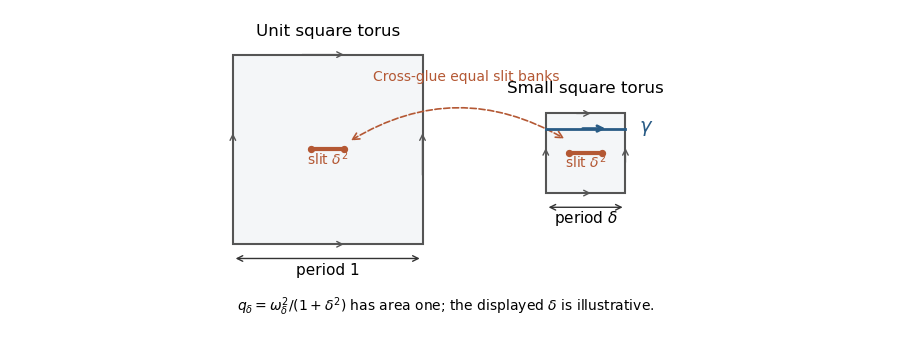
A small translation torus joined by equal slits; its generator is flat-short while retaining a positive extremal-length bound
. Details. Past exam of the mathematics course of the University of Cambridge 2017 iii Paper 132 4 a Solution by Codex 0 Created 2026-10-03 Updated 2026-10-05
Codex 0 Created 2026-10-03 Updated 2026-10-05For fixed , Mumford's compactness theorem states thatHere is the unmarked moduli space of Riemann surfaces, with its usual topology, and the hyperbolic systole is the shortest nonconstant closed hyperbolic geodesic, in Gaussian curvature . Equivalently, a subset of is relatively compact exactly when its hyperbolic systoles have a common positive lower bound.
We use two standard structural results. The Bers pants decomposition theorem provides a constant such that every closed genus- hyperbolic surface has a pants decomposition with all cuff lengths at most . For a fixed topological pants decomposition, the Fenchel–Nielsen coordinates identify Teichmüller space withThe length coordinates are , and the twist coordinates are measured in length units: a full Dehn twist changes by . Reconstruction from these coordinates is continuous; locally the marked metrics can be chosen to vary smoothly on a fixed reference surface, and the quotient by the mapping class group is the Hausdorff moduli space of Riemann surfaces.
Take any sequence in . The pants decompositions supplied by the Bers pants decomposition theorem have cuff lengths in . There are finitely many topological types of pants decomposition: their dual graphs have vertices and edges, with loops and multiple edges allowed, giving finitely many finite graphs. Choose a subsequence of one type, and choose markings carrying each decomposition to a fixed reference one. Compose these markings with Dehn twists so that . The resulting points of Teichmüller space lie in the compact boxThey therefore have a convergent subsequence inside Teichmüller space; its continuous projection gives a convergent subsequence in the moduli space of Riemann surfaces. If the thick set is empty, which is already compact. Equivalently, using all the finitely many reference decompositions gives a finite union of compact projected boxes containing the whole thick set.
Finally the hyperbolic systole is continuous. Nearby marked hyperbolic surfaces admit metric comparisons with bi-Lipschitz distortion tending to one; the length of every loop, and hence the infimum over all essential loops, obeys the same multiplicative comparison. Therefore is closed in that compact union and is compact. A compact subset has a positive minimum hyperbolic systole, proving the converse characterization of relative compactness. This theorem concerns the unmarked quotient: repeated Dehn twists can give an unbounded sequence in Teichmüller space while leaving the underlying surface and its hyperbolic systole unchanged.
Past exam of the mathematics course of the University of Cambridge 2017 iii Paper 132 3 c Solution by Codex 0 Created 2026-10-03 Updated 2026-10-05
Codex 0 Created 2026-10-03 Updated 2026-10-05Use the closed genus version of Teichmüller's uniqueness theorem. Let be a Teichmüller map: for a nonzero holomorphic quadratic differential , normalized by , and ,The value at a zero of is irrelevant to the Beltrami coefficient, which is defined almost everywhere. For every quasiconformal map preserving orientation and homotopic to , the conclusion isThe normalized is also uniquely determined when .
We use the following analytic input, stated with its hypotheses. The Reich–Strebel inequality says that if has the displayed Beltrami coefficient and a competitor has the same target and homotopy class, then, for ,This is the standard fundamental inequality for an integrable holomorphic quadratic differential; it also holds on a finite-type punctured surface with the homotopy fixing the punctures. Its formulation is given in Gardiner and Hu, §5. We quote this analytic inequality as the lecture result used in the proof.
Put . Pointwise, away from the isolated zeros of ,Integrating against the probability density function proves . If , all these inequalities are equalities almost everywhere. The strictly increasing last function forces almost everywhere; equality in the triangle inequality then forces . ThereforeTwo quasiconformal maps with the same Beltrami coefficient differ by postcomposition with a biholomorphism, by the local chain rule for the Beltrami equation. Consequently is a biholomorphism from to itself homotopic to the identity.
For completeness, such a biholomorphism is the identity when . Apply the uniformization theorem and choose the lift of the homotopy to starting at the identity. Its endpoint lift commutes with every deck transformation. It is a real Möbius transformation. The compact quotient has no parabolic Möbius transformations in its deck group, and freeness excludes elliptic Möbius transformations. Two distinct hyperbolic axes exist: a discrete free group preserving just one axis would be cyclic, contradicting the fundamental group of a closed surface of genus at least two. Commutation with two deck transformations represented by hyperbolic Möbius transformations having distinct axes makes it fix their boundary endpoints individually; there are at least three such endpoints. A Möbius transformation fixing three points is the identity. Hence and .
If is another unit-area differential for the same map, then , so is positive real wherever defined. This meromorphic function is constant by the open mapping theorem, and normalization makes the constant one. Without normalization, positive multiples of describe the same map. At , uniqueness of the map still holds in genus at least two, but there is no distinguished . In genus one, translations supply nontrivial biholomorphisms homotopic to the identity, so equality determines the map only up to those biholomorphisms; the genus hypothesis cannot be omitted.
Past exam of the mathematics course of the University of Cambridge 2017 iii Paper 132 3 b Solution by Codex 0 Created 2026-10-03 Updated 2026-10-05
Codex 0 Created 2026-10-03 Updated 2026-10-05In local holomorphic coordinates, write the two positive singular values of as . Preservation of orientation gives , and quasiconformality gives .
For an admissible conformal metric on , define a density on by . Along each path,so . The change of variables formula and giveAlso , so . Thus has positive finite area and is admissible, andTaking the supremum over provesApplying the same argument to , which has the same bound on its maximal dilatation, also gives . The inequalities remain valid for extended extremal lengths; no extremizing density need exist.
Past exam of the mathematics course of the University of Cambridge 2017 iii Paper 132 3 a Solution by Codex 0 Created 2026-10-03 Updated 2026-10-05
Codex 0 Created 2026-10-03 Updated 2026-10-05A generalized conformal metric is locally , where is nonnegative and measurable and transforms as a length density under a holomorphic change of coordinate. Its area is . Use the usual convention of using locally rectifiable paths for a path family , and put . ThenThis is extremal length. Zeros and isolated singularities of an admissible density are allowed; requiring a smooth strictly positive Riemannian metric would unnecessarily restrict the definition. Line integrals have their extended nonnegative values; if an arbitrary family is supplied, use its members that are locally rectifiable paths. An empty path family has infinite infimal length, whereas a family containing a constant path has extremal length zero.
Both numerator and denominator scale quadratically when is multiplied by a positive constant. The coordinate transformation of the area element makes the quotient unchanged under conformal equivalence.
The normalization relevant later is worth deriving. On the conformal cylinder , let contain the loops going once around it. For the horizontal loop at height , Cauchy-Schwarz inequality givesIntegrating in shows . The constant density achieves equality, since every winding-one loop has Euclidean length at least one. HenceHere is the height divided by circumference, the conformal modulus of an annulus; the reciprocal is used for the family joining its boundary components.
Past exam of the mathematics course of the University of Cambridge 2017 iii Paper 132 2 c Solution by Codex 0 Created 2026-10-03 Updated 2026-10-14
Codex 0 Created 2026-10-03 Updated 2026-10-14Label the polygon vertices cyclically. Translation pairing of opposite sides identifieswith indices modulo . The vertex classes are consequently the cosets of the subgroup generated by in , and their number isThe quotient is a compact Hausdorff space. An interior point has a disk neighbourhood, a paired-side point has two half-disks joined to a disk, and each vertex class has its incident sectors cyclically joined to a cone, topologically a disk. Thus it is a connected closed surface with an orientation. Its Euler characteristic is , since there are paired edges and one face. Hence
The polygon interior and paired-side charts are translation surface charts with . Each corner angle is . For even , all corners meet, giving cone angle ; for odd , each of the two classes contains corners, giving cone angle . Both are integral multiples of . A cone of angle has the local uniformizing coordinate with ; the holomorphic one-form is . Filling the vertices therefore supplies the Riemann surface structure and the holomorphic one-form, withAn order-zero entry denotes a regular point, not an actual zero: for the surface is a torus and the form is nowhere zero. The zero orders otherwise sum to , as a check against the degree of the canonical bundle.
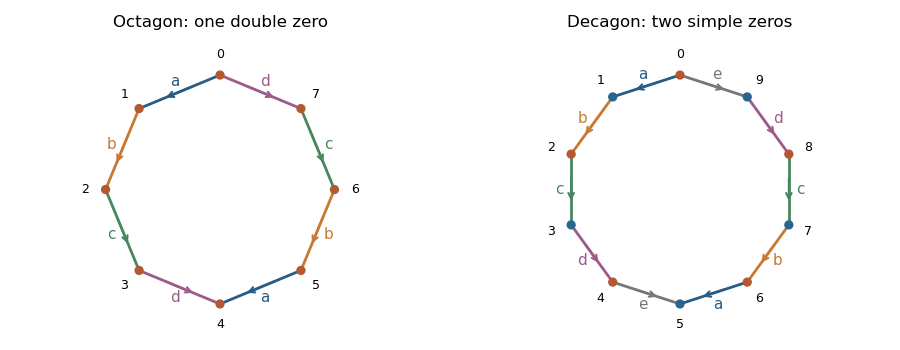
For , the form has one double zero and lies in the stratum of holomorphic one-forms ; for , it has two simple zeros and lies in . The SL2R action on differentials preserves zero multiplicities, as the local cone argument shows. ThereforeTheir equal genus and area do not distinguish the orbits; their different strata of holomorphic one-forms do.
Past exam of the mathematics course of the University of Cambridge 2017 iii Paper 132 2 b Solution by Codex 0 Created 2026-10-03 Updated 2026-10-05
Codex 0 Created 2026-10-03 Updated 2026-10-05The analogous flat-coordinate construction does not define a full action on arbitrary cubic differentials. Away from zeros, a nonzero holomorphic cubic differential has flat coordinatesTheir changes of coordinate are with . A branch change is therefore a rotation through , not merely a sign. Applying a real-linear map changes its linear part to , where is that rotation. In general this is not a complex-linear map, so the proposed changes of coordinate are not holomorphic and cannot define the required deformed complex structure.
For example, take and with . Thenwhose off-diagonal entries fail the condition for a complex-linear map. This dependence on the choice of cube-root coordinate is the obstruction even when considering descent from the locus : the three possible roots need not lead to the same deformation of the cubic pair.
The real matrices preserving orientation that normalize the order-three rotations are precisely the matrices of complex-linear maps; intersecting with leaves . Indeed a nonreal rotation determines its complex structure, and conjugation to its inverse would reverse that structure's orientation. Thus there is a natural rotation action,The conclusion concerns the geometric group action analogous to that for translation surfaces and half-translation surfaces; it does not rule out artificial group actions unrelated to these atlases.
Past exam of the mathematics course of the University of Cambridge 2017 iii Paper 132 2 a Solution by Codex 0 Created 2026-10-03 Updated 2026-10-05
Codex 0 Created 2026-10-03 Updated 2026-10-05First use the nonzero loci, as required by the standard SL2R action on differentials. A nonzero holomorphic one-form has, away from its zeros, flat coordinateswhose changes of coordinate are translations. A nonzero holomorphic quadratic differential similarly has local flat coordinates , with and changes of coordinate . These are respectively translation surfaces and half-translation surfaces.
Identify a flat coordinate with a vector in . For , replace every flat coordinate by . Since preserves orientation and commutes with multiplication by , the new changes of coordinate areThey are holomorphic in the new coordinates, and so define a new complex structure. Define or in that structure. The forms glue because translations preserve , and the extra signs preserve .
The zeros also extend. A zero of order of a holomorphic one-form has cone angle ; a zero of order of a holomorphic quadratic differential has cone angle . The real-linear deformation preserves the corresponding winding multiplicity. Filling the cone in a local coordinate gives in the first case, or a local branch of in the second. Thus the resulting forms are constant multiples of or and have the same zero orders. This verifies extension across the missing points, rather than merely producing an atlas on the punctured surface.
An isomorphism preserving the original differential identifies its flat coordinates up to the permitted translations or signs; applying identifies the deformed atlases too. Hence the construction descends to the corresponding moduli spaces. Applying after replaces by , soThe area of a quadratic differential, and the analogous area of a holomorphic one-form, are preserved because .
For , the flat coordinates obtained from already give the required half-translation surface atlas for . The same replacement therefore constructs both deformations, and
The printed sets include identically zero differentials. They have no flat coordinates, so the customary geometric group action is defined on the nonzero loci. One can obtain a set-theoretic action on the displayed entire sets by declaring ; the same equivariance identity then holds at zero. This extension is generally not continuous: as , the deformed underlying surface is the same for every real , and can differ from . Thus a claim about the standard continuous geometric group action requires the nonzero convention.
Past exam of the mathematics course of the University of Cambridge 2017 iii Paper 132 1 c Solution by Codex 0 Created 2026-10-03 Updated 2026-10-14
Codex 0 Created 2026-10-03 Updated 2026-10-14Use the Gaussian curvature normalizationof the Poincaré half-plane model. This is a complete conformal metric, invariant under real Möbius transformations. Its quotient by the free effective principal congruence subgroup is again complete: a geodesic lifts to the complete covering plane and extends there for all time. Transporting the quotient metric through the biholomorphism supplies the required complete conformal metric.
A nonconstant closed geodesic corresponds to a hyperbolic Möbius transformation of , and its hyperbolic translation length is . Indeed its eigenvalues have magnitudes with , and its axis quotient has length . For in , implies . The odd numbers therefore have the same residue modulo four, andA hyperbolic Möbius transformation must have , so its smallest possible absolute trace is six. It is attained byConsequentlyThis element is primitive: a proper power would have a shorter root represented by a hyperbolic Möbius transformation, contradicting the trace bound. No essential simple closed geodesic exists on the three-punctured sphere, since every essential simple loop is peripheral and corresponds to a parabolic Möbius transformation. The minimizing closed geodesic is therefore nonsimple. Finally, the PDF leaves the numerical Gaussian curvature unspecified: the displayed length uses Gaussian curvature ; for Gaussian curvature , it is divided by .
Pinned article: Introduction to the OurBigBook Project
Welcome to the OurBigBook Project! Our goal is to create the perfect publishing platform for STEM subjects, and get university-level students to write the best free STEM tutorials ever.
Everyone is welcome to create an account and play with the site: ourbigbook.com/go/register. We belive that students themselves can write amazing tutorials, but teachers are welcome too. You can write about anything you want, it doesn't have to be STEM or even educational. Silly test content is very welcome and you won't be penalized in any way. Just keep it legal!
Intro to OurBigBook
. Source. We have two killer features:
- topics: topics group articles by different users with the same title, e.g. here is the topic for the "Fundamental Theorem of Calculus" ourbigbook.com/go/topic/fundamental-theorem-of-calculusArticles of different users are sorted by upvote within each article page. This feature is a bit like:
- a Wikipedia where each user can have their own version of each article
- a Q&A website like Stack Overflow, where multiple people can give their views on a given topic, and the best ones are sorted by upvote. Except you don't need to wait for someone to ask first, and any topic goes, no matter how narrow or broad
This feature makes it possible for readers to find better explanations of any topic created by other writers. And it allows writers to create an explanation in a place that readers might actually find it.
Figure 1. Screenshot of the "Derivative" topic page. View it live at: ourbigbook.com/go/topic/derivativeVideo 2. OurBigBook Web topics demo. Source. - local editing: you can store all your personal knowledge base content locally in a plaintext markup format that can be edited locally and published either:This way you can be sure that even if OurBigBook.com were to go down one day (which we have no plans to do as it is quite cheap to host!), your content will still be perfectly readable as a static site.
- to OurBigBook.com to get awesome multi-user features like topics and likes
- as HTML files to a static website, which you can host yourself for free on many external providers like GitHub Pages, and remain in full control

Figure 2. You can publish local OurBigBook lightweight markup files to either OurBigBook.com or as a static website.
Figure 3. Visual Studio Code extension installation.
Figure 5. . You can also edit articles on the Web editor without installing anything locally. Video 3. Edit locally and publish demo. Source. This shows editing OurBigBook Markup and publishing it using the Visual Studio Code extension. 
- Infinitely deep tables of contents:




All our software is open source and hosted at: github.com/ourbigbook/ourbigbook
Further documentation can be found at: docs.ourbigbook.com
Feel free to reach our to us for any help or suggestions: docs.ourbigbook.com/#contact