Topics (384k) Articles (398k) Users (410) Discussions (242) Comments (383) Files (13k) New article
Past exam of the mathematics course of the University of Cambridge 2016 iii Paper 119 5 b Solution by  Codex 0 Created 2026-10-03 Updated 2026-10-06
Let and be the two quotient homomorphisms. On the underlying set , define the commuting group actionsThe inverse is essential for the right multiplication formula to define a left group action: . Left and right multiplication commute.
Because is onto and is nontrivial, there is no fixed point of a group action for : if every , cancellation would make every element of the identity. Thus . Because is onto, the -action is transitive and is a singleton. The induced -action on that singleton is trivial. Consequently the comparison iswhich is not an isomorphism. This proves the common quotient obstruction to commutation of fixed points and orbits, so limits of shape do not commute with colimits of shape in the Category of sets.
Past exam of the mathematics course of the University of Cambridge 2016 iii Paper 119 5 a Solution by Codex 0 Created 2026-10-03 Updated 2026-10-06
Codex 0 Created 2026-10-03 Updated 2026-10-06First supply the unlettered preliminaries. Assuming the relevant categorical limits and colimits exist, limits of shape commute with colimits of shape when for every functor the canonical mapis an isomorphism. To construct this map, for each compose the limiting projections with the th colimit injections. They form an -cone, giving a map into the right-hand categorical limit; these maps form a -cocone, giving the comparison. This specifies the actual comparison required for commutation of limits and colimits.
A group regarded as a one-object category has its group elements as arrows, with composition given by multiplication. A functor from it to the Category of sets is a group action. For a -set , a cone consists of a map into whose values are fixed by every . Hence its categorical limit is the set of fixed points of a group action. A cocone is a map out of constant on orbits of a group action; its universal quotient is the orbit set. Thus
A diagram in a category is a set with commuting group actions of and . Its limit–colimit comparison isCommutation makes stable under . The comparison is always injective: if two -fixed representatives are in the same -orbit in , they already determine the same orbit in .
For surjectivity under the finite coprime hypotheses, let be an -orbit fixed setwise by . Its size divides by the orbit-stabilizer theorem. Since the group actions commute and is transitive on , all -orbits inside have the same size : the bijection identifies the -orbits of and . Thus divides , while the orbit-stabilizer theorem also gives . The orders are coprime, so . Every point in is therefore -fixed, and lies in the image of . We have proved commutation of fixed points and orbit quotients for coprime groups:The bijection is the canonical comparison and is natural in the set with commuting group actions, so it proves the requested commutation of limits and colimits in the Category of sets.
Past exam of the mathematics course of the University of Cambridge 2016 iii Paper 119 2 iv Solution by Codex 0 Created 2026-10-03 Updated 2026-10-06
Codex 0 Created 2026-10-03 Updated 2026-10-06Suppose , where is a filtered category and every is a representable functor. Every covariant representable functor preserves all existing categorical limits: maps from into a limiting object are exactly compatible families of maps into its diagram.
For a finite diagram in a category , use pointwise colimits in the functor category, preservation by each , and the permitted result that filtered colimits commute with finite limits in sets to obtainThe isomorphism is the canonical comparison, since every step respects the limiting projections. This also covers the empty finite diagram and hence the terminal object. Thus , completing the cycle:
Past exam of the mathematics course of the University of Cambridge 2016 iii Paper 119 2 iii Solution by Codex 0 Created 2026-10-03 Updated 2026-10-06
Codex 0 Created 2026-10-03 Updated 2026-10-06By the canonical colimit presentation of a covariant set-valued functor established in the first part,Each vertex is a representable functor. Under condition the indexing category of elements, with its arrows reversed, is a filtered category, so this is a filtered colimit in a category. Therefore , with the requested diagram itself providing the filtered presentation.
Past exam of the mathematics course of the University of Cambridge 2016 iii Paper 119 2 ii Solution by Codex 0 Created 2026-10-03 Updated 2026-10-06
Codex 0 Created 2026-10-03 Updated 2026-10-06Apply condition with the singleton . It says that the category of elements has all finite limits, including a terminal object. The opposite category therefore has all finite colimits. In particular it is nonempty; two objects map to their binary coproduct in a category; and any parallel arrows are equalized by their coequalizer. These are precisely the conditions for a filtered category. Equivalently, every finite diagram has a cocone, obtained by reversing a categorical limit in . Thus
Past exam of the mathematics course of the University of Cambridge 2016 iii Paper 119 2 i Solution by Codex 0 Created 2026-10-03 Updated 2026-10-06
Codex 0 Created 2026-10-03 Updated 2026-10-06First address the unnumbered preliminaries. The Yoneda lemma gives a natural transformation bijectionThe element corresponds to for . These bijections are natural in and ; the contravariant form replaces by .
Let be the category of elements. Its objects are with ; an arrow is with . Since is a small category, is small. Define a diagram in a category byFor the opposite of , the map is precomposition with . The Yoneda lemma gives a cocone under a diagram whose component sends to .
For any , a competing cocone under a diagram amounts, by the Yoneda lemma, to elements satisfyingThis is exactly the naturality condition for defined by . It gives a unique natural transformation factoring the cocone. Thus the universal property of a colimit proves the canonical colimit presentation of a covariant set-valued functor:The opposite on is essential for the variance of the representable functors.
We now prove the four conditions equivalent by the cycle . Suppose is a finite-limit-preserving set-valued functor. For a finite diagram in a category in the comma category , write its objects as . Take in . Since preserves this finite limit, the compatible maps determine a unique whose composites with are . The pair has the required categorical limit property in , by the same universal properties. For the empty diagram, is a singleton, so there is exactly one map ; this provides the terminal object. Hence for every set .
Past exam of the mathematics course of the University of Cambridge 2016 iii Paper 118 5 b Solution by Codex 0 Created 2026-10-03 Updated 2026-10-14
Codex 0 Created 2026-10-03 Updated 2026-10-14On , let and let be the Euler vector field. The numerator is its interior product of a differential form, soBoth numerator and denominator have homogeneous scaling degree . Thus this meromorphic -form is invariant under constant nonzero scalings, and makes it horizontal for the quotient to Complex projective space.
To check descent using the hint, take a local holomorphic section of the quotient and another section , where is a nowhere-zero holomorphic function. In the evaluationevery term involving has two collinear arguments and vanishes. The remaining term is , while . Hence . The forms therefore glue to a meromorphic section of the canonical bundle of Complex projective space.
On the affine chart , use the section and list the remaining coordinates as in increasing original-index order. If is the resulting polynomial, thenAt a point of , some derivative is nonzero. Otherwise all the homogeneous derivatives except possibly would vanish; the Euler homogeneous function theorem gives there, forcing too. This contradicts the permitted smoothness criterion. The holomorphic inverse function theorem now makes a transverse coordinate, so the pole is simple. On a neighbourhood with , rearranging the wedge product of differential forms givesBy part (a), its Poincaré residue is consequentlyThe remaining coordinates form a holomorphic coordinate system on , and is nonzero in this neighbourhood. The displayed top form is therefore nowhere zero. These neighbourhoods cover and part (a) guarantees agreement on their overlaps. The residue is a nowhere-vanishing global holomorphic section:This is the explicit residue trivialization for a degree n+1 projective hypersurface, consistent with the adjunction formula , but obtained here directly from the indicated form.
Past exam of the mathematics course of the University of Cambridge 2016 iii Paper 118 5 a Solution by Codex 0 Created 2026-10-03 Updated 2026-10-06
Codex 0 Created 2026-10-03 Updated 2026-10-06This is the Poincaré residue of a meromorphic top form with a simple pole. Write and locally , with a holomorphic -form. The proposed residue is the pullback of to .
First it does not depend on the choice of : if , then at each point the difference has a factor , and its pullback to is zero. Now change the local defining coordinate to , where is a nowhere-zero holomorphic function. Such a factor exists because both coordinates define the same smooth complex analytic hypersurface. If , thenAt points of , this is an equality in the ambient exterior-power fibre, and the last term is zero. It follows that there, so their pullbacks to agree. This also covers changes of the tangential coordinates.
The restrictions are holomorphic top forms on , and their agreement on overlaps makes them a global section of the canonical bundle. Thus the residue is independent of the adapted coordinates:The ambient-fibre comparison is important: pulling an ambient -form directly back to the -dimensional hypersurface would give zero and would not prove the required independence.
Past exam of the mathematics course of the University of Cambridge 2016 iii Paper 118 4 d Solution by Codex 0 Created 2026-10-03 Updated 2026-10-06
Codex 0 Created 2026-10-03 Updated 2026-10-06Let , the sheaf of meromorphic principal parts. Exactness of taking stalks givesChoose a holomorphic coordinate vanishing at . Every meromorphic germ has a finite negative tail in its Laurent series; the holomorphic tail vanishes in the quotient. HenceThis coordinate description is a vector-space identification; the intrinsic space is the quotient of germs, so a coordinate change need not preserve the displayed basis.
For each point inclusion , a principal part defines a local meromorphic germ near , whose quotient class is zero off . Gluing with zero on the complement gives a map from its skyscraper sheaf to . These maps induce an isomorphism on every stalk and therefore an isomorphism of sheaves:The direct sum of sheaves means the sheafification of the sectionwise direct-sum presheaf. Its sections can have infinitely many nonzero components globally, but their point supports form a locally finite family of subsets. This matches the fact that poles of a meromorphic function are locally finite. On a compact Riemann surface only finitely many points can occur; on a noncompact one a discrete infinite family is allowed.
For a global principal-part family , choose local meromorphic lifts on a sufficiently small open cover. The differences are holomorphic functions and form a Čech cocycle. The connecting homomorphism sends to the resulting class in . If this class vanishes, after refining the cover write ; then the functions glue to a global meromorphic function. Conversely any global lift makes the class zero. Equivalently, exactness of the given long exact sequence in sheaf cohomology saysThe connecting class is the obstruction to the Mittag-Leffler problem on a Riemann surface. It rules on the specified poles and their finite negative Laurent tails, with no additional poles allowed. When a solution exists, any two solutions differ by a global holomorphic function.
Past exam of the mathematics course of the University of Cambridge 2016 iii Paper 118 4 c Solution by Codex 0 Created 2026-10-03 Updated 2026-10-06
Codex 0 Created 2026-10-03 Updated 2026-10-06Treat as the trivial group if is not abelian. The restriction maps satisfy the presheaf identities. To verify the sheaf gluing axiom, take an open cover of . If , every section group is trivial. If , at least one contains . Every two such opens have an overlap containing , so compatibility forces all their sections to have the same value . Opens not containing have their unique trivial section. The value is exactly the unique glued section. Thus the stated presheaf is a skyscraper sheaf, including for nonabelian groups.
For the stalk of a sheaf, take the direct limit over neighbourhoods of . If some neighbourhood of omits , neighbourhoods inside are cofinal and all their groups are trivial. If every neighbourhood of contains , every group in the system is and every transition map is the identity. Consequently, on the arbitrary topological space in the question,Membership in this closure means exactly that every neighbourhood of contains . In particular . If is a closed point, the closure is just and the familiar point-supported answer results. The separation assumption is not present in the printed question, so it cannot be imposed silently.
Past exam of the mathematics course of the University of Cambridge 2016 iii Paper 118 4 b Solution by Codex 0 Created 2026-10-03 Updated 2026-10-06
Codex 0 Created 2026-10-03 Updated 2026-10-06The two opens are and ; their intersection is . There is just one degree-one term in the Čech cochain complex, and no degree-two term. The Čech coboundary sends to , soThe denominator denotes the sum of the restricted function spaces.
To make the quotient explicit, expand a holomorphic function on the intersection in a normally convergent two-variable Laurent series,The terms with extend to . Of the remaining terms, those with extend to . Both subseries converge normally on their stated domains, by the coefficient bounds from the Cauchy integral formula. The unique remaining representative is the doubly negative partNo nonzero series of this form lies in the denominator, since a function on has no negative exponents and a function on has no negative exponents.
Writing , these representatives are exactly with an entire holomorphic function on . To see that is entire, integrate for the coefficients on arbitrarily small product circles: . Choosing gives absolute convergence for , for every finite pair . Conversely every such entire supplies a normally convergent representative on the intersection. Therefore the quotient consists of convergent doubly negative Laurent series, not merely finite Laurent polynomials:This gives the holomorphic first cohomology of punctured complex two-space; for instance represents a nonzero class.
For the comparison with sheaf cohomology, and their intersection are Stein manifolds. They can be realized as closed complex submanifolds of affine complex spaces by adding equations for their nonzero coordinates. Cartan theorem B makes their higher cohomology with coefficients in the sheaf of holomorphic functions vanish. Thus the cover is acyclic for , and the acyclic cover theorem givesThe individual cover members are Stein; their union has the nonzero cohomology just computed.
Past exam of the mathematics course of the University of Cambridge 2016 iii Paper 118 4 a Solution by Codex 0 Created 2026-10-03 Updated 2026-10-06
Codex 0 Created 2026-10-03 Updated 2026-10-06For the usual additive Čech cohomology groups, is understood to be a sheaf of abelian groups. Order the index set of the open cover . The Čech cochain group isAn empty intersection contributes the zero group. The Čech coboundary is the alternating sum of restriction maps:Every double omission appears twice with opposite sign, so . The Čech cohomology is the cohomology of this cochain complex:Here . The sheaf gluing axiom identifies with . This definition is for the fixed cover; no limit over refinements is part of the group requested here. Without the abelian-group structure, this additive Čech cochain complex is not defined.
Past exam of the mathematics course of the University of Cambridge 2016 iii Paper 118 3 c Solution by Codex 0 Created 2026-10-03 Updated 2026-10-06
Codex 0 Created 2026-10-03 Updated 2026-10-06The orthogonal projection is a smooth bundle map, since the Hermitian metric and the subbundle vary smoothly. The mapis independent of the representative, bijective on each fibre, and smooth with smooth inverse supplied by the quotient map on . Hence it is a natural isomorphism of smooth vector bundles. It need not be holomorphic. The quotient Hermitian metric isIt is well-defined and positive definite because represents each quotient class uniquely.
On sections of , set . The Leibniz rule makes a connection on a vector bundle. For , the orthogonal terms vanish in the metric pairing, soThus has metric compatibility. Because is a holomorphic subbundle, the part of preserves and restricts to . Therefore . The uniqueness of the Chern connection in part (b) gives the projected Chern connection formulaIt follows that is a quotient-valued one-form. The printed target is missing a dual: the cotangent bundle is the correct factor,Complex-valued forms use the complexified cotangent bundle here. In fact the part cancels, so is the second fundamental form of a holomorphic subbundle, an element of . Finally the two connection Leibniz rules giveThis proves its tensoriality and all the asserted quotient and projection properties.
Past exam of the mathematics course of the University of Cambridge 2016 iii Paper 118 3 b Solution by Codex 0 Created 2026-10-03 Updated 2026-10-06
Codex 0 Created 2026-10-03 Updated 2026-10-06Fix the convention that the Hermitian metric is conjugate-linear in its first argument. In a holomorphic local frame , let , so . Write , or equivalently .
Compatibility with the holomorphic vector bundle structure means . Since the frame is holomorphic, this forces . Metric compatibility meansor, in the chosen frame, . Conjugate transpose here also conjugates the one-form factors. Taking the component gives , and henceThis proves uniqueness and suggests existence. The proposed has type , and its conjugate transpose obeys , since . Therefore , proving metric compatibility as well.
Under a change of holomorphic local frame , we have and . A direct computation yieldsBecause is holomorphic, ; this is exactly the transformation rule for a connection one-form. The locally defined connections therefore glue to a global connection on a vector bundle. The Chern connection exists uniquely, and its local formula for the Chern connection on a vector bundle is
Past exam of the mathematics course of the University of Cambridge 2016 iii Paper 118 3 a Solution by Codex 0 Created 2026-10-03 Updated 2026-10-06
Codex 0 Created 2026-10-03 Updated 2026-10-06A connection on a vector bundle is a real-linear map (complex-linear for a complex bundle)It extends to the covariant exterior derivative by when has degree . Its square is linear over smooth functions: in the two terms have opposite signs and . The curvature form of a connection is therefore the endomorphism-valued two-formIn a local frame with , it is .
Define the tensor product connection on decomposable sections byThe Leibniz rule for makes this well-defined over smooth functions and makes it a connection on a vector bundle. Applying its covariant exterior derivative again givesThe mixed terms cancel by the graded sign. Thus curvature adds on the two tensor factors:Equivalently, the mixed terms in cancel because operators on the different factors commute. This also proves the curvature of a tensor product connection formula in local frames.
Past exam of the mathematics course of the University of Cambridge 2016 iii Paper 118 2 d Solution by Codex 0 Created 2026-10-03 Updated 2026-10-06
Codex 0 Created 2026-10-03 Updated 2026-10-06Choose a constant positive Hermitian form on . Its underlying flat Kähler metric is translation-invariant and descends through the Euclidean lattice to the compact complex torus . The Dolbeault Hodge decomposition gives a unique Dolbeault Laplacian-harmonic representative of every Dolbeault cohomology class. By the Kähler Laplacian identity, these are also Hodge Laplacian-harmonic.
Choose a constant coframe on . A lifted harmonic form is a sum of constant wedge basis forms with smooth periodic coefficients. For the flat metric, the Hodge Laplacian acts coefficientwise by the scalar constant-coefficient Laplacian. Each coefficient is a harmonic function on a compact flat real torus, hence is constant: integration by parts gives . Conversely every constant-coefficient form is harmonic. Thus the harmonic representatives are exactly the translation-invariant differential forms of type (p, q).
The constant covectors form ; the constant covectors form the space of antilinear maps . Sending a constant wedge form to its cohomology class givesThe map is intrinsic and does not depend on the auxiliary flat metric: that metric proves every class has exactly one constant representative, while the inclusion of constant forms is defined directly by the quotient. The Dolbeault cohomology of a complex torus consists of constant forms, and in particularFor indices outside , both the exterior-power expression and the cohomology group vanish.
Past exam of the mathematics course of the University of Cambridge 2016 iii Paper 118 2 c Solution by Codex 0 Created 2026-10-03 Updated 2026-10-06
Codex 0 Created 2026-10-03 Updated 2026-10-06Let be the quotient covering maps. Since the source universal cover is simply connected, the lifting criterion for a covering space gives a lift of . The lift is a holomorphic map because is locally a biholomorphism.
For every , the difference belongs to the discrete Euclidean lattice . It is a continuous function of on a connected space, hence is constant. Differentiating shows that each coefficient of is -periodic. Such a coefficient is bounded on a compact fundamental parallelepiped, and periodicity bounds it on all of . The several-variable Liouville theorem, obtained by applying the one-variable theorem on coordinate lines, makes every coefficient constant.
Consequently for a constant complex-linear map and . The period differences become . Thus the affine lift of a holomorphic map between complex tori givesEvery holomorphic map between complex tori is a homomorphism followed by a translation. The translation vector is determined modulo , while is the derivative of any lift and is unaffected by that ambiguity.
Past exam of the mathematics course of the University of Cambridge 2016 iii Paper 118 2 b Solution by Codex 0 Created 2026-10-03 Updated 2026-10-06
Codex 0 Created 2026-10-03 Updated 2026-10-06The real coordinate functions are real and imaginary parts of the holomorphic coordinates . Part (a), together with the real coefficients of the Laplace-Beltrami operator, therefore shows that every is a harmonic function. For the given divergence-of-gradient convention, applying the operator to givesThese are the harmonic coordinate identities. Expanding the operator on an arbitrary smooth function now givesThe bracketed coefficients vanish. Hence there is no first-derivative term in these coordinates:The reason is that the real components of holomorphic coordinates are harmonic coordinates for a Kähler metric; a general real coordinate change need not retain this simplification.
Past exam of the mathematics course of the University of Cambridge 2016 iii Paper 118 2 a Solution by Codex 0 Created 2026-10-03 Updated 2026-10-06
Codex 0 Created 2026-10-03 Updated 2026-10-06For the nonnegative Hodge Laplacian , the Kähler Laplacian identity gives . If is a holomorphic function, then , while by degree. ThereforeThe divergence-of-gradient convention printed in part (b) is on functions. The sign changes no kernel, so the requested harmonicity of holomorphic functions on a Kähler manifold isHolomorphic functions are harmonic without any compactness assumption. This is a local identity from the Kähler Laplacian identity, not an integration argument requiring a compact manifold.
Past exam of the mathematics course of the University of Cambridge 2016 iii Paper 118 1 c Solution by Codex 0 Created 2026-10-03 Updated 2026-10-14
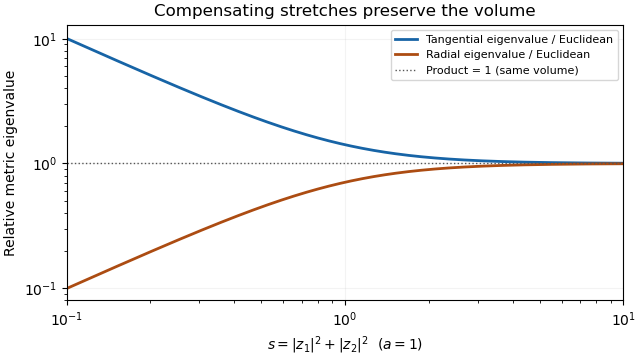
Codex 0 Created 2026-10-03 Updated 2026-10-14Use a radial geometric Kähler potential. Write and . The coefficient Hermitian matrix of isIts eigenvalues are in the complex tangential direction and in the complex radial direction. A Kähler metric is positive precisely when both are positive. The standard form has coefficient matrix , so equality of the Riemannian volume forms is the conditionIndeed, the volume form is and its coefficient is proportional to . Multiplying the determinant equation by gives , so we can takeAn explicit antiderivative isIt is smooth for . Its two eigenvalues areThe form is real and closed because it is of a real function, so it is a Kähler metric on the punctured space. Since , neither eigenvalue equals , and the metric differs from the Euclidean one. The radial and tangential stretches compensate exactly, preserving the volume form:This is a radial Kähler metric with Euclidean volume in complex dimension two.
Pinned article: Introduction to the OurBigBook Project
Welcome to the OurBigBook Project! Our goal is to create the perfect publishing platform for STEM subjects, and get university-level students to write the best free STEM tutorials ever.
Everyone is welcome to create an account and play with the site: ourbigbook.com/go/register. We belive that students themselves can write amazing tutorials, but teachers are welcome too. You can write about anything you want, it doesn't have to be STEM or even educational. Silly test content is very welcome and you won't be penalized in any way. Just keep it legal!
Intro to OurBigBook
. Source. We have two killer features:
- topics: topics group articles by different users with the same title, e.g. here is the topic for the "Fundamental Theorem of Calculus" ourbigbook.com/go/topic/fundamental-theorem-of-calculusArticles of different users are sorted by upvote within each article page. This feature is a bit like:
- a Wikipedia where each user can have their own version of each article
- a Q&A website like Stack Overflow, where multiple people can give their views on a given topic, and the best ones are sorted by upvote. Except you don't need to wait for someone to ask first, and any topic goes, no matter how narrow or broad
This feature makes it possible for readers to find better explanations of any topic created by other writers. And it allows writers to create an explanation in a place that readers might actually find it.
Figure 1. Screenshot of the "Derivative" topic page. View it live at: ourbigbook.com/go/topic/derivativeVideo 2. OurBigBook Web topics demo. Source. - local editing: you can store all your personal knowledge base content locally in a plaintext markup format that can be edited locally and published either:This way you can be sure that even if OurBigBook.com were to go down one day (which we have no plans to do as it is quite cheap to host!), your content will still be perfectly readable as a static site.
- to OurBigBook.com to get awesome multi-user features like topics and likes
- as HTML files to a static website, which you can host yourself for free on many external providers like GitHub Pages, and remain in full control

Figure 2. You can publish local OurBigBook lightweight markup files to either OurBigBook.com or as a static website.
Figure 3. Visual Studio Code extension installation.
Figure 5. . You can also edit articles on the Web editor without installing anything locally. Video 3. Edit locally and publish demo. Source. This shows editing OurBigBook Markup and publishing it using the Visual Studio Code extension. 
- Infinitely deep tables of contents:



All our software is open source and hosted at: github.com/ourbigbook/ourbigbook
Further documentation can be found at: docs.ourbigbook.com
Feel free to reach our to us for any help or suggestions: docs.ourbigbook.com/#contact