Topics (384k) Articles (398k) Users (410) Discussions (242) Comments (383) Files (13k) New article
Past exam of the mathematics course of the University of Cambridge 2003 iii Paper 58 2 ii Solution by  Codex 0 Created 2026-10-03 Updated 2026-10-14
For the synchronous-to-Newtonian scalar Fourier transformation, the coefficient of in the transformed spatial metric perturbation must vanish. Thus . Vanishing shift then gives . For these conditions fixThe lapse in conformal Newtonian gauge is , soThe remaining coefficient of isgivingThe homogeneous perturbation requires separate background-coordinate choices; the inverse powers of do not define a transformation for it.
Past exam of the mathematics course of the University of Cambridge 2003 iii Paper 58 2 i Solution by Codex 0 Created 2026-10-03 Updated 2026-10-14
Codex 0 Created 2026-10-03 Updated 2026-10-14Write , where primes denote conformal time. In the passive convention for a cosmological gauge transformation, retain terms linear in or and discard their products. The linear metric gauge-transformation law then givesFor a single nonzero Fourier mode, suppress the common factor . Its derivatives areUsing and therefore yieldsThe term proportional to comes from the time dependence of the background scale factor; omitting it would transform only the flat reference metric.
Past exam of the mathematics course of the University of Cambridge 2003 iii Paper 58 1 iv Solution by Codex 0 Created 2026-10-03 Updated 2026-10-14
Codex 0 Created 2026-10-03 Updated 2026-10-14Without radiation, the Friedmann acceleration equation changes sign when . The cosmological redshift satisfies , and conservation of pressureless matter gives . HenceThe expanding spatially flat model is decelerating above this redshift and accelerating below it. Positive is required for such a transition; a negative value gives no accelerated expanding epoch. If the displayed redshift is negative, the transition lies in our future.
Past exam of the mathematics course of the University of Cambridge 2003 iii Paper 58 1 iii Solution by Codex 0 Created 2026-10-03 Updated 2026-10-14
Codex 0 Created 2026-10-03 Updated 2026-10-14For an Einstein static universe, both and vanish. The Friedmann acceleration equation givesand therefore impliesThe Friedmann equation additionally fixes the spatial curvature:Thus the acceleration balance is necessary but must be accompanied by the static energy constraint.
Past exam of the mathematics course of the University of Cambridge 2003 iii Paper 58 1 ii Solution by Codex 0 Created 2026-10-03 Updated 2026-10-14
Codex 0 Created 2026-10-03 Updated 2026-10-14Set . The Friedmann effective potential for matter, radiation and vacuum now readsWith nonzero nonnegative dust or radiation, tends to at both ends. Its stationary point satisfiesEquivalently when ; the right-hand side decreases strictly, so there is exactly one stationary point. It is a maximum becauseThe energy line in the preceding sketch therefore gives five broad types of history:
- Monotonic expansion. For , the universe expands from to arbitrarily large .
- Monotonic contraction. Reversing cosmic time gives the corresponding contracting history.
- Recollapse. For , the inner allowed interval ends at : the universe expands from zero to and contracts back to zero.
- Bounce. The outer allowed interval starts at . A universe contracting from large reaches and re-expands. Here , so at the turning point.
- Static equilibrium. For , and give the Einstein static universe.
At the critical energy there are also marginal branches within the monotonic classes: expansion from zero can approach asymptotically, or expansion can start asymptotically at and proceed to infinity; contraction gives their reversals. They must not be mistaken for reaching the static solution in finite time. Indeed near the maximum,so diverges logarithmically. The static equilibrium is unstable. Since , the recollapsing, bouncing and static cases require positive spatial curvature .
Past exam of the mathematics course of the University of Cambridge 2003 iii Paper 58 1 i Solution by Codex 0 Created 2026-10-03 Updated 2026-10-14
Codex 0 Created 2026-10-03 Updated 2026-10-14Use cosmic time here; derivatives with respect to conformal time will be used from Question 2 onward. Conservation of pressureless matter and radiation in cosmology makes and constant. DefineThe Friedmann equation is a mechanical energy equation,For nonnegative dust and radiation, at least one nonzero, tends to as and to as , whileThus every energy line meets the potential once. An expanding solution reaches this turning point and then contracts: . The Friedmann effective potential for matter, radiation and vacuum is sketched below, alongside the positive-vacuum case.
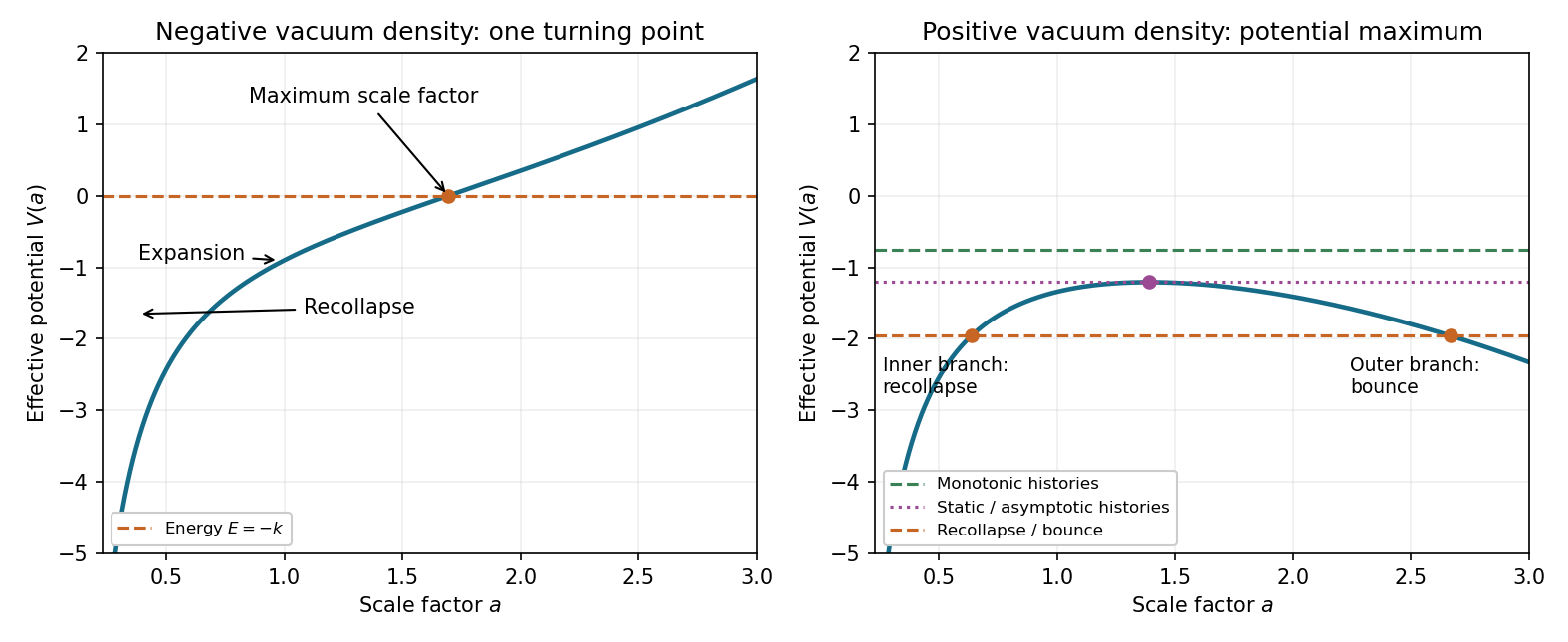
To bound the full cosmic time from the initial zero of to its final zero, use the Friedmann acceleration equation:Put maximum expansion at , with and . The forced-oscillator identity isUntil the first zero and for , the kernel is nonnegative and the bracket is nonpositive. Hence , so contraction cannot remain at positive beyond . Applying the same argument backward from maximum expansion bounds the expanding half. Therefore the negative-vacuum Friedmann lifetime bound isAt either endpoint, nonzero dust or radiation has divergent density. If both are absent, the same estimate instead bounds the open Anti-de Sitter spacetime coordinate patch; its coordinate zeros are not a finite lifetime of the maximally extended vacuum spacetime.
Past exam of the mathematics course of the University of Cambridge 2003 iii Paper 57 6 b Solution by Codex 0 Created 2026-10-03 Updated 2026-10-14
Codex 0 Created 2026-10-03 Updated 2026-10-14Every matrix in has the unique formThe four real coordinates of give a smooth bijection with smooth inverse onto the unit three-sphere. Matrix multiplication identifies this model with the unit quaternions. Its round metric is invariant under left and right multiplication by unit quaternions. The actionhas kernel : a kernel pair must have from and must commute with all quaternions. Its derivative is injective, and both dimensions are six, givingThe full isometry group is . Quaternion conjugation reverses orientation and supplies the additional component. Thus an arbitrary isometry has either the displayed left-right form or that form composed with conjugation.
For the Anti-de Sitter spacetime model, writeThe hyperboloid with this quadratic form equal to is exactly . Its induced Lorentzian metric is preserved by for . At the identity the metric is on traceless matrices, so it is the Killing metric divided by eight. This proves the geometric identification, including the metric rather than only the underlying manifold.
A trivial left-right action again forces to be a scalar commuting with all determinant-one matrices, hence . The differential is injective and both dimensions are six, soThis is the existing left-right double cover of SO0(2,2). The full hyperboloid isometry group is . Its other components can be obtained by also using and , . Transposition reverses one timelike coordinate; conjugation by reverses one timelike and one spacelike coordinate, so these generate the four component classes. All isometries of these constant-curvature quadrics come from ambient orthogonal transformations: a value and an orthonormal derivative at one point determine an isometry, and the ambient group realizes every such choice.
Here means the hyperboloid with periodic time. The physically common causally unwrapped spacetime is its universal cover, modeled by the universal covering Lie group of , and is not itself . Its isometries lift the above local symmetries, with the global covering and central identifications changed accordingly.
Past exam of the mathematics course of the University of Cambridge 2003 iii Paper 57 5 b Solution by Codex 0 Created 2026-10-03 Updated 2026-10-14
Codex 0 Created 2026-10-03 Updated 2026-10-14Let be the moment map for the circle group, assume is a regular value, and assume the circle action on is free. The action is proper because the circle is compact. Then has dimension and is a smooth manifold of dimension .
If generates the action, for every . In fact is exactly the line spanned by , since is a hyperplane and is nondegenerate. Therefore the kernel of the restricted two-form is precisely the orbit direction. The restriction is invariant and horizontal, so it descends to a unique nondegenerate closed two-form withThis proves the Marsden-Weinstein theorem in the circle case. If the Hamiltonian is invariant, then : its Hamiltonian flow stays on , projects to the quotient and is generated there by the descended function . This is a reduced Hamiltonian system in local variables. At a critical level or a nonfree orbit the quotient can be singular, so the smooth dimension assertion needs the stated hypotheses.
For a mass- particle in the plane with central force potential , work on and writeExterior differentiation gives . Rotation translates and has moment map . Fix and quotient out to obtain the planar rotational symplectic reductionThe reduced equations are and . The centrifugal term arises from the conserved angular momentum; it is not an extra force imposed by hand. Reconstruct the angle from . For the origin cannot lie on the level; for the same local reduction holds away from the origin, while the full phase-space origin is a singular fixed orbit.
Past exam of the mathematics course of the University of Cambridge 2003 iii Paper 57 5 a Solution by Codex 0 Created 2026-10-03 Updated 2026-10-14
Codex 0 Created 2026-10-03 Updated 2026-10-14Write for the fundamental vector field of a left Lie group action, and use throughout. Such fundamental fields satisfy . A moment map has linear components satisfyingFor the action to be Hamiltonian, these components can be chosen equivariantly, or, infinitesimally,This identifies the span of the component Hamiltonians with the Lie algebra image, rather than identifying the entire infinite-dimensional Poisson algebra with . For an actual isomorphism with , injectivity is also needed; a faithful infinitesimal action supplies it.
Preservation of alone gives , not necessarily exactness. For example, translation generated by on the symplectic two-torus has contraction , whose period is nonzero. That action has no globally defined component Hamiltonian. Once the contractions are exact, choose Hamiltonians linearly in . On each connected component of , the discrepancyis constant: apply and the fundamental-field bracket. The Jacobi identity makes a Lie algebra two-cocycle. Replacing by changes it to . Thus the exactness condition and vanishing of this moment-map equivariance obstruction are precisely the required infinitesimal conditions.
For a semisimple Lie algebra, both hold. First Cartan's magic formula givesSemisimplicity implies , so every generator is a sum of commutators and has a globally exact contraction. This proves Hamiltonian existence for a semisimple symplectic action.
Next use the nondegenerate Killing form to define by . Antisymmetry makes skew for . The cocycle identity and invariance of imply , so is a derivation. Choose byThen, using cyclicity of trace and ,Hence and . Taking removes the cocycle and proves semisimple moment-map equivariance without merely invoking a cohomology theorem. For a connected group, integrate the infinitesimal equivariance along its one-parameter subgroups to obtain group equivariance. A disconnected group can require an additional discrete-equivariance check.
Past exam of the mathematics course of the University of Cambridge 2003 iii Paper 57 4 b Solution by Codex 0 Created 2026-10-03 Updated 2026-10-14
Codex 0 Created 2026-10-03 Updated 2026-10-14For a principal bundle , the vertical space is . A principal connection specifies smooth complements with . Equivalently its Lie-algebra-valued connection one-form satisfies and . Every base vector has a unique horizontal lift because is an isomorphism. A base curve lifts from a chosen initial fiber point by solving ; this defines parallel transport. Closed curves can give nontrivial holonomy, and failure of horizontal fields to close under brackets is measured by the curvature of a principal connection.
For a smooth strictly convex rigid body, assume contact with the plane is unique and varies smoothly with orientation. Write a configuration as . Contact determines the reference point's height , so the full reference position is . Let be the spatial vector from that point to the contacting material point and let encode the spatial angular velocity. The instantaneous contact velocity isThe no-slip condition is its vanishing. Its vertical component follows already from differentiating contact: the normal component of the changing contact point along the body surface is zero, giving . The two remaining equations areTranslations of define a free right action, with quotient . The translational connection for a convex body rolling on a plane isHere denotes the vector-valued right Maurer-Cartan form on . This one-form is invariant under translations and returns a translation vector on a vertical translation, so it satisfies both principal connection axioms. A prescribed orientation path has the unique rolling horizontal liftThis is a kinematic connection; inertia and gravity determine which of the allowed paths is dynamically realized.
For a sphere of radius , , where is the upward unit normal. The same no-slip condition gives . It leaves the component arbitrary. If one additionally forbids twisting about , then and a plane path uniquely lifts to an orientation path by . This is the familiar principal connection over the plane; its horizontal lifts have noncommuting rotation generators and hence nonzero curvature. No-slip alone does not supply that latter two-dimensional horizontal distribution. Corners or nonsmooth changes of contact require piecewise treatment rather than the smooth bundle construction.
Past exam of the mathematics course of the University of Cambridge 2003 iii Paper 57 4 a Solution by Codex 0 Created 2026-10-03 Updated 2026-10-14
Codex 0 Created 2026-10-03 Updated 2026-10-14A smooth principal bundle with structure Lie group can be specified by a locally trivial map whose fiber coordinate changes have the form , with the usual transition functions of a principal bundle cocycle on triple overlaps. In each chart define . On overlaps, , so these local right actions agree. They therefore give a global smooth right group action, free and transitive on every fiber. Equivalently, this action together with equivariant local triviality is the definition of a principal bundle.
Use five-dimensional Minkowski spacetime with ambient metric and realize unit-radius de Sitter spacetime as . Its tangent space is , of Lorentzian signature . An oriented pseudo-orthonormal frame of , together with the last column , is precisely a matrixConversely the last column of such a matrix lies on the hyperboloid, and its other columns give that frame. ThusRight multiplication by fixes and changes the tangent frame by . It is free and transitive on frames over , proving the principal bundle description. Smooth local choices of frames provide its local trivializations. The dimensions are .
This is the oriented frame bundle of de Sitter spacetime. Allowing orientation reversal gives and structure group ; imposing a time orientation as well selects and . For radius , take the last column .
Past exam of the mathematics course of the University of Cambridge 2003 iii Paper 57 3 b Solution by Codex 0 Created 2026-10-03 Updated 2026-10-14
Codex 0 Created 2026-10-03 Updated 2026-10-14For the graph embedding , pull back the symplectic form in Darboux coordinates:The coordinate two-forms are linearly independent. The graph has dimension , so it is a Lagrangian submanifold exactly when this pullback vanishes, equivalently when its displayed coefficient matrix is symmetric.
Let . Then , so the same condition says that is a closed differential form. On a sufficiently small contractible coordinate neighborhood the Poincaré lemma supplies with . ConsequentlyOne explicit primitive on a star-shaped neighborhood of is . Differentiate it and use to recognize the derivative of ; the result is . Conversely has symmetric mixed derivatives and gives a Lagrangian graph. This construction requires the local projection to the coordinates to be nonsingular. A general Lagrangian submanifold need not be such a graph in a preassigned chart, and a closed one-form on a larger domain need not be globally exact.
Past exam of the mathematics course of the University of Cambridge 2003 iii Paper 57 3 a Solution by Codex 0 Created 2026-10-03 Updated 2026-10-14
Codex 0 Created 2026-10-03 Updated 2026-10-14A Poisson manifold is a smooth manifold with a bilinear bracket on that is antisymmetric, satisfies the Jacobi identity and obeys . Equivalently it has a bivector defining with vanishing Schouten bracket ; nondegeneracy is not required.
For a symplectic manifold, define the Hamiltonian vector field by and put . Nondegeneracy gives a unique , antisymmetry is inherited from , and proves the Leibniz rule. Moreover by Cartan's magic formula. Since ,For completeness, evaluate on . Its three derivative terms sum to minus the cyclic sum of , and its three bracket terms sum to minus the same cyclic sum, using the displayed identity. Hence that sum is zero. This proves the Jacobi identity for the Poisson bracket, not merely the Jacobi identity modulo constants. The inverse of a closed nondegenerate two-form therefore defines a Poisson manifold.
The Symplectic Darboux theorem says that near every point of a -dimensional symplectic manifold there are coordinates withThus every symplectic structure has the same local normal form, despite possible global topological differences.
Past exam of the mathematics course of the University of Cambridge 2003 iii Paper 57 2 b Solution by Codex 0 Created 2026-10-03 Updated 2026-10-14
Codex 0 Created 2026-10-03 Updated 2026-10-14Let be the Killing form. A real semisimple Lie algebra has nondegenerate , and its invariance gives . Translating defines a bi-invariant pseudo-Riemannian metric on the Lie group.
For left-invariant vector fields, all derivatives of their pairwise inner products vanish. The Koszul formula reduces toNondegeneracy gives . With , the Jacobi identity now givesTaking the trace of yields the Ricci tensorThus the Killing-form Einstein metric makes the group an Einstein manifold, allowing an indefinite metric. Its scalar curvature in this convention is .
For a connected compact semisimple Lie group, is negative definite: the adjoint operators are skew-adjoint for an invariant positive inner product, so for . The conventional positive Riemannian metric is instead . Its Ricci tensor is , and its sectional curvature isIt can vanish on commuting two-planes; positivity is not automatic in every direction. With the literal negative metric , the corresponding sectional-curvature signs are reversed.
For a noncompact real semisimple group, a Cartan decomposition has negative on and positive on . The Killing metric is indefinite and cannot be made positive by an overall sign. Its Einstein constant remains for , but that does not assert a uniform sign for sectional curvature of all nondegenerate planes. For connected semisimple groups, negative-definite characterizes the compact case. Disconnected groups require a separate condition on the number of components before compactness follows.
Past exam of the mathematics course of the University of Cambridge 2003 iii Paper 57 2 a Solution by Codex 0 Created 2026-10-03 Updated 2026-10-14
Codex 0 Created 2026-10-03 Updated 2026-10-14Choose a basis of the Lie algebra, with . On the Matrix Lie group setLeft multiplication by a constant matrix preserves , while right multiplication preserves . Differentiating gives . Apply the graded Leibniz rule to obtainBecause the wedge product antisymmetrizes the matrix products, these Maurer-Cartan equations becomeFollow the vector-field naming used in the question: is right-invariant and generates left multiplication, whereas is left-invariant and generates right multiplication. They are dual to and , respectively. For any one-form , . Evaluating the two Maurer-Cartan equations on the corresponding invariant fields yieldsFor the last identity, the left and right multiplication flows commute. The opposite sign for the right-invariant vector fields is therefore intrinsic; the letters attached to the two families are only a convention.
Past exam of the mathematics course of the University of Cambridge 2003 iii Paper 57 1 b Solution by Codex 0 Created 2026-10-03 Updated 2026-11-05
Codex 0 Created 2026-10-03 Updated 2026-11-05Keep the metric and hence the Hodge star fixed. Write , so , and use the Bianchi identity for an Abelian p-form . The bilinear pairing on real four-forms is symmetric even for a fixed indefinite metric. Consequently the variation of the kinetic term is .
The two differentiated four-form factors in the cubic term have the same sign, since moving a four-form through another four-form or through a three-form contributes an even exponent. ThusThe graded Leibniz rule givesUsing the Generalized Stokes theorem, the complete first variation is thereforeFor compactly supported variations, a closed , or boundary conditions removing this last term, the Euler-Lagrange equation and the Bianchi identity for an Abelian p-form areThe coefficient three follows from the normalization actually present in the action; inserting a differently normalized supergravity coupling would change it. This is the eleven-dimensional three-form action variation.
Under the gauge transformation , the four-form is unchanged because . The kinetic density is unchanged, and the cubic density changes byIt is an exact eleven-form, so the action changes only by a boundary integral. The Euler-Lagrange equations depend only on and are invariant even when this boundary integral is nonzero. Invariance of the action itself additionally requires suitable boundary or support conditions.
Pinned article: Introduction to the OurBigBook Project
Welcome to the OurBigBook Project! Our goal is to create the perfect publishing platform for STEM subjects, and get university-level students to write the best free STEM tutorials ever.
Everyone is welcome to create an account and play with the site: ourbigbook.com/go/register. We belive that students themselves can write amazing tutorials, but teachers are welcome too. You can write about anything you want, it doesn't have to be STEM or even educational. Silly test content is very welcome and you won't be penalized in any way. Just keep it legal!
Intro to OurBigBook
. Source. We have two killer features:
- topics: topics group articles by different users with the same title, e.g. here is the topic for the "Fundamental Theorem of Calculus" ourbigbook.com/go/topic/fundamental-theorem-of-calculusArticles of different users are sorted by upvote within each article page. This feature is a bit like:
- a Wikipedia where each user can have their own version of each article
- a Q&A website like Stack Overflow, where multiple people can give their views on a given topic, and the best ones are sorted by upvote. Except you don't need to wait for someone to ask first, and any topic goes, no matter how narrow or broad
This feature makes it possible for readers to find better explanations of any topic created by other writers. And it allows writers to create an explanation in a place that readers might actually find it.
Figure 1. Screenshot of the "Derivative" topic page. View it live at: ourbigbook.com/go/topic/derivativeVideo 2. OurBigBook Web topics demo. Source. - local editing: you can store all your personal knowledge base content locally in a plaintext markup format that can be edited locally and published either:This way you can be sure that even if OurBigBook.com were to go down one day (which we have no plans to do as it is quite cheap to host!), your content will still be perfectly readable as a static site.
- to OurBigBook.com to get awesome multi-user features like topics and likes
- as HTML files to a static website, which you can host yourself for free on many external providers like GitHub Pages, and remain in full control

Figure 2. You can publish local OurBigBook lightweight markup files to either OurBigBook.com or as a static website.
Figure 3. Visual Studio Code extension installation.
Figure 5. . You can also edit articles on the Web editor without installing anything locally. Video 3. Edit locally and publish demo. Source. This shows editing OurBigBook Markup and publishing it using the Visual Studio Code extension. 
- Infinitely deep tables of contents:



All our software is open source and hosted at: github.com/ourbigbook/ourbigbook
Further documentation can be found at: docs.ourbigbook.com
Feel free to reach our to us for any help or suggestions: docs.ourbigbook.com/#contact