Topics (384k) Articles (398k) Users (410) Discussions (242) Comments (383) Files (13k) New article
Past exam of the mathematics course of the University of Cambridge 2017 iii Paper 314 3 Solution by  Codex 0 Created 2026-10-03 Updated 2026-10-06
Write for the constant isothermal sound speed squared and for the constant Alfvén speed squared. The horizontal magnetic field has no vertical magnetic tension; magnetostatic equilibrium isConsequently the magnetized isothermal atmosphere hasThe sign of specifies the orientation of the magnetic field. The adiabatic sound speed is , also constant.
For the proposed normal mode, let , , and temporarily write for its constant complex amplitude. The divergence amplitude is . Using and , the Eulerian and Lagrangian fluid perturbations giveSince , the magnetohydrodynamic total pressure amplitude isThe vertical derivative of is . For the magnetic tension perturbation, the terms proportional to from and cancel, leavingThus the linearization really reduces to the constant-coefficient eigenvalue problem
For a static ideal magnetohydrodynamics equilibrium with conservative gravitational acceleration, the magnetohydrodynamic energy principle gives a Hermitian operator for the restoring force in the mass density weighted inner product, provided the surface terms vanish. The factor removes the exponential mass density weight. This can be checked directly, without assuming stability: set , , and . Then , whereThis is a Hermitian matrix for real and real positive . Therefore every squared frequency is real; negative values give exponential growth, rather than an oscillation with a complex squared frequency. In an infinite atmosphere these are generalized plane waves, not finite-total-energy global modes.
At and , the equation, after cancelling its magnetic terms, gives . For nonzero magnetic field, the equation also gives . Substituting and then yieldsFor a nontrivial mode ; otherwise these equations and force every component to vanish. Substitution in the vertical equation givesFor example, the determinant provides an independent check:
To prove the claimed “if and only if”, rather than merely locating a zero eigenvalue, use the magnetic buoyancy energy criterionIf , every term is nonnegative, so all eigenvalues are nonnegative for every wavevector, including . If , choose , any fixed , and , , . The first two squares vanish; the remaining value iswhich is negative for sufficiently small nonzero . The Rayleigh quotient of this displacement is therefore negative, proving a negative eigenvalue and an unstable normal mode. This uses precisely the assumption that boundary conditions do not exclude the chosen wavelengths. Equality is a neutral threshold, not exponential growth.
Finally the plasma beta is . HenceThe magnetic field is assumed nonzero in the marginal-mode elimination and in the finite expression. The positive-sound-speed, nonmagnetic limit remains covered by the energy identity; for the usual it is stable. Parker instability occurs because magnetic pressure supports part of the atmosphere's weight while the gas can drain along gently bent magnetic field lines. The resulting buoyant displacement can release Newtonian gravitational potential energy; choosing long wavelengths along the magnetic field makes the stabilizing magnetic tension small. The completed-square calculation quantifies this competition, including the adiabatic process restoring force.
Past exam of the mathematics course of the University of Cambridge 2017 iii Paper 314 2 Solution by Codex 0 Created 2026-10-03 Updated 2026-10-14
Codex 0 Created 2026-10-03 Updated 2026-10-14Use for the radial speed and distinguish the central mass from the Mach number . In each smooth nonzero-flow region, mass conservation, the adiabatic equation of state, and the Bernoulli equation giveHere is constant on a smooth isentropic flow branch, is the adiabatic sound speed, and is the Bernoulli function. Either sign of is possible. The positive-radius nondimensionalization in the question requires ; flows with do not have these positive and require another scaling.
Indeed, the supplied adiabatic process equations give , so is spatially constant along a steady nonzero radial fluid flow. The adiabatic sound speed is , and the specific enthalpy is . The radial Euler momentum equation, , integrates to because on this isentropic flow branch.
Put . Eliminating the mass density from the continuity equation givesWith , the Bernoulli equation becomesTherefore the physical constants of the spherical polytropic flow with adiabatic exponent three halves are
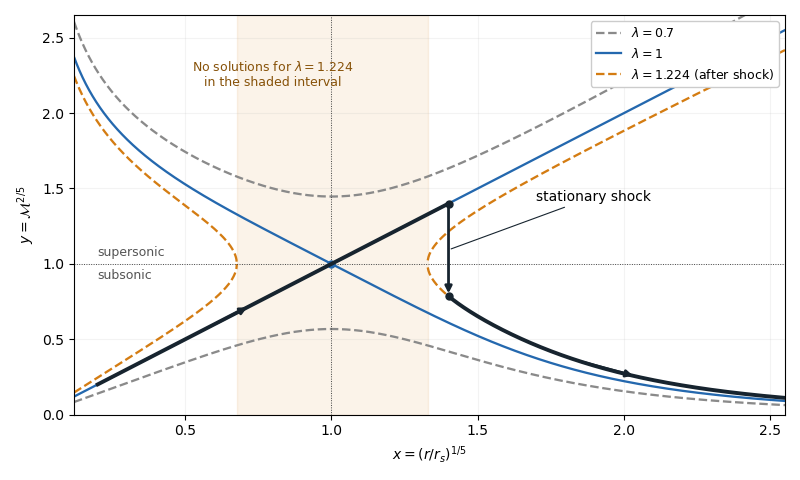
For , , so decreases from infinity to its unique minimum , then increases to infinity. This completely determines the algebraic curves. For , there are two disconnected branches at every , one subsonic flow with and one supersonic flow with . For , the line and a decreasing branch meet at . Their slopes are and , since the leading expansion is . For , solutions exist only where : if solve , there is a forbidden interval . At either endpoint the two branches turn at and have an infinite slope.
A smooth sonic point needs ; hence a regular sonic transition requires and . The critical speed of a polytropic flow is then , and the allowed mass flux is . Here the subscript on denotes evaluation at the sonic point, rather than the isothermal sound speed convention used in the next solution.
The simple transonic branch is . Direct substitution givesThus the radial velocity has constant magnitude, while the mass density and pressure scale as and . For an outward fluid flow, this is a subsonic flow becoming a supersonic flow as its adiabatic sound speed decreases.
On the other transonic branch, decreases as increases. At large , the terms and dominate, giving . At small , the terms and dominate, giving . The resulting asymptotic expansions areFor inward fluid flow, these are the nearly static reservoir at infinity and the inner free fall region of Bondi accretion. The specific enthalpy is smaller than in the inner limit, which explains free fall. Reversing the radial velocity gives a decelerating outflow with the same profiles. The formal small- limit describes the point-mass model: if the spherical gravitating body has a finite surface, the exterior solution stops there.
A stationary, nonradiative normal shock wave conserves the mass flux and the sum , while the Newtonian gravitational potential is continuous across its thin layer. Hence and are unchanged. The entropy production in a perfect-gas shock increases , soMore explicitly, the Rankine-Hugoniot condition for gives, with upstream ,Thus the shock wave jumps vertically, at the same , from the supersonic flow to a subsonic flow on a larger- curve. The figure illustrates an outward flow on with a shock wave at ; the downstream subsonic flow has and continues to larger . The shock wave radius is an additional boundary-data choice, rather than being determined by the smooth equations alone.
Pinned article: Introduction to the OurBigBook Project
Welcome to the OurBigBook Project! Our goal is to create the perfect publishing platform for STEM subjects, and get university-level students to write the best free STEM tutorials ever.
Everyone is welcome to create an account and play with the site: ourbigbook.com/go/register. We belive that students themselves can write amazing tutorials, but teachers are welcome too. You can write about anything you want, it doesn't have to be STEM or even educational. Silly test content is very welcome and you won't be penalized in any way. Just keep it legal!
Intro to OurBigBook
. Source. We have two killer features:
- topics: topics group articles by different users with the same title, e.g. here is the topic for the "Fundamental Theorem of Calculus" ourbigbook.com/go/topic/fundamental-theorem-of-calculusArticles of different users are sorted by upvote within each article page. This feature is a bit like:
- a Wikipedia where each user can have their own version of each article
- a Q&A website like Stack Overflow, where multiple people can give their views on a given topic, and the best ones are sorted by upvote. Except you don't need to wait for someone to ask first, and any topic goes, no matter how narrow or broad
This feature makes it possible for readers to find better explanations of any topic created by other writers. And it allows writers to create an explanation in a place that readers might actually find it.
Figure 1. Screenshot of the "Derivative" topic page. View it live at: ourbigbook.com/go/topic/derivativeVideo 2. OurBigBook Web topics demo. Source. - local editing: you can store all your personal knowledge base content locally in a plaintext markup format that can be edited locally and published either:This way you can be sure that even if OurBigBook.com were to go down one day (which we have no plans to do as it is quite cheap to host!), your content will still be perfectly readable as a static site.
- to OurBigBook.com to get awesome multi-user features like topics and likes
- as HTML files to a static website, which you can host yourself for free on many external providers like GitHub Pages, and remain in full control

Figure 2. You can publish local OurBigBook lightweight markup files to either OurBigBook.com or as a static website.
Figure 3. Visual Studio Code extension installation.
Figure 5. . You can also edit articles on the Web editor without installing anything locally. Video 3. Edit locally and publish demo. Source. This shows editing OurBigBook Markup and publishing it using the Visual Studio Code extension. 
- Infinitely deep tables of contents:



All our software is open source and hosted at: github.com/ourbigbook/ourbigbook
Further documentation can be found at: docs.ourbigbook.com
Feel free to reach our to us for any help or suggestions: docs.ourbigbook.com/#contact