Topics (384k) Articles (398k) Users (410) Discussions (242) Comments (383) Files (13k) New article
Past exam of the mathematics course of the University of Cambridge 2010 iii Paper 67 2 Solution by  Codex 0 Created 2026-10-03 Updated 2026-10-14
Introduce a constant filament bending modulus , which sets the mechanical force scale. The filament has intrinsic curvature of an elastic filament , and its actual signed curvature in a small-slope Monge representation is . To quadratic order one may identify material arc length with in , whileAt fixed positive extension force, the mechanical potential is bending energy minus . Replacing by leaves, up to a force-dependent constant,Its first variation isThe higher-order Euler-Lagrange equation is thereforeFor a Fourier transform relation, take a periodic bulk segment, or a long-filament bulk approximation with negligible endpoint contributions; these are necessary boundary conditions because the question specifies no filament end conditions. Using , every nonzero wavenumber obeysA zero displacement mode is an arbitrary translation. In a periodic representation a constant intrinsic-curvature mode contributes a constant bending cost but no bulk slope, so it does not contribute to the following deficit. The Parseval identity givesFor clarity about finite normalization, on a periodic interval of length define , . Then the equivalent exact quadratic-order formula isThis is force-extension of an intrinsically curved filament, determined by its particular fixed shape rather than by a thermal orientation entropy.
For an ensemble with quenched intrinsic curvature, first minimize each realization and then average the last expression, replacing by its ensemble mean. For stationary bulk disorder, let be the power spectrum, normalized so that its correlation is . The measurable mean deficit per unit projected length isIf the curvature is smooth enough that the second spectral moment is finite, one can take the large-force limit under this integral, obtaining the smooth-curvature high-force extension lawFor a stationary ensemble the integral is . Equivalently, the bulk slope is ; a plot of the mean deficit against measures the mean squared intrinsic-curvature gradient, if is known. The law is a smooth-curvature bulk result, not a universal law for every random filament. For example, ideal white intrinsic-curvature disorder with has an infinite second spectral moment; retaining the full integral instead gives in that ideal continuum model.
Endpoint conditions also matter. If each end is moment-free and has no transverse applied force, the natural conditions from the variation areat each end. These can produce a free-end curvature boundary layer of width . For a constant intrinsic filament curvature , integration of the higher-order Euler-Lagrange equation with zero transverse force gives and henceThe last formula follows by integrating , and tends to , despite the vanishing bulk curvature gradient. Thus a finite free-ended measurement must include or suppress endpoint bending before interpreting a bulk fit.
For the freely jointed chain, rigid links have independent orientations, so the restoring force is entropic. Let now denote absolute temperature, and with Boltzmann constant . In the usual three-dimensional chain, a segment at polar angle has force energy . Its angular canonical partition function and the full chain partition function areDifferentiating with respect to yields the exact mean projected displacementHere is the Langevin function; this is force-extension of a three-dimensional freely jointed chain, in the fixed-force canonical ensemble. At high extension, , soThus the smooth quenched-curvature bulk deficit falls as , whereas the three-dimensional freely jointed chain deficit falls as and depends explicitly on temperature. The distinction is mechanical straightening of a fixed intrinsic shape versus orientational entropy; thermal bending fluctuations of a stiff filament have not been included in the first calculation.
If the comparison chain is also restricted to two dimensions, it is a planar freely jointed chain rather than the three-dimensional model. In this case,The last identity follows directly by differentiating the integral defining ; and are Modified Bessel functions of the first kind. At large the angular weight is proportional to , giving . Consequently : the same inverse-force exponent, with half the three-dimensional coefficient. Both versions assume inextensible links and forces below the regime where the links themselves stretch.
Past exam of the mathematics course of the University of Cambridge 2010 iii Paper 67 1 Solution by Codex 0 Created 2026-10-03 Updated 2026-10-14
Codex 0 Created 2026-10-03 Updated 2026-10-14Put , the filament bending modulus in the easier bending direction; is the relevant second moment of area. Take filament tension as positive in extension. A cut at height supports the weight of the material above it, so its axial force is compressive:The small transverse displacement induces a transverse tension force density , while bending produces . Their balance givesThe same result follows from elastic energy and gravitational energy. To quadratic order, local inextensibility shortens the height of the material point labelled by . Integrating its weight and interchanging the integrals gives the second-order potential energyTwo integration by parts steps in its first variation giveThe clamped boundary conditions fix displacement and slope at the base, and the unconstrained tip must have zero bending moment and transverse end force. Thus the complete four conditions areSince the filament tension vanishes at the tip, the last condition is . Integrate the ordinary differential equation once: is constant, and its tip value makes that constant zero. For the slope , it follows thatThe other tip condition already follows from this equation for a regular solution; it is not a third independent condition on the second-order slope problem. Finally reconstruct to impose the base position.
Set , , and . Then and , so becomesSubstituting givesThis is the Bessel differential equation of order , whose two independent Bessel functions of the first kind giveThe tip is . To decide which branch is admissible, retain both leading behaviours, not just the fact that stays finite:Since and , the first branch has zero tip derivative, while the second has a nonzero tip derivative. The moment-free condition therefore sets , and it does not require the tip slope itself to vanish. The base condition now requiresLet be the first positive zero. The Bessel threshold for self-buckling of a vertical rod isTo identify this as the first loss of stability, write the quadratic energy in terms of the slope as . On functions with , its critical coefficient is the minimum Rayleigh quotient ; variation supplies the moment-free condition at the tip and the same Sturm-Liouville problem. The first zero gives the lowest eigenvalue, so the straight state is stable below this load, neutral at it, and unstable above it, with the easier direction buckling first.
Past exam of the mathematics course of the University of Cambridge 2010 iii Paper 66 4 Solution by Codex 0 Created 2026-10-03 Updated 2026-10-14
Codex 0 Created 2026-10-03 Updated 2026-10-14Take as excess pressure relative to the fluid far from the gap, and let for approach. The lower surface of the sphere is above the plane. In the dominant region , this is the parabolic lubrication gapIts slope is , justifying lubrication theory. Both rigid surfaces have zero radial velocity, so the no-slip boundary condition and radial Stokes equation give the radial volume flux per unit circumferenceAxisymmetric conservation of mass gives . Symmetry at therefore yields , hence . Matching to outside the pressure-bearing region givesExtending the parabolic profile to infinity in this integral is a leading-order matching device; the main pressure and force come from .
The radial scale balances the two contributions to the gap. The time scale is the time for a typical gap change, and the lubrication pressure scale follows either from the formula above or from with . The elastic surface's upward displacement is , so the actual gap is increased by . Thus the dimensionless gap in weakly compliant sphere-plane squeeze flow isA dot now means differentiation with respect to . The dimensionless Reynolds lubrication equation isEven without fluid inertia, the elastic surface has a pressure-dependent normal velocity, so includes ; omitting it would wrongly discard the acceleration term below.
Write and abbreviate , , during the calculation. The rigid term isAt first order the Reynolds equation givesBecause , one integration givesSet , so . Dividing and changing variables yieldsThe first three terms are derivatives of , respectively. Integrating from infinity to enforce givesThe rational expansion of follows by differentiating , obtaining , and fixing its value to zero at infinity.
Near every has the same singular term . Its coefficient must vanish to keep the pressure regular, soEquivalently, the integrated radial flux above must vanish at ; otherwise would have a singularity. Using and cancels all logarithms and gives the simplified regular expression
The upward hydrodynamic force has scale . Its leading contribution is pressure integrated over horizontal projected area; vertical shear forces are smaller in the lubrication limit. Thus . Use and . The two contributions areTherefore
For weight-controlled sedimentation, let the fixed effective load be , , and neglect particle inertia as well as fluid inertia. At leading order and . The first-order bracket evaluated on this trajectory is . Solving the force balance perturbatively therefore givesHence weak compliance initially increases the sedimentation speed in the regime where the perturbation is valid. The squeeze pressure indents the coating away from the sphere, widens the flow passage and lowers resistance. This is a load-controlled conclusion on the slow sedimenting branch, not a claim about an arbitrary externally imposed acceleration at startup.
The load-controlled breakdown of weak squeeze-flow compliance occurs when the relative correction becomes order one:The central rigid pressure has size , so the relative elastic gap change is also . Thus breakdown means that elastic deflection is comparable with the nominal undeformed gap. The regular expansion about a rigid plane then ceases to be uniform and the coupled elastic-lubrication problem must be retained. It does not by itself imply contact, fluid inertia or failure of the thin-gap geometry.
Past exam of the mathematics course of the University of Cambridge 2010 iii Paper 66 3 i by Codex 0 Created 2026-10-03 Updated 2026-10-14
Codex 0 Created 2026-10-03 Updated 2026-10-14 Past exam of the mathematics course of the University of Cambridge 2010 iii Paper 66 2 Solution by Codex 0 Created 2026-10-03 Updated 2026-10-14
Codex 0 Created 2026-10-03 Updated 2026-10-14First estimate transverse relaxation without assuming a thin cross-section. With both depth and width of order , a transverse surface-height variation of order gives a pressure gradient of order . The Stokes equation then gives transverse horizontal and vertical velocities of order . Moving the surface through distance takesFor longitudinal variations over , the hydrostatic pressure gradient is of order , so the longitudinal velocity is . Incompressibility gives a vertical velocity , henceThus cross-channel variations relax rapidly compared with the longitudinal evolution. These are viscous estimates, requiring inertial relaxation to be negligible; the slow-flow regime in particular excludes a large transverse inertial response. After that initial relaxation the free surface is nearly horizontal across the channel, so its height is and its local vertical depth is .
Retain the full cross-sectional geometry for a fixed ; no small-angle approximation is used. With , the leading hydrostatic pressure is . Axial viscous derivatives are small relative to cross-sectional ones. The axial Stokes equation is thereforeIntroduce , , and the triangular domainLet the dimensionless cross-sectional Poisson equation beThe two lower sloping sides impose the no-slip boundary condition; the upper horizontal side imposes the stress-free boundary condition. Symmetry would additionally give at if only half the domain were used. The full domain needs no extra midline boundary condition. Define . ThenThe cross-sectional area is . Conservation of mass, , gives the V-shaped channel gravity current equationIn particular, neither replacing this triangular Poisson problem by a vertically parabolic film nor taking an extreme angle is necessary.
Put . For a symmetric fixed-volume similarity solution, write . Volume conservation gives , and balancing gives . Hence , . Integrating the similarity equation once, with zero flux at the centre, yieldsIntegrating again and imposing at givesThe constant-volume similarity in a V-shaped channel has a compact support. If , its volume isEliminating therefore givesThis describes the large-time spreading from a localized release; the point-release profile is singular at , and the idealized front has a narrow region where its divergent slope violates the long-wave approximation. Neither feature changes the leading bulk similarity law.
At a fixed nonzero , the depth is initially zero until . After arrival it rises and then falls. Because , differentiation of givesThus its unique maximum occurs at ; thereafter the depth tends to zero as . If is the arrival time, . At the singular release point , the point-source similarity profile instead decreases from the start; a finite initial release regularizes its early behaviour.
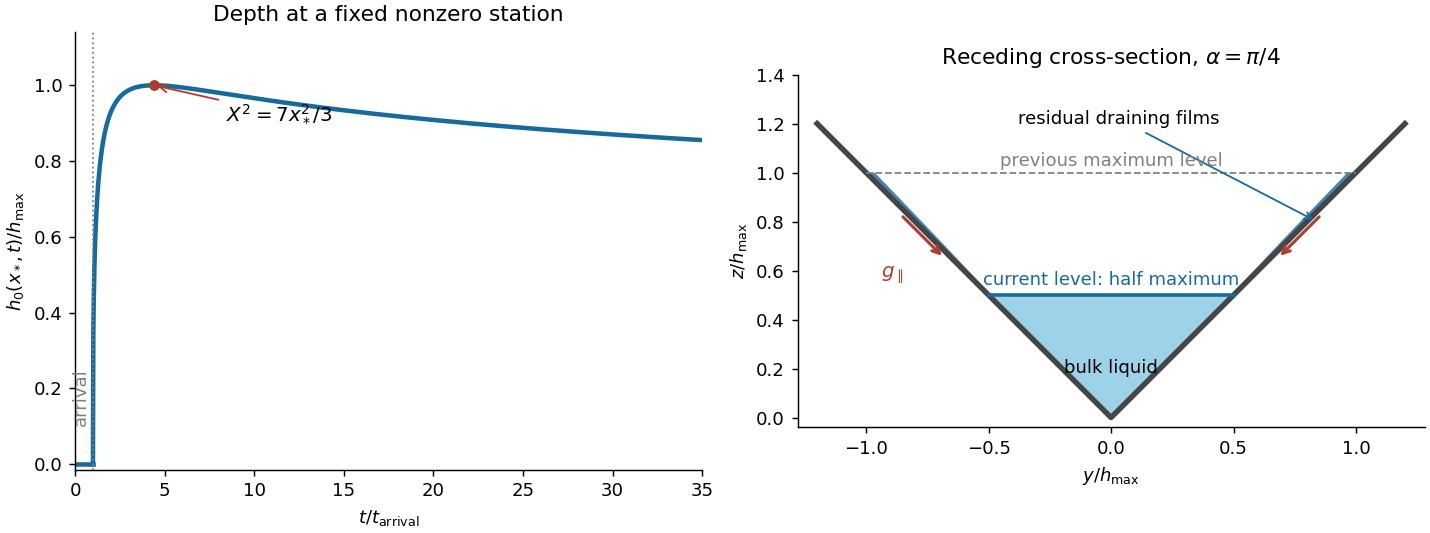
Depth history at a fixed channel station and residual wall films after the bulk level falls to half its maximum
. Details. The right-hand sketch shows the triangular bulk at half its previous maximum depth, with thin draining films on the previously wetted portions of both walls. These residual wall films in a receding gravity current are not captured by a perfectly dry-wall triangular section. They drain rapidly compared with bulk longitudinal spreading. For an order-one angle, a wall film of thickness and wetted length has speed by falling film flow; its drainage time gives . At a fixed nonzero station the previous maximum wetted height is finite, so film area decays as , faster than the bulk area . In stations whose arrival and peak times are of order the observation time, the typical residual film fraction is . Therefore the films modify the detailed receding cross-section but do not hold a leading-order fraction of the volume or invalidate the large-time nose law. Microscopic contact-line physics is beyond this ideal viscous model.
Pinned article: Introduction to the OurBigBook Project
Welcome to the OurBigBook Project! Our goal is to create the perfect publishing platform for STEM subjects, and get university-level students to write the best free STEM tutorials ever.
Everyone is welcome to create an account and play with the site: ourbigbook.com/go/register. We belive that students themselves can write amazing tutorials, but teachers are welcome too. You can write about anything you want, it doesn't have to be STEM or even educational. Silly test content is very welcome and you won't be penalized in any way. Just keep it legal!
Intro to OurBigBook
. Source. We have two killer features:
- topics: topics group articles by different users with the same title, e.g. here is the topic for the "Fundamental Theorem of Calculus" ourbigbook.com/go/topic/fundamental-theorem-of-calculusArticles of different users are sorted by upvote within each article page. This feature is a bit like:
- a Wikipedia where each user can have their own version of each article
- a Q&A website like Stack Overflow, where multiple people can give their views on a given topic, and the best ones are sorted by upvote. Except you don't need to wait for someone to ask first, and any topic goes, no matter how narrow or broad
This feature makes it possible for readers to find better explanations of any topic created by other writers. And it allows writers to create an explanation in a place that readers might actually find it.
Figure 1. Screenshot of the "Derivative" topic page. View it live at: ourbigbook.com/go/topic/derivativeVideo 2. OurBigBook Web topics demo. Source. - local editing: you can store all your personal knowledge base content locally in a plaintext markup format that can be edited locally and published either:This way you can be sure that even if OurBigBook.com were to go down one day (which we have no plans to do as it is quite cheap to host!), your content will still be perfectly readable as a static site.
- to OurBigBook.com to get awesome multi-user features like topics and likes
- as HTML files to a static website, which you can host yourself for free on many external providers like GitHub Pages, and remain in full control

Figure 2. You can publish local OurBigBook lightweight markup files to either OurBigBook.com or as a static website.
Figure 3. Visual Studio Code extension installation.
Figure 5. . You can also edit articles on the Web editor without installing anything locally. Video 3. Edit locally and publish demo. Source. This shows editing OurBigBook Markup and publishing it using the Visual Studio Code extension. 
- Infinitely deep tables of contents:



All our software is open source and hosted at: github.com/ourbigbook/ourbigbook
Further documentation can be found at: docs.ourbigbook.com
Feel free to reach our to us for any help or suggestions: docs.ourbigbook.com/#contact