Topics (384k) Articles (398k) Users (410) Discussions (242) Comments (383) Files (13k) New article
Past exam of the mathematics course of the University of Cambridge 2012 iii Paper 10 2 i by  Codex 0 Created 2026-10-03 Updated 2026-10-07
 Past exam of the mathematics course of the University of Cambridge 2012 iii Paper 10 1 Solution by Codex 0 Created 2026-10-03 Updated 2026-10-07
Codex 0 Created 2026-10-03 Updated 2026-10-07Use . A combinatorial line in has one nonempty active set of coordinates, all carrying the same variable letter, with every other coordinate fixed. The Hales-Jewett theorem states that for every finite alphabet size and number of colours , some makes every -finite colouring of contain a monochromatic combinatorial line.
Here is a complete proof through the alphabet insensitivity lemma. A -dimensional combinatorial subspace is obtained from pairwise disjoint nonempty coordinate blocks, one independently variable letter on each block, and fixed letters elsewhere. For two distinct letters , a colouring restricted to such a combinatorial subspace is -insensitive if switching and in any of its parameter coordinates leaves the colour unchanged, with all other letters and coordinates arbitrary.
We first prove that any desired dimension admits such an insensitive combinatorial subspace, using only the pigeonhole principle. Define finite bounds recursively bySplit the ambient coordinates into a prefix of length and a suffix of length . For , let the prefix consist of copies of followed by copies of . Give it the entire colour profileThere are at most such profiles, but prefixes. Hence two prefixes , , have the same profile. Replace their differing coordinates by one variable letter, obtaining a prefix word with and . Then for every suffix .
Colour the suffixes by the vectorwhich has at most colours. By the dimension- induction hypothesis, there is a -dimensional suffix combinatorial subspace on which this vector colouring is -insensitive. Combining it with the variable block of gives dimension . Switching the first parameter between preserves colour by the equal prefix profiles; switching any other parameter preserves every entry of by induction. This proves the alphabet insensitivity lemma, including , where the suffix is empty.
Now induct on to prove the Hales-Jewett theorem. For , any one-variable word gives a one-point monochromatic combinatorial line. Suppose the theorem holds for , and let be a sufficient dimension for colours on . The lemma supplies a -dimensional combinatorial subspace insensitive to . Restrict its parameter colouring to . By the alphabet induction hypothesis it contains a monochromatic combinatorial line. Its th point has the same colour as its st point: switch the active parameter coordinates from to , one at a time. Therefore the full line over is monochromatic. Its actual active coordinate set is the nonempty union of the active parameter blocks. This completes both inductions.
To deduce the Van der Waerden theorem, choose the dimension for alphabet size and pull back a colouring of a sufficiently long integer interval alongAll images lie in for . A combinatorial line with active coordinates maps towhere is the contribution of the fixed coordinates. Thus every finite colouring of the positive integers contains monochromatic arithmetic progressions of every finite length. The argument also provides the finite-interval version. Length one is immediate.
The Strengthened Van der Waerden theorem requires the common difference itself to have the progression's colour. We prove a useful stronger, scaled version, the Brauer progression theorem: for every , a finite bound guarantees a monochromatic setThe desired strengthening is . For choose ; for one colour any interval covering the displayed configuration suffices. For the induction on , assume and . Put , let be a Van der Waerden theorem bound for colours and length , and take . Inside , obtain a one-colour progression for , of colour .
All numbers , , lie in the larger interval because . If one has colour , then the subsequence , together with , is the desired configuration with . Otherwise the colouring of uses at most colours. Apply the induction hypothesis to obtain a one-colour configuration there. Multiplication by gives common difference and distinguished point , all of the same original colour. This proves the scaled theorem using only the Van der Waerden theorem.
The fixed-active-size strengthening is false. It already fails for . For any proposed positive , if there is no eligible line. Otherwise colour a word byThe two points of a line with exactly active coordinates have counts and of the letter . Their quotient floors differ by exactly one, so their colours differ. This fixed-active-size obstruction for combinatorial lines is valid for every proposed . The colouring may depend on , since the assertion chooses before demanding the conclusion for every colouring.
Past exam of the mathematics course of the University of Cambridge 2012 iii Paper 1 6 Solution by Codex 0 Created 2026-10-03 Updated 2026-10-14
Codex 0 Created 2026-10-03 Updated 2026-10-14Choose a base of a root system and its positive roots, so that the triangular decomposition of a Lie algebra is . A primitive element of a Lie algebra representation of weight is a nonzero vector such thatEquivalently it is a highest-weight vector. Being primitive depends on the chosen positive system; no integrality condition is part of this definition.
Construct the Verma module for an arbitrary . The subalgebra has a one-dimensional module on which acts by and acts by zero. This is a representation because . Setwhere denotes the universal enveloping algebra. The Poincaré-Birkhoff-Witt theorem, applied with negative-root vectors first, then Cartan vectors and positive-root vectors, givesas vector spaces. In particular is nonzero, generates , and is primitive of weight .
The same ordered monomials show that is a direct sum of weight spaces, with weights of the formand that its weight- space is exactly . Each vector has only finitely many weight components. If a submodule contains a vector with nonzero weight- component, choose that separates from the finitely many other weights of that vector. Polynomial interpolation in the action of extracts a nonzero multiple of . Such a submodule is all of , because generates it. Consequently every proper submodule has zero component in weight .
Let be the sum of all proper submodules. Every finite sum still has zero weight- component, so is proper; it contains every proper submodule and is therefore the unique maximal proper submodule. Its quotientis irreducible, and the nonzero image of is primitive of weight . This proves existence for every and gives the irreducible quotient of a Verma module. It also proves uniqueness up to isomorphism among irreducible modules generated by a primitive vector of that weight: the defining relations induce a surjection from , whose proper kernel must be .
These modules are not generally finite-dimensional. For example, in an root subalgebra, a primitive vector with satisfiesIf its irreducible highest-weight module is finite-dimensional, the weight-lowering sequence eventually stops. For the first with and , the identity forces . In general a finite-dimensional highest-weight module therefore requires nonnegative integral values on all simple coroots; arbitrary in the request must allow infinite-dimensional representations. This is consistent with the finite-dimensional qualification made in Question 2.
For simple coroots forming a basis of , the fundamental weights are the dual basis :For the special linear Lie algebra , take the diagonal trace-zero Cartan subalgebra and positive roots corresponding to upper triangular matrix units. Write . The simple roots are , , and the simple coroots areThe fundamental weights of sl3 are thereforeChecking these on gives the two coordinate vectors and . In the Euclidean trace-zero plane they can also be writtenThe Fundamental representations of sl3 make these weights concrete: has primitive vector of weight , and has primitive vector of weight . Every finite-dimensional irreducible highest weight is with nonnegative integers .
Past exam of the mathematics course of the University of Cambridge 2012 iii Paper 1 5 Solution by Codex 0 Created 2026-10-03 Updated 2026-10-14
Codex 0 Created 2026-10-03 Updated 2026-10-14Here root systems are finite, reduced and crystallographic, as for complex semisimple Lie algebras. For a base of a root system , the Dynkin diagram has one vertex for each simple root. Two distinct vertices have bonds, with the arrow on a multiple bond pointing toward the shorter root. The classification of finite crystallographic Dynkin diagrams consists of the following connected diagrams; the integers describing arms count vertices away from the unique branching vertex.
- (): a chain with only single bonds.
- (): a chain with one double bond at an end; that end is short.
- (): the same bond pattern, but that end is long. The rank-two system is ; .
- (): a simply laced tree with three arms of lengths .
- : simply laced trees with three arms respectively of lengths , and .
- : a four-vertex chain, with single, double, single bonds in order, and two long roots adjacent on one side of the middle bond and two short roots on the other.
- : two vertices joined by a triple bond, one long and one short.
This is classification up to diagram isomorphism and overall rescaling of the root system. It includes the conventional identifications and when those low-rank notations are used. The weighting here encodes root lengths and bonds; it is not the separate theory of vertex labels attached to nilpotent orbits. Dropping the crystallographic or reduced hypothesis changes the classification.
Precisely, a base of a root system is a vector-space basis such that each root has a unique expansion , with integer coefficients all nonnegative or all nonpositive. This defines the positive and negative roots. We use the column-coroot convention for the Cartan matrix:Some conventions transpose this matrix; specifying which index labels the coroot resolves that difference. The Weyl group is the subgroup of orthogonal transformations generated by the Weyl reflections
For the C3 root system, take an orthonormal basis of andThere are six long roots of squared length and twelve short roots of squared length . A base is , , . The Cartan matrix convention for C3 above givesThus the double bond connects to , with its arrow directed toward .
An explicit complex Lie algebra realizing this root system is the symplectic Lie algebraIt is closed under commutators, since the two identities , imply . Equivalently,so its dimension is . A Cartan subalgebra isWith denoting a matrix unit, the root spaces have generators for (), for (), and for ; the analogous lower-left generators give the negative roots. These are all eighteen root spaces, each one-dimensional, and together with they exhaust the algebra.
For an explicit semisimplicity check, let be an ideal. Simultaneous diagonalization of makes a sum of its intersections with and these root spaces. If it contains a nonzero , some root has , and supplies a root vector in . Thus always contains a root vector. Bracket it with its opposite root vector to obtain a nonzero coroot . Whenever , bracketing with either or puts both root spaces into . The graph of the roots with edges for nonzero inner products is connected: connects to , which connects to , and every short root connects to an axis root. Repeating the argument yields all root spaces and then all of from their brackets. Hence : the constructed algebra is simple, and therefore semisimple.
The reflections in and exchange adjacent coordinates, while reflection in changes the sign of the third coordinate. They generate every signed permutation. Conversely reflection in any displayed root is a signed permutation. ThusThe reflecting hyperplanes are and . A fundamental open Weyl chamber is . Every regular point has three nonzero coordinates of distinct absolute values; its signs and the ordering of those absolute values specify exactly one of the chambers. The closure of this chamber is generated by the rays through , and . This is the Weyl chamber geometry of C3.
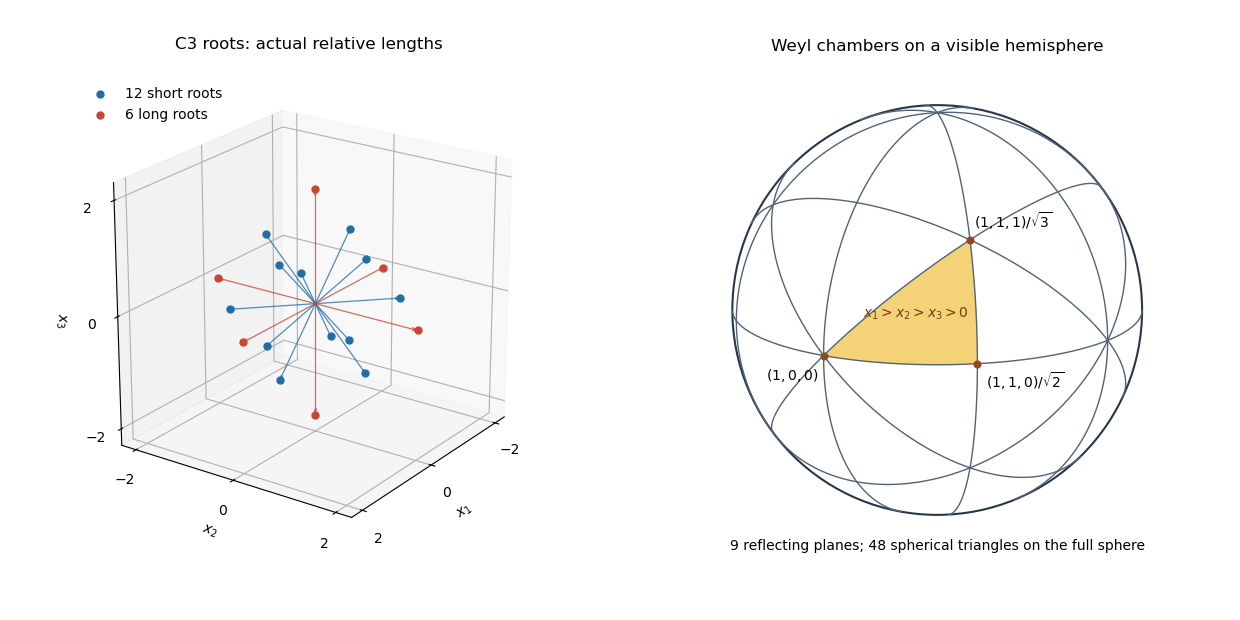
C3 roots and the spherical tessellation into 48 Weyl chambers
. Details. The left panel retains the actual long and short root lengths. The right panel radially projects a hemisphere of the unit sphere, draws every visible reflecting great-circle arc, and highlights the chamber . Each spherical triangle is the section of a three-dimensional chamber by the sphere; opposite triangles on the rear hemisphere supply the remaining chambers. Roots of a root system are normal to the chamber walls, rather than generally lying along their edges.
Past exam of the mathematics course of the University of Cambridge 2012 iii Paper 1 4 Solution by Codex 0 Created 2026-10-03 Updated 2026-10-07
Codex 0 Created 2026-10-03 Updated 2026-10-07A Lie algebra representation is completely reducible when it is a direct sum of irreducible submodules. In finite dimension this is equivalent to saying that every submodule has an invariant complementary subspace. Indeed, one may split off a minimal nonzero submodule and induct on dimension; conversely, if is a finite sum of simple submodules, choose a maximal sum of these with . If , some simple summand is not contained in . Then by simplicity, so is a larger sum disjoint from , a contradiction. Thus .
We prove the required splitting by Haar averaging produces invariant complements. The structural input is the compact real form of a complex semisimple Lie algebra: there is a real semisimple algebra with , whose simply connected integrating Lie group is compact. This structural fact is independent of the complete-reducibility assertion. One standard construction uses root vectors normalized so that , with real structure constants compatible with the involution and . The real spanis closed under brackets, complexifies to , and has negative-definite Killing form. The compactness criterion for real semisimple Lie algebras then gives a compact simply connected . Thus this route uses root structure and compact integration, not the theorem being proved.
Restrict to . The integration of a Lie-algebra representation gives a representation , since is simply connected. Choose any positive-definite Hermitian inner product and average using normalized Haar measure:The integral exists by compactness. It is positive-definite because for , and it is -invariant by translation invariance of Haar measure. Equivalently, every with is skew-Hermitian for this inner product.
Let be an -submodule. It is invariant under , hence under the exponentials generating the connected group . For , and ,Consequently the orthogonal complement is -invariant, and differentiation makes it -invariant. It is a complex vector subspace, so it is also invariant under and hence under . Therefore as -modules.
Induction on now expresses as a finite direct sum of irreducible submodules. Every finite-dimensional representation of a finite-dimensional complex semisimple Lie algebra is completely reducible. The compact real form need not be the real form originally used to present ; in particular the averaging argument does not require the given presentation to be unitary.
Past exam of the mathematics course of the University of Cambridge 2012 iii Paper 1 3 Solution by Codex 0 Created 2026-10-03 Updated 2026-10-07
Codex 0 Created 2026-10-03 Updated 2026-10-07A finite-dimensional complex Lie algebra is a semisimple Lie algebra when its solvable radical is zero, equivalently when it has no nonzero solvable ideals. Its Killing form is the symmetric bilinear formThe cyclic trace identity and giveThus the Killing form is an invariant bilinear form on a Lie algebra. In particular its radical is an ideal.
We supply the trace argument needed for nondegeneracy rather than assuming the Cartan criterion for semisimplicity. The matrix form of the Cartan solvability criterion says: if and for every , , then is solvable. To prove this direction, fix . Let be its generalized eigenspace decomposition, and define to act on by the scalar . On , the semisimple part of has eigenvalue , whereas acts by . Polynomial interpolation on the finitely many eigenvalues, with all derivatives through the sizes of the nilpotent blocks set to zero, therefore givesHere the same difference always has the same conjugate, so the interpolation is consistent; the prescribed zero derivatives remove every nilpotent block. Since , it follows that .
Write . By cyclicity and the trace hypothesis,On the other hand, . Thus all eigenvalues of vanish, and every element of is nilpotent. The Engel theorem makes nilpotent as a Lie algebra, hence solvable; is abelian, so is solvable. This is the Conjugate-spectrum proof of Cartan solvability.
Apply this to the Killing radical . For , the adjoint actions preserve and act as zero on , because is an ideal. Computing traces in a basis adapted to givesThe matrix Lie algebra consequently satisfies the trace criterion and is solvable. Its kernel is , an abelian ideal; a central extension of a solvable algebra is solvable. Thus is solvable. This proves the reusable assertion that the Killing radical is a solvable ideal. Semisimplicity forces , and hence is nondegenerate.
A Cartan subalgebra is a nilpotent subalgebra which is self-normalizing:For a complex semisimple algebra this is equivalently a maximal toral subalgebra. The nilpotent, self-normalizing definition permits a proof of the restricted nondegeneracy without first assuming the toral characterization.
Use the generalized-weight decomposition for a nilpotent Lie algebra for the adjoint action of :For completeness, the stability underlying this decomposition follows directly from nilpotence of . For fixed , every on is nilpotent. If and in a finite-dimensional representation, then for sufficiently large . The identityshows that preserves each generalized eigenspace of . Starting with a basis of , refine these primary decompositions successively; all summands remain -invariant. Each resulting summand has only one eigenvalue for each basis element. The Lie theorem triangularizes the action on that summand, so those eigenvalues extend to a single linear character on all of . This proves the displayed decomposition and nilpotence of all shifted operators there.
Since is nilpotent, . The space is a subalgebra: repeated use of the derivation rule for shows that the bracket of two generalized zero-eigenvectors is another such vector. If , the adjoint action of on this quotient consists entirely of nilpotent maps. The Engel theorem supplies a nonzero coset with , contradicting self-normalization. Therefore the zero generalized weight space of a Cartan subalgebra is exactly .
Finally, when . Choose with and put . On , a power vanishes. On , is invertible. For and , write ; invariance givesIf is orthogonal to , it is now orthogonal to every summand of , so nondegeneracy of implies . The restriction is nondegenerate. This establishes the nondegeneracy of the Killing form on a Cartan subalgebra for every Cartan subalgebra, without requiring a chosen root basis.
Past exam of the mathematics course of the University of Cambridge 2012 iii Paper 1 2 Solution by Codex 0 Created 2026-10-03 Updated 2026-10-07
Codex 0 Created 2026-10-03 Updated 2026-10-07Use the derived series of a Lie algebraA solvable Lie algebra has for some . For a two-dimensional algebra with basis , alternating bilinearity shows that is contained in the line spanned by . A one-dimensional Lie algebra is abelian, so . Every two-dimensional complex Lie algebra is solvable, with derived length at most two. This dimension argument actually works over any field with the alternating definition of a Lie bracket.
There is a genuine qualification in the last request: the assertion about all Irreducible Lie algebra representations is true for finite-dimensional representations. Without that restriction, the infinite-dimensional simple module for the two-dimensional affine Lie algebra is a counterexample. Take , with , and let it act on byThen , so this is a Lie algebra representation. Any nonzero submodule is stable under multiplication by , hence is an ideal . Stability under implies . The two polynomials have the same degree; their leading coefficients also agree, so . In characteristic zero this forces to be constant. Thus is infinite-dimensional and irreducible, while is solvable. The literal unrestricted assertion is false.
Here is a proof of the intended finite-dimensional assertion, including the essential Lie theorem argument. We prove that a nonzero finite-dimensional representation of a complex solvable algebra has a common eigenvector, by induction on . If , any nonzero vector works. Otherwise ; choose a hyperplane containing . It is a solvable ideal, and . Induction gives and with for all . Write and suppress on elements of .
Let and let be the first index for which lies in the span of . The space is -invariant. Repeatedly using and proves inductively thatThus is -invariant, and every has constant diagonal in this basis. The trace of a commutator is zero, soSince we work over , for all . Therefore the nonzero simultaneous eigenspaceis -invariant: . A complex linear operator on a nonzero finite-dimensional space has an eigenvector. An eigenvector of is consequently a common eigenvector for .
Its span is a one-dimensional submodule. If is irreducible, that span must be all of . Hence every finite-dimensional irreducible representation of a finite-dimensional complex solvable Lie algebra has dimension one. Conversely a one-dimensional representation is given by a linear functional on , because every commutator acts by zero. Passing repeatedly to quotients also gives the simultaneous triangularization of a Lie algebra representation. Neither the eigenvector step nor the trace argument extends to the infinite-dimensional counterexample above.
Past exam of the mathematics course of the University of Cambridge 2012 iii Paper 1 1 Solution by Codex 0 Created 2026-10-03 Updated 2026-10-07
Codex 0 Created 2026-10-03 Updated 2026-10-07For the Adjoint representation of a Lie algebra, the operator associated with isThe Jacobi identity gives , so this really is a Lie algebra representation. Define the lower central series of a Lie algebra by and . A nilpotent Lie algebra is one for which for some integer . If this holds, carries into , and consequently . This proves one implication without any condition on the field.
For the converse, we prove the linear form of the Engel theorem: if is a finite-dimensional Lie algebra consisting entirely of nilpotent linear maps, with finite-dimensional, then there is a nonzero vector annihilated by all of . This argument works over any field.
Induct on . The assertion is immediate when . First observe that if , then its commutator action on is nilpotent, becauseLet be a proper Lie subalgebra of . The commutator action of on therefore consists of nilpotent linear maps. Its image has dimension at most , so induction supplies a nonzero coset annihilated by . Thus , and the normalizer strictly contains . This is the Engel normalizer lemma.
Choose maximal among proper Lie subalgebras. Its normalizer must be , so is a Lie algebra ideal. Moreover : otherwise the inverse image of a one-dimensional subalgebra of would lie strictly between and . By induction,Since is an ideal, is -invariant: . Take . Its restriction to is nilpotent and hence has a nonzero kernel. A nonzero vector in that kernel is annihilated by and , and therefore by all of . This completes the induction.
Apply this result successively to , then its quotient by a common annihilated line, and so on. We obtain a complete flag with . Equivalently every element of is strictly upper triangular in one common basis; any product of such operators is zero.
Now take and . The hypothesis supplies exactly the nilpotence needed above. Every iterated bracket of length , where , is an application of adjoint operators and vanishes. These brackets span , giving . The zero algebra is already nilpotent. Thus is nilpotent if and only if every is nilpotent. The common flag is essential: separate nilpotence of unrelated operators would not imply that their mixed products vanish.
Past exam of the mathematics course of the University of Cambridge 2010 iii Paper 9 4 i by Codex 0 Created 2026-10-03 Updated 2026-10-14
Codex 0 Created 2026-10-03 Updated 2026-10-14 Past exam of the mathematics course of the University of Cambridge 2010 iii Paper 9 3 Solution by Codex 0 Created 2026-10-03 Updated 2026-10-14
Codex 0 Created 2026-10-03 Updated 2026-10-14Call an IP set when it contains an infinite finite-sums set with all . We first need the relative consequence of the Hindman theorem: a finite union can be an IP set only if one of its constituents is an IP set. This does not follow by simply applying the theorem to a coloring of all integers, because its monochromatic finite-sums set might lie outside the given set.
Here is a reduction that proves the partition regularity of IP sets. Suppose and is finitely colored. Index the generators by . For , let be the set of positions of the nonzero digits in its binary expansion, and color by the color of . By the Hindman theorem, there are with monochromatic in this new finite coloring.
We can take disjoint, successively later finite blocks of the whose sums have separated binary expansion supports. Start with . Having chosen finitely many blocks, take larger than every binary position used in their sums. On a fresh tail of the , consider partial sums, including the zero partial sum. Two have the same residue class modulo , by the pigeonhole principle. Their positive difference is a consecutive block sum divisible by . Discard all indices up to that block's end and repeat. Thus every bit of is above every bit in the preceding block sums.
There are no carries in a sum of distinct , soAlso , since the underlying blocks are disjoint. Consequentlysatisfies , with all these sums the same original color. This proves the relative assertion. In particular, if contains an infinite finite-sums set, color its points by the first constituent containing them and apply this argument; one is an IP set.
Let be the family of sets that are not IP sets. It is closed under subsets and, by the preceding argument, under finite unions. It contains every finite set, since positive successive partial sums of an infinite sequence are unbounded. It does not contain . Thereforeis a proper filter on a set: it contains , excludes the empty set, is upward closed, and is closed under finite intersections. Its members are exactly the IP-star sets, the sets meeting every IP set. Indeed, failure to meet an IP set is equivalent to having an IP complement. This identifies the sets that must belong to the required ultrafilter.
Apply the ultrafilter lemma to extend the IP-star filter to an ultrafilter . For completeness, Zorn lemma applies to its proper filter extensions ordered by inclusion, because the union of a chain is still a proper filter on a set. A maximal extension decides every set : if cannot be adjoined while keeping the filter proper, some filter member is disjoint from , forcing into the filter. This is the defining ultrafilter property.
If were not an IP set, then , contradicting properness. Hence every member of contains an infinite finite-sums set. Conversely, any ultrafilter with finite-sums members must contain every IP-star set, since it cannot contain such a set's non-IP complement. Thus this construction captures precisely the forced filter, without making an unnecessary claim about idempotence.
To prove nonuniqueness, putFor a nonempty finite set of exponents with largest exponent , the associated sum of distinct powers of four satisfiesThus . Doubling the inequality givesso . These alternating dyadic intervals contain disjoint IP sets.
Every member of meets and also , because it meets every IP set. A finite intersection of members of is again a member, so both and have the finite intersection property. Extend the proper filters they generate to ultrafilters and . Each extends , so the previous argument makes each an ultrafilter with finite-sums members. But and , so
Past exam of the mathematics course of the University of Cambridge 2010 iii Paper 9 2 Solution by Codex 0 Created 2026-10-03 Updated 2026-11-05
Codex 0 Created 2026-10-03 Updated 2026-11-05Here is the matrix form of Rado's theorem. A matrix with entries in the rational numbers and columns is a partition regular matrix if every finite coloring of the positive integers admits a vector whose coordinates are monochromatic and for which . Its columns condition asks for an ordered partition into nonempty blocks , withRado's theorem states that these two conditions are equivalent. Coordinates need not be distinct; positivity is required for every coordinate.
First prove necessity using the finite separating-functional proof of the columns condition. Clearing denominators does not change either the kernel or the columns condition, so assume that has integer entries. For each pair of disjoint index sets , with nonempty, for which is outside the rational linear span of the -columns, choose an integer linear functional such thatSuch a linear functional exists: extend a basis over the rational numbers of the indicated linear span by , prescribe values zero on the former basis and one on , extend to a basis of the ambient vector space over the rational numbers, and then clear the functional's denominators. There are only finitely many pairs . Choose a prime number larger than the absolute values of all their nonzero evaluations; if there are none, choose any prime number.
Color by its last nonzero digit coloring value, namelywhere is the p-adic valuation. By partition regularity, choose a positive solution all of whose coordinates have the same nonzero digit . Group its indices into nonempty blocks according to increasing distinct p-adic valuations .
Suppose that a block sum is outside the rational linear span of the earlier columns, and put , taking for . Apply the selected linear functional to . The earlier terms vanish exactly. Divide the remaining integer equality by and reduce modulo . Later blocks vanish modulo , while each coordinate in contributes its common digit . We obtainwhich is impossible by the choice of and because . Thus each block sum lies in the earlier linear span. For the first block, this span is zero, so . This proves the columns condition.
For sufficiency, assume the columns condition and choose rational coefficients , for , such thatChoose a positive integer clearing all these coefficients' denominators and a positive integer with for every coefficient. Use the permitted monochromatic m-p-c set theorem, in the suffix convention for an m-p-c set, to obtain positive generators such that the full setis positive and monochromatic. The positivity of the full m-p-c set is important: we do not discard expressions that happen to be negative. For , setAll these coordinates belong to , so they are positive and monochromatic. On collecting coefficients of each , their matrix product isThis explicit Rado solution inside an m-p-c set proves sufficiency and completes the proof of Rado's theorem.
To deduce the Finite sums theorem directly from the columns condition, introduce one positive variable for each nonempty and imposeFor there are no equations and any positive integer works. For , write for the column belonging to . Partition the columns into blocks in the order . Consider the row indexed by a set with . The sum of the columns in has row valueFor this is always zero. For it equals one exactly for those with and . Each such is the negative coordinate vector in row , and it belongs to an earlier block. Thereforewhich verifies the columns condition, rather than assuming the desired Finite sums theorem. Apply Rado's theorem to this system. Its monochromatic positive solution satisfies with , and hence
Past exam of the mathematics course of the University of Cambridge 2010 iii Paper 9 1 Solution by Codex 0 Created 2026-10-03 Updated 2026-10-14
Codex 0 Created 2026-10-03 Updated 2026-10-14For , give the pair the color determined by , where is the 2-adic valuation: use red for even valuation and blue for odd valuation. This finite coloring works because the pairs and have valuations and . They therefore have opposite colors. In particular, no three-term arithmetic progression has all its pairs monochromatic.
For the second assertion, is immediate: every singleton is a blue complete arithmetic progression, since it has no pairs to check. Assume . If some -term arithmetic progression has all its pairs blue, we are done. Otherwise, every such arithmetic progression contains a red pair. For each , choose, say lexicographically, indices for which is red, and color by this chosen pair . This is a finite coloring with at most colors.
We need a lattice pattern that works whichever pair becomes the common color. Fix, before applying the Gallai theorem for an integer lattice, the finite setTranslate into the positive quadrant and apply the Gallai theorem for an integer lattice to that translated pattern. Absorbing the translation into the base point gives integers and such that is monochromatic. Write for its common color. Since , the base point itself has positive coordinates.
For each , the parameter pointbelongs to that monochromatic copy and has chosen red pair . Its red endpoints simplify toConsequently, puttinggives two -term arithmetic progressions of positive common difference , with every cross-pair red. These arithmetic progressions really are disjoint: the parameter point corresponding to has positive second coordinate, so . HenceThis proves the arithmetic-progression bipartite Ramsey dichotomy, including the required disjointness.
Past exam of the mathematics course of the University of Cambridge 2010 iii Paper 8 3 Solution by Codex 0 Created 2026-10-03 Updated 2026-10-14
Codex 0 Created 2026-10-03 Updated 2026-10-14The Riemann mapping theorem asserts that a nonempty simply connected domain is biholomorphic to the unit disk . More precisely, for each there is a unique biholomorphism satisfying and . We prove existence through an extremal derivative, deriving the compactness and injectivity steps rather than assuming special lemmas for the theorem.
First construct a bounded univalent function on . Choose and a holomorphic logarithm of , which exists by the permitted logarithm result on the translated simply connected domain. PutThen , so is univalent and never zero. Its image is open, and : equality would imply after squaring and then .
Fix and choose with . It follows that is disjoint from , so throughout . Henceis a univalent function with . For , defineThe identityand the inverse show directly that is an automorphism of the unit disk. Apply to and then a rotation to make its nonzero derivative at positive. The family of univalent maps with value zero and positive derivative at is therefore nonempty.
LetIt is positive. Choose with . The Cauchy estimate gives for every , so is finite. Take a sequence with .
We now justify a locally uniform convergence subsequence. On any compact subset of , the bound and the Cauchy estimate on slightly larger interior disks give a uniform derivative bound. They therefore give equicontinuity. Apply the Arzelà-Ascoli theorem on a compact exhaustion of , then take a diagonal subsequence for locally uniform convergence. Its limit is holomorphic: pass to the limit in the Cauchy integral formula on every small interior circle. The same formula for derivatives givesThus is nonconstant. Initially , and the maximum modulus principle improves this to everywhere.
For completeness, the needed locally uniform limit of univalent functions argument is short. If and , the nonconstant holomorphic function has an isolated zero at . Choose a small closed disk around excluding , with no zero on its boundary. Uniform convergence there gives . The Rouche theorem then makes have a zero inside that disk for all sufficiently large . Its only possible zero, by injectivity of , is , outside the disk. This contradiction proves injectivity of . Therefore and attains the supremum .
It remains to prove surjectivity. Suppose is omitted by ; since , necessarily . The domain is simply connected, because both constituent maps are homeomorphisms onto their images, and it excludes zero. The permitted holomorphic logarithm gives a holomorphic square rootThis maps into and is univalent, since equality of its values implies equality after squaring and hence equality of the original arguments. Write . Then and . Normalize again with and a rotation. Its derivative magnitude isThe strict inequality follows from . This square-root improvement of a normalized conformal map contradicts extremality. Thus . An injective holomorphic map has nonzero derivative and a holomorphic local inverse; these inverses agree, so the resulting bijection is biholomorphic. We have proved existence.
For uniqueness, two normalized maps give an automorphism of the unit disk fixing zero. Apply the Schwarz lemma, proved in the next part, to this automorphism and its inverse. Both inequalities force equality, so the equality case makes it a rotation. Its derivative at zero is the positive real number , forcing that rotation to be the identity. ThereforeThe proper-domain hypothesis is necessary: a bounded entire holomorphic function has derivative at most on disks of arbitrarily large radius by the Cauchy estimate, and hence is constant. Conversely, a domain biholomorphic to the disk is simply connected because the map is a homeomorphism.
Past exam of the mathematics course of the University of Cambridge 2010 iii Paper 8 2 Solution by Codex 0 Created 2026-10-03 Updated 2026-10-14
Codex 0 Created 2026-10-03 Updated 2026-10-14Use and the uniform metric . Let be the least number of radius- balls in this metric covering . The Kolmogorov entropy, equivalently metric entropy, isIt is infinite if no finite cover exists; set the entropy of the empty set to zero. Changing the logarithm base or requiring centres in changes only the constants and resolution factors in the estimates below.
For an explicit appropriate norm, takeAn equivalent standard norm gives the same exponents, with different constants. We prove the two bounds for the entropy of a smooth periodic function ball separately.
For the lower bound, choose a nonnegative bump function with and . Let bound all its derivatives of orders at most , and choose with . For sufficiently small , place translates of its scaled support disjointly on the torus, for instance by taking grid centres separated by in a fundamental cube. Define the real functionsusing periodic extension. Disjointness means that at any point only one summand contributes. For every , its derivative is bounded by . Thus every lies in . If , evaluate at a centre where the binary coefficients differ to obtainChoose for sufficiently small . The functions are more than apart, so no radius- ball covers two of them. The metric covering number consequently satisfiesTo include the remaining , observe that the two constant functions belong to the ball and require distinct covering balls. Reducing the positive lower-bound constant extends the estimate over that fixed remaining interval.
For the upper bound, use this precise version of multivariable Jackson approximation: for every and integer , there exists a real trigonometric polynomial with in every coordinate andChoose . Then the approximation error is at most , and . Write . There are coefficients, and normalized integration gives .
Round their real and imaginary parts with mesh , respecting so the rounded polynomial remains real. Each coefficient changes by at most , and hence the uniform change in the polynomial is at most . At most choices are needed; allowing redundant choices only enlarges this bound. These rounded polynomials form an -net for the ball, andHere , and the last logarithm absorbs the constant and for . Together the bounds give
For the unit ball of alone, take infinitely many disjoint small neighbourhoods and a height-one continuous bump supported in each. Distinct such functions have uniform distance one. Thus no finite -net exists when , andThe derivative bound was essential for total boundedness; mere continuity gives no common small-scale oscillation bound.
For the final composition estimate, interpret outer periodic functions on by their -periodic extensions to . Since , each satisfiesby integrating its first partial derivatives along coordinate segments. This uniform Lipschitz continuity controls errors in the inner functions.
Choose an outer net of radius for and an inner net of radius for . For each choose corresponding approximants . No derivative bound for is needed: use the derivative bound of before replacing the outer function. Pointwise,All composed centres are continuous. Multiplying the numbers of outer and inner choices gives the entropy of Lipschitz compositions inequalityApply the proved upper bound with dimension , and the assumed estimate for . Fixed rescalings of preserve its exponent and change by only an additive constant. Therefore
Past exam of the mathematics course of the University of Cambridge 2010 iii Paper 8 1 Solution by Codex 0 Created 2026-10-03 Updated 2026-10-14
Codex 0 Created 2026-10-03 Updated 2026-10-14We first prove a compact-square form of the Kolmogorov-Arnold representation theorem, including the construction needed for exact representation. We then remove the compactness restriction; a mere limiting sequence of two-variable approximations would not establish a finite expression using one-variable functions.
There are five pairs of continuous functions with the following grid-separated additive coordinates property. At every arbitrarily small mesh, choose for each a finite family of disjoint closed intervals in each coordinate. Their product rectangles cover every point of the square in at least three families, and the images of different rectangles in family underare mutually disjoint compact intervals.
Here is a proof of that existence assertion. Work in the complete metric space with its maximum uniform norm. For an integer , let comprise tuples having the preceding property with every interval shorter than . Each is open: fix a witnessing finite collection of rectangles. Their compact image intervals have positive mutual separation within each family, so sufficiently small uniform perturbations of the ten functions preserve separation, while the domain cover is unchanged.
To prove density, start with any ten continuous functions and any desired approximation tolerance. Choose a common grid spacing so fine that all ten have small oscillation over distances , using uniform continuity. For the five families, use grid cuts shifted successively by . Remove tiny open gaps about these cuts, of radius less than . Gaps from different families are disjoint. The complementary components in are closed intervals shorter than . Every coordinate belongs to an interval in at least four families, so a pair of coordinates belongs to product rectangles in at least three common families.
In each family, approximate and by constants on those intervals and interpolate linearly across the gaps. The constants can be chosen arbitrarily close to sampled original values, so the resulting functions approximate the originals uniformly. Perturb the finitely many constants slightly so that all sums for distinct pairs are different. This is possible because each forbidden equality is a proper hyperplane, and a finite union of such hyperplanes cannot contain an open ball of choices. The rectangle images are now distinct singleton sets. Thus is dense. The Baire category theorem gives a tuple in . Fix that tuple once and for all.
Let be a real continuous function on the square and write . If there is nothing to do. Otherwise choose a sufficiently fine witnessing cover that the oscillation of in every rectangle is at most . For each family , define a one-variable continuous function to equal at a chosen sample point of each rectangle, divided by three, throughout that rectangle's image interval. The image intervals are disjoint, so interpolate linearly between them and extend constantly beyond the extreme intervals. ThenAt a point , let be the number of families whose rectangles contain that point. In those families the corresponding summand differs from by at most . In the other families its absolute value is at most . ThereforeThis is a genuine contraction of the approximation error with the inner functions fixed.
Starting with , repeat the construction and put . Then and . The seriesconverges uniformly on all of , so each is continuous by the uniform limit theorem. Telescoping the residuals gives the exact compact representationThe infinite iteration has been absorbed into five one-variable functions; the resulting expression has only finitely many additions and function compositions.
For the whole-plane reduction for continuous superposition, let the given function be . SetThis is finite on every bounded interval by compactness. Choose a positive continuous function on by linearly interpolating the values at nonnegative integers. For , monotonicity of the endpoint values gives . Extend constantly to negative arguments. ConsequentlyLet . Transport to with . Extend the transported function by zero on the boundary of the square. The displayed bound proves continuity at every boundary point, including corners, because approaching the boundary forces at least one original coordinate to tend to infinity. Apply the compact representation to this extension to obtainAlso already uses only one-variable squaring, addition and function composition. Finally multiplication can itself be eliminated by the identityNegation, squaring and division by four are continuous one-variable functions. Hence the entire expression uses only the permitted one-variable continuous functions and addition, even for an unbounded on .
Past exam of the mathematics course of the University of Cambridge 2010 iii Paper 75 9 Solution by Codex 0 Created 2026-10-03 Updated 2026-10-14
Codex 0 Created 2026-10-03 Updated 2026-10-14A classifying topos for a coherent theory is a Grothendieck topos with a generic model such that, for every Grothendieck topos , inverse image gives an equivalencepseudonatural in . The equivalence includes model homomorphisms and geometric transformations, not merely a bijection between isomorphism classes of set-based models.
Construct the coherent syntactic category . Its objects are coherent formulas in finite contexts, modulo provable equivalence, and an arrow is a provably total single-valued coherent relation between their contexts. Composition existentially quantifies the intermediate tuple. Context concatenation, conjunction and equality give finite limits; existential quantification gives stable images; finite disjunction gives stable finite unions. Thus it is a small coherent category, after choosing representatives.
Equip it with the coherent topology : a finite family covers when the union of its images is the whole object, equivalently when the associated finite existential disjunction is provable from the target formula. Pullback stability and closure of covers under composition follow from the corresponding properties of images and unions. SetThe functor , consisting of the Yoneda embedding followed by sheafification, interprets each sort, function and relation of the syntax and yields the generic model . It preserves finite limits, images and finite unions: syntactic covers become epimorphic families after sheafification, and the syntactic image factorization thus becomes the image factorization of the corresponding arrow. All the axioms consequently hold in .
Here is the classifying argument. A model in interprets each context-formula as a subobject and each functional relation as a map. This gives a functor preserving finite limits, images and finite unions, so carrying covers to jointly epimorphic families. Conversely such an interpretation functor recovers exactly a model and all its formula interpretations. Because the source category has finite limits, a finite-limit-preserving functor is flat; cover preservation says that it is -continuous.
For explicitness, the associated inverse image is the flat tensor extensionwhere a set of sections indexes a coproduct and the coend identifies the two actions of every arrow. Flatness makes this extension preserve finite limits. The cover condition makes it identify a presheaf with its sheafification, so it descends to a finite-limit-preserving left adjoint on -sheaves. Its right adjoint sends to ; this is a sheaf because matching maps along an interpreted covering family glue uniquely across its jointly epimorphic cover. This is the Diaconescu equivalence for geometric morphisms, with its actual functors displayed.
The resulting geometric inverse image satisfies , hence . Conversely any inverse image preserves finite limits and colimits, hence images and unions, and its composite with is the interpretation functor of . Since the sheafified representables generate the topos, these constructions recover the geometric morphism up to its unique appropriate isomorphism. Natural transformations of interpretation functors correspond to the model homomorphisms and geometric transformations. This proves the required equivalence and the construction's classifying property.
Past exam of the mathematics course of the University of Cambridge 2010 iii Paper 75 8 Solution by Codex 0 Created 2026-10-03 Updated 2026-10-14
Codex 0 Created 2026-10-03 Updated 2026-10-14A coherent category is a regular category with finite unions of subobjects, including the empty union, stable under pullback. Thus it has finite limits, pullback-stable regular-epimorphism/monomorphism image factorizations, and pullback-stable finite joins in each subobject lattice.
Write and . Their inclusions give a commutative squareTo establish the pushout property, take arrows , agreeing on . Regard their graphs as subobjects of and form their union . Internally, this relation says that a point of is related to its -value when it lies in , or to its -value when it lies in .
The relation is total because every point of belongs to at least one of . It is single-valued: two witnesses in the same summand give the same value by functionality of that map; witnesses in different summands have their shared point in , where the two maps agree. By the relation argument proved in Question 7's unheaded continuation, the projection is both a regular epimorphism and monic, hence an isomorphism. It consequently gives a map restricting to .
For uniqueness, the equalizer of two possible maps contains and , hence contains their union and is all of . Thus the square is a pushout, provingThis is the unions of subobjects are pushouts property; it does not assume arbitrary pushouts already exist in a coherent category.
Pinned article: Introduction to the OurBigBook Project
Welcome to the OurBigBook Project! Our goal is to create the perfect publishing platform for STEM subjects, and get university-level students to write the best free STEM tutorials ever.
Everyone is welcome to create an account and play with the site: ourbigbook.com/go/register. We belive that students themselves can write amazing tutorials, but teachers are welcome too. You can write about anything you want, it doesn't have to be STEM or even educational. Silly test content is very welcome and you won't be penalized in any way. Just keep it legal!
Intro to OurBigBook
. Source. We have two killer features:
- topics: topics group articles by different users with the same title, e.g. here is the topic for the "Fundamental Theorem of Calculus" ourbigbook.com/go/topic/fundamental-theorem-of-calculusArticles of different users are sorted by upvote within each article page. This feature is a bit like:
- a Wikipedia where each user can have their own version of each article
- a Q&A website like Stack Overflow, where multiple people can give their views on a given topic, and the best ones are sorted by upvote. Except you don't need to wait for someone to ask first, and any topic goes, no matter how narrow or broad
This feature makes it possible for readers to find better explanations of any topic created by other writers. And it allows writers to create an explanation in a place that readers might actually find it.
Figure 1. Screenshot of the "Derivative" topic page. View it live at: ourbigbook.com/go/topic/derivativeVideo 2. OurBigBook Web topics demo. Source. - local editing: you can store all your personal knowledge base content locally in a plaintext markup format that can be edited locally and published either:This way you can be sure that even if OurBigBook.com were to go down one day (which we have no plans to do as it is quite cheap to host!), your content will still be perfectly readable as a static site.
- to OurBigBook.com to get awesome multi-user features like topics and likes
- as HTML files to a static website, which you can host yourself for free on many external providers like GitHub Pages, and remain in full control

Figure 2. You can publish local OurBigBook lightweight markup files to either OurBigBook.com or as a static website.
Figure 3. Visual Studio Code extension installation.
Figure 5. . You can also edit articles on the Web editor without installing anything locally. Video 3. Edit locally and publish demo. Source. This shows editing OurBigBook Markup and publishing it using the Visual Studio Code extension. 
- Infinitely deep tables of contents:



All our software is open source and hosted at: github.com/ourbigbook/ourbigbook
Further documentation can be found at: docs.ourbigbook.com
Feel free to reach our to us for any help or suggestions: docs.ourbigbook.com/#contact