Topics (384k) Articles (398k) Users (410) Discussions (242) Comments (383) Files (13k) New article
Every two-sheeted covering of a path-connected base has a nonidentity deck transformation that exchanges the two sheets. In monodromy terms, every subgroup of is centralized by its unique transposition.
For a bounded function and a partition of an interval , the lower Darboux sum multiplies the infimum of on each subinterval by its length and adds the results.
For a bounded function and a partition of an interval , the upper Darboux sum multiplies the supremum of on each subinterval by its length and adds the results.
The Galois group of isIts only subfield degrees over are , and every subfield is Galois because this group is abelian.
The algebraic set in defined byis the disjoint union of the cuspidal cubic and the two reduced points and . Its radical vanishing ideal is the intersection of the three corresponding prime ideals.
The van Trees inequality is a Bayesian Cramer--Rao bound. For scalar likelihood information and a differentiable prior density vanishing at its boundary,It follows by integration by parts and the Cauchy--Schwarz inequality applied to the joint likelihood-prior score.
A Courant–Friedrichs–Lewy condition requires the numerical domain of dependence to contain the differential equation's physical domain of dependence. It commonly bounds a ratio such as for an explicit hyperbolic scheme.
Consider a spatially flat universe containing radiation and a cosmic string network. If their densities are both at scale factor , thenIn conformal time , the flat Friedmann equation becomesChoosing the Big Bang at , its expanding solution is
If a Lebesgue-measurable set has positive measure, then its difference set contains an open neighbourhood of zero. For finite measure, the convolution is continuous and positive at zero; the general case follows by taking a finite positive-measure subset.
For nonnegative sequences with , convergence of implies convergence of , while divergence of implies divergence of .
The F-distribution with degrees of freedom is the distribution of for independent chi-squared random variables and .
The Student's t-distribution describes a standard normal random variable divided by an independent estimate of its scale. For any real , let have the standard normal distribution and let have the chi-squared distribution, with and independent. ThenThe parameter is called the number of statistical degrees of freedom. It need not be an integer: the chi-squared distribution is a gamma distribution with shape and rate . The independence assumption is essential; specifying only the two marginal distributions does not determine the probability distribution of their ratio.
Its probability density function on the whole real line iswhere is the gamma function. Every member is a symmetric distribution about zero. At it is the Standard Cauchy distribution; as it approaches the standard normal distribution. The essential shape change is the tail: at any fixed finite , decays like a constant times , much more slowly than the standard normal density's exponential decay. Thus it is a heavy-tailed distribution. [ref]
1.3.6.6.4. t Distribution. NIST and SEMATECH e-Handbook of Statistical Methods; NIST/SEMATECH e-Handbook, Section 1.3.6.6.4: density, Cauchy special case and normal limit; the ratio derivation here also permits noninteger degrees of freedom
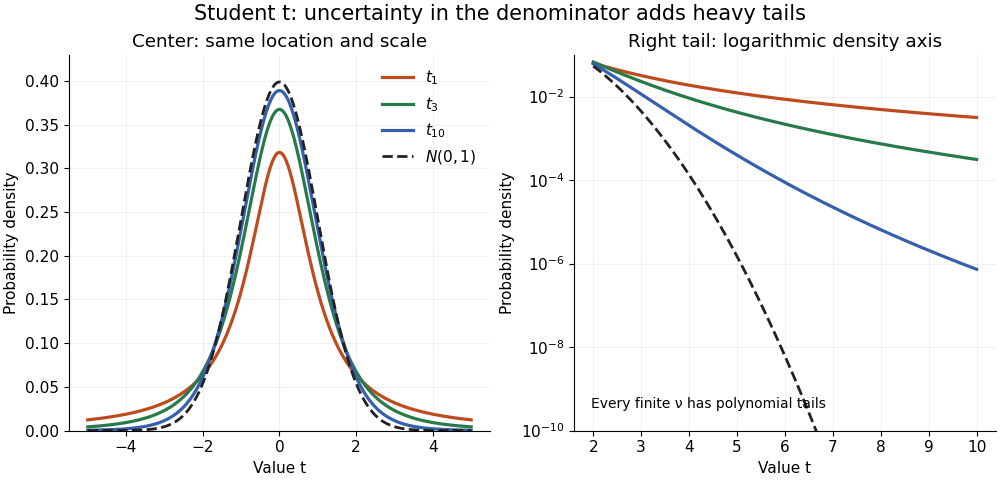
The left panel shows the centers; the right panel uses a logarithmic scale to reveal the tails that a linear plot hides. All four curves have location zero and scale one. They do not have the same variance: the curve has no finite mean or variance, whereas has variance 3 and has variance .
More generally, the absolute moment for is finite exactly when , as follows by comparing the tail integrand with . ConsequentlyFor there is no finite mean; symmetry alone cannot supply one. For the mean exists but the variance is infinite. For even the centered definition of variance is unavailable because the mean does not exist.
A shifted and scaled version , , has probability density function . The scale is not its standard deviation: for ,For example, and scale give standard deviation , rather than 2. The distinction matters when using a Student's t-distribution to model data with occasional extreme values, as well as when interpreting a Student t confidence interval.
A continuous linear functional is a continuous linear map from a topological vector space to its scalar field. The collection of all such functionals is the continuous dual space.
Extension of a bounded linear operator from a dense subspace by  Codex 0 Created 2026-09-29 Updated 2026-10-14
Let be a dense linear subspace of a normed space , let be a Banach space, and let be linear with . Then has a unique bounded extension , defined by for any sequence converging to , and .
A reduced fraction is a best approximation of the second kind to a real number if for every competing fraction with . It minimizes the error after multiplication by the denominator; this differs from best rational approximation of the first kind, which minimizes .
For the simple continued fraction of an irrational number, the continued fraction convergents with have this property. The initial convergent needs an exception when the fractional part of exceeds , since then is closer. For example, if , the initial convergent is beaten by . The next convergent is , and the subsequent continued fraction convergents have the usual best-approximation property.
A production rule specifies a permitted replacement during a grammar derivation. In a context-free grammar it has the form , with one nonterminal on the left.
A terminal symbol belongs to the alphabet of completed words and is not replaced by a grammar production.
A nonterminal symbol is a grammar symbol that may be replaced by a production and need not occur in a completed word.
Pinned article: Introduction to the OurBigBook Project
Welcome to the OurBigBook Project! Our goal is to create the perfect publishing platform for STEM subjects, and get university-level students to write the best free STEM tutorials ever.
Everyone is welcome to create an account and play with the site: ourbigbook.com/go/register. We belive that students themselves can write amazing tutorials, but teachers are welcome too. You can write about anything you want, it doesn't have to be STEM or even educational. Silly test content is very welcome and you won't be penalized in any way. Just keep it legal!
Intro to OurBigBook
. Source. We have two killer features:
- topics: topics group articles by different users with the same title, e.g. here is the topic for the "Fundamental Theorem of Calculus" ourbigbook.com/go/topic/fundamental-theorem-of-calculusArticles of different users are sorted by upvote within each article page. This feature is a bit like:
- a Wikipedia where each user can have their own version of each article
- a Q&A website like Stack Overflow, where multiple people can give their views on a given topic, and the best ones are sorted by upvote. Except you don't need to wait for someone to ask first, and any topic goes, no matter how narrow or broad
This feature makes it possible for readers to find better explanations of any topic created by other writers. And it allows writers to create an explanation in a place that readers might actually find it.
Figure 1. Screenshot of the "Derivative" topic page. View it live at: ourbigbook.com/go/topic/derivativeVideo 2. OurBigBook Web topics demo. Source. - local editing: you can store all your personal knowledge base content locally in a plaintext markup format that can be edited locally and published either:This way you can be sure that even if OurBigBook.com were to go down one day (which we have no plans to do as it is quite cheap to host!), your content will still be perfectly readable as a static site.
- to OurBigBook.com to get awesome multi-user features like topics and likes
- as HTML files to a static website, which you can host yourself for free on many external providers like GitHub Pages, and remain in full control

Figure 2. You can publish local OurBigBook lightweight markup files to either OurBigBook.com or as a static website.
Figure 3. Visual Studio Code extension installation.
Figure 5. . You can also edit articles on the Web editor without installing anything locally. Video 3. Edit locally and publish demo. Source. This shows editing OurBigBook Markup and publishing it using the Visual Studio Code extension. 
- Infinitely deep tables of contents:



All our software is open source and hosted at: github.com/ourbigbook/ourbigbook
Further documentation can be found at: docs.ourbigbook.com
Feel free to reach our to us for any help or suggestions: docs.ourbigbook.com/#contact