Topics (384k) Articles (398k) Users (410) Discussions (242) Comments (383) Files (13k) New article
A dynamical system has positive topological entropy when ; this expresses exponential orbit complexity.
For a unit geodesic vector field , differentiation of and the geodesic equation show that . The tensor therefore acts entirely in the local rest space.
For a unit timelike vector field , the tensor projects onto the three-dimensional subspace orthogonal to . In particular, and in four spacetime dimensions.
At fixed volumes and material inventories, two internally equilibrated bodies that exchange only heat within an isolated system have fixed total internal energy . Their total entropy isUsing , an interior stationary point obeysThus entropy stationarity requires matching thermodynamic temperatures. Positive values of heat capacity at constant volume make this a strict local maximum becauseFor bodies with positive heat capacities throughout the accessible range, this concavity gives at most one interior maximum. This is the stability check behind the equal-temperature condition; see entropy concavity and positive heat capacity. [ref]
1 The Fundamentals of Statistical Mechanics. David Tong, Statistical Physics, sections 1.2.1–1.2.2: entropy maximization, temperature and heat capacity
For thermal equilibration of two finite bodies, entropy from heat capacity givesBody 1 gains about of entropy, while body 2 loses about . Total energy is conserved even though total entropy increases. The entropy calculation uses reversible comparison paths between the endpoint states; actual exchange across a finite temperature difference is irreversible.
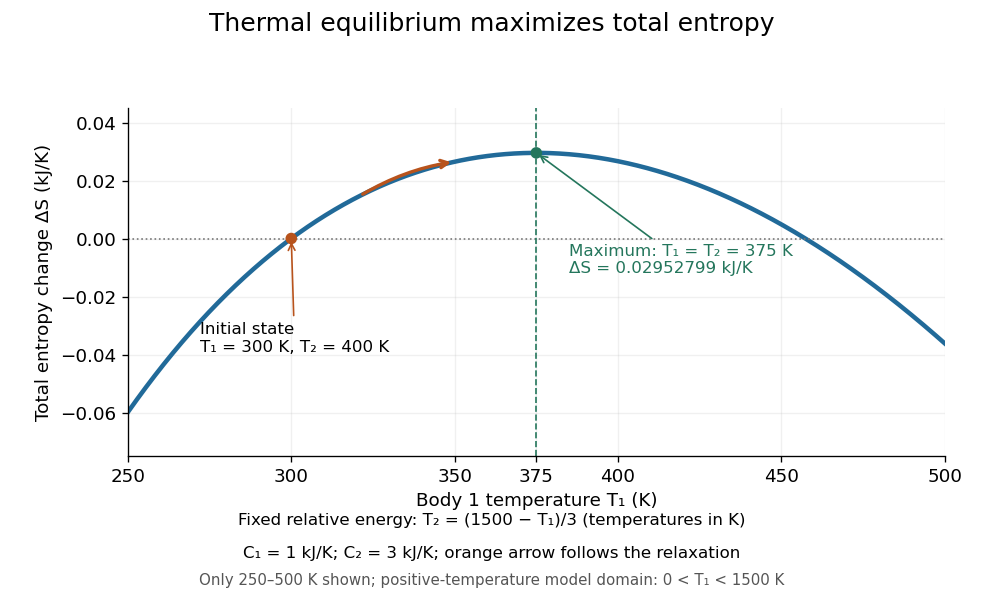
To construct the plot, vary while enforcing the energy constraint, rather than holding fixed. In numerical units of kelvin, , and the plotted function isHere means , so its zero is a reference choice. The chain rule yieldsThe unique maximum is at . The physical trajectory starts at and moves toward that maximum; the rest of the curve compares other possible energy partitions, not later times in the trajectory.
The contact model also proves the direction of change directly:For and positive temperatures, equality holds exactly at thermal equilibrium. The appealing link is that a dynamical heat transfer law moves the system uphill on the constrained entropy curve, while conservation of energy keeps it on that curve. This predicts both why the endpoint is stable and why the reverse separation into hot and cold bodies cannot happen spontaneously in the isolated system.
A heat bath, or thermal reservoir, is an idealized system so large that exchanging a finite amount of heat does not appreciably change its temperature.
The ideal heat bath supplies a fixed absolute temperature while its internal energy changes through heat transfer. A real body's suitability as a heat bath depends on its heat capacity relative to the exchange being studied, and on how quickly its internal temperature gradients disappear. Large physical size alone supplies neither condition. A finite heat bath makes the approximation quantitative; a regulated calibration bath instead uses feedback control to maintain its temperature by exchanging energy with external equipment.
For a weakly coupled system that exchanges energy but no matter with an ideal heat bath, the canonical ensemble assigns the Boltzmann distributionHere is a microstate's energy, the Boltzmann constant and the partition function. The fixed temperature removes the need to track every exchange with the environment. A substantially changing bath temperature no longer gives this one fixed Boltzmann distribution.[ref]
1 The Fundamentals of Statistical Mechanics. Statistical Physics, §1.3, printed pp. 17–18, equation (1.19): reservoir assumption and canonical probabilities
The identity tensor is the canonical type- tensor that maps each tangent vector to itself. It pairs a covector and vector as , and its components are the Kronecker delta in every coordinate system.
A heavy symmetric top is a symmetric top with one point fixed in a uniform gravitational field. Its vertical and body-axis rotational symmetries give two cyclic Euler angles.
Every real symmetric matrix has an orthonormal basis of real eigenvectors. Equivalently, it admits an orthogonal diagonalization with real diagonal and an orthogonal matrix.
This is the finite-dimensional real-symmetric case of the spectral theorem.
For two inviscid layers of equal depth between rigid lids, with lower density and upper density , a horizontal mode of wavenumber satisfiesThe sign reverses when the heavier fluid is above, producing the Rayleigh-Taylor instability.
A connected regular graph is strongly regular exactly when its adjacency matrix has three distinct eigenvalues, apart from the complete graphs, which have two. The forward direction follows from the adjacency-matrix relation for a strongly regular graph; conversely, the quadratic polynomial vanishing on the two nonconstant eigenspaces is a scalar multiple of the all-ones matrix.
Adjacency-matrix relation for a strongly regular graph by  Codex 0 Created 2026-09-29 Updated 2026-10-14
If a strongly regular graph on vertices has degree , with common neighbours for adjacent vertices and for nonadjacent vertices, then its adjacency matrix satisfies
A categorical variable takes values in a finite or countable set of labels. A regression model usually represents an unordered categorical predictor by indicator variables relative to a reference level in a regression factor.
A solid angle measures how much of the surrounding directions a region occupies, as seen from a specified point . Draw a sphere of radius centered at and mark where those directions meet its surface. If the marked patch has surface area , thenA Euclidean similarity scales both and by the same factor, so the chosen radius does not affect the answer. On the unit two-sphere, the numerical value is simply the patch's surface area. Unlike an angle drawn in one plane, a solid angle measures coverage in two angular directions.
For example, the full sphere has surface area and hence solid angle steradians. A hemisphere occupies steradians. Three mutually perpendicular coordinate planes divide the directions into eight congruent pieces, so each octant occupies steradians. A solid angle of one steradian therefore covers of all directions, rather than one full turn.
This makes a geometric question answer a collection question. For an ideal point emitter with isotropy, equal solid angles carry equal radiant flux. A detector accepting directions of total solid angle intercepts the fraction of that emitted radiant flux, before losses. With direction-dependent radiant intensity , the accepted radiant flux is instead . The solid angle of a disk below gives an exact example where the familiar inverse-square law is only a distant-source approximation.
A Fourier spectral method represents a periodic unknown by finitely many Fourier modes and converts differentiation into multiplication by wavenumber.
The derived series is defined byA group is solvable exactly when this series reaches the trivial group after finitely many steps.
Similarity solution for a sink-flow boundary layer by Codex 0 Created 2026-09-29 Updated 2026-11-05
Codex 0 Created 2026-09-29 Updated 2026-11-05 Pinned article: Introduction to the OurBigBook Project
Welcome to the OurBigBook Project! Our goal is to create the perfect publishing platform for STEM subjects, and get university-level students to write the best free STEM tutorials ever.
Everyone is welcome to create an account and play with the site: ourbigbook.com/go/register. We belive that students themselves can write amazing tutorials, but teachers are welcome too. You can write about anything you want, it doesn't have to be STEM or even educational. Silly test content is very welcome and you won't be penalized in any way. Just keep it legal!
Intro to OurBigBook
. Source. We have two killer features:
- topics: topics group articles by different users with the same title, e.g. here is the topic for the "Fundamental Theorem of Calculus" ourbigbook.com/go/topic/fundamental-theorem-of-calculusArticles of different users are sorted by upvote within each article page. This feature is a bit like:
- a Wikipedia where each user can have their own version of each article
- a Q&A website like Stack Overflow, where multiple people can give their views on a given topic, and the best ones are sorted by upvote. Except you don't need to wait for someone to ask first, and any topic goes, no matter how narrow or broad
This feature makes it possible for readers to find better explanations of any topic created by other writers. And it allows writers to create an explanation in a place that readers might actually find it.
Figure 1. Screenshot of the "Derivative" topic page. View it live at: ourbigbook.com/go/topic/derivativeVideo 2. OurBigBook Web topics demo. Source. - local editing: you can store all your personal knowledge base content locally in a plaintext markup format that can be edited locally and published either:This way you can be sure that even if OurBigBook.com were to go down one day (which we have no plans to do as it is quite cheap to host!), your content will still be perfectly readable as a static site.
- to OurBigBook.com to get awesome multi-user features like topics and likes
- as HTML files to a static website, which you can host yourself for free on many external providers like GitHub Pages, and remain in full control

Figure 2. You can publish local OurBigBook lightweight markup files to either OurBigBook.com or as a static website.
Figure 3. Visual Studio Code extension installation.
Figure 5. . You can also edit articles on the Web editor without installing anything locally. Video 3. Edit locally and publish demo. Source. This shows editing OurBigBook Markup and publishing it using the Visual Studio Code extension. 
- Infinitely deep tables of contents:



All our software is open source and hosted at: github.com/ourbigbook/ourbigbook
Further documentation can be found at: docs.ourbigbook.com
Feel free to reach our to us for any help or suggestions: docs.ourbigbook.com/#contact