Topics (384k) Articles (398k) Users (410) Discussions (242) Comments (383) Files (13k) New article
A truth table lists a propositional formula's value for every Boolean valuation of its distinct primitive propositions. With primitive propositions, there are rows: each independently receives T or F. Evaluate compound columns from their subexpressions using the classical rules for logical connectives. This is exhaustive checking, so a formula true on every row is valid in classical propositional logic.
For a computed example over the natural numbers, let mean that is an even number and mean . The choices realize respectively : all four possible inputs.
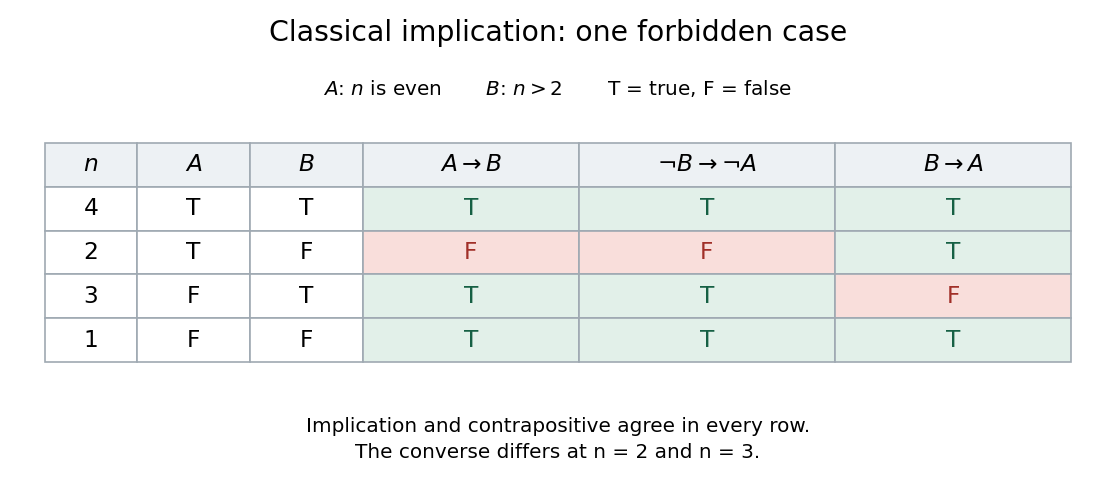
The logical implication and its contrapositive agree on every row; the converse implication differs on two rows. A truth table therefore checks equivalence or supplies a counterexample. Classical truth conditions are given in forall x: Calgary, section 31.2. These two-valued truth tables do not characterize validity in Intuitionistic propositional logic.
A diagonal subsequence argument successively extracts nested subsequences that converge in the first, first two, and then first coordinates. Taking the th term from the th nested subsequence produces one subsequence that converges in every fixed coordinate.
An inner cylinder of radius centered at and an outer cylinder of radius centered at have polar boundaries and . If their angular velocities are and , respectively, the no-slip Stokes flow between them has streamfunctionIts unique interior stagnation point is , and its nonzero streamlines are closed curves around that point.
Galaxy bias describes the statistical relation between fluctuations in galaxy counts and the underlying matter density contrast. In the simplest large-scale limit, , so the corresponding deterministic power spectrum is . Different selections can have different because they sample different formation environments. More generally, the bias expansion includes nonlinear, tidal and stochastic terms, so a single multiplicative constant is an approximation.[ref]
Large-Scale Galaxy Bias by Vincent Desjacques and others. Abstract: statistical tracer-matter relation and large-scale expansion
For polynomials in fixed variables and of a fixed degree, the monomials of that degree form a basis of the corresponding homogeneous component.
If a vector space is spanned by vectors, every linearly independent family in it has at most members. Consequently, any two finite bases have the same number of vectors.
The icosidodecahedron has 20 triangular and 12 pentagonal faces, with the faces alternating around each of its 30 vertices. It can be obtained by cutting a dodecahedron through the midpoints of its edges.
The Cauchy approximate identity isIt is a probability density of total mass one, and its mass outside every fixed neighbourhood of zero tends to zero as . It therefore converges to the Dirac delta function as a distribution.
Over one circular orbit at radius , the orbiting clock measuresThe factor combines gravitational and orbital kinematic time dilation.
Accretion-disk self-gravity is the contribution of the disk's own matter to its gravitational field. A low total disk mass can still matter for local vertical confinement or the growth of density disturbances. The Toomre parameter compares gravity with pressure and rotation, but instability does not guarantee fragmentation: heating by gravitationally driven motions can balance cooling. Local numerical experiments distinguish that regulated state from breakup when cooling is sufficiently rapid.[ref]
Nonlinear Outcome of Gravitational Instability in Cooling, Gaseous Disks by Charles F. Gammie. Abstract: self-regulated gravitational turbulence versus fragmentation in a local cooling model
Distribution of the Akaike information criterion in a normal linear model by  Codex 0 Created 2026-09-29 Updated 2026-11-05
Consider the correctly specified fixed-design normal linear model , with an full-column-rank design matrix, , and with . Both and are unknown, so the Akaike information criterion counts fitted parameters. If is the residual sum of squares, thenThe orthogonal-projection decomposition of a random variable with a multivariate normal distribution gives . Substituting into yieldsHere denotes a random variable, not a quantile. The maximum-likelihood estimator of the error variance uses divisor ; the unbiased residual variance estimator with divisor cannot be substituted into the maximized likelihood. If and is invertible, the fit has zero residual sum of squares, and the Gaussian likelihood is unbounded as decreases to zero. There is then no finite positive-variance maximum-likelihood estimator to which the displayed Akaike information criterion law applies.
An isentropic process keeps the entropy constant. Every reversible adiabatic process is isentropic, while an irreversible adiabatic process can increase entropy.
Every Lebesgue-measurable additive function is continuous. Small-value preimages are measurable; one of their integer dilates has positive measure, so the Steinhaus theorem puts a neighbourhood of zero in their difference set. Additivity then makes small on that neighbourhood.
A measure dominates a family of measures when every member is absolutely continuous with respect to . Any two finite positive measures and have the common dominating measure .
A finitely generated abelian group has a finite generating set. Equivalently, it is the cokernel of a homomorphism between finitely generated free abelian groups.
Metrization of the weak topology on a bounded set by Codex 0 Created 2026-09-29 Updated 2026-10-03
Codex 0 Created 2026-09-29 Updated 2026-10-03 Pinned article: Introduction to the OurBigBook Project
Welcome to the OurBigBook Project! Our goal is to create the perfect publishing platform for STEM subjects, and get university-level students to write the best free STEM tutorials ever.
Everyone is welcome to create an account and play with the site: ourbigbook.com/go/register. We belive that students themselves can write amazing tutorials, but teachers are welcome too. You can write about anything you want, it doesn't have to be STEM or even educational. Silly test content is very welcome and you won't be penalized in any way. Just keep it legal!
Intro to OurBigBook
. Source. We have two killer features:
- topics: topics group articles by different users with the same title, e.g. here is the topic for the "Fundamental Theorem of Calculus" ourbigbook.com/go/topic/fundamental-theorem-of-calculusArticles of different users are sorted by upvote within each article page. This feature is a bit like:
- a Wikipedia where each user can have their own version of each article
- a Q&A website like Stack Overflow, where multiple people can give their views on a given topic, and the best ones are sorted by upvote. Except you don't need to wait for someone to ask first, and any topic goes, no matter how narrow or broad
This feature makes it possible for readers to find better explanations of any topic created by other writers. And it allows writers to create an explanation in a place that readers might actually find it.
Figure 1. Screenshot of the "Derivative" topic page. View it live at: ourbigbook.com/go/topic/derivativeVideo 2. OurBigBook Web topics demo. Source. - local editing: you can store all your personal knowledge base content locally in a plaintext markup format that can be edited locally and published either:This way you can be sure that even if OurBigBook.com were to go down one day (which we have no plans to do as it is quite cheap to host!), your content will still be perfectly readable as a static site.
- to OurBigBook.com to get awesome multi-user features like topics and likes
- as HTML files to a static website, which you can host yourself for free on many external providers like GitHub Pages, and remain in full control

Figure 2. You can publish local OurBigBook lightweight markup files to either OurBigBook.com or as a static website.
Figure 3. Visual Studio Code extension installation.
Figure 5. . You can also edit articles on the Web editor without installing anything locally. Video 3. Edit locally and publish demo. Source. This shows editing OurBigBook Markup and publishing it using the Visual Studio Code extension. 
- Infinitely deep tables of contents:



All our software is open source and hosted at: github.com/ourbigbook/ourbigbook
Further documentation can be found at: docs.ourbigbook.com
Feel free to reach our to us for any help or suggestions: docs.ourbigbook.com/#contact