Ciro Santilli @cirosantilli 40
Joined 2022-11-02 Message

Incoming links: Dirac equation
Antimatter Updated 2025-07-16
Predicted by the Dirac equation.
Can be easily seen from the solution of Equation "Expanded Dirac equation in Planck units" when the particle is at rest as shown at Video "Quantum Mechanics 12b - Dirac Equation II by ViaScience (2015)".
Atom 2007 Mini Series episode 3 Created 2025-02-22 Updated 2025-07-16
Derivation of the Dirac equation Updated 2025-07-16
The Dirac equation can be derived basically "directly" from the Representation theory of the Lorentz group for the spin half representation, this is shown for example at Physics from Symmetry by Jakob Schwichtenberg (2015) 6.3 "Dirac Equation".
The Diract equation is the spacetime symmetry part of the quantum electrodynamics Lagrangian, i.e. is describes how spin half particles behave without interactions. The full quantum electrodynamics Lagrangian can then be reached by adding the internal symmetry.
As mentioned at spin comes naturally when adding relativity to quantum mechanics, this same method allows us to analogously derive the equations for other spin numbers.
Bibliography:
Deriving The Dirac equation by Andrew Dotson (2019)
Source. Derivation of the Klein-Gordon equation Updated 2025-07-16
But since this is quantum mechanics, we feel like making into the "momentum operator", just like in the Schrödinger equation.
But we don't really know how to apply the momentum operator twice, because it is a gradient, so the first application goes from a scalar field to the vector field, and the second one...
But then, we have to avoid taking the square root to reach a first derivative in time, because we don't know how to take the square root of that operator expression.
So the Klein-Gordon equation just takes the approach of using this squared Hamiltonian instead.
Since it is a Hamiltonian, and comparing it to the Schrödinger equation which looks like:taking the Hamiltonian twice leads to:
We can contrast this with the Dirac equation, which instead attempts to explicitly construct an operator which squared coincides with the relativistic formula: derivation of the Dirac equation.
Derivation of the quantum electrodynamics Lagrangian Updated 2025-07-16
Like the rest of the Standard Model Lagrangian, this can be split into two parts:
- spacetime symmetry: reaches the derivation of the Dirac equation, but has no interactions
- add the internal symmetry to add interactions, which reaches the full equation
Deriving the qED Lagrangian by Dietterich Labs (2018)
Source. As mentioned at the start of the video, he starts with the Dirac equation Lagrangian derived in a previous video. It has nothing to do with electromagnetism specifically.
He notes that that Dirac Lagrangian, besides being globally Lorentz invariant, it also also has a global invariance.
However, it does not have a local invariance if the transformation depends on the point in spacetime.
He doesn't mention it, but I think this is highly desirable, because in general local symmetries of the Lagrangian imply conserved currents, and in this case we want conservation of charges.
To fix that, he adds an extra gauge field (a field of matrices) to the regular derivative, and the resulting derivative has a fancy name: the covariant derivative.
Then finally he notes that this gauge field he had to add has to transform exactly like the electromagnetic four-potential!
So he uses that as the gauge, and also adds in the Maxwell Lagrangian in the same go. It is kind of a guess, but it is a natural guess, and it turns out to be correct.
Dirac equation Updated 2025-07-16
Adds special relativity to the Schrödinger equation, and the following conclusions come basically as a direct consequence of this!
Experiments explained:
Experiments not explained: those that quantum electrodynamics explains like:See also: Dirac equation vs quantum electrodynamics.
- Lamb shift
- TODO: quantization of the electromagnetic field as photons?
The Dirac equation is a set of 4 partial differential equations on 4 complex valued wave functions. The full explicit form in Planck units is shown e.g. in Video 1. "Quantum Mechanics 12a - Dirac Equation I by ViaScience (2015)" at youtu.be/OCuaBmAzqek?t=1010:Then as done at physics.stackexchange.com/questions/32422/qm-without-complex-numbers/557600#557600 from why are complex numbers used in the Schrodinger equation?, we could further split those equations up into a system of 8 equations on 8 real-valued functions.
Equation 1.
Expanded Dirac equation in Planck units
. PHYS 485 Lecture 14: The Dirac Equation by Roger Moore (2016)
Source. Dirac equation solution for the hydrogen atom Updated 2025-07-16
Predicts fine structure.
Bibliography:
How To Solve The Dirac Equation For The Hydrogen Atom | Relativistic Quantum Mechanics by Dietterich Labs (2018)
Source. Dirac equation vs quantum electrodynamics Updated 2025-07-16
TODO: in high level terms, why is QED more general than just solving the Dirac equation, and therefore explaining quantum electrodynamics experiments?
Also, is it just a bunch of differential equation (like the Dirac equation itself), or does it have some other more complicated mathematical formulation, as seems to be the case? Why do we need something more complicated than
The main high level insight seems to be that The Dirac equation does not work for more than one electron.
Bibliography:
- physics.stackexchange.com/questions/101307/dirac-equation-in-qft-vs-relativistic-qm
- physics.stackexchange.com/questions/44188/what-is-the-relativistic-particle-in-a-box/44309#44309 says:
- physics.stackexchange.com/questions/64206/why-is-the-dirac-equation-not-used-for-calculations
- www.physicsforums.com/threads/is-diracs-equation-still-useful-after-qed-is-developed.663994/
Dirac Lagrangian Updated 2025-07-16
where:
Remember that is a 4-vetor, gamma matrices are 4x4 matrices, so the whole thing comes down to a dot product of two 4-vectors, with a modified by matrix multiplication/derivatives, and the result is a scalar, as expected for a Lagrangian.
Like any other Lagrangian, you can then recover the Dirac equation, which is the corresponding equations of motion, by applying the Euler-Lagrange equation to the Lagrangian.
Fine structure Updated 2025-07-16
Split in energy levels due to interaction between electron up or down spin and the electron orbitals.
Numerically explained by the Dirac equation when solving it for the hydrogen atom, and it is one of the main triumphs of the theory.
Hyperfine structure Updated 2025-07-16
Small splits present in all levels due to interaction between the electron spin and the nuclear spin if it is present, i.e. the nucleus has an even number of nucleons.
As the name suggests, this energy split is very small, since the influence of the nucleus spin on the electron spin is relatively small compared to other fine structure.
The most important examples:
- hydrogen line useful in astronomy, and also the simplest possible case between 1s
- caesium standard, which is used to define the second in the International System of Units since 1967.
Internal and spacetime symmetries Updated 2025-07-16
The different only shows up for field, not with particles. For fields, there are two types of changes that we can make that can keep the Lagrangian unchanged as mentioned at Physics from Symmetry by Jakob Schwichtenberg (2015) chapter "4.5.2 Noether's Theorem for Field Theories - Spacetime":
- spacetime symmetry: act with the Poincaré group on the Four-vector spacetime inputs of the field itself, i.e. transforming into
- internal symmetry: act on the output of the field, i.e.:
From the spacetime theory alone, we can derive the Lagrangian for the free theories for each spin:Then the internal symmetries are what add the interaction part of the Lagrangian, which then completes the Standard Model Lagrangian.
Klein-Gordon equation Updated 2025-07-16
A relativistic version of the Schrödinger equation.
Correctly describes spin 0 particles.
The most memorable version of the equation can be written as shown at Section "Klein-Gordon equation in Einstein notation" with Einstein notation and Planck units:
Has some issues which are solved by the Dirac equation:
- it has a second time derivative of the wave function. Therefore, to solve it we must specify not only the initial value of the wave equation, but also the derivative of the wave equation,As mentioned at Advanced quantum mechanics by Freeman Dyson (1951) and further clarified at: physics.stackexchange.com/questions/340023/cant-the-negative-probabilities-of-klein-gordon-equation-be-avoided, this would lead to negative probabilities.
- the modulus of the wave function is not constant and therefore not always one, and therefore cannot be interpreted as a probability density anymore
- since we are working with the square of the energy, we have both positive and negative value solutions. This is also a features of the Dirac equation however.
Bibliography:
- Video "Quantum Mechanics 12a - Dirac Equation I by ViaScience (2015)" at youtu.be/OCuaBmAzqek?t=600
- An Introduction to QED and QCD by Jeff Forshaw (1997) 1.2 "Relativistic Wave Equations" and 1.4 "The Klein Gordon Equation" gives some key ideas
- 2011 PHYS 485 lecture videos by Roger Moore from the University of Alberta at around 7:30
- www.youtube.com/watch?v=WqoIW85xwoU&list=PL54DF0652B30D99A4&index=65 "L2. The Klein-Gordon Equation" by doctorphys
- sites.ualberta.ca/~gingrich/courses/phys512/node21.html from Advanced quantum mechanics II by Douglas Gingrich (2004)
Lamb-Retherford experiment Updated 2025-07-16
Published as "Fine Structure of the Hydrogen Atom by a Microwave Method" by Willis Lamb and Robert Retherford (1947) on Physical Review. This one actually has open accesses as of 2021, miracle! journals.aps.org/pr/pdf/10.1103/PhysRev.72.241
Microwave technology was developed in World War II for radar, notably at the MIT Radiation Laboratory. Before that, people were using much higher frequencies such as the visible spectrum. But to detect small energy differences, you need to look into longer wavelengths.
This experiment was fundamental to the development of quantum electrodynamics. As mentioned at Genius: Richard Feynman and Modern Physics by James Gleick (1994) chapter "Shrinking the infinities", before the experiment, people already knew that trying to add electromagnetism to the Dirac equation led to infinities using previous methods, and something needed to change urgently. However for the first time now the theorists had one precise number to try and hack their formulas to reach, not just a philosophical debate about infinities, and this led to major breakthroughs. The same book also describes the experiment briefly as:
Willis Lamb had just shined a beam of microwaves onto a hot wisp of hydrogen blowing from an oven.
It is two pages and a half long.
They were at Columbia University in the Columbia Radiation Laboratory. Robert was Willis' graduate student.
Previous less experiments had already hinted at this effect, but they were too imprecise to be sure.
Lamb shift Updated 2025-07-16
2s/2p energy split in the hydrogen emission spectrum, not predicted by the Dirac equation, but explained by quantum electrodynamics, which is one of the first great triumphs of that theory.
Note that for atoms with multiple electrons, 2s/2p shifts are expected: Why does 2s have less energy than 1s if they have the same principal quantum number?. The surprise was observing that on hydrogen which only has one electron.
Initial experiment: Lamb-Retherford experiment.
On the return from the train from the Shelter Island Conference in New York, Hans Bethe managed to do a non-relativistic calculation of the Lamb shift. He then published as The Electromagnetic Shift of Energy Levels by Hans Bethe (1947) which is still paywalled as of 2021, fuck me: journals.aps.org/pr/abstract/10.1103/PhysRev.72.339 by Physical Review.
The Electromagnetic Shift of Energy Levels Freeman Dyson (1948) published on Physical Review is apparently a relativistic analysis of the same: journals.aps.org/pr/abstract/10.1103/PhysRev.73.617 also paywalled as of 2021.
TODO how do the infinities show up, and how did people solve them?
Lamb shift by Dr. Nissar Ahmad (2020)
Source. Whiteboard Lecture about the phenomena, includes description of the experiment. Seems quite good.www.mdpi.com/2624-8174/2/2/8/pdf History and Some Aspects of the Lamb Shift by G. Jordan Maclay (2019)
Mentions that he moved to the USA from the United Kingdom specifically because great experiments were being carried at Columbia University, which is where the Lamb-Retherford experiment was done, and that Isidor Isaac Rabi was the head at the time.
He then explains mass renormalization briefly: instead of calculating from scratch, you just compare the raw electron to the bound electron and take the difference. Both of those have infinities in them, but the difference between them cancels out those infinities.
Hans Bethe - The Lamb shift (1996)
Source. Lamb shift by Vidya-mitra (2018)
Source. Mathematical formulation of quantum field theory Updated 2025-07-16
The Dirac equation, OK, is a partial differential equation, so we can easily understand its definition with basic calculus. We may not be able to solve it efficiently, but at least we understand it.
But what the heck is the mathematical model for a quantum field theory? TODO someone was saying it is equivalent to an infinite set of PDEs somehow. Investigate. Related:
The path integral formulation might actually be the most understandable formulation, as shown at Richard Feynman Quantum Electrodynamics Lecture at University of Auckland (1979).
Quantum electrodynamics by Lifshitz et al. 2nd edition (1982) chapter 1. "The uncertainty principle in the relativistic case" contains an interesting idea:
The foregoing discussion suggests that the theory will not consider the time dependence of particle interaction processes. It will show that in these processes there are no characteristics precisely definable (even within the usual limitations of quantum mechanics); the description of such a process as occurring in the course of time is therefore just as unreal as the classical paths are in non-relativistic quantum mechanics. The only observable quantities are the properties (momenta,
polarizations) of free particles: the initial particles which come into interaction, and the final particles which result from the process.
Particle creation and annihilation Updated 2025-07-16
Predicted by the Dirac equation.
We've likely known since forever that photons are created: just turn on a light and see gazillion of them come out!
Photon creation is easy because photons are massless, so there is not minimum energy to create them.
The creation of other particles is much rarer however, and took longer to be discovered, one notable milestone being the discovery of the positron.
Particle physics Updated 2025-07-16
Currently an informal name for the Standard Model
Chronological outline of the key theories:
- Maxwell's equations
- Schrödinger equation
- Date: 1926
- Numerical predictions:
- hydrogen spectral line, excluding finer structure such as 2p up and down split: en.wikipedia.org/wiki/Fine-structure_constant
- Dirac equation
- Date: 1928
- Numerical predictions:
- hydrogen spectral line including 2p split, but excluding even finer structure such as Lamb shift
- Qualitative predictions:
- Antimatter
- Spin as part of the equation
- quantum electrodynamics
- Date: 1947 onwards
- Numerical predictions:
- Qualitative predictions:
- Antimatter
- spin as part of the equation
Paul Dirac Updated 2026-08-21
Eccentric nerdy slow speaking physicist mostly based in University of Cambridge.
Created the Dirac equation, what else do you need to know?!
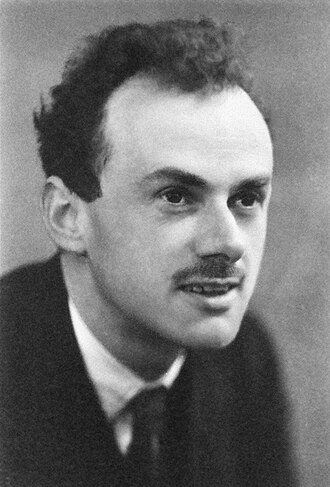

QED and the men who made it: Dyson, Feynman, Schwinger, and Tomonaga by Silvan Schweber (1994) chapter 1.3 "P.A.M. Dirac and the Birth of Quantum Electrodynamics" quotes Dirac saying how being at high school during World War I was an advantage, since all slightly older boys were being sent to war, and so the younger kids were made advance as fast as they could through subjects. Exactly the type of thing Ciro Santilli wants to achieve with OurBigBook.com, but without the need for a world war hopefully.
Dirac was a staunch atheist having said during the Fifth Solvay Conference (1927)[ref]:
If we are honest - and scientists have to be - we must admit that religion is a jumble of false assertions, with no basis in reality. The very idea of God is a product of the human imagination. It is quite understandable why primitive people, who were so much more exposed to the overpowering forces of nature than we are today, should have personified these forces in fear and trembling. But nowadays, when we understand so many natural processes, we have no need for such solutions. I can't for the life of me see how the postulate of an Almighty God helps us in any way. What I do see is that this assumption leads to such unproductive questions as why God allows so much misery and injustice, the exploitation of the poor by the rich and all the other horrors He might have prevented. If religion is still being taught, it is by no means because its ideas still convince us, but simply because some of us want to keep the lower classes quiet. Quiet people are much easier to govern than clamorous and dissatisfied ones. They are also much easier to exploit. Religion is a kind of opium that allows a nation to lull itself into wishful dreams and so forget the injustices that are being perpetrated against the people. Hence the close alliance between those two great political forces, the State and the Church. Both need the illusion that a kindly God rewards - in heaven if not on earth - all those who have not risen up against injustice, who have done their duty quietly and uncomplainingly. That is precisely why the honest assertion that God is a mere product of the human imagination is branded as the worst of all mortal sins.
Quantum electrodynamics Updated 2025-07-16
Theory that describes electrons and photons really well, and as Feynman puts it "accounts very precisely for all physical phenomena we have ever observed, except for gravity and nuclear physics" ("including the laughter of the crowd" ;-)).
While Ciro acknowledges that QED is intrinsically challenging due to the wide range or requirements (quantum mechanics, special relativity and electromagnetism), Ciro feels that there is a glaring gap in this moneyless market for a learning material that follows the Middle Way as mentioned at: the missing link between basic and advanced. Richard Feynman Quantum Electrodynamics Lecture at University of Auckland (1979) is one of the best attempts so far, but it falls a bit too close to the superficial side of things, if only Feynman hadn't assumed that the audience doesn't know any mathematics...
The funny thing is that when Ciro Santilli's mother retired, learning it (or as she put it: "how photons and electrons interact") was also one of her retirement plans. She is a pharmacist by training, and doesn't know much mathematics, and her English was somewhat limited. Oh, she also wanted to learn how photosynthesis works (possibly not fully understood by science as that time, 2020). Ambitious old lady!!!
Combines special relativity with more classical quantum mechanics, but further generalizing the Dirac equation, which also does that: Dirac equation vs quantum electrodynamics. The name "relativistic" likely doesn't need to appear on the title of QED because Maxwell's equations require special relativity, so just having "electro-" in the title is enough.
Before QED, the most advanced theory was that of the Dirac equation, which was already relativistic but TODO what was missing there exactly?
As summarized at: youtube.com/watch?v=_AZdvtf6hPU?t=305 Quantum Field Theory lecture at the African Summer Theory Institute 1 of 4 by Anthony Zee (2004):
- classical mechanics describes large and slow objects
- special relativity describes large and fast objects (they are getting close to the speed of light, so we have to consider relativity)
- classical quantum mechanics describes small and slow objects.
- QED describes objects that are both small and fast
That video also mentions the interesting idea that:Therefore, for small timescales, energy can vary a lot. But mass is equivalent to energy. Therefore, for small time scale, particles can appear and disappear wildly.
- in special relativity, we have the mass-energy equivalence
- in quantum mechanics, thinking along the time-energy uncertainty principle,
QED is the first quantum field theory fully developed. That framework was later extended to also include the weak interaction and strong interaction. As a result, it is perhaps easier to just Google for "Quantum Field Theory" if you want to learn QED, since QFT is more general and has more resources available generally.
Like in more general quantum field theory, there is on field for each particle type. In quantum field theory, there are only two fields to worry about:
- photon field
- electromagnetism field
Lecture 01 | Overview of Quantum Field Theory by Markus Luty (2013)
Source. This takes quite a direct approach, one cool thing he says is how we have to be careful with adding special relativity to the Schrödinger equation to avoid faster-than-light information.