
Past exam of the mathematics course of the University of Cambridge 2017 ia Paper 4 5D c Solution Created 2026-09-24 Updated 2026-10-05
Split the factorial at , using :By Wilson theorem, this is . Therefore . If the prime number is odd, then is even, so andFor , the signs and are identical modulo , and the two possibilities also give the same result. The empty product convention includes the endpoint cases. This is the complementary factorial congruence.
Past exam of the mathematics course of the University of Cambridge 2017 ia Paper 4 5D b Solution Created 2026-09-24 Updated 2026-10-05
Suppose . Then is a unit modulo n for modulus , and Fermat's little theorem impliesSince is an odd prime number, and are distinct residue classes. Therefore is even, and .
Conversely, put . Pair each integer with in the factorial. Wilson theorem yieldsWhen , is even, so satisfies . This proves the first supplementary law for quadratic reciprocity without assuming a primitive root. HenceThe two solutions are and modulo : their difference is nonzero, and factoring shows that a degree-two polynomial over the field of residues modulo has no further roots.
Past exam of the mathematics course of the University of Cambridge 2017 ia Paper 4 5D a Solution Created 2026-09-24 Updated 2026-10-05
The Fermat-Euler theorem states that for an integer and a positive integer with ,where the Euler totient function counts the residue classes coprime to . For , choose a reduced residue system . Multiplication by the unit modulo n preserves coprimality and is injective on these residue classes: implies , because has a multiplicative inverse modulo . It therefore permutes the reduced residue system, givingThe product is also a unit modulo n, so it can be cancelled. This proves the Fermat-Euler theorem. For every modular congruence is automatic; one may use .
For a prime number , the Euler totient function has value . Thus whenever . Multiplying by , and treating separately, gives the all-integer version of Fermat's little theorem:Finally, Wilson theorem states that for every prime number , . Its converse is also true: an integer is prime exactly when . For the converse, any proper divisor would divide both and , contradicting that congruence.
Past exam of the mathematics course of the University of Cambridge 2017 ia Paper 4 2D b ii Created 2026-09-24 Updated 2026-09-24
Past exam of the mathematics course of the University of Cambridge 2017 ia Paper 4 2D b i Created 2026-09-24 Updated 2026-09-24
Past exam of the mathematics course of the University of Cambridge 2017 ia Paper 4 2D a Solution Created 2026-09-24 Updated 2026-10-05
A binary relation on a set is a subset of its Cartesian product; means . It is an equivalence relation when it is a reflexive relation, a symmetric relation, and a transitive relation:An equivalence relation partitions into equivalence classes: two elements belong to the same class exactly when they are related.
Past exam of the mathematics course of the University of Cambridge 2017 ia Paper 4 1D b Solution Created 2026-09-24 Updated 2026-10-05
For a Pythagorean triple, each square number is or modulo . If neither nor were divisible by , modular congruence would give , impossible for a square number. Thus at least one of is divisible by ; both can be divisible, as in .
An odd number has square number congruent to modulo , whereas an even number has square number congruent to . If both and were odd numbers, their sum of square numbers would again be modulo , which no square number can be. Hence and cannot both be odd. They can both be even; the conclusion does not require the Pythagorean triple to be primitive.
Past exam of the mathematics course of the University of Cambridge 2017 ia Paper 4 1D a Solution Created 2026-09-24 Updated 2026-10-05
Reduce using modular congruence: its residue class modulo is , , or . A square number therefore has residue class or , and raising either residue to the positive integer power leaves it unchanged. ConsequentlyThe exponent in the original PDF is ; the polynomial identities in the converted TeX are a transcription error. The argument uses ; it does not assign a value.
Past exam of the mathematics course of the University of Cambridge 2017 ia Paper 4 12A b Solution Created 2026-09-24 Updated 2026-10-05
For , the first burn reduces the total mass from to . The rocket equation therefore givesDetachment exerts negligible impulse, so the surviving second stage keeps velocity . Its initial and final masses are and , respectively. A second application of the rocket equation givesFor the single-stage comparison from rest, . HenceEquality holds at ; for positive fuel and exhaust speed it is strict when . This two-stage rocket with proportional fuel and body masses gains speed by discarding inert body mass before the last burn.
As the expression tends to , but the surviving second-stage mass also tends to zero. At exactly there is no second stage, so its final speed is undefined and that limiting formula cannot be assigned to it. The first stage alone reaches the single-stage burnout speed before detachment. If , neither design gains speed.
Past exam of the mathematics course of the University of Cambridge 2017 ia Paper 4 12A a Solution Created 2026-09-24 Updated 2026-10-05
Write the total remaining rocket mass as , with . Over an interval , an exhaust mass is expelled backwards with inertial velocity to first order. Applying momentum conservation to the rocket and this exhaust givesCancellation and division by give the rocket equationWith , , and , integration givesAt burnout,The logarithm depends on the mass ratio, not on the burn rate. This follows from momentum conservation of the complete rocket–exhaust system; applying a constant-mass equation directly to the rocket alone would omit the momentum carried away.
Past exam of the mathematics course of the University of Cambridge 2017 ia Paper 4 11A b iii Created 2026-09-24 Updated 2026-09-24
Past exam of the mathematics course of the University of Cambridge 2017 ia Paper 4 11A b ii Created 2026-09-24 Updated 2026-09-24
Past exam of the mathematics course of the University of Cambridge 2017 ia Paper 4 11A b i Created 2026-09-24 Updated 2026-09-24
Past exam of the mathematics course of the University of Cambridge 2017 ia Paper 4 11A a Solution Created 2026-09-24 Updated 2026-10-05
The rotating-frame derivative formula is . Applying it twice to the position vector, with constant angular velocity, givesSolving for identifies the displayed terms: its left side is the acceleration relative to the rotating reference frame, the first right-hand term is the inertial acceleration, is the Coriolis acceleration, and is the outward centrifugal acceleration.
For a particle of mass , replace by the actual force divided by using Newton's second law. The remaining terms then appear as apparent forces in . There is no Euler acceleration because is constant and no translational acceleration term because the common origin is fixed in the inertial frame.
Past exam of the mathematics course of the University of Cambridge 2017 ia Paper 4 10A b iii Created 2026-09-24 Updated 2026-09-24
Past exam of the mathematics course of the University of Cambridge 2017 ia Paper 4 10A b ii Created 2026-09-24 Updated 2026-09-24
Past exam of the mathematics course of the University of Cambridge 2017 ia Paper 4 10A b i Created 2026-09-24 Updated 2026-09-24
Past exam of the mathematics course of the University of Cambridge 2017 ia Paper 4 10A a Solution Created 2026-09-24 Updated 2026-10-14
A central force has no component in the angular direction. The angular component of the acceleration in polar coordinates therefore gives , orFor unit mass, is the signed angular momentum perpendicular to the orbital plane, so its magnitude is conserved. Equivalently, the torque vanishes, which also fixes that plane.
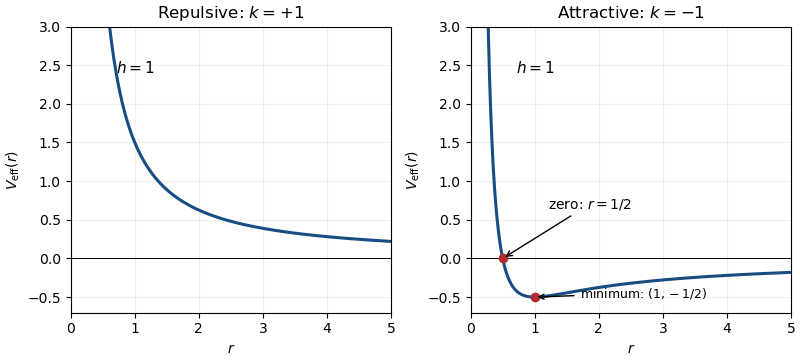
The given potential energy is , whose radial force is : positive is repulsive and negative attractive. The kinetic energy in polar coordinates is , so conservation of energy givesFor and , the effective potential is positive, strictly decreasing from to , and has no stationary point. For , it still tends to at zero, crosses zero at , and has its unique minimum atIt then approaches zero from below. The minimum corresponds to a stable circular orbit. If , the centrifugal barrier disappears; the attractive effective potential is simply and has no minimum.

Past exam of the mathematics course of the University of Cambridge 2017 ia Paper 3 9B c Solution Created 2026-09-24 Updated 2026-10-05
Use the usual setting of a continuously differentiable solenoidal vector field defined on all radial segments from the origin, including the origin. More generally an open star-shaped set containing zero suffices. Differentiation under the integral sign givesApply divergence and curl of a cross product with the second field , using and :The scaling identity in part (a) now converts the last expression to a one-variable derivative:Continuity at the origin ensures the lower endpoint is zero. Hence the radial vector potential of a solenoidal vector field isThe order of the cross product matters: would produce . This construction is not valid on every punctured or multiply connected domain. For example is solenoidal away from zero, but its radial integral diverges at zero and it has nonzero flux through a surrounding sphere. The stated formula therefore implicitly needs the regular radial-domain hypothesis, rather than just local zero divergence.
Past exam of the mathematics course of the University of Cambridge 2017 ia Paper 3 9B b Solution Created 2026-09-24 Updated 2026-10-05
For a twice continuously differentiable vector potential , write the curl with the Levi-Civita symbol:The second derivatives are symmetric in , whereas is antisymmetric, so the contraction is zero. Equivalently, writing out the three components shows that each mixed derivative cancels its reversed-order partner. ThusThis is divergence of a curl is zero. The regularity hypothesis is what licenses commutation of the mixed partial derivatives; it must not be omitted for a singular potential without specifying a weaker derivative interpretation.
There are unlisted articles, also show them or only show them.