
Past exam of the mathematics course of the University of Cambridge 2017 ib Paper 1 7H b Solution Created 2026-09-24 Updated 2026-10-05
Since , the indicator is an unbiased estimator of . The joint probability mass function isThe Fisher-Neyman factorization theorem therefore makes a sufficient statistic. More explicitly, conditioning on gives a multinomial distribution with trials and cell probabilities , so has the binomial distribution . Consequently conditioning by the Rao-Blackwell theorem givesFor , interpret the value at as and at as ; thus the same expression uses in this probability convention. For all observations and are zero almost surely. For and , the reduction in variance is strict: given , the event still has a nondegenerate conditional probability. Directly, using the probability generating function of , the new variance is .
Past exam of the mathematics course of the University of Cambridge 2017 ib Paper 1 7H a Solution Created 2026-09-24 Updated 2026-10-05
The Rao-Blackwell theorem applies to an estimator with finite second moment and a sufficient statistic . The conditional estimator can be chosen as a function of the observed that does not depend on the unknown parameter: this uses the parameter-independent conditional data distribution in the definition of sufficient statistic. The tower property of conditional expectation gives , so their bias agrees. The law of total variance givesFor any target it follows thatEquality holds exactly when almost surely under that parameter value. This proves variance reduction and reduction of mean squared error, whether or not the original estimator is an unbiased estimator. More generally, conditional Jensen inequality proves the corresponding inequality for any convex loss in the estimate, whenever the expectations exist.
Past exam of the mathematics course of the University of Cambridge 2017 ib Paper 1 5D ii Solution Created 2026-09-24 Updated 2026-10-14
Here both the divergence and vorticity vanish:The flow is incompressible and irrotational. With and ,The streamlines are the level sets . To determine the arrows, put and . A particle satisfies , . Thus the separatrix approaches the stagnation point at the origin, whereas leaves it; the other streamlines are hyperbolas following those asymptotes. The origin itself is a stationary particle.
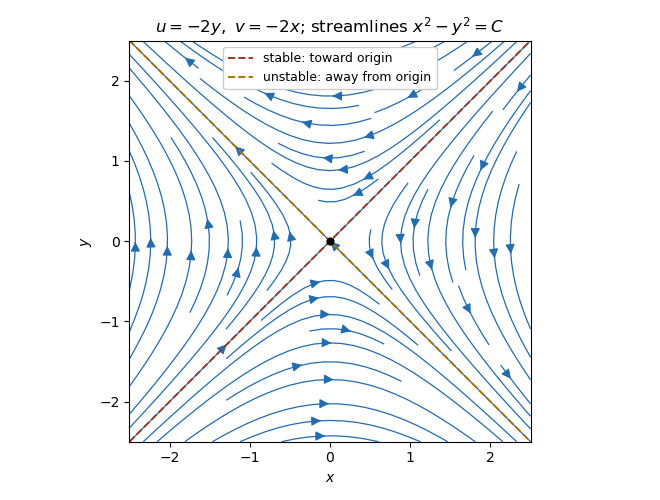
Streamlines and directions for the incompressible irrotational flow
. Details. Past exam of the mathematics course of the University of Cambridge 2017 ib Paper 1 5D i Solution Created 2026-09-24 Updated 2026-10-05
The divergence and scalar vorticity areThus the flow is irrotational but not incompressible on the plane. A velocity potential satisfying isIndeed its two partial derivatives are the two velocity components. A usual two-dimensional stream function would satisfy , and hence have identically zero divergence. No such stream function exists on an open region where this divergence is not identically zero; the line is not a two-dimensional flow domain.
Past exam of the mathematics course of the University of Cambridge 2017 ib Paper 1 1F iii Solution Created 2026-09-24 Updated 2026-10-05
If spans and has elements but is linearly dependent, a nontrivial linear combination equal to zero lets us remove one member without changing the span. This produces spanning vectors, whereas the standard basis contains linearly independent vectors, contradicting the Steinitz exchange lemma. Therefore . Together the three deductions establish that any two of the three properties imply the third. For , the only independent or zero-element family is the empty basis, and the same conclusions hold.
Past exam of the mathematics course of the University of Cambridge 2017 ib Paper 1 1F ii Solution Created 2026-09-24 Updated 2026-10-05
If is linearly independent and has elements, apply the Steinitz exchange lemma with as the independent family and the standard basis as the spanning family. All members of the standard basis are replaced, leaving itself spanning. Thus , so is a basis.
Past exam of the mathematics course of the University of Cambridge 2017 ib Paper 1 1F i Solution Created 2026-09-24 Updated 2026-10-05
The Steinitz exchange lemma says that if span a vector space and are linearly independent, then , and after reordering the , the family still spans. Here is a proof. Suppose the first replacements have been made. Express in that spanning family. Some coefficient of a remaining must be nonzero, since otherwise belongs to the span of , contrary to linear independence. Solve for that and replace it by ; this preserves spanning. If , the first replacements leave a spanning family , contradicting linear independence of the first vectors. This proves both assertions.
Now suppose is linearly independent and spans . Express each member of the standard basis using finitely many members of , and let be the finite union of those members. Then spans. No element of can exist, since it would be a linear combination of and violate linear independence. Thus is finite. Applying the Steinitz exchange lemma in both directions to and the standard basis gives and . Hence .
Past exam of the mathematics course of the University of Cambridge 2017 ib Paper 1 19H b Solution Created 2026-09-24 Updated 2026-10-05
For a target , the bias of an integrable estimator is ; it is an unbiased estimator if this is zero at every allowed parameter value. Here has a zero-truncated Poisson distribution, , and . Write an estimator based only on as , assuming a finite expectation for every . Unbiasedness requiresAbsolute integrability at every positive parameter ensures that the power series on the left converges absolutely on every complex disc. Uniqueness of coefficients in a power series therefore gives for odd and for positive even . Conversely these values give the displayed identity, sois the unique unbiased estimator of this form. The uniqueness claim concerns nonrandomized functions of ; allowing external randomness would permit addition of independent mean-zero noise.
For this parity estimator for a zero-truncated Poisson count, usefulness depends on the loss, but under squared-error loss it performs poorly despite being an unbiased estimator. Since , andIt takes the inadmissible value with positive probability, and its variance tends to one rather than zero as . Clipping to the parameter interval gives . This has bias , butThus a simple biased estimator strictly improves its mean squared error at every parameter value; uniqueness among unbiased estimators does not make it optimal for this loss.
Past exam of the mathematics course of the University of Cambridge 2017 ib Paper 1 19H a Solution Created 2026-09-24 Updated 2026-10-05
A sufficient statistic has a conditional distribution of the full data given its value that is independent of the unknown parameter. A minimal sufficient statistic is sufficient and is a function of every other sufficient statistic, up to null sets. For a dominated family with common positive support, the likelihood-ratio criterion for minimal sufficiency states that is minimal sufficient if holds exactly when is independent of .
For , the joint probability mass function isThe Fisher-Neyman factorization theorem proves sufficiency of . For two samples, the likelihood ratio is , independent of exactly when their sums agree. Thus is minimal sufficient. Any one-to-one transformation of it is also minimal sufficient, so chooseThis chosen estimator is an unbiased estimator, since each observation has mean . If instead the statistic is reported as , its expectation is , and as an estimator of it has bias (zero only when ). Being a minimal sufficient statistic is unchanged by this rescaling; being an unbiased estimator is not.
Past exam of the mathematics course of the University of Cambridge 2017 ib Paper 1 17D d Solution Created 2026-09-24 Updated 2026-10-14
The wall shear stress vanishes when . ThereforeFor a genuinely inclined plane the entire moving layer now flows upslope. The profile touches zero at the wall with zero derivative and becomes increasingly negative towards the surface. In the plot with velocity horizontal and height vertical, the zero derivative at the wall is represented by a vertical tangent. The resulting volume flux is , so zero wall shear stress does not mean zero flux.
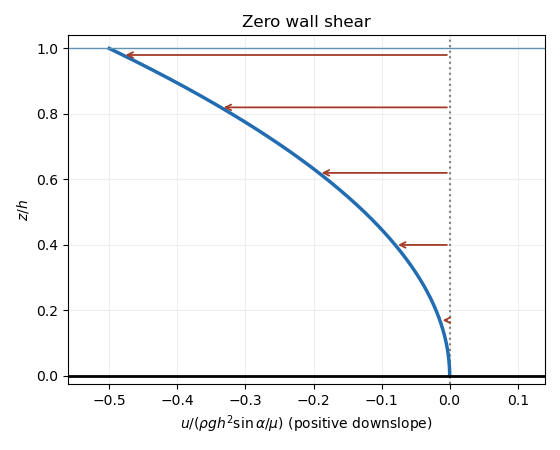
Zero wall shear and an entirely upslope velocity profile
. Details. Past exam of the mathematics course of the University of Cambridge 2017 ib Paper 1 17D c Solution Created 2026-09-24 Updated 2026-10-14
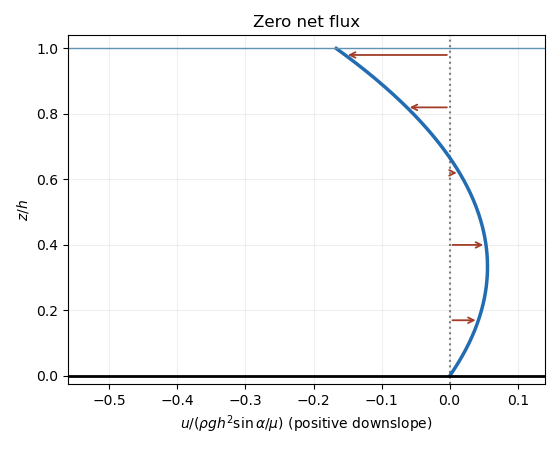
The volume flux per unit transverse width isThusAssume a genuinely inclined plane, . With and , the zero-flux velocity profile is . It is positive for , zero at , and negative above that level. Its maximum is at , and its surface value is . Thus equal integrated downslope and upslope transports cancel, rather than the fluid being motionless.
Past exam of the mathematics course of the University of Cambridge 2017 ib Paper 1 17D b Solution Created 2026-09-24 Updated 2026-10-05
For an inclined viscous film with opposing surface shear, the steady parallel velocity automatically satisfies the continuity equation and the advective acceleration vanishes. The two components of the Navier-Stokes equations reduce toThe uniform thickness and constant atmospheric pressure make . The boundary conditions areThese are respectively no-slip boundary condition, imposed tangential traction on the surface with outward normal , and the normal stress condition on the flat free surface. The normal viscous stress is zero because the normal velocity vanishes. Integrating givesIn particular is the downslope tangential traction exerted by the fluid on the wall. The wall's tangential traction on the fluid has the opposite sign, because the outward normal of the fluid at its bottom is . This fixes the potentially confusing wall sign convention.
Past exam of the mathematics course of the University of Cambridge 2017 ib Paper 1 17D a Solution Created 2026-09-24 Updated 2026-10-14
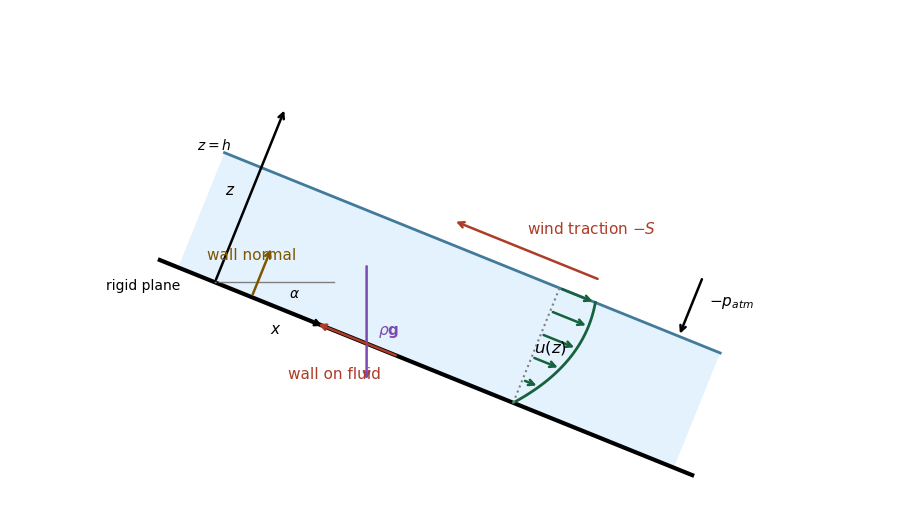
Choose downslope along the rigid plane and normal to it into the fluid, with the wall at and the flat free surface at . The gravitational body force per unit volume has components . The wind's tangential traction on the top surface is in the direction; the atmospheric normal traction is in the direction. At the wall there is no-slip boundary condition, and the wall supplies the opposing normal force and a tangential traction whose sign depends on the wind strength.
The velocity is parallel to the plane, . Its velocity profile is a concave quadratic, with and negative slope at the free surface when . The diagram uses moderate wind, for which the flow is still everywhere downslope. Stronger wind can reverse the upper portion, or the entire moving layer; the later cases quantify this.


Past exam of the mathematics course of the University of Cambridge 2017 ib Paper 1 15B b Solution Created 2026-09-24 Updated 2026-10-20
A bound state has and , since outside the delta potentials a square-integrable solution must decay exponentially. The wavefunction is continuous at each delta: a jump would produce a delta derivative in with no matching term in the equation. Integrating the time-independent Schrödinger equation across either givesThe symmetry of the symmetric double-delta potential permits even and odd solutions. Up to a nonzero normalization factor, the even candidate is for , and outside. Its derivative jump at givesThe odd candidate is inside and outside. Its jump givesParity ensures the jump at as well. Put and . The continuous strictly increasing function ranges from to infinity, so there is exactly one even bound state for every . The continuous strictly increasing function ranges from to infinity, so the odd bound state of a symmetric double-delta potential exists if and only if . Strict increase follows from the allowed monotonicity facts plus the strictly increasing term . ThereforeAt equality the odd limiting solution has and is not square integrable, so it is not a bound state. No nonnegative energy can supply another full-line square-integrable state, since its exterior solutions are oscillatory or affine.
Past exam of the mathematics course of the University of Cambridge 2017 ib Paper 1 15B a Solution Created 2026-09-24 Updated 2026-10-05
Define the parity operator by . For the usual full-line Hamiltonian operator, or any parity-invariant operator domain and boundary conditions, an even potential gives : the second derivative is unchanged by reflection and . If , then . A nondegenerate energy eigenvalue has a one-dimensional eigenspace, so for some scalar . Since , . HenceThus the stationary state has even or odd parity. The symmetry must include the operator domain: an even potential alone would not imply this conclusion with asymmetric boundary conditions.
Past exam of the mathematics course of the University of Cambridge 2017 ib Paper 1 14B b Solution Created 2026-09-24 Updated 2026-10-05
For smooth rapidly decaying initial data, apply the Fourier transform in and differentiate under the integral. The Fourier transform of a derivative turns the wave equation intoSolving this constant-coefficient ordinary differential equation givesAt the quotient means its continuous limit , so .
Since , the Translation property of the Fourier transform inverts the first term as . Also has Fourier transform , including its limiting value at zero. The convolution theorem therefore inverts the second term asThis proves the D'Alembert formulaThe formula itself extends beyond the rapidly decaying class: and suffice for a classical solution, verified by differentiation and the two initial conditions. The decay assumption above justifies the ordinary transform derivation without distributional qualifications.
Past exam of the mathematics course of the University of Cambridge 2017 ib Paper 1 14B a ii Created 2026-09-24 Updated 2026-09-24
Past exam of the mathematics course of the University of Cambridge 2017 ib Paper 1 14B a i Created 2026-09-24 Updated 2026-09-24
Past exam of the mathematics course of the University of Cambridge 2017 ib Paper 1 13A b iii Created 2026-09-24 Updated 2026-09-24
Past exam of the mathematics course of the University of Cambridge 2017 ib Paper 1 13A b ii Created 2026-09-24 Updated 2026-09-24
There are unlisted articles, also show them or only show them.