
Past exam of the mathematics course of the University of Cambridge 2017 ia Paper 3 9B a Solution Created 2026-09-24 Updated 2026-10-05
Assume is continuously differentiable. Apply the chain rule to each component with :Contracting the first identity with provesHere differentiates with respect to at fixed , while the time derivative holds fixed. The equality follows directly even at ; no division by is needed. It holds componentwise for the vector field, so it is not restricted to scalar functions.
Past exam of the mathematics course of the University of Cambridge 2017 ia Paper 3 8E b Solution Created 2026-09-24 Updated 2026-10-05
Write , with . Conjugation relabels a transposition, sowhere labels are read modulo . In particular the subgroup contains . These are the edge transpositions of a path through all letters; transpositions on a connected graph generate the symmetric group, so the two original generators generate .
For the general separation , conjugating produces every edge transposition modulo . The components of this graph are precisely the residue classes modulo : moving along an edge adds or subtracts , and the subgroup of generated by consists of multiples of . Hence, if , the graph is connected and the same graph argument gives the whole symmetric group.
For completeness, the graph argument can be proved without assuming a generating-set theorem. On a simple path , put . ThenThis is a conjugate of the last edge transposition; connectivity therefore supplies every transposition, and part (a) supplies every permutation.
If , there are residue blocks of size , since . The cycle permutes these blocks, and swaps two letters in the same block. Both preserve this block system, so their generated subgroup does too. The full does not: a transposition exchanging one letter of two different blocks sends a block to a mixture of them. Thus the subgroup is proper. This provesThus a cycle and a transposition generate the symmetric group exactly at coprime separation. The obstruction is preservation of a partition, not failure of transitivity: the -cycle already acts transitively even when .
Past exam of the mathematics course of the University of Cambridge 2017 ia Paper 3 8E a Solution Created 2026-09-24 Updated 2026-10-05
With rightmost-first composition, a permutation cycle satisfiesTracing each verifies the equality, and every other letter is fixed. Thus every cycle is a product of transpositions; decomposing a permutation into disjoint permutation cycles proves that every element of is such a product. The identity is the empty product.
To establish that parity is well defined, use the permutation matrix defined by . Its determinant is , and . A transposition swaps two columns of the identity matrix and has determinant . Therefore if is expressed as a product of transpositions,The left side depends only on , so any two decompositions have the same parity. DefineMultiplicativity of the determinant makes this the sign homomorphism. Its kernel of a group homomorphism is the alternating groupIt is a normal subgroup consisting of the even permutations. For the sign map is surjective because a transposition has sign , so . For both groups are trivial.
Past exam of the mathematics course of the University of Cambridge 2017 ia Paper 3 7E b Solution Created 2026-09-24 Updated 2026-10-05
Centre the cube at the origin with faces having normals . Every rotational symmetry fixes the centre and permutes these normals, so its rotation matrix is a signed permutation matrix of determinant one. Conversely any such matrix permutes the cube’s coordinates up to signs and preserves the cube. For each of coordinate permutations, four of the eight choices of signs give determinant one. Consequently the rotational symmetry group of a cube hasThis counts the rotations directly, without an unverified stabilizer calculation. The TeX’s is damaged transcription: the PDF prints 24.
Let be the face colourings. A colouring fixed by a rotation must be constant on each permutation cycle of faces, giving fixed colourings if the rotation has face cycles. The rotation types are:
There are three face axes, each with two quarter-turns and one half-turn; six edge axes, each with one half-turn; and four vertex axes, each with two nonidentity third-turns. These rotations are distinct and, with the identity, total 24, so the table is exhaustive. Face-axis rotations fix their two axial faces; the remaining four faces cycle or pair. Edge half-turns pair all faces, while vertex third-turns form two triples.
Burnside lemma now givesThe three colours are labelled, orthogonal reflections are excluded, and no condition requires every colour to appear.
Past exam of the mathematics course of the University of Cambridge 2017 ia Paper 3 7E a Solution Created 2026-09-24 Updated 2026-10-05
For a group action, the orbit of a group action of is , and its stabilizer subgroup is . The orbit-stabilizer theorem gives : the map is a well-defined bijection from stabilizer cosets to the orbit.
Within one orbit, the stabilizer subgroups are conjugate, since . Their sizes are therefore equal. Summing stabilizer sizes over a single orbit gives , and summing over all orbits yieldsNow count the pairs fixed by the action in two ways. Holding fixed gives choices of , whereas holding fixed gives choices of . ThusCombining the two identities proves Burnside lemma:The finiteness hypotheses justify these cardinality sums. If is empty, every sum and the orbit count are zero, so the formula still applies.
Past exam of the mathematics course of the University of Cambridge 2017 ia Paper 3 4B b Solution Created 2026-09-24 Updated 2026-10-05
The quotient theorem for Cartesian tensors here says: if contracting with every vector gives the components of a vector in every right-handed orthonormal basis, then obeys the second-order tensor transformation law. Conversely that transformation law guarantees the contraction is a vector. One may equivalently test that is a scalar for every pair of vectors .
By part (a), and . The contraction property in the new basis saysSince this holds for every test vector, . Using givesFor the converse, , exactly the vector law. For the equivalent scalar formulation, invariance of for every gives , forcing the same matrix identity.
The quantifier “every” matters: an arbitrary nonzero matrix can annihilate one fixed vector, so a single successful contraction cannot establish tensoriality. The stated bases test proper rotations; transformation under orthogonal reflections would require an additional hypothesis if that were wanted. “Second-order” counts tensor indices, rather than the matrix rank of a particular component matrix.
Past exam of the mathematics course of the University of Cambridge 2017 ia Paper 3 4B a Solution Created 2026-09-24 Updated 2026-10-05
Use the Einstein summation convention. Substitute the given basis transformation into the expansion of the vector:By linear independence of the basis vectors, . In matrix notation . A rotation matrix is orthogonal, so multiplication by givesThe placement of the transpose follows from the specified convention . It must not be guessed from a different convention for an active rotation of a vector.
Past exam of the mathematics course of the University of Cambridge 2017 ia Paper 3 12B c Solution Created 2026-09-24 Updated 2026-10-05
Let , using real-valued smooth and a fixed bounded region. Differentiation under the integral sign and Green's first identity yieldThe boundary term vanishes because on , and the heat equation gives in . ConsequentlyThe integrand is continuous and nonnegative. Thus at any fixed time, equality is equivalent to everywhere in , also giving there at that time. This proves Dirichlet energy dissipation for the heat equation.
The boundary condition fixes the boundary temperature in time; it is not a zero normal derivative condition. No sign condition on is used. The stated smoothness licenses the time derivative, spatial integration by parts and boundary trace; without that regularity an appropriate weak energy argument would be required.
Past exam of the mathematics course of the University of Cambridge 2017 ia Paper 3 12B b Solution Created 2026-09-24 Updated 2026-10-05
Put . Then on , and the constant does not change a gradient, so . Expand the unnormalized Dirichlet energy:The cross term is zero by Green's first identity:Thus the useful stronger identity isEquality holds exactly when has zero gradient. It is then constant on every connected component and zero on that component’s boundary, hence . Therefore equality holds precisely when throughout . This is the Dirichlet principle; an additive boundary constant does not alter the minimizing energy. The energy here omits the optional factor , which does not affect minimizers or the inequality.
Past exam of the mathematics course of the University of Cambridge 2017 ia Paper 3 12B a Solution Created 2026-09-24 Updated 2026-10-05
Work with real-valued smooth functions on the bounded region enclosed by , with the oriented surface element pointing outward. Set . It is a harmonic function in and has zero Dirichlet boundary conditions on . Applying Green's first identity to with itself givesBoth terms on the right vanish by the boundary condition and harmonicity. The integrand is nonnegative and continuous, so throughout . Consequently is constant on each connected component; every bounded component meets the prescribed boundary, where that constant is zero. ThereforeThis is the energy proof of Uniqueness of the Dirichlet problem. Connectedness of is not essential if the boundary values are prescribed on every component. Boundedness, or suitable decay and integrability at infinity, is needed for the boundary/energy argument; the finite enclosed-volume interpretation is used here.
Past exam of the mathematics course of the University of Cambridge 2017 ia Paper 3 11B c Solution Created 2026-09-24 Updated 2026-10-05
The directional derivative along the specified vector field givesUse the magnitude formula for the curvature of an integral curve of a vector field:It vanishes on the plane and on the axis away from the origin, consistent with straight field lines there. At the origin the vector field vanishes, so it fails the nowhere-zero hypothesis and this field-line curvature is not defined.
As an independent geometric check, an integral curve of a vector field satisfies , , , giving . Its velocity is and acceleration ; the ordinary curvature of a space curve formula gives the same expression.
Past exam of the mathematics course of the University of Cambridge 2017 ia Paper 3 11B b Solution Created 2026-09-24 Updated 2026-10-05
Let and choose an orientation of a regular curve following the vector field. Its unit tangent vector is , where is constant along a connected regular segment. Arc length differentiation along that curve is . ThereforeTaking the cross product with removes the term parallel to :Where the Frenet frame exists, . ThusThe printed sign corresponds to orientation along or against the field. Taking magnitudes gives the orientation-independent curvature of an integral curve of a vector field, . This scalar formula also applies at zero curvature, where itself may be undefined.
Past exam of the mathematics course of the University of Cambridge 2017 ia Paper 3 11B a Solution Created 2026-09-24 Updated 2026-10-05
For an arc-length parametrization, the unit tangent vector is , with . Its derivative is perpendicular to . The curvature of a space curve is ; where , its principal normal vector is , so . The binormal vector completes the positively oriented Frenet frame.
Differentiate to get . AlsoThus has only an component. Define the torsion of a space curve by , giving .
Next, , and differentiating the other inner products gives and . Hence the Frenet-Serret formulas areThese statements require enough smoothness, for example a curve with positive curvature on the interval under discussion. If , the unit tangent vector is still defined, but the standard principal normal vector, binormal vector and torsion of a space curve need not be; their existence cannot be inferred just from smoothness of the curve.
Past exam of the mathematics course of the University of Cambridge 2017 ia Paper 2 9F c Solution Created 2026-09-24 Updated 2026-10-05
Let and use the floor function to chooseInterpret an empty integer interval as an empty sum. These bounds give exactly the event , where has the binomial distribution of parameters . Since , the central limit theorem for a sum of independent Bernoulli distribution variables gives convergence in distribution of that standardized count to the standard normal distribution. Its cumulative distribution function is continuous at both endpoints, soThe TeX's additional malformed inequality involving and is absent from the PDF and is not a condition on the requested integers.
Past exam of the mathematics course of the University of Cambridge 2017 ia Paper 2 9F b Solution Created 2026-09-24 Updated 2026-10-05
For fixed and sufficiently large ,The finite product and last factor tend to one, while . Thus the Poisson limit theorem givesThese numbers form a probability mass function because they are nonnegative and their sum is , by the exponential series. They define the Poisson distribution of parameter . Only is needed to make the binomial parameter valid, which is sufficient for the limit.
Past exam of the mathematics course of the University of Cambridge 2017 ia Paper 2 9F a Solution Created 2026-09-24 Updated 2026-10-05
The binomial theorem makes the sum of the proposed probability mass function equal to ; every term is nonnegative. Realize the associated binomial distribution as , where the are independent variables with the Bernoulli distribution of parameter . Each has expected value and variance . Linearity of expectation and variance additivity for independent random variables yieldAt or this is a constant random variable; the same formulas apply, with the endpoint mass understood by continuity.
Past exam of the mathematics course of the University of Cambridge 2017 ia Paper 2 8C b Solution Created 2026-09-24 Updated 2026-10-05
Choose and , so . The Jacobian determinant of the coordinate change is two, so it is an invertible linear map. By the chain rule, and . ConsequentlyThis is the wave equation with . The D'Alembert formula is , with arbitrary twice differentiable functions . Returning to the old coordinates and absorbing factors of two into the arbitrary functions givesDirect differentiation checks the cancellation. Equivalently, first integrating produces the same two-function family.
Past exam of the mathematics course of the University of Cambridge 2017 ia Paper 2 8C a Solution Created 2026-09-24 Updated 2026-10-05
For real initial data, separation of variables givesThis includes , whose solution is identically zero. Every other real has a pole at , so only gives a finite solution on the whole real line. If complex-valued initial data are allowed, a nonreal has no real-time pole; the whole-real-line conclusion here uses the usual real-valued differential-equation convention.
Along a characteristic curve , the chain rule gives . For the homogeneous transport equation this is zero, so . For the nonlinear equation, the same method of characteristics reduces the problem to , with initial value . ThereforeFor differentiable real , this is the classical solution wherever its denominator is nonzero, on the characteristic intervals containing the initial line. If for some , that characteristic blows up at , . Thus the only real-valued solution bounded on all of has , giving .
Past exam of the mathematics course of the University of Cambridge 2017 ia Paper 2 6C b Solution Created 2026-09-24 Updated 2026-10-05
For , differentiate and use the angular derivative . The polar coordinates satisfyHence the rotation is clockwise. The origin is an unstable equilibrium, while is a limit cycle of period . Writing gives the logistic differential equation . For ,All nonzero solutions tend to the unit-circle attracting limit cycle as , spiralling outward for and inward for . For the solution exists for every real time and approaches the origin as ; for it remains periodic in both time directions. For , the denominator first vanishes atThis finite-time blow-up of an ordinary differential equation occurs backward in time. Such exterior solutions have no behavior: their maximal time interval is . The zero solution exists for all time and has no defined polar angle.
Past exam of the mathematics course of the University of Cambridge 2017 ia Paper 2 6C a Solution Created 2026-09-24 Updated 2026-10-14
Use the complete system in the PDF: the TeX omits . Both coordinate axes are invariant, and the equilibrium points are , and . The Jacobian matrix isAt its eigenvalues are , and at they are : both points are saddle equilibria. At the coexistence point,Thus the interior point is a stable spiral. The nontrivial nullclines are and : increases below the first and decreases above it, while increases to the right of the second and decreases to the left. The rotation near coexistence is counterclockwise.
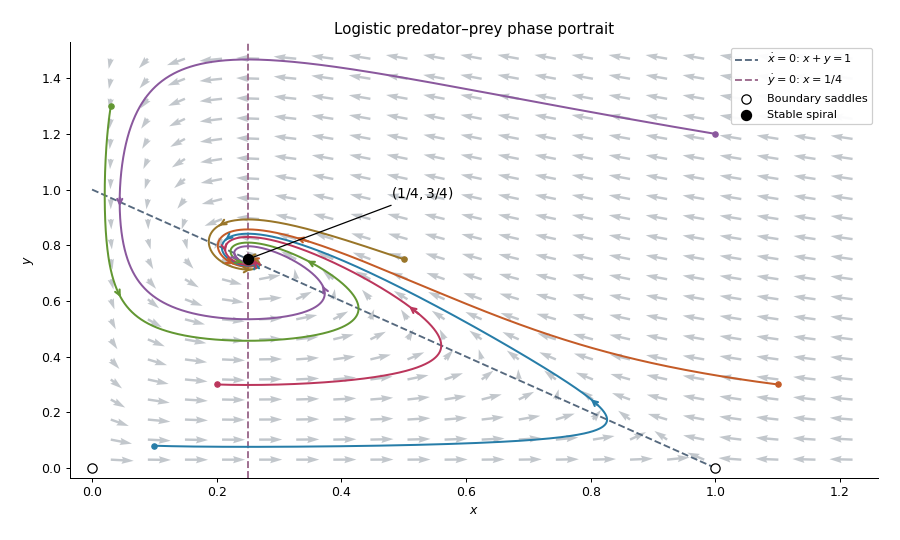

A local linearization by itself does not prove that every interior solution has the same limit. For this logistic predator-prey model, let and use the Lyapunov functionThe inequality makes nonnegative, with equality only at coexistence. Its sublevel sets are compact inside the positive quadrant, because diverges both at the axes and at infinity. Direct differentiation cancels the predator-prey cross terms and givesOn one has , and remaining there requires . The largest invariant subset is therefore the coexistence point. The LaSalle invariance principle provesOn , decays as toward the origin. On , the logistic differential equation takes every to one. The origin itself stays fixed. These boundary trajectories are the exceptions to the interior convergence statement.
There are unlisted articles, also show them or only show them.