
Past exam of the mathematics course of the University of Cambridge 2008 ib Paper 2 15D a Created 2026-09-24 Updated 2026-09-24
Past exam of the mathematics course of the University of Cambridge 2008 ib Paper 2 14C Solution Created 2026-09-24 Updated 2026-10-14
Near zero, expand and invert the parenthesized series. The first three nonzero Laurent series terms areThe zero quadratic coefficient also follows from , which makes odd. The nearest other singularities are at .
All poles of occur at , , and have residue one, since the derivative of equals one at those zeros. AlsoThus subtracts the complete principal part at zero and at every pole with . These are all the poles in the stated open disk; each singularity of there is removable.
For , expanding each rational summand in inverse powers givesThis contributes no constant or positive-power term. To find the first Taylor coefficients of the analytic , expand near zero as and subtract it from the already calculated local series of . Combining its Taylor series with the exterior series above yields the three requested annular coefficients:Both series converge on , so this combination is a valid Laurent expansion there.
For the Basel sum from exponential poles, let . The Laurent coefficient formula givesThe function is bounded on these circles by one constant independent of . Indeed, if , use ; if , use . In the remaining strip , the imaginary part has magnitude , within of the odd multiple of . Its cosine is negative, so .
Past exam of the mathematics course of the University of Cambridge 2008 ib Paper 2 13F Solution Created 2026-09-24 Updated 2026-10-14
Because and the numerical series converges, its tails can be made arbitrarily small independently of :Thus the partial sums satisfy the uniform Cauchy criterion; completeness of the real numbers supplies the pointwise limit, and the same tail bound proves uniform convergence. This is the Weierstrass M-test.
For with , choose an integer . If and , then , so . The tail is therefore uniformly convergent by the M-test; adding its finitely many earlier terms preserves uniform convergence, even though those earlier terms can be unbounded near excluded integers. For the set is empty and the claim is vacuous.
Each summand is continuous on . Around any , choose an interval containing , avoiding integers and lying in some . The uniform-limit continuity theorem then proves .
The series is not uniformly convergent on all of . Uniform convergence would require uniformly, but for every . These evaluation points belong to , contradicting that necessary condition.
Past exam of the mathematics course of the University of Cambridge 2008 ib Paper 2 12G Solution Created 2026-09-24 Updated 2026-10-14
Work on the unit sphere with geodesic edges. A spherical lune of angle has area . The three great circles through the sides of a spherical triangle partition the sphere into four antipodal pairs of triangles. If the original triangle has area and the other pair representatives have areas , then . The three lunes at its vertices have areas , soThis proves the spherical excess formula . Triangulate a convex spherical -gon from one vertex into triangles; summing areas and vertex angles givesFor a decomposition of the whole sphere, angles around every vertex sum to and each edge belongs to two faces. Summing the polygon area formula over all faces therefore givesNow , , and , since three edges meet at each vertex. Substituting into Euler's formula yields . Nonnegative integer solutions therefore give at most seven pairs:At least three distinct pairs are realized: a dodecahedron gives , a pentagonal prism gives , and a cube gives . Center each convex polyhedron around an interior origin and radially project its faces onto the sphere; edges become great-circle arcs and the resulting spherical faces are convex, preserving the incidence counts. This supplies the required actual decompositions.
Past exam of the mathematics course of the University of Cambridge 2008 ib Paper 2 11G Solution Created 2026-09-24 Updated 2026-10-14
We prove the needed Hilbert basis theorem step rather than assuming it. Suppose is a commutative Noetherian ring and is an ideal. The set of leading coefficients of elements of , together with zero, is an ideal of : align degrees with powers of before addition, and use scalar multiplication. Choose finitely many generators of , represented by polynomials , and let be the maximum of their degrees. If then and there is nothing to prove.
For each , let consist of the coefficients of of elements of of degree at most . This is also an ideal of ; choose finitely many generating coefficients and representing polynomials of degree at most . The finite collection of all and generates : for any of degree , express its leading coefficient using those of and subtract the matching combination of to lower degree. When the degree becomes , use the representatives of to lower it again. Induction on degree eventually leaves zero.
A field is Noetherian because its only ideals are zero and the whole field. Repeatedly applying the proved step gives every ideal of finitely generated.
The coefficient restriction in the second ring says preciselyIt contains one and is closed under addition, additive inverses and multiplication: . To show it is not Noetherian, consider the ideals in They form an ascending chain. In any with , the coefficient of is a polynomial in of degree at most , since the nonconstant part of introduces at least . It cannot equal ; hence . If the union ideal were finitely generated, all its generators would lie in one , forcing the chain to stabilize. This contradiction proves , the constant-plus-ideal non-Noetherian subring example.
Past exam of the mathematics course of the University of Cambridge 2008 ib Paper 2 10E ii Created 2026-09-24 Updated 2026-09-24
Past exam of the mathematics course of the University of Cambridge 2008 ib Paper 2 10E i Created 2026-09-24 Updated 2026-10-14
Past exam of the mathematics course of the University of Cambridge 2008 ib Paper 1 9E Solution Created 2026-09-24 Updated 2026-10-14
The row rank of is the dimension of the span of its rows in ; its column rank is the dimension of the span of its columns in . Elementary row operations replace rows by invertible linear combinations, so preserve their span. They also preserve every column relation: if and only if for an invertible elementary matrix . Reduce to row echelon form , with nonzero rows. These rows are independent because their leading entries occur in distinct, successively later columns. The pivot columns are independent by their triangular pivot submatrix, while every column lies in the -dimensional coordinate space supported on the nonzero rows. Thus both ranks of , and hence both ranks of , equal . Row rank equals column rank.
Elementary column operations replace columns by invertible linear combinations and preserve their span. Equivalently, right multiplication by an invertible elementary matrix preserves row relations, since if and only if . Therefore either elementary row operations or elementary column operations preserve the matrix rank, and any finite sequence gives .
For the block matrices, put . The explicit invertible multiplicationsfollow by first subtracting times the lower block row from the upper one and then subtracting the first block column times from the second. Changing the sign of the upper block row gives . These operations preserve matrix rank, proving that the two specified block matrices have equal rank. Their off-diagonal form gives , since the two image components occupy independent coordinate blocks.
Choose independent columns of and independent columns of . Select the corresponding columns from the first block column of and from the second. In a linear relation among these selected columns, the upper coordinate block forces every coefficient of the first selection to vanish; the lower block then forces every coefficient of the second to vanish. Consequently . Combining this with the equality of block ranks proves the Frobenius rank inequality:
Past exam of the mathematics course of the University of Cambridge 2008 ib Paper 1 8H Solution Created 2026-09-24 Updated 2026-10-14
The Lagrangian sufficiency theorem for an equality constraint states that if a feasible and a multiplier exist such that globally maximizes over the underlying domain, then globally maximizes over . Indeed at every feasible point, so global maximality of directly compares the feasible objective values. The underlying domain can already impose .
For , choose . Each function on is a strictly concave function and attains its unique maximum at , since there. The sum Lagrangian is therefore globally maximized when every , and this point is feasible. For the objective is identically one on the feasible set. For , each feasible lies in , so , with equality only at or ; equality in the total is attained exactly at a simplex vertex. ConsequentlyFor the unique maximizer is ; for every feasible point is a maximizer; for the maximizers are exactly the vertices with one coordinate one and all others zero. When these descriptions coincide.
Past exam of the mathematics course of the University of Cambridge 2008 ib Paper 1 7H Solution Created 2026-09-24 Updated 2026-10-14
Let and . The Gaussian distribution likelihood is proportional to . Multiplying by the normal-gamma distribution prior gives the quadratic exponent . Completing the square,The power of is , so the posterior distribution has exactly the required family withandFor a proper prior, and . The separate factor is retained in both densities; it does not add to the update of . This is a conjugate prior for the Gaussian mean and precision parameter.
Past exam of the mathematics course of the University of Cambridge 2008 ib Paper 1 6D Solution Created 2026-09-24 Updated 2026-10-14
A unit lower triangular is invertible. For , , so an LDL decomposition with positive diagonal givesAlso is symmetric. Hence is a positive-definite matrix.
For the specified matrix, comparing entries successively gives , , , , andThusThe last pivot is negative, so this particular factorization is outside the positive-diagonal case proved above. Indeed has , and . There is no positive-diagonal LDL factorization for the printed matrix. The unrestricted LDL decomposition above is nevertheless valid.
Past exam of the mathematics course of the University of Cambridge 2008 ib Paper 1 5B Solution Created 2026-09-24 Updated 2026-10-14
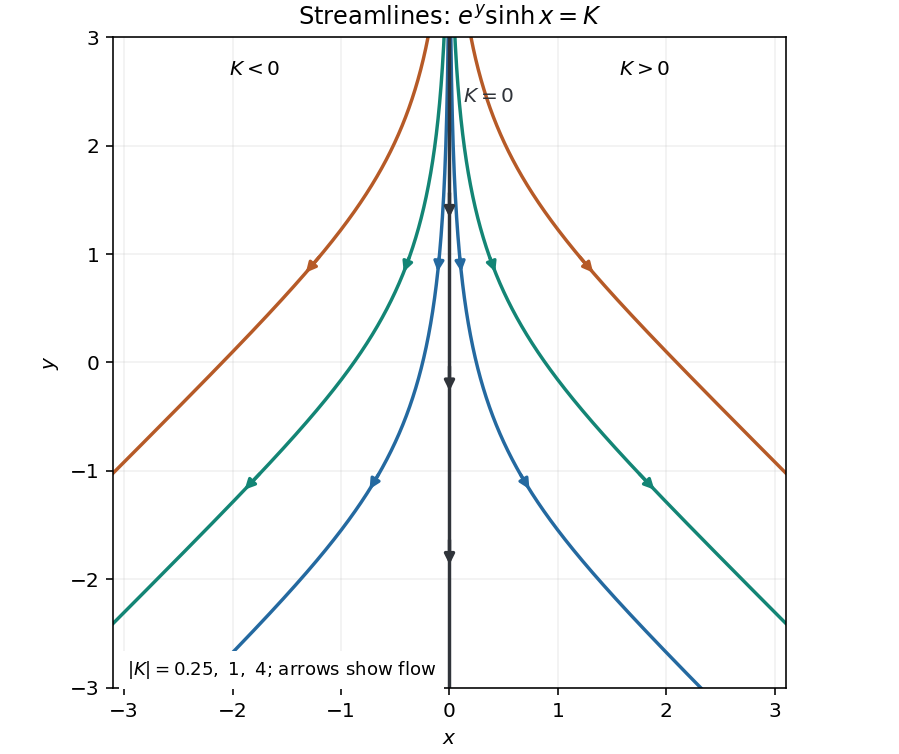
The divergence is , proving incompressibility. Use the stream function convention , . Integration of either component then givesThe streamlines are its level curves. Setting the irrelevant constant to zero, a nonzero level haswith for and for . Each curve rises to as from its side and approaches at large . The zero streamline is . Flow is downward everywhere, outward to the right when and outward to the left when ; on it is vertically downward.

Past exam of the mathematics course of the University of Cambridge 2008 ib Paper 1 4C Solution Created 2026-09-24 Updated 2026-10-14
Choose the transverse axis so that the photon travels in the plane. Its energy-momentum four-vector is . A Lorentz boost of speed along , with and , givesBecause a photon has zero invariant mass, . ThereforeThe first is the relativistic Doppler effect in angular form, and the second is relativistic aberration.
Past exam of the mathematics course of the University of Cambridge 2008 ib Paper 1 3C b Created 2026-09-24 Updated 2026-09-24
Past exam of the mathematics course of the University of Cambridge 2008 ib Paper 1 3C a Created 2026-09-24 Updated 2026-09-24
Past exam of the mathematics course of the University of Cambridge 2008 ib Paper 1 2G Solution Created 2026-09-24 Updated 2026-10-14
Let . Since and ,so . Choose a unit vector with . Its orthogonal complement is an invariant subspace: for , . In an orthonormal basis , therefore has a scalar block and a two-dimensional orthogonal matrix block of determinant one. Such a block has columns and . Consequently is a rotation in three dimensions about the axis through angle , including the identity when .
To construct the Householder reflections, let reflect in the plane spanned by and let reflect in the plane spanned by . They fix , while on their matrices areTheir product is the planar rotation matrix through . Taking proves . This gives the composition of two plane reflections explicitly; each is a Householder reflection for the corresponding unit plane normal .
Past exam of the mathematics course of the University of Cambridge 2008 ib Paper 1 1E iv Created 2026-09-24 Updated 2026-09-24
Past exam of the mathematics course of the University of Cambridge 2008 ib Paper 1 1E iii Created 2026-09-24 Updated 2026-09-24
Past exam of the mathematics course of the University of Cambridge 2008 ib Paper 1 1E ii Created 2026-09-24 Updated 2026-09-24
Past exam of the mathematics course of the University of Cambridge 2008 ib Paper 1 1E i Created 2026-09-24 Updated 2026-10-14
There are unlisted articles, also show them or only show them.