
First-pair antisymmetry of the Riemann tensor Created 2026-09-24 Updated 2026-09-24
Weyl tensor Created 2026-09-24 Updated 2026-09-28
The Weyl tensor is the completely trace-free part of the Riemann curvature tensor. In four dimensions,
First Bianchi identity Created 2026-09-24 Updated 2026-10-03
Symmetric Hessian of a scalar field Created 2026-09-24 Updated 2026-09-24
Geodesic deviation Created 2026-09-24 Updated 2026-10-14
For a family of affinely parametrized geodesics with tangent and connecting field , the Jacobi equation in the convention used here isIt describes the relative acceleration produced by spacetime curvature.
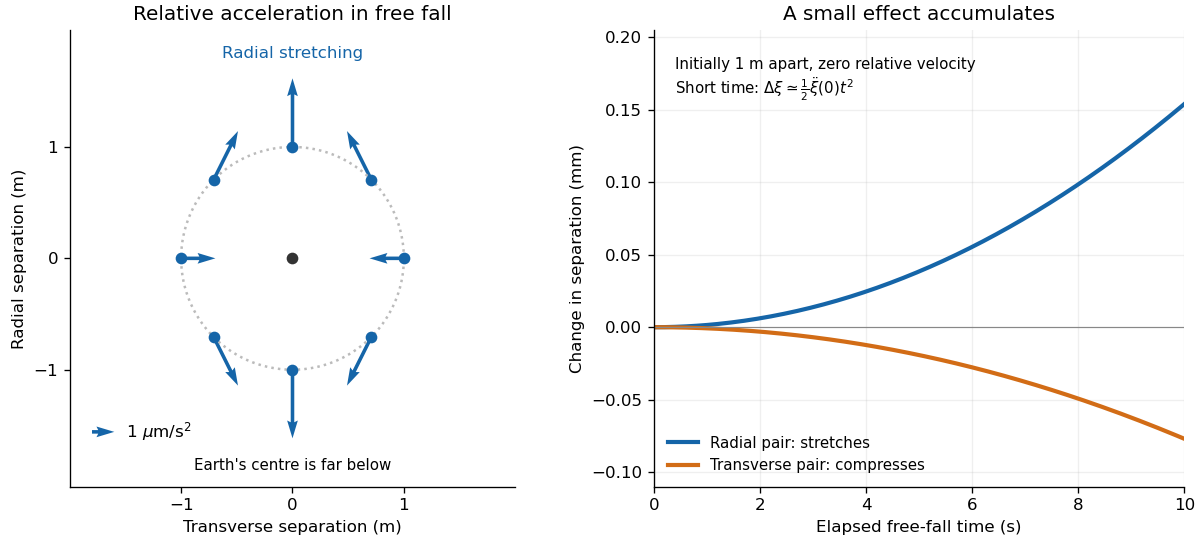
Here describes an infinitesimal separation and the covariant derivatives compare it in a frame transported along the reference geodesic. The Riemann curvature tensor thus becomes something measured with neighboring trajectories. The Newtonian version follows by differentiating gravitational acceleration with respect to position. In the exterior of a spherical mass, let be radial separation and separation in either transverse direction. Newton's law of universal gravitation givesThe upper particle falls less strongly than the lower one, stretching their radial separation; side-by-side particles accelerate toward converging radial directions, compressing their transverse separation. See Oregon State's derivation of tidal acceleration.
For a spherical Earth model with , and , a one-metre radial separation gives ; a one-metre transverse separation gives . Initially comoving particles therefore change separation after one second by approximately : micrometres radially or micrometres transversely. This short-time calculation holds the reference radius fixed to leading order. Its beauty is that common falling motion drops out, leaving a measurable stretching pattern that reveals curvature.

Curvature commutator on a covariant tensor Created 2026-09-24 Updated 2026-10-05
For a rank-two covariant tensor, the derivative commutator contributes one curvature action on each index:
Symmetric residue summation Created 2026-09-24 Updated 2026-11-05
When a residue theorem argument encloses increasingly many poles, the resulting infinite sum needs a specified grouping and convergence justification. Symmetric summation means taking poles in matched groups, such as and , before sending the contour size to infinity.
The meromorphic function has a simple pole of residue at each integer . Its partial-fraction expansion isThe paired terms are uniformly on each compact set avoiding the poles, so the paired series converges absolutely and locally uniformly. The individual one-sided terms are only ; one cannot infer absolute convergence from the unpaired expression.[ref]
NIST Digital Library of Mathematical Functions. section4.22, equation4.22.5, with its argument replaced by pi times z
Residue cancellation by symmetry Created 2026-09-24 Updated 2026-11-05
Symmetry can relate residues, but the sign depends on the symmetry. If a meromorphic function is even, , and , thenIndeed the substitution replaces the local variable at by , reversing the coefficient of in the Laurent series. A contour containing both poles with the same winding number therefore receives cancelling residue contributions.
For example, has residues and at and . An upper-half-plane contour contains only the first pole, so those residues do not cancel in that contour. For an odd meromorphic function, the residues at opposite nonzero poles are instead equal: has residue at both poles. One must check both the local symmetry and which poles the contour actually encloses.
Upper-half-plane indentation rule Created 2026-09-24 Updated 2026-10-05
Suppose a contour follows the real axis, closes in the upper half-plane, and avoids each simple real pole by a small semicircle above it. Each indentation is clockwise and tends toIf the large arc vanishes and there are no enclosed poles away from the real axis, the Cauchy principal value is therefore
Residue at a pole of order n Created 2026-09-24 Updated 2026-10-25
Indecomposable representation Created 2026-09-24 Updated 2026-10-14
An indecomposable representation is nonzero and cannot be expressed as a direct sum of two nonzero invariant subspaces. It is an indecomposable module over the associated group algebra or representing algebra.
Finite quotient representation Created 2026-09-24 Updated 2026-11-05
A group representation factors through a finite quotient group exactly when its kernel of a group homomorphism has finite subgroup index, equivalently when its image of a function is a finite group. If a specific quotient group is prescribed, factorization through it is equivalent to .
For , the one-dimensional group representation factors through a finite quotient group exactly when is a root of unity. Taking gives a one-dimensional group representation with infinite image. Finite dimension therefore does not imply factorization through a finite quotient group.
One-dimensional character Created 2026-09-24 Updated 2026-11-05
A one-dimensional character is a character of a representation arising from a one-dimensional representation, equivalently a homomorphism from a group to the multiplicative group of its scalar field.
Infinite dihedral group Created 2026-09-24 Updated 2026-09-24
The infinite dihedral group is .
Irreducible representation Created 2026-09-24 Updated 2026-10-14
An irreducible group representation is nonzero and has no nonzero proper invariant subspace. These are the pieces that cannot be decomposed further by taking a smaller symmetry-preserved vector space.
The real two-dimensional rotation through degrees illustrates the role of the coefficient field. A one-dimensional real invariant subspace would supply a real eigenvector, but the characteristic polynomial has no real root. The representation is therefore irreducible over the real numbers. Over the complex numbers, that polynomial has distinct roots of unity and , giving two invariant eigenlines. Irreducibility over the real numbers does not imply absolute irreducibility.
Induced representation Created 2026-09-24 Updated 2026-11-05
For a subgroup and a left group algebra -module , its induced representation is , with acting by left multiplication on the first tensor factor. If has finite index of a subgroup and is a finite-dimensional vector space, the dimension of the induced representation is .
Inducing the trivial representation gives the permutation representation on cosets . Frobenius reciprocity characterizes the construction: intertwining operators from the induced representation to correspond to -intertwining operators from to the restriction of a representation . Thus induction of representations extends a smaller group action while imposing only the identifications forced by that subgroup.
Dual representation Created 2026-09-24 Updated 2026-10-14
Intertwining operator Created 2026-09-24 Updated 2026-10-14
An intertwining operator between representations and is a linear equivariant map satisfying for every group element .
Permutation representation Created 2026-09-24 Updated 2026-10-14
Character of a representation Created 2026-09-24 Updated 2026-10-14
The character of a finite-dimensional representation is the class function . Isomorphic representations have the same character.
There are unlisted articles, also show them or only show them.