
Vacuum manifold Created 2026-09-24 Updated 2026-11-05
A vacuum manifold is the space of field values minimizing the potential in the specified homogeneous classical description. For a global symmetry group acting transitively on one orbit of minima, a chosen vacuum with stabilizer gives that orbit as .
The orbit need not be connected: a real scalar field with two symmetry-related minima provides a disconnected example. Restricting to the identity component requires the corresponding connected subgroup and stabilizer, rather than automatically identifying every with one connected component. Continuous vacuum directions motivate Goldstone modes, while nontrivial surrounding maps can classify topological defects. In a gauge theory, some minimum-field values are gauge-equivalent, so the distinction between field-space minima and physical vacuum labels must also be stated.
Isotropic tensor integral Created 2026-09-24 Updated 2026-11-05
A second-rank tensor invariant under every member of the orthogonal group on is a scalar multiple of the Kronecker delta . For a radial weight with absolutely integrable second moments,Reflections force off-diagonal entries to vanish, and coordinate exchanges make all diagonal entries equal. Taking the matrix trace determines their common value. The same proof applies to a ball or a spherical shell centered at the origin.
For , invariance under all proper rotations already forces this second-rank form. In two dimensions, proper rotations alone also preserve an antisymmetric tensor; full orthogonal invariance, or the symmetry of , excludes that extra term. Higher moments use all possible pairings of Kronecker deltas, as in radial tensor moments in three dimensions.
Spectral radius formula Created 2026-09-24 Updated 2026-10-14
Mantle convection Created 2026-09-24 Updated 2026-11-05
Mantle convection is buoyancy-driven motion in a rocky planetary mantle. Heating and cooling create density differences; chemical and mineral-phase differences can also affect buoyancy. Although the mantle is mostly solid, deformation by material creep permits slow flow over geological time.
A simple model balances viscous resistance with buoyancy and transports heat by both flow and thermal conduction. Its Rayleigh number compares those effects. Temperature-dependent mantle viscosity and the strength of the lithosphere help determine whether the surface moves as plates or remains a stagnant lid. Seismic structure, surface deformation and heat flux constrain different parts of this model.
Largest prime factor Created 2026-09-24 Updated 2026-11-05
For an integer , the largest prime factor is the greatest prime number dividing . For example, and : multiplicity affects the size of , but does not repeat a factor in this maximum.
In notation involving smooth numbers, one often extends the definition by . With that convention and , a positive integer is -smooth exactly when . The number zero is excluded, since every prime number divides zero and there is no largest one.
S-smooth number Created 2026-09-24 Updated 2026-11-05
For a finite set of prime numbers, an S-smooth number is a positive integer all of whose prime factors belong to . It has the unique form with nonnegative integer exponents. The empty product includes one, so if is empty, one is the only S-smooth number.
For , the number qualifies, whereas does not because of its factor three. Restricting to positive integers is part of the convention here; the related B-smooth integer notation explicitly permits a negative sign. A numerical smooth number bound corresponds to taking to be all prime numbers at most .
Sine-Gordon breather Created 2026-09-24 Updated 2026-10-14
A sine-Gordon breather is a spatially localized solution that is periodic in time and can be interpreted through a complex-conjugate pair of discrete scattering eigenvalues.
This is a breather of the Sine-Gordon equation; the general breather concept also occurs in other nonlinear systems.
One-soliton solution of the sine-Gordon equation in light-cone coordinates Created 2026-09-24 Updated 2026-09-29
Quantum order finding Created 2026-09-24 Updated 2026-11-05
Quantum order finding Fourier-transforms a superposition of arguments having the same modular-exponentiation value, producing peaks near multiples of the reciprocal period.
Factor extraction from an even modular order Created 2026-09-24 Updated 2026-10-14
Vortex sheet Created 2026-09-24 Updated 2026-11-05
A vortex sheet idealizes a thin shear region as a surface across which tangential velocity jumps while normal velocity remains continuous. Vorticity is then concentrated on the surface in the zero-thickness description. Its sheet strength is related to the tangential velocity difference, rather than to an ordinary finite vorticity value evaluated inside a resolved layer.
A shear layer between two streams motivates the approximation when its thickness is small relative to the wavelength being studied. The ideal model can support Kelvin-Helmholtz instability, but its very short-wave behavior can differ strongly from that of a finite-thickness viscous layer. The surface's kinematic boundary condition and the appropriate dynamic stress balance must be supplied as well as the velocity jump. It is therefore a useful scale-dependent interface model, not a literal claim that a physical fluid has an infinitely sharp resolved velocity profile.
Ordinal Created 2026-09-24 Updated 2026-11-05
An ordinal records the order type of a well-order. In the von Neumann representation, it is a transitive set well-ordered by membership. The first examples are , , , and .
Every well-order is isomorphic to exactly one ordinal. Ordinal order distinguishes arrangements with the same cardinality: and are both countably infinite, but only the latter has a greatest element. Transfinite induction and transfinite recursion extend finite reasoning through these order types. Their ordinal addition generally fails commutativity because it records concatenation order.
Cardinal number Created 2026-09-24 Updated 2026-11-05
A cardinal number records the size of a set up to bijection. Two sets have the same cardinality exactly when such a bijection exists. Finite cardinals are ; the least infinite one is , the size of the natural numbers.
With the axiom of choice, every set can be well-ordered, and its cardinal is represented by the least ordinal in its bijection class, an initial ordinal. Infinite size does not behave like finite counting: the even natural numbers and all natural numbers have equal cardinality via . This notion is distinct from the order type recorded by an ordinal.
Fiber product of sets Created 2026-09-24 Updated 2026-11-05
For functions and , the fiber product of sets isIt retains only pairs whose images agree. Its two projections commute with the maps to , and any other compatible pair of maps factors through it uniquely.
For example, let send an integer to its parity class. Their fiber product consists of all integer pairs with the same parity. If is a singleton, every pair qualifies and the construction reduces to the Cartesian product. This elementary model explains the matching-data condition in more general pullbacks.
Disjoint union Created 2026-09-24 Updated 2026-09-24
The disjoint union tags the elements of its summands, for example .
Cartesian product Created 2026-09-24 Updated 2026-09-24
Image and preimage of a function Created 2026-09-24 Updated 2026-10-14
The image of a function asks which outputs a chosen set of inputs reaches. A preimage asks which inputs reach a chosen set of outputs. Both constructions apply to every function, including one that loses information by sending several inputs to the same output. Their difference is useful whenever a transformation must be followed forward or a condition on its result must be traced back.
Consider the function withEvery input has exactly one output, but zero has two inputs and three has none. The full image of a function is , a proper subset of the codomain . Selecting inputs gives image . Selecting outputs instead gives preimage .
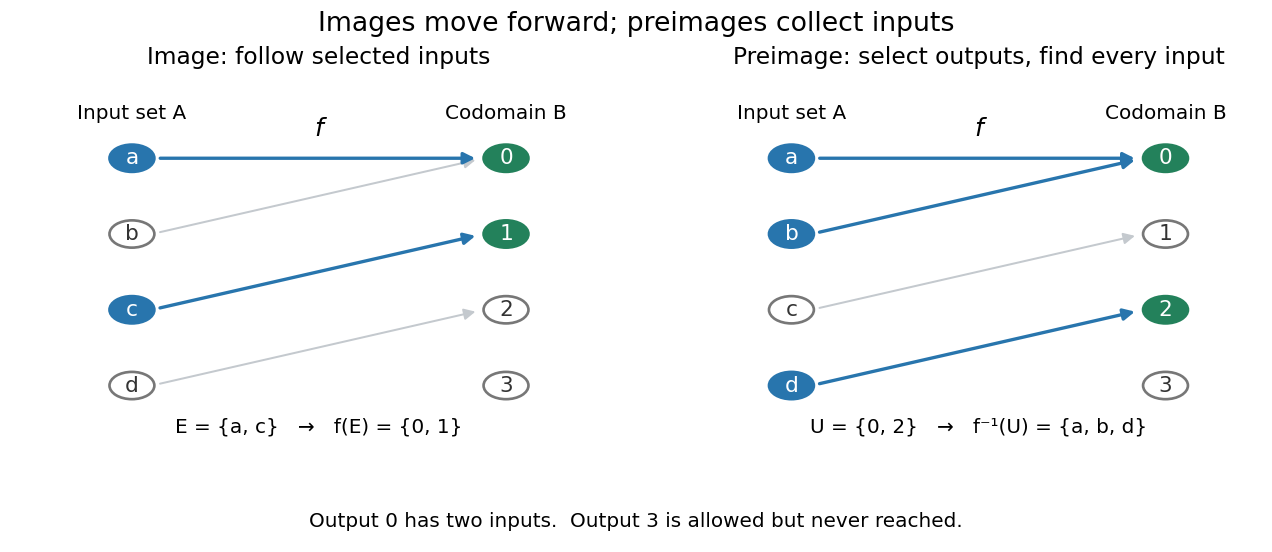

The function is not injective, because , and is not surjective onto , because three is absent from its image. Restricting only the codomain to makes the same rule surjective; it remains noninjective. This separates the output set actually reached from the target set specified in the definition. The definitions of images of a function and preimages, including the distinction from an inverse function, are given in Richard Hammack, Book of Proof, §12.6: Image and Preimage.
Tarski cardinal-square theorem Created 2026-09-24 Updated 2026-09-24
In ZF, if for every infinite , apply this to . The product-sum comparison lemma applied to and its Hartogs ordinal gives either an impossible injection or a surjection . In the latter case, ordering each by its least ordinal preimage well-orders . The converse is the well-orderable-cardinal identity .
Hartogs theorem Created 2026-09-24 Updated 2026-10-14
Axiom of choice Created 2026-09-24 Updated 2026-10-14
Every family of nonempty sets has a choice function. In ZF this is equivalent to the well-ordering theorem.
There are unlisted articles, also show them or only show them.