
Partition regular matrix Created 2026-09-24 Updated 2026-10-07
A matrix over the rational numbers is partition regular when every finite coloring of the positive integers admits a monochromatic vector satisfying , with every coordinate a positive integer. Repeated coordinates are permitted.
Gallai theorem for an integer lattice Created 2026-09-24 Updated 2026-10-14
For every finite , every finite coloring of contains a monochromatic homothetic copy . The theorem follows from the Hales-Jewett theorem by coloring a word according to the sum of the points indexed by its letters.
Van der Waerden theorem Created 2026-09-24 Updated 2026-09-28
Every finite coloring of the positive integers contains monochromatic arithmetic progressions of every prescribed finite length.
Combinatorial line Created 2026-09-24 Updated 2026-09-28
Ramsey's theorem Created 2026-09-24 Updated 2026-10-03
The infinite form of Ramsey's theorem says that if the -element subsets of an infinite set are finitely colored, then some infinite subset has all its -element subsets in one color.
Finite coloring Created 2026-09-24 Updated 2026-10-07
Radiation-field moment Created 2026-09-24 Updated 2026-09-24
Radiative transfer equation Created 2026-09-24 Updated 2026-09-24
Optical depth Created 2026-09-24 Updated 2026-10-14
Series-termination quantization of the Coulomb radial equation Created 2026-09-24 Updated 2026-11-05
For an attractive Coulomb potential with , let be the relative-motion mass, using the reduced mass for a two-body system. A bound energy definesIn the orbital angular momentum sector , the Radial Schrodinger equation isExtract the regular origin power and decaying exponential by , with . Equating powers gives the recurrence relationThe regular confluent hypergeometric function otherwise contains an exponentially growing large-radius part. A physical bound state therefore requires termination: if has degree , then , soHere is the principal quantum number and counts positive radial nodes. For , the recurrence reduces to ; that denominator is an s-wave specialization, not the general angular-momentum recurrence. Regularity at the origin and normalizability at infinity are both essential boundary conditions.
Path algebra Created 2026-09-24 Updated 2026-11-05
The path algebra has the directed paths in a quiver as a basis; multiplication concatenates composable paths and is zero otherwise. Representations of are naturally modules over .
Representation of a quiver Created 2026-09-24 Updated 2026-11-05
A representation of a quiver over a field assigns a vector space to each vertex and a linear map to each arrow. A morphism is a compatible family of vertexwise linear maps.
Stationary state Created 2026-09-24 Updated 2026-11-05
A stationary pure state of a time-independent Hamiltonian is an energy eigenstate. Its time evolution is multiplication by , a global phase, so probabilities for observables with no explicit time dependence remain constant.
For example, a quantum harmonic oscillator number state has a fixed spatial probability density even though its vector acquires a phase. A superposition of states with different energy eigenvalues generally develops changing relative phases and need not be stationary. Conversely, a superposition inside one degenerate energy eigenspace stays stationary. For mixed states, stationarity means , allowing mixtures of different energies as well as pure eigenstates. Stationarity does not imply that every measured observable has zero uncertainty.
Bound state Created 2026-09-24 Updated 2026-11-05
A bound state is a normalizable energy eigenstate localized in its internal or relative coordinates. In a one-particle potential problem, its wavefunction remains spatially concentrated rather than representing an incoming or outgoing asymptotic flux. A sufficiently deep potential well supplies elementary examples.
For the finite square well, bound-state energy lies below the outside continuum threshold and the wavefunction decays exponentially outside the well. A hydrogen atom similarly has discrete internal bound states below its ionization threshold. The atom's center of mass can still move freely: binding refers to relative motion, not necessarily to the localization of an entire composite object. Ordinary below-threshold bound states are distinct from scattering states, while more exceptional embedded bound states require additional qualifications.
Observable Created 2026-09-24 Updated 2026-11-05
An observable represents a measurable quantity in quantum mechanics; in the standard projective description it is a self-adjoint operator on the system's Hilbert space. Its spectrum gives the possible measurement values, and its spectral projections give their probabilities through the Born rule.
For a qubit, the Pauli matrix observable has outcomes and . In the state , their probabilities are and , so the expectation value is . That average need not be an allowed individual outcome. For unbounded observables such as position and momentum, operator domains matter. More general measurement procedures use a positive operator-valued measure and need not correspond to one projective observable alone.
Quantum phase Created 2026-09-24 Updated 2026-11-05
Multiplying a quantum state by one global complex phase does not change any measurement probability; relative phases between components can affect interference.
The global phase is common to the whole state; relative phases control interference between state components.
Quantum number Created 2026-09-24 Updated 2026-11-05
A quantum number is a label used to distinguish quantum states, commonly obtained from an observable's spectral values. The magnetic quantum number labels projections of angular momentum, and the oscillator occupation labels number states. Several compatible labels may be needed to identify a state uniquely.
Discrete labels arise naturally for confined motion and rotation, but a complete state labeling can also include continuous variables such as the momentum of a free particle. Labels associated with commuting observables can be specified together; labels of incompatible components cannot generally be sharp simultaneously. An interaction preserves a quantum number when its Hamiltonian respects the corresponding conserved quantity. A useful label in an approximate model can cease to be conserved when neglected couplings are restored.
Qubit state Created 2026-09-24 Updated 2026-10-25
A qubit state specifies measurement probabilities, rather than a pre-existing answer to every possible measurement. For a pure state, normalized vectors differing by a global phase represent the same physical state:Equivalently, the pure state is a ray: the one-dimensional complex linear subspace spanned by any nonzero representative. Dividing a nonzero vector by its norm fixes its length, but leaves the global phase free. The density operator is unchanged because . In contrast, multiplying only one nonzero component by changes a relative quantum phase and can change measurement probabilities. [ref].
After choosing a global phase, every pure state of a qubit can be writtenAt or , the parameter does not distinguish physical states: only one component survives. Elsewhere it is the relative quantum phase. The corresponding unit Bloch vector is on the existing Bloch sphere. Its angles describe a space of states; for a photon polarization qubit they are not the photon's position or direction of travel. [ref].
The Born rule in the computational basis gives and . These probabilities discard . In the Hadamard basis , adding or subtracting the probability amplitudes instead givesThis last equality follows by substituting the angular representative. In the basis , the same calculation givesThus both the real and imaginary parts of quantum coherence can be observed, using different measurement settings. For example, and both give , but the first gives and the second . A global phase could never cause this difference.
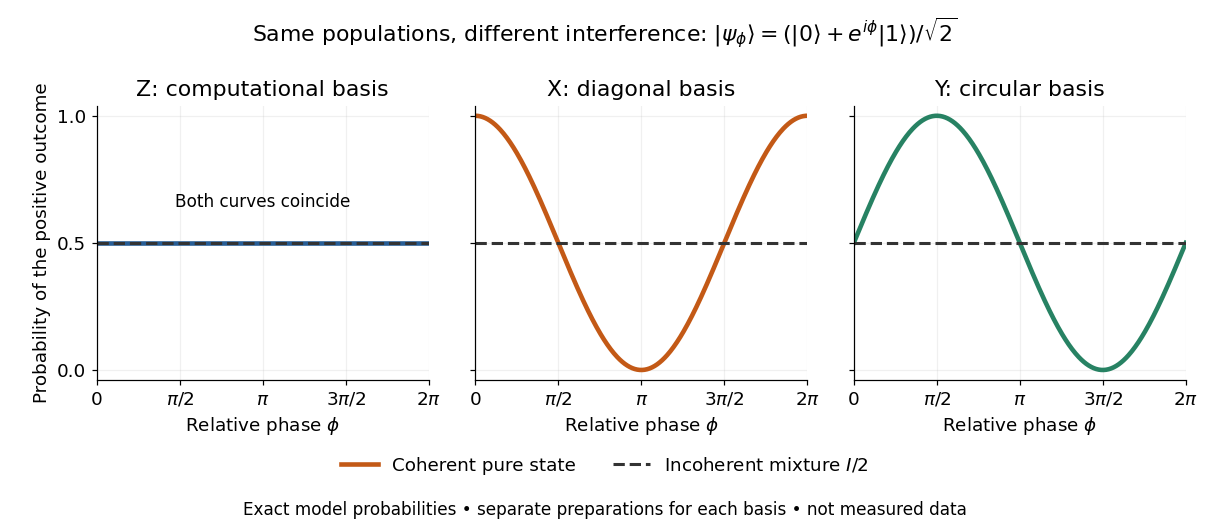
Identical computational-basis probabilities can hide different relative phases and coherence
. Exact model probabilities for , compared with the incoherent mixture . Each curve requires repeated preparations measured in the indicated basis; these are not experimental data. Details.
For a general qubit state, write its density matrix in the computational basis asThese are exactly the Hermitian, unit-trace, positive semidefinite constraints. Positivity means every eigenvalue is nonnegative, not that every matrix entry is nonnegative. The general definition is given in density matrix. [ref].
For this two-by-two matrix, the explicit constraint follows from its determinant, : with trace one, a nonnegative determinant and real eigenvalues rule out a negative eigenvalue. Its eigenvalues areThe pure states have and eigenvalues ; the mixed states have strict inequality and two positive eigenvalues. For a normalized representative, and . A statistical preparation , with and , averages probabilities, rather than adding probability amplitudes. Such a preparation is mixed if the positive-weight vectors do not all represent the same ray. A reduced density matrix of an entangled pair can also be mixed even when the pair has a pure state. [ref].
For a concrete check, the pure state and the mixed state obtained by preparing with probability and with probability haveBoth have trace one and the same computational-basis measurement probabilities. Their eigenvalues are respectively and ; the respective values of their purity of a density operator are and . Their Hadamard basis plus probabilities are respectively and . By contrast, setting would give determinant and eigenvalue : normalized diagonal entries alone do not make a valid qubit state.
The same constraints become especially beautiful in the Bloch ball representation. With the Pauli matrices and the identity operator ,The eigenvalues are , so the Bloch sphere is precisely the pure state boundary, and is the maximally mixed centre. For each axis , the Born rule gives . This unifies a geometric picture, matrix positivity, and experimental frequencies in one description. For the equatorial family in the phase diagram, and ; replacing it by erases the transverse components and every fringe. See quantum state tomography for how independent ensembles measured along the three axes estimate these components. [ref].
Scattering amplitude Created 2026-09-24 Updated 2026-11-05
A scattering amplitude is the complex coefficient relating a specified outgoing asymptotic component to a specified incident state. In three-dimensional short-range potential scattering with incident wave , the outgoing spherical part is .
In this convention has length units, and equal-speed elastic scattering gives . Other kinematics require flux or velocity factors. Contributions from indistinguishable alternatives are added as amplitudes before squaring, producing interference. An overall phase shared by the entire state is unobservable, while relative phases between partial waves affect angular distributions. A relativistically normalized matrix element uses different conventions and dimensions, so cross-section formulas cannot be transferred between amplitude definitions without their normalization factors.
Lippmann-Schwinger equation Created 2026-09-24 Updated 2026-11-05
The Lippmann-Schwinger equation rewrites the Schrodinger differential equation as an integral equation using a free Green function and a prescribed incoming state.
There are unlisted articles, also show them or only show them.