
Character table Created 2026-09-24 Updated 2026-11-05
The character table of a finite group lists its irreducible complex characters on its conjugacy classes. The number of rows equals the number of conjugacy classes, and the squared row degrees sum to the group order.
Character orthogonality Created 2026-09-24 Updated 2026-11-05
For a finite group , its irreducible characters over the complex numbers are orthonormal for , and .
Unitary representation Created 2026-09-24 Updated 2026-11-05
A unitary representation of a group on a complex Hilbert space is a group homomorphism into its unitary operators. Thus and . In finite dimension, this is the condition in an orthonormal basis.
For a topological group, one normally also requires strong continuity: is continuous for every vector . This gives a continuous group action on and permits the integrated unitary representation. For example, is a strongly continuous unitary representation of the additive real numbers on ; preservation of the inner product follows from translation invariance of the Lebesgue measure.
Averaging over a finite group Created 2026-09-24 Updated 2026-11-05
When is invertible in the coefficient field or ring, averaging an element of a group representation over a finite group, , produces a group-invariant object because left multiplication permutes the summation index.
Character of an exterior cube Created 2026-09-24 Updated 2026-11-05
For a finite-dimensional complex representation , the character of its exterior cube isWrite for the power sums of the eigenvalues of . The trace on the exterior cube is the elementary symmetric polynomial . Newton's identities give , proving the formula.
For a -dimensional vector space, evaluation at the identity gives . The formula therefore vanishes for , as the exterior cube must.
Character of an exterior square Created 2026-09-24 Updated 2026-11-05
For a finite-dimensional complex representation with character , the exterior square has characterIf the eigenvalues of on are , counted with algebraic multiplicity, its eigenvalues on the exterior square are for . Expanding the square of their sum giveswhich proves the formula by taking traces. A basis giving an upper triangular matrix suffices for this argument, so diagonalizability is unnecessary.
At the identity, the formula becomes . This supplies a quick consistency check before using the character to decompose the representation.
Complex representation Created 2026-09-24 Updated 2026-11-05
Maschke's theorem Created 2026-09-24 Updated 2026-10-14
Every group representation of a finite group over a field whose characteristic does not divide the number of elements of the group is semisimple. Given an invariant subspace, averaging any projection onto it over the group produces an equivariant projection, whose kernel is an invariant complement.
Group representation Created 2026-09-24 Updated 2026-11-05
A group representation is a group homomorphism from a group to the general linear group of a vector space. It realizes abstract group elements as invertible linear transformations.
The defining identities are and , so an inverse element is represented by a matrix inverse. A choice of basis gives a matrix representation, but the underlying action does not depend on that choice. The action need not distinguish every group element: the trivial representation sends all of them to .
Gauge field Created 2026-09-24 Updated 2026-10-06
A gauge field is a connection associated with a local symmetry in a gauge theory. Its gauge potential defines the internal-symmetry contribution to a covariant derivative. For an Abelian gauge field, the gauge field strength is .
Dirac field Created 2026-09-24 Updated 2026-11-05
A Dirac field is a quantum field transforming as a Dirac spinor. Its free Lagrangian density is , giving the Dirac equation. Unlike a single-particle wave function, a quantized Dirac field can create and remove particles and antiparticles.
Its mode expansion of a Dirac field contains fermionic annihilation operators for particles and fermionic creation operators for antiparticles, with canonical anticommutation relations enforcing Fermi-Dirac statistics. For the electron field, these excitations are electrons and Positrons. A global phase symmetry gives the conserved Dirac current; coupling that current to the electromagnetic field produces the matter interaction in quantum electrodynamics.
Complex scalar field Created 2026-09-24 Updated 2026-11-05
A complex scalar field can be written using two real scalar components. For a free relativistic field with a global phase symmetry, its excitations include particles and antiparticles carrying opposite values of the conserved phase charge.
The transformation rotates the two components, and Noether theorem gives a charge current when the action has that symmetry. A potential depending only on preserves it; additional terms need not. Coupling the phase symmetry to a gauge field gives scalar electrodynamics. A complex field therefore supplies a useful description of charged spin-zero matter or an effective two-component order parameter, with the interpretation and conserved charge fixed by the model.
Real scalar field Created 2026-09-24 Updated 2026-11-05
A real scalar field is a Hermitian spin-zero field whose components are unchanged by proper Lorentz transformations apart from their spacetime arguments. Its free relativistic equation is the Klein-Gordon equation, and its mode expansion combines an annihilation contribution with its Hermitian conjugate.
The elementary free excitation is its own antiparticle, so there are not independent particle and antiparticle charges as in a charged complex field. Interactions such as a quartic potential modify correlations and scattering while retaining scalar transformation character. Reality alone does not guarantee a reflection symmetry ; an allowed cubic term can break that extra symmetry. A specified field content and action, rather than the word scalar alone, determine the physical symmetries.
Null crossed electromagnetic field Created 2026-09-24 Updated 2026-11-05
Perpendicular fields with and form a null electromagnetic field. The constant-field Lorentz-force generator is nilpotent, so its exponential terminates as a polynomial.
Both invariants of the electromagnetic field tensor vanish for this field class.
Relativistic hyperbolic motion in a uniform electric field Created 2026-09-24 Updated 2026-11-05
A particle released from rest in a constant electric field parallel to its motion follows a spacetime hyperbola and has rapidity proportional to proper time.
Lorentz transformation of electromagnetic fields Created 2026-09-24 Updated 2026-11-05
A Lorentz transformation mixes components of electric field and magnetic field. For a frame moving at velocity relative to another, the parallel components are unchanged, while the perpendicular components obey and in SI.
Thus a purely magnetic field in one frame need not remain purely magnetic in another. The frame choice must also be applied to sources and particle motion; transforming only the field while retaining the original particle velocity is inconsistent. The combinations and remain invariant and constrain which field types can be obtained by changing frames.
Electromagnetic four-potential Created 2026-09-24 Updated 2026-11-05
The four-potential combines the electric potential and magnetic vector potential as . The electromagnetic four-potential transforms underwhile the antisymmetric field tensor is unchanged.
Relativistic charged-particle action Created 2026-09-24 Updated 2026-11-05
For metric signature , a particle of mass and charge coupled to a four-potential has the reparametrization-invariant action
Binary expansion Created 2026-09-24 Updated 2026-11-05
Every real number has a binary expansionFor , construct it by repeated doubling. Set , then and , using the floor function. Each remainder stays in , and induction givesThe remaining error is less than , so the finite partial sums converge to . For , choose every binary digit equal to one and use the geometric series.
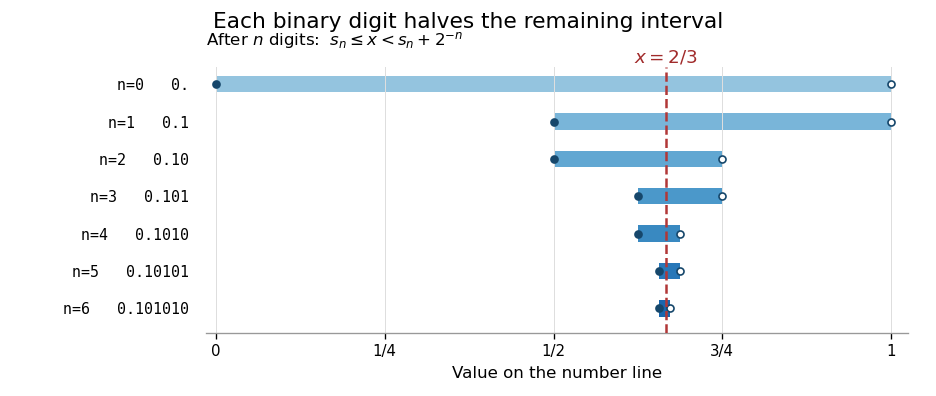

An expansion need not be unique: . For , this ambiguity occurs precisely at the dyadic rationals, through a terminating expansion and an alternative ending in ones. At the endpoints, the displayed purely fractional form uses all zeros for zero and all ones for one. A general nonnegative real number is represented by adding the finite binary representation of its floor to an expansion of its fractional part; a negative real number is handled by a separate sign. In that broader notation, too.
Measure theory Created 2026-09-24 Updated 2026-10-14
Measure theory studies measures, which assign sizes to measurable sets, and the Lebesgue integral, which accumulates values weighted by those sizes. The same framework describes Lebesgue measure on the real numbers, counting measure on discrete collections, and probability measures on possible outcomes. The choice of measure determines what counts as large; the choice of sigma-algebra determines what can be measured.
A striking example separates size from proximity: the rational numbers in form a dense set with Lebesgue measure zero, although the whole interval has Lebesgue measure one. This distinction makes almost everywhere statements useful: exceptional null sets can be ignored in a Lebesgue integral even when they meet every open subinterval. The monotone convergence theorem and dominated convergence theorem then give precise conditions for passing a limit through an integral.
A historical starting point is Lebesgue's 1902 thesis, [ref]
https://www.ime.usp.br/~glaucio/mat5798/textos/aula1.pdf#page=2. Intégrale, Longueur, Aire (original title page reproduced in USP lecture notes)
. Its title connects integration with the geometric task of assigning sizes. There are unlisted articles, also show them or only show them.