In a TRIZ interpretation, this resolves the contradiction by spatial separation and periodic alternation of opposing functions, rather than demanding that one static element satisfy both. The useful result is smaller beam envelopes and magnetapertures for a suitable lattice. This is a retrospective design analysis; it does not claim that the historical inventors actually followed TRIZ. The matrixcalculation supplies atest of the proposed resolution rather than just attaching a slogan to an invention.
A propagating conventional laser wake generally uses an underdense plasma, rather than this cutoff density. Strong relativistic lasermotion, collisions or a magnetized plasma modify this simple critical-density condition.
Conventional RF cavities accelerate beams with controlled phase, energy spread and transverse beam emittance. Their material surfaces limit sustainable gradients to order 10–100MVm−1, depending on technology and operating conditions. Mature RF systems already reached multi-GeV and much higher beam energies in 2015. The 2013 ILC baseline proposed 250GeVelectrons colliding with 250GeVpositrons, approximately 31.5MVm−1 superconducting cavities and a roughly 31km facility. These were design parameters, not an operating collider.[ref]
An RF cavity stores an oscillating electromagnetic field. Its longitudinal electric field does work on a correctly phased bunch, with energy gain ΔE=qVRFTsinϕs for a chosen phase convention and transit-time factor T. The bunch arrival time is synchronized so successive gaps accelerate rather than decelerate it. The magnetic force guides and focuses the beam but does no work.
A linear acceleratoruses new accelerating structures along its path; celllengths and timing accommodate the particle speed, and each bunch normally traverses a given section once. A circular synchrotron reuses the same RF cavities each revolution. Its synchronous phase supplies both acceleration and radiation replacement; RF frequency or harmonic synchronization and bending-field strength follow the required orbit and particle speed. Longitudinal phase stability captures nearby particles into RF buckets.
The aperture should therefore be enlarged vertically. A full width of order 0.30m covers ±1 characteristic width; approximately 0.90m covers ±3 and gives containment comparable with the preceding X-ray estimate in the same Gaussian model. The original 10mm width would pass only roughly erf[0.005/(20.149)]≃2.7% in that model. Equivalent optics could instead reduce the spot at a relocated aperture, at the expense of angular acceptance. These estimates concern geometric acceptance; THz coherence and bunch structure require further beam data.
The full aperture width is 10mm, so its half-width is 5mm=2.94σy. It therefore passes almost all the central 8keVphoton beam. A Gaussian angular approximation would give
This is the whole beam's radiated power, not the power accepted by one beamline. If the specified radius describes only one dipole and the other bends are different, the radiationintegral is needed instead:
The numerical result uses the standard equal-radius-bend assumption; the ringcircumference, including straight sections, is not required. The RF system must replenish this loss to maintain stored beam energy.
Let D(d)=(10d1) be the drift beam transfer matrix. Start immediately before the firstlens and end immediately before its counterpart in the next FODO cell. Matrices act on column vectors from right to left. With A=1/f1 and B=1/f2, where both focal lengths are signed in the chosen plane,
Choosing a different start within the cell gives a conjugate matrix, with the same trace and eigenvalues. If f2 is specified asa positive magnitude of a defocusing lens, its signed value in these formulas is −f2.
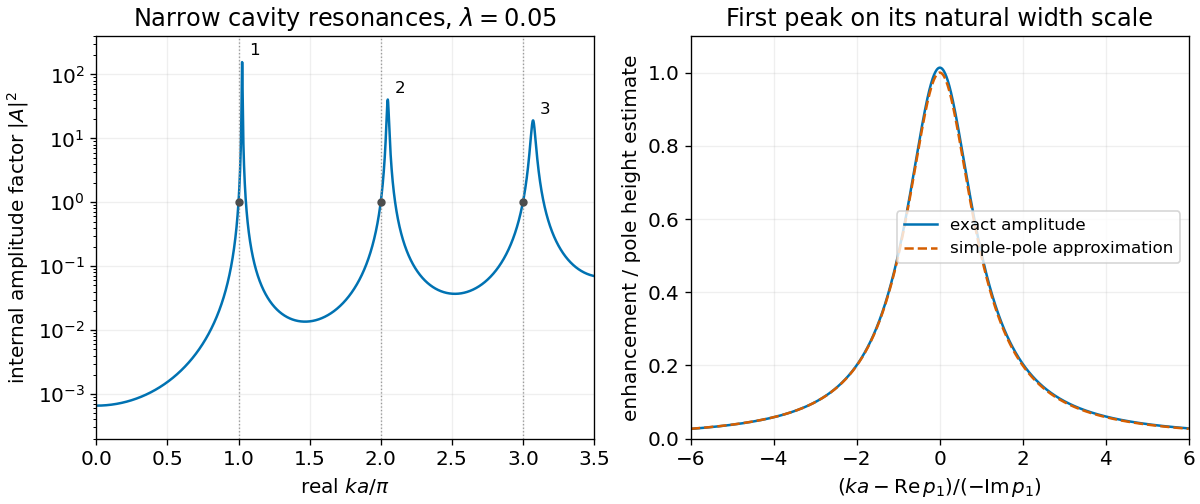
Thus the sketch has narrow, tall peaks with a locally Lorentzian line shape, just above positive integer multiples of π. Their half-widths are γn, and the leading peak heights are 4/(λ2n2π2). In this fixed-low-mode approximation, increasing n broadens and lowers the peaks. Exactly at x=nπ=0, the value is one. At zero it has the finite limit λ2/(2−λ)2 for λ=2.
Averaging over a gyroperiod removes the transverse oscillatory velocity and leaves this drift, together with any constant parallel velocity. For an electric force F=qE, this becomes the charge-independent E×B/B2 drift; a charge-independent force instead gives opposite drift directions for opposite charge signs.
Using 2kBT/meas the thermal-speed convention doubles this estimate; its order of magnitude is the physical content. Once the quiver is comparable to the thermal speed, acollision rate computed for an undriven thermal distribution is no longer adequate.
Relativistic motion begins when the normalized field a0=eE0/(mecω) is of order one. Thus
The ratio Irel/Ith=mec2/(kBT)≃511 checks the separation of the two regimes. These estimates use peak field and cycle-averaged vacuum intensity. The small refractive-index and interface-transmission corrections in this underdense plasma change only the few-percent prefactor, below the accuracy intended here.
Estimate bminas the larger of the classical Coulomb-deflection length Ze2/(4πϵ0kBT) and the electronquantumlength ℏ/mekBT. Both are about 9×10⁻¹²m here, giving lnΛC≃8. With the usual thermal collision convention,