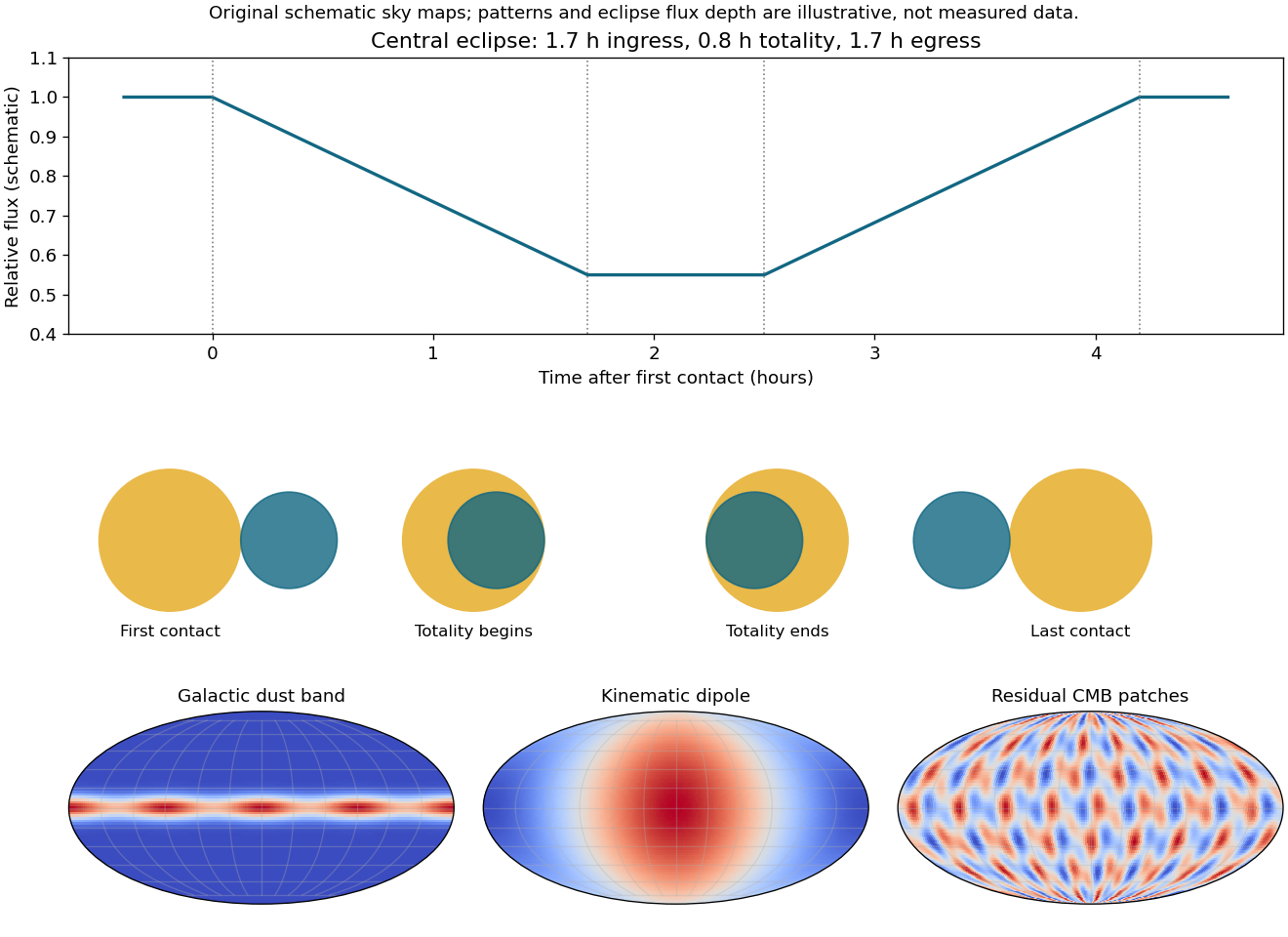
Assume a central eclipse and nearly uniform projected speed during it. Let be the smaller radius and the larger. First-to-second contact requires travel , whereas the totality interval requires . With relative speed 200 km s,
The light curve has ingress, flat minimum and egress lasting 1.7, 0.8 and 1.7 hours. At the four contacts the projected center separations are . A noncentral chord would require an impact parameter and changes the inferred radii; the data alone do not fix that geometry exactly. For comparable masses in an ordinary coeval system, a component larger than its main sequence companion suggests expansion away from the main sequence, conventionally toward a subgiant/early giant track. That is a conditional evolutionary interpretation: neither effective temperature nor a bolometric flux is supplied, so a unique position on the Hertzsprung-Russell diagram cannot be inferred from these radii alone. Binary interactions and the assumed central chord also matter; these numbers do not establish an ordinary single-star evolutionary model.
Figure 1.
Central-eclipse contact geometry and schematic microwave sky components
. Details.
Eclipses justify an approximately edge-on orbit, and equal velocity amplitudes imply equal masses. The relative speed is 200 km s, so m, or . Substitution in the binary period law gives , hence . Inclination corrections scale the dynamical masses as if exact edge-on viewing is relaxed.
The first law gives elliptical relative orbits with the center of force at a focus; the second gives equal swept areas in equal times, expressing angular-momentum conservation. For circular binary motion, let and . The force equation gives
The corresponding relation for ellipses uses the relative semimajor axis rather than instantaneous separation.
For a 1 micrometre laser, m and a cold underdense wave has . At peak wave scale , optimal passage through an accelerating half-cycle gives ideal stage gain ; crest-to-zero injection gives half that. With the illustrative m, the optimal ideal gain is about 32 GeV and a 9.9 TeV increment needs order 300 stages, or order 600 with the crest convention.
TODO — no unique stage count follows without the missing density and laser/wake amplitude assumptions. Depletion, diffraction, guiding, beam loading, injection, energy spread, driver evolution and interstage losses can all increase or otherwise alter the requirement. The parametric count is , with the phase and field conventions explicitly retained.
Propagation through an already formed cold plasma requires , hence . For the illustrative density above, that is a cutoff near 126 micrometres. It is a propagation ceiling, not a sufficient condition for producing ionization.
TODO — the unique cutoff inherits the unspecified density, and a literal maximum wavelength for gas ionization also needs gas species, laser intensity and the ionization mechanism. A single-photon threshold would impose ; strong-field or multiphoton ionization is a different criterion. None of those data is supplied. The density-dependent propagation condition is the part determined symbolically.
The required energy increment is 9.9 TeV. If the usable longitudinal gradient is , with , the channel length is
Under the illustrative preceding m and choices, GV m and m. TODO — a unique numerical length inherits the missing compression/density specification and additionally requires a usable wake amplitude/loading factor or driver information. A driver energy per proton alone does not fix its bunch population or accelerating gradient.
TODO — the source does not supply the longitudinal position-energy correlation, imposed chirp, or chicane dispersion/geometry needed for a unique compressed bunch length. A four-bend drawing and an uncorrelated energy spread are insufficient. In linear optics,
If the given spread is uncorrelated, the minimum is the unchanged 0.2 m, not a compressed submillimetre bunch. If a chirp is supplied, optimal depends on it and on the uncorrelated residual spread.
A sometimes intended phase-space lower-bound estimate conserves longitudinal emittance and permits final relative energy spread of order unity, giving m. This is an additional extreme energy-spread allowance, not a consequence of an unspecified magnetic chicane. If one illustratively matches a plasma scale , then m. Matching to a whole wavelength instead changes this by . The parametric density relation is valid; the unique requested numerical compression is not established by the source.
Lower energy changes the source spectrum as well as emittance. At fixed bending geometry, bending-radiation critical energy scales as , so it falls by ; for fixed undulator period and deflection parameter the fundamental wavelength grows as , by ten. A smaller electron emittance therefore does not automatically improve brightness at the original 10 nm wavelength: the device may no longer radiate there on its fundamental, flux and harmonic operation change, and diffraction remains. Lattice redesign can retain beam energy and target spectrum while reducing emittance, which is why energy reduction alone is not a generally satisfactory substitute.
For the same lattice radiation-integral ratio, natural geometric emittance scales as . A factor-ten decrease therefore requires . Keeping coupling ratio fixed reduces the vertical emittance by the same factor, within that ideal scaling model.
Emittance reduction has little effect when radiation dominates every source width and divergence. At fixed m, the strongest condition is , or . The divergence condition only requires nm. There is no sharp “negligible” cutoff without an allowed percentage. If the optics were reoptimized to match diffraction instead, the weaker comparison would set the relevant scale; it is not the same fixed-beta problem.
At fixed flux and bandwidth, brightness is inversely proportional to . Lowering both geometric emittances by ten makes the electron rms widths and divergences smaller by . Add the unchanged radiation widths in quadrature again and divide the old phase-space product by the new one. The resulting brightness factor is approximately , an increase of about , rather than the factor 100 that would follow if diffraction were negligible in both planes. The exact value under the adopted width convention is given by the accompanying check and plot.
State a radiation-width convention. For rms Gaussian-equivalent single-electron undulator radiation take and , so the diffraction emittance is . These give 11.3 micrometres and 70.7 microradians. Convolve independent electron and radiation widths in quadrature. The total photon source is then
Some approximate undulator width conventions differ by order-one factors; these must be kept consistent in the following brightness comparison.
At zero dispersion and , and . The results are
The repeated entries in the source are interpreted as intended vanishing dispersion and its slope. If dispersion slopes were not zero, energy spread would contribute to divergence and further data would be needed.
A uniform nonrelativistic electron column has radial electric field inside its radius. A relativistic proton therefore has focusing strength per unit length. Electron-current magnetic effects are small under the stated nonrelativistic assumption. To change the nominal doublet strength by requires
One illustrative choice is a one-metre lens with m; other density-length combinations work. The electron beam must cover the proton beam and have a sufficiently uniform profile. Its placement changes the detailed transfer-map correction; the estimate treats the required additional integrated focusing at the entrance and does not claim a uniquely specified electron-lens engineering design.
The beam rigidity is T m. Equal opposing strengths have , and weak separated-doublet net power is . Taking m gives the design family
There is not a unique pair without a spacing/layout choice. A compact estimate gives about 18 m for each, showing immediately that neither is extremely small compared with 50 m and the advertised asymptotic approximation is only rough. For example m gives m in the same estimate.
An equal-strength doublet also has exact parallel-input focal distances and : it is astigmatic, so a single exact common 50 m focus cannot be imposed without specifying incoming optical functions or allowing unequal strengths. The family above is a scale estimate of net focusing, not a complete collider final-focus design.
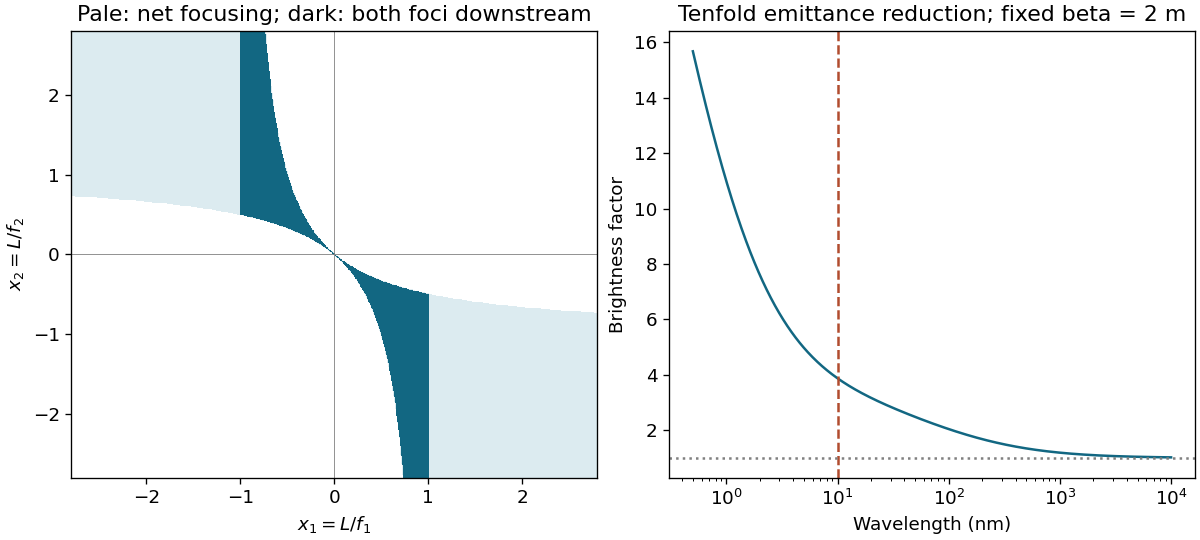
Let , with positive focusing in the first transverse plane. The doublet matrix is , with . Its lower-left entry is . In the other plane both quadrupole signs reverse, giving . Thus positive effective focusing power in both planes requires
For a parallel incident ray bundle, actual downstream focal distances are and . Requiring both foci downstream adds . Positive effective power alone need not imply a real image after the final element. The original schematic below distinguishes these conditions.
Figure 1.
Doublet focusing region and wavelength-dependent emittance benefit under fixed source optics
. Details.
Differentiate the approximate dispersion: , while . Therefore . In the high-phase-speed regime that justified the approximation, the group speed is correspondingly small. Trying to make much larger than would put the phase speed into the thermally populated distribution, where resonant Landau damping is strong and the undamped-fluid estimate becomes unreliable. This explains the stated tendency for these electron electrostatic waves, not a universal prohibition on fast electromagnetic waves in plasma.
When over the populated velocities, expand the denominator in powers of . Odd Gaussian moments vanish. The first two nonzero terms use and , yielding . Solving consistently to order gives
This is a long-wavelength/high-phase-speed approximation, not an exact Maxwellian dispersion relation at arbitrary .
Take electrostatic perturbations proportional to , with ions immobile on the fast electron time scale. Linearized Vlasov gives . Integrating over transverse velocities gives . Combine the perturbed charge density with Poisson's equation:
Since , this is precisely
The pole selects particles moving at phase speed. A causal initial-value prescription specifies how the contour passes it and produces resonant energy exchange, including Landau damping for a decreasing Maxwellian. A bare real improper integral without that prescription is incomplete. The unclosed brace in the printed Maxwellian exponent is typographical; the normalized Gaussian above fixes its meaning.
Room temperature corresponds to about 0.026 eV, or keV. Read the left-hand branch there and draw a horizontal line to the rising hot branch. The original graph gives a return temperature of order , with graph-reading uncertainty, not the temperature of minimum conductivity.
At full ionization m. Inserting the inferred temperature into gives a Debye-sphere occupancy of order –. This is much greater than one and supports a collective weak-coupling description more than the conductivity-minimum region does. The approximate collision-time formula and omitted Coulomb logarithm do not warrant forcing the entire plotted conductivity curve to have its exact prefactor.

There are unlisted articles, also show them or only show them.