Write u=1/T. Then logζ=constant−(3/4)logu−THu, giving local slope dlog10ζ/du=−(TH+3T/4)/log10. At 5000–6000 K its magnitude is about 3.6×10⁴K. The low-ionization tail in the original graph drops roughly one decade per 2.8×10⁻⁵K−1, consistent with this value.
At u=2.0×10⁻⁴K−1, the graph gives T≃5000K and ζ≃0.004. Invert the full equation to get n=CT3/2e−R/(kBT)(1−ζ)/ζ2, yielding n∼1018m−3. The neighboring tail markers give the same order; plotting precision and the squared dependence on the read ionization fraction preclude claiming many significant digits.
Different partition-degeneracy conventions must be propagated consistently. Screening, dense-plasma level dissolution and departures from local thermodynamic equilibrium lie outside this derivation.
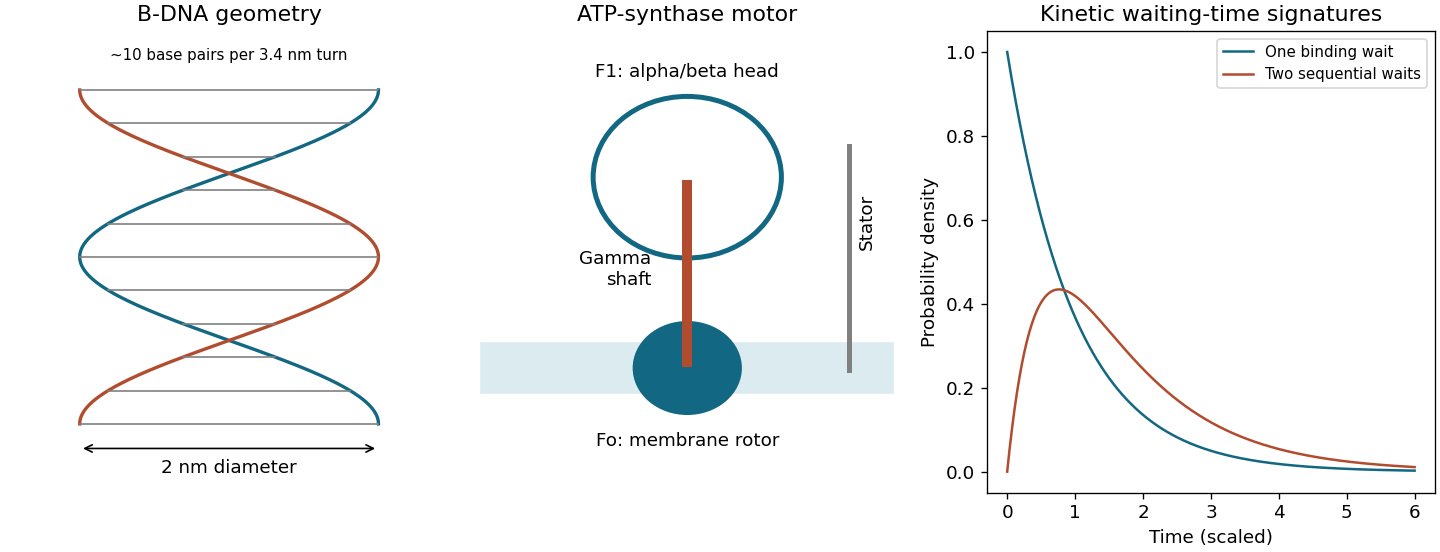
An ATP-binding step with pseudo-first-order rate k1c has survival probabilityS1=e−k1ct and waiting densityP1=−S1′=k1ce−k1ct. It decreases from a finite value at zero, integrates to one and has mean 1/(k1c). Its concentration dependence suggests binding-limited waiting before the large 80-degree substep.
Two independent sequential exponential steps of rates ka,kb give the convolution
It begins at zero, rises to a maximum at log(ka/kb)/(ka−kb) and decays; its mean is ka−1+kb−1. At equal rates it becomes k2te−kt. This supports at least two kinetic events during the waiting associated with the 40-degree substep, plausibly chemical transformation/product release and conformational changes. It does not uniquely identify which rate belongs to hydrolysis or a particular product: different hidden-state networks can have the same waiting distribution. Three 120-degree catalytic cycles per revolution, partitioned into 80 and 40 degrees in the assay, are consistent with three catalytic sites.
For independent equiprobable bases there are 43=64codons, three of them stops, so pstop=3/64. In a fixed reading frame, and conditional on starting translation, surviving at least L successive non-stop codons has probability(61/64)L. For 300 it is about 5.6×10⁻⁷. Strictly “exceeding 300” requires 301 non-stop codons, giving (61/64)301. A specified start codon, codon bias, correlations or looking for a long sequence anywhere in a large genome changes the sampling problem and cannot be silently folded into this single-frame probability.
Ahaploidhuman genome has about 6×10⁹ raw bits; in a nucleus of several hundred cubic micrometres its bulk density is order 1025bitsm−3, far lower. Cellular DNA must allow hydration, packaging, regulatory access and copying/repair machinery, and cannot fill acellas parallel bare cylinders. Diploidy and repeated or constrained sequence also reduce independent functionalinformation compared with the raw four-letter capacity; those concepts should not be confused with geometric storage density.
The original molecular figure in question 3 shows the approximate helical dimensions.
The chemical mismatch types are A–C and G–T, with either strand actingas template. In the fixed ring alignment shown, A–C has no correct hydrogen bonds while G–T retains one. Relative probabilities must specify the template: template A loses two bonds versus A–T, giving e−10; template G loses two versus G–C, giving e−10; template C loses three versus C–G, giving e−15; template T loses one versus T–A, giving e−5. Equal incoming activities and 5kBT per bond give approximate relative weights 4.5×10−5,4.5×10−5,3.1×10−7,6.7×10−3 respectively.
For roughly equal template frequencies the mean error probability is order 1.7×10⁻³, or several million errors across 3×10⁹ copied base pairs. Restricting the estimate to purine templates instead gives order 105 errors; neither is an accurate replicationmodel. Both greatly exceed the source's order-one surviving mutation input. Polymerase kinetic discrimination, proofreading and mismatch repair suppress errors, and a transient mismatch need not become an inherited mutation. Ring relaxation, stacking, solvent and rare tautomers are missing from this simple hydrogen-bondcalculation. Real G–T wobble geometry can form additional bonds. The source's mutation rate is illustrative, not a universal measured human rate.[ref]
The roots are z=(−3±2)/(2−i), only z+=−1/(2−i) lying inside. The derivative of the quadratic at z+ is two, so the residue is 1/(2i). Consequently ∫02πdθ/(3+2cosθ+sinθ)=π. The denominator is positive since 3>5, so no principal-value qualification is required.
For z=eiθ, w=itan(θ/2), which is purely imaginary; z=−1 supplies the point at infinity. Conversely, the inverse map is z=(1+w)/(1−w). Requiring ∣w∣=1 is equivalent to ∣z−1∣=∣z+1∣, hence Rez=0, including the appropriate infinite point in the extended-plane formulation. The unit circle and imaginary axis are exchanged, but the real axis is not.
The identity w−1=−2/(z+1) gives ∣w−1∣=2/r on ∣z+1∣=r. Thus the imagecircle has center one and radius2/r. Points strictly inside the original circle satisfy ∣w−1∣>2/r; the center itself maps to infinity. The interior therefore becomes the exterior together with infinity on the Riemann sphere, rather than the interior of the imagecircle. This inversion is auseful warning against assuming conformality preserves global inside/outside assignments.
For real x=−1, w=1−2/(x+1) is real. Its finite image is the entire real axis except w=1, which is approached only as x→±∞. The point x=−1maps to infinity. On the extended complex plane the extended real axismaps onto itself, with z=∞ mapping to one.
A conformal map preserves local oriented angles and has a nonzero local scale factor. For an orientation-preserving complex map this is equivalent to holomorphy with f′(z)=0 at the point concerned. Infinitesimal figures are rotated and uniformly scaled there, but finite shapes need not be preserved: derivative magnitude and direction can vary across a region. Antiholomorphic maps preserve unoriented angles while reversing orientation; the convention being used must be stated.