On the square, ∣z∣≥N. The identity ∣sinπ(x+α+iy)∣2=sin2π(x+α)+sinh2πy bounds the sine away from zero on the vertical sides because x=±N; on horizontal sides it grows exponentially. Therefore the whole contour integral is O(N−1) or smaller and vanishes. The residue theorem then gives
There is also a double pole at zero, not included in that list because 0<α<1. Its residue, needed for the next contourcalculation, is the derivative of cscπ(z+α) at zero, namely −πcsc(πα)cot(πα).
For the standard meaning of a canonical transformation, the new coordinates must retain Hamiltonian form for every Hamiltonian, with the same physical function expressed in the new coordinates. Let z=(q,p), Z=F(z)=(Q,P), S=DF and J=(0−II0). With K(Z)=H(F−1(Z)), the chain rule gives
The Jacobi identity is {f,{g,h}}+{g,{h,f}}+{h,{f,g}}=0. If f,g have no explicit time dependence and are conserved, {f,H}={g,H}=0. Taking h=H in that identity yields {H,{f,g}}=0, or
Subtracting qdAi/dt from the secondequation gives the familiar Lorentz force, π˙=q(E+r˙×B), with E=−∇ϕ−∂tA and B=∇×A. This also checks the signs of both potential terms.
The cancellation of qr˙⋅A in the Legendre transform does not remove magnetic effects: A remains in the relation between canonical and mechanical momenta. The expression is the relativistic kinetic-plus-rest energy with an electrostatic potential-energy term, expressed in canonical variables.
The word independent here counts symmetry generators and tensor components; it needs qualification if it is meant asfunctional independence of all charges for only two particles in arbitrarily high dimension. In centre-of-mass coordinates, L=R∧P+r∧p. Consequently P∧L∧L=0, a nontrivial identity from dimension five onwards, since (r∧p)∧(r∧p)=0. Thus the displayed number is the symmetry-charge count; it is not an assertion that these functions have unrestricted values for a two-particle realization in every D.
In one dimension this supplies P and H: two charges. In two dimensions it supplies Px,Py,Lxy,H: four charges. In three dimensions it supplies three momentum components, three angular-momentum components and H: seven charges. For generic states these listed charges are independent in those dimensions. Galilean boosts can also be expressed by explicitly time-dependent conserved combinations, but are not part of the requested translation-rotation-energy count.
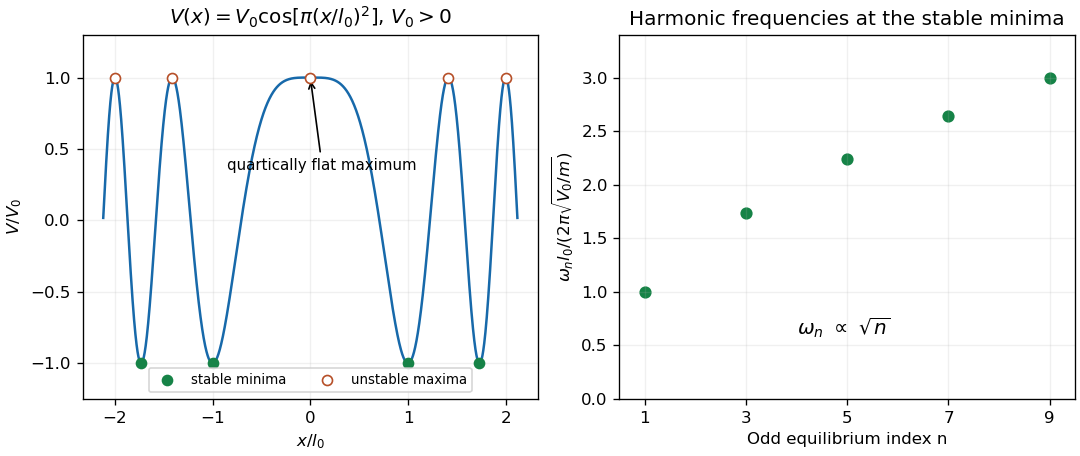
Write u=πx2/l02 and assume V0>0. The derivative of the potential is V′(x)=−2πV0xsinu/l02. Its equilibrium positions are zero and x=±l0n for positive integers n. At a nonzero equilibrium,
Even positive n give unstable maxima. At zero the quadratic term vanishes but V(x)=V0−V0π2x4/(2l04)+⋯, so the equilibrium is still unstable; a zero linearized frequency does not prove stability. If the unspecified sign of V0 were chosen negative, even-npositions would be stable instead, together with a degenerate quartic minimum at zero whose frequency tends to zero with oscillationamplitude.
Compared with the supplied composition curves, this is inconsistent with a bare iron-rich or ordinary rock-only planet. A volatile-rich interior and/or an extended low-densitygas envelope is needed. Awater-rich body with an atmosphere and a rocky core with a modest H/He envelope are different plausible families; mass and radius do not uniquely determine the composition.[ref]
For the requested H/He estimate, assume a hydrostatic, approximately isothermal terminator at the zero-Bond-albedo, fully redistributed equilibrium temperature. The orbit and temperature are
Thus one scale height is about 338 parts per million in transit depth; a clear strong feature spanning roughly five scale heights is of order 1.7×10⁻³. The number of scale heights requires the actual opacityratio; N≃ln(κline/κcont) is auseful isothermal estimate, not a supplied measured value. The true terminator temperature need not equal this redistribution estimate.
A nearly flat spectrum can result from a high-mean-molecular-massatmosphere with a much smaller scale height, or from optically thick clouds/hazes that hide the deeper absorption features. These are the two qualitative possibilities; detailed precision data can discriminate them. In particular, the pre-2015 HST study favored clouds over the clear high-molecular-massmodels it tested, so listing both physical mechanisms is not a claim that all such models fit those data equally well.[ref]
The formal finite time to unlimited mass is not physical. Growth depletes the feeding region; embryos also stir planetesimalvelocities and reduce focusing, while fragmentation, orbital competition and stellar tides alter the encounter geometry. A growing core can enter an oligarchic rather than runaway regime, and eventually reach a supply-limited isolation mass.
Dynamical friction transfers random kinetic energy from a massive body to a swarm and tends toward MvM2∼mvm2. Larger bodies therefore have smaller random eccentricities and inclinations, remain concentrated near the planetesimal layer, and can retain favorable encounter conditions. When their own random motion contributes appreciably to relative speed, damping it also strengthens focusing through f∝v0−2. If the small-body dispersion already dominates v0, equipartition of the core alone does not further lower that encounter speed: the displayed growth law assumed a fixed v0, not an automatically imposed v0∝M−1/2.