Without gravity it is only σgeom=π(rM+rm)2, so gravitational focusing increases the cross-section by 1+f. Trajectories that would miss geometrically can be bent into contact, especially for slow relative encounters. Gravity does not itself guarantee sticking: the following accretion estimate assumes collisions agglomerate rather than fragment, rebound or erode the target.
The formula counts mass swept per unit time and assumes an adequate continuing projectile supply, the stated speed, and negligible many-body or stellar-tidal modification of the two-body cross-section.
This includes target recoil. If the given initial speed were instead at a finite non-negligible separation, its potential energy would have to be retained; v0 would then not equal the asymptotic speed used in the focusing formula.
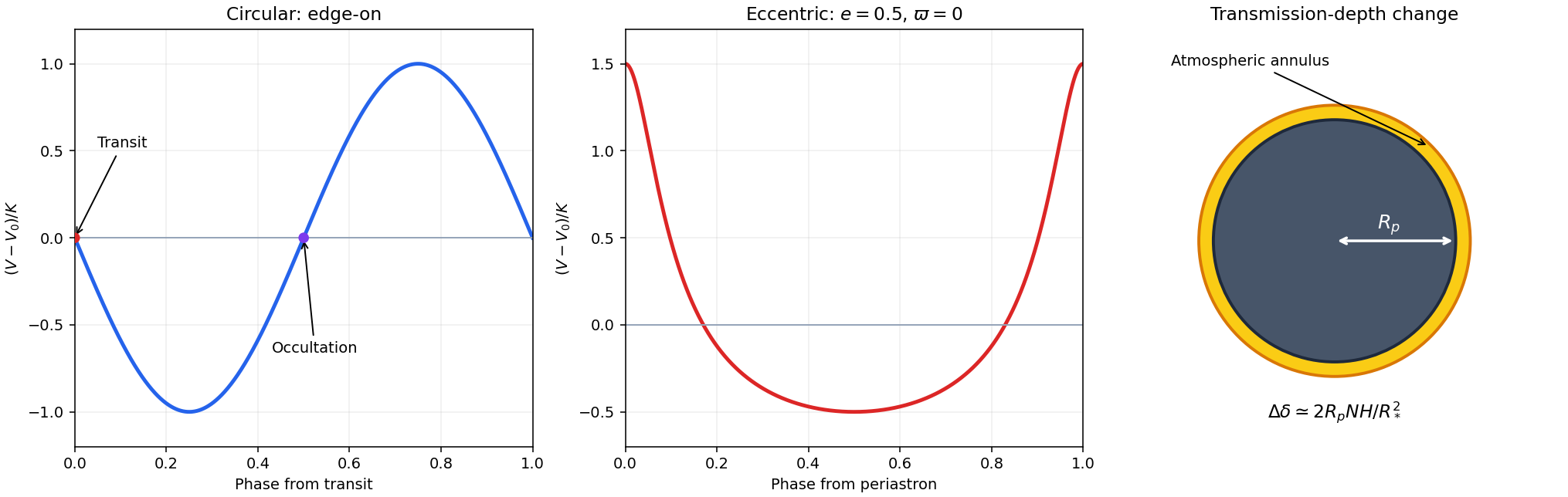
Assume the companion is much less massive than the star, the sinusoid represents a circular Keplerian orbit, and the transit implies sini≃1. Ignore dilution, limb darkening and grazing geometry when estimating the radius. With P=5×86400s,
Transit occurs at the decreasing systemic-velocity crossing ϕ=0; secondary eclipse is at the increasing crossing ϕ=1/2. Extrema occur one quarter of an orbit away. Reversing the velocitysign convention reverses the crossing directions but not the conjunction phases.
For an eccentric orbit, ν is not proportional to time. Solve M=E−esinE, then use tan(ν/2)=(1+e)/(1−e)tan(E/2) in the stated velocity relation. Motion is fastest near periastron, so the curve has an abrupt feature there and a more prolonged change near apastron, with its shape also depending on ϖ. It is not merely a shifted sinusoid. An eccentric transit need not coincide with V=V0, because the ecosϖ offset remains at conjunction.
. Original calculated velocitycurves use a circular transit as phase zero on the left, and periastron as phase zero for the separate eccentric example with e=0.5 and ϖ=0. The right panel illustrates the projected area added by one atmospheric scale height; its atmospheric thickness is exaggerated for visibility. Details.
For r=l/(1+ecosθ), differentiation gives r˙=Jesinθ/l, while the transverse speed is rθ˙=J/r=J(1+ecosθ)/l. Adding the squared orthogonal components yields
The printed division by l is an error: J2 has dimensions length4/time2, while G(M+m)/l has dimensions of speed squared. Acircular orbit independently checks the correction: J2=r2v2=G(M+m)r, with l=r.
For a closed ellipse, l=a(1−e2) and 1+2ecosθ+e2=2l/r−(1−e2). Substitution now gives the vis-viva equation,
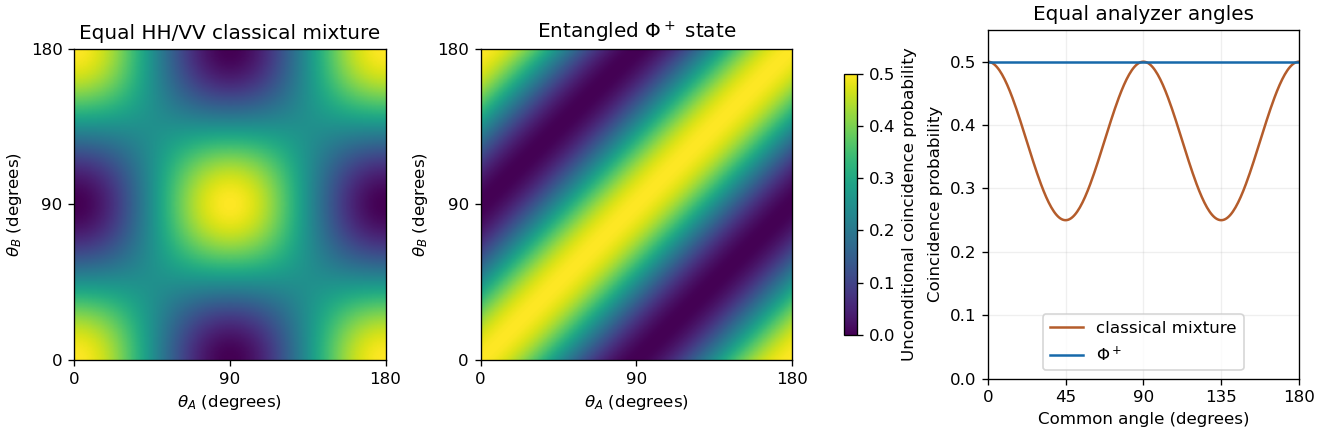
has equal outcomes for any common real linear-polarizationbasis. In the stated rotated basis it is (∣θ(+)θ(+)⟩+∣θ(−)θ(−)⟩)/2: the cross terms cancel when the inverse rotation is substituted.
Thus the coincidenceprobability for the transmitted ports is p(A,B)=21cos2(θA−θB). At equal angles it is 1/2 per emitted pair, while Bob transmits with probability one conditional on Alice's transmission. Both photons are blocked for the other half of idealpairs. The phrase always in coincidence must therefore mean matching outcomes or conditional transmission, rather than unit unconditional transmission through both polarizers.
For a uniformly illuminated single slit of width w, the far-fieldamplitude is proportional to sinu/u, with u=πwsinϑ/λ. Its first zeros occur at sinϑ=±λ/w. If the quoted peak width is the full width between those zeros, the small-anglegeometry gives
The Fraunhofer diffractionapproximation is appropriate since w2/(λL)≪1. If the supplied width instead meant a half-width or full width at half maximum, its numerical conversion factor would differ; the displayed answer states the first-zero convention explicitly.
One way to see the phase is that the horizontal arms differ in gravitational potential energy by mgasinθ for aflighttime a/v. Which-path detection entangles the atom with distinguishable detector states. If those states are orthogonal and the path record is ignored, their coherence is lost and the interference fringes disappear. This is a loss of interferencevisibility, not a change in the atom's de Broglie wavelength.
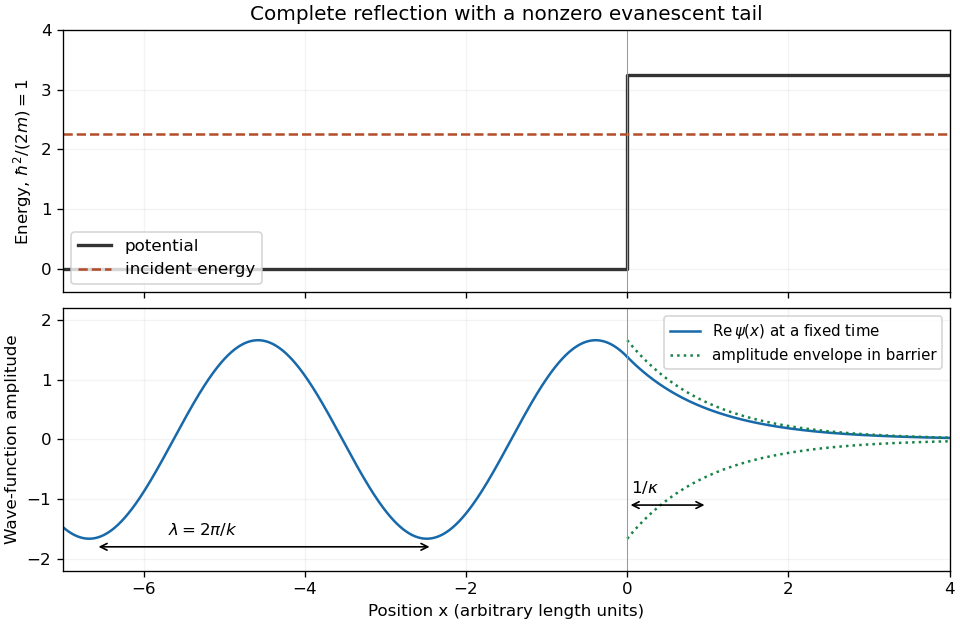
This gives atime in terms of m,E,V0 through the definitions of k,κ. A simpler dimensional estimate is the penetration length divided by the incident speed, Δx/vin=m/(ℏkκ)=ℏ/[2E(V0−E)]. The dwell time equals (2E/V0)times that estimate. Different operational timing definitions need not agree; treating the imaginary under-barrier momentumasa real particle velocity would not justify a unique traversal time.
The reflection-one result describes asemi-infinite potential step, rather than a finite-width barrier. Define k=2mE/ℏ and κ=2m(V0−E)/ℏ. For E>0, take
The secondlaw does not, just by its algebra, identify the coordinate systems in which accelerationmeasures the response to physical interactions. Afree body described in coordinates x′=x−21At2 has x¨′=−A, despite experiencing no impressed interaction. If the secondlaw is restricted to inertial frames, the firstlaw supplies a criterion for that restriction and asserts that a common inertial structure exists. If instead one introduces afictitious force −mA to preserve the equation in the accelerated coordinates, that coordinate-dependent bookkeeping should not be confused with a newly discovered physical interaction.
Nor can the firstlaw simply be used asacircular definition in which “free” means “unaccelerated” and “inertial” means “whatever makes the chosen body free”. The framework requires empirical identification of interactions and a mutually consistent class of free-bodytrajectories. Removing an influence or improving isolation should make the same inertial descriptionwork for many bodies, not merely one fitted trajectory.
Thus the two laws have distinguishable jobs: the first articulates the force-free inertial background; the second quantifies departures caused by impressed forces. A modern axiomatization may build that background into its spacetime structure and then omit a separately numbered firstlaw. That is a legitimate reorganization, but it incorporates the firstlaw's content rather than obtaining all of it from the equation F=ma. Newton states the laws separately in the opening axioms.[ref]
Consequently the equation has the same form if the resultant physical force satisfies F′=RF. For a pure boost, this reduces to F′=F. More explicitly, if aforce is represented by afunction of positions, velocities and other physical data, those arguments and data must transform so that its primed value is Rtimes the old value. It is this condition on the complete dynamical model, not the typography of F=ma, that establishes covariance.
An instantaneous inverse-square interaction depending on the separation of two particles passes this test: their common boost cancels from the separation, and arotation rotates the forcevector. A resistance law F=−ζ(v−u) also passes when the medium's velocityutransforms with the body. In contrast, keeping F=−ζv in every boosted frame while silently resetting the same medium to rest changes the physical problem. That model has not been shown covariant by noting a′=a.
Likewise, the full Maxwell equations are not made Galilean covariant merely because some equation of particle motion is written asforce equals masstimesacceleration. The covariance of a framework has to be checked together with its interaction laws. Newton's own CorollaryV expresses the corresponding equivalence of uniformly translating, nonrotating systems for the mechanics under consideration.[ref]
Newton's first law says that a body retains uniform rectilinear motion, including rest as the zero-velocity case, unless impressed forces change that motion. Its physical content includes the existence of a common class of inertial frames: free bodies do not each require an unrelated frame chosen just to straighten their own trajectory. Uniformity refers to the inertial timeparameter, and straightness to the spatial structure of those frames. Everyday slowing under friction is compatible with this claim because it involves an interaction, not an exception to inertia.
so for constant mass it becomes ma=Fnet. An impulsive version is Δp=∫Fdt. The change is directed along the impressed resultant, not necessarily along the body's current velocity. The original wording concerns change of quantity of motion; the differential equation is its modern continuous-time formulation.[ref]
These are substantive physical claims only when mass, interactions and the inertial structure are constrained independently. If “force” merely abbreviates whatever equals ma in any arbitrarily chosen coordinates, the secondlaw by itself predicts nothing. Actual applications combine the law with independently testable interaction laws, vector addition of forces, initial conditions and a specification of the inertial frames.