
Past exam of the mathematics course of the year 2 of the natural sciences course of the University of Cambridge 2018 Paper 2 7 b i Solution Created 2026-10-18 Updated 2026-11-05
Choose positive so the bob is displaced to the right relative to the cart. Its Cartesian coordinates areDifferentiation gives . Thus the exact kinetic energy and potential energy areRetain quadratic terms, using in the kinetic cross term and in the potential. The Lagrangian isIts Euler-Lagrange equations giveThe kinetic cross term is essential: acceleration of the support couples the pendulum and cart. These equations define the normal modes of a spring-mounted pendulum cart.
The divergence of a cross product identity and the vacuum Maxwell equations implyThe divergence theorem therefore gives the required balance withAn additive time-independent constant in is immaterial. This is the vacuum Poynting theorem in the normalization of the given equations: equivalently . The order of the cross product accounts for the plus sign in the stated integral identity.
The same Maxwell equations givewhere the last equality uses . Combining with part (ii),The divergences of the symmetric gradients satisfyThus the local identity is . Integrate over the fixed volume and apply the divergence theorem componentwise:Here uses the outward normal vector.
Differentiate with respect to time. The vacuum Maxwell equations give , soThe curl of the curl identity is . Since ,
Apply the symmetric gradient and curl decomposition separately to the electric field and the magnetic field:The corresponding axial parts areThe second equalities use the vacuum Maxwell equations. Their divergence constraints also show that both symmetric gradient tensors are traceless.
At , the inverse-transform denominator is . For , its upper-half-plane double-pole residue is the derivative of the exponential:It is also the continuous limit of both answers above as or . This critically damped response tends to zero with a linear factor multiplying the exponential.
In all three cases, for close the contour in the lower half-plane, where decays. There are no poles inside, soAt its continuous value is zero and , producing the unit derivative jump required by . Thus all three formulas are causal Green's functions and all decay to zero at late times.
For , put , so and the poles are . Closing in the upper half-plane for again includes both simple poles. The residue theorem givesThis overdamped response has no oscillation. Its slow tail is , and it tends to zero because .
For , close the inverse-transform contour in the upper half-plane. There ; the rational factor is , so the arc integral vanishes. For , write . The two simple poles are , and the residue theorem yieldsThis causal Green function of a damped oscillator has damped oscillations with envelope and tends to zero as .
Let , so and the forced equation is . The small-parameter Taylor expansion of the forcing isEach Chebyshev polynomial can be inverted separately under . None of the required denominators vanishes because is a real noninteger. Thus the regular solution of a forced Chebyshev equation hasHere we select the same regular endpoint domain as in part (a), with finite function values and finite endpoint derivatives. This qualification is needed: the printed forced equation alone does not state endpoint conditions. Without this selection one can add , which remain finite but generally have singular endpoint derivatives. With , regularity gives ; the corresponding homogeneous equation has only the zero solution for noninteger . This makes the displayed expansion unique.
Retain the question's common crossing condition , and replace the slope-ratio condition of part (iii) by the specified initial slope. Then part (i) givesso . Substitution in part (ii) gives the rayIt starts at with slope , passes through with slope one, and reaches the receiver with slope . The final height isThe left-hand curvature is ; the right-hand curvature is . Thus the graph is increasing throughout, with a change from upward to downward curvature at the interface.
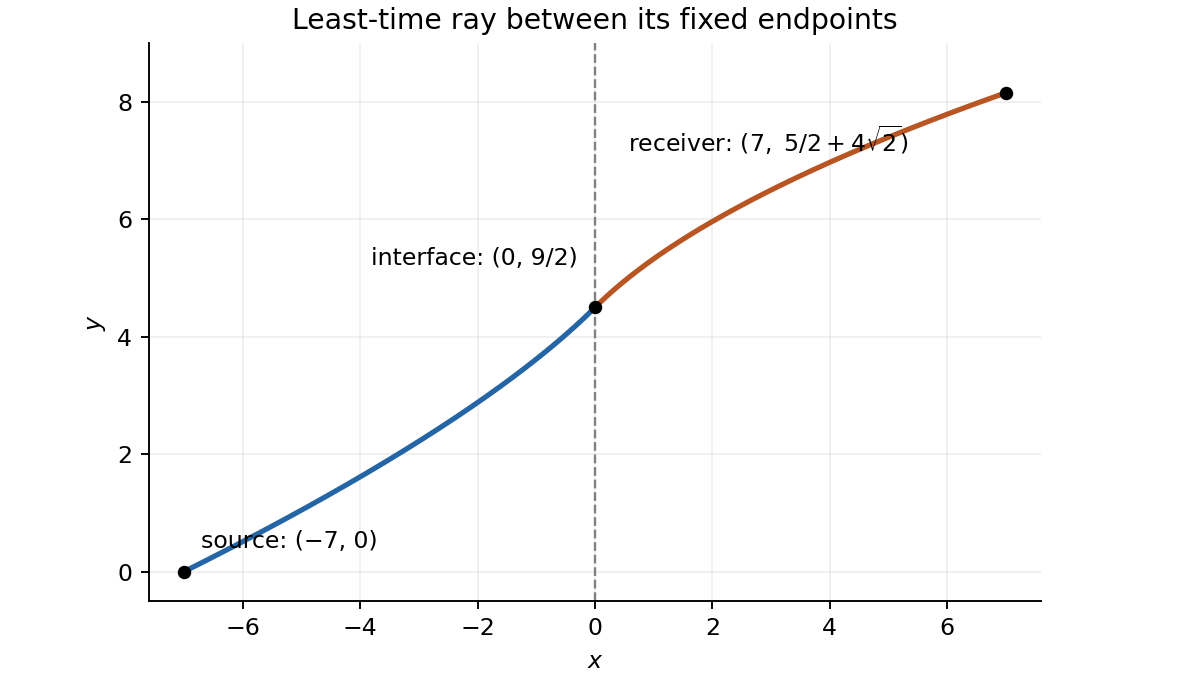

The integrand has no explicit dependence. Thus the Euler-Lagrange equation gives the conserved transverse optical momentumAt , and the crossing slope is one, so . Solving for the positive slope gives , henceThe slopes agree at zero. The same conserved momentum holds across the interface because the refractive index is continuous and there is no point source in the variational equation.
Here a least-time ray means the minimum between the source and the receiver point selected by this ray. For those fixed endpoints, proves strict convexity in the slope, so the stationary ray is the unique minimum among graph paths. If the receiver could instead be freely placed anywhere on the line and its height were also minimized over, the horizontal ray would be faster; that different problem is incompatible with the prescribed crossing slope.
The reduced forcing is . Its exponential-weighted integrals converge, even though the resulting reduced function is not bounded. For , the Green's function formula givesFor it givesUse and to simplify this to . Dividing by yieldsThus with its continuous value at zero. At , both pieces give and , so neither a Dirac delta distribution nor its derivative is introduced at the forcing jump. The solution is bounded at both ends, with at infinity. Its reduced function confirms the growth qualification in part (i).
For , differentiation of givesThus the radial Laplacian equation reduces toBoundedness of at zero implies . Conversely, a regular reduced solution with gives finite .
There is an important qualification to the reduction in the printed question: bounded at infinity requires , not bounded . The example in part (ii) actually has , so it cannot be the bounded solution described in part (a). The differential equation and origin condition reduce as asserted, and the same Green's function can still be used with the correct growth condition. This is the radial reduction and growth at infinity distinction.
For constant diffusivity, the trial Rayleigh quotient simplifies toIts derivative is , so its only positive critical point is . The second derivative is ; also the quotient diverges as or . Therefore this is the global optimum within the trial family:The two requested profiles areThe initial radial graph decreases from one at the centre to zero at the rim, has horizontal tangent at the centre, and is concave downward for . The central temperature decreases exponentially from one to zero, with initial time derivative . These are trial profiles, not exact solutions of the full heat equation. Although the radial trial function is not twice differentiable at the centre, it has finite weighted energy and belongs to the variational trial class used by the Rayleigh-Ritz variational principle.
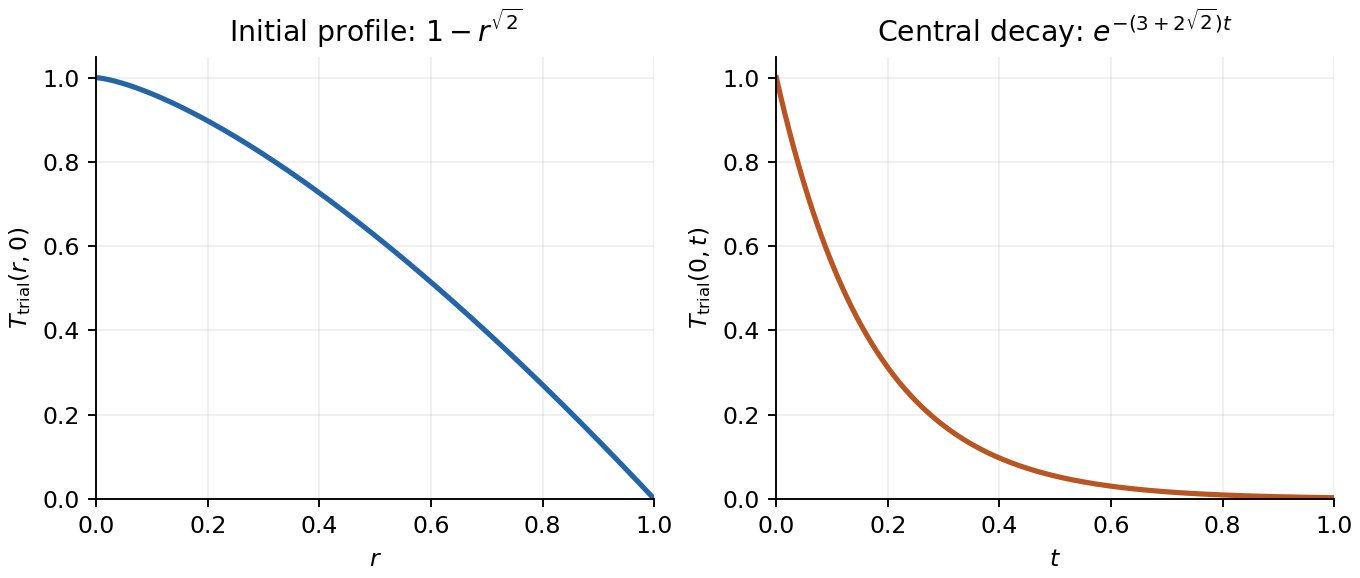
Optimal trial radial profile and its assumed exponential decay at the centre
. Details. 
For the proposed trial profile, . Its weighted energy isThe squared weighted norm isBoth are finite for and , and . Therefore the Rayleigh-Ritz variational principle givesWhen a fundamental diffusion mode exists, its decay rate is the infimum and is bounded above by this expression.
The existence qualification matters for the full range of printed in the question. For , trial functions concentrated within radius have quotient proportional to , proving the loss of a spectral gap under strongly degenerate radial diffusion. The infimum is zero and is not attained, because zero energy together with forces the zero function. Thus there is no positive lowest-mode decay rate in that case. Even at , the mode equation is : its characteristic powers are , and for every nonzero solution is unbounded at the centre. Hence the asserted bounded fundamental mode cannot be assumed for all . The trial quotient remains valid, and the next part's case has the usual fundamental mode.
The domain is the three-dimensional upper half-space. Reflect the source point to . The method of images places an opposite source at this reflected point, giving the Dirichlet image kernel for the three-dimensional modified Helmholtz equationOn , the two Euclidean distances are equal, so the terms cancel exactly. The image lies outside the domain, so its contribution satisfies the homogeneous modified Helmholtz equation everywhere inside; only the original source contributes a Dirac delta. Both terms decay at infinity, including for , and the homogeneous Dirichlet boundary condition follows.
By translation and rotation invariance, use a radial Green function , where is the Euclidean distance. Away from the source, the radial modified Helmholtz equation isWriting reduces this to , where . For , decay eliminates , leaving . For , the two radial branches are a constant and ; decay again leaves .
To fix the singular normalization, integrate the defining equation over a ball of radius about . The divergence theorem givesThe volume term is , whereasConsequentlySource qualification. The printed is the decaying branch only when , although the source declares real. For negative it grows, so it cannot be the requested decaying Green function. The absolute value above covers every real and reduces to the printed form for nonnegative .
There are unlisted articles, also show them or only show them.