
The radial Rayleigh quotient isFor the given trial profile, the numerator is . The denominator isThereforeThe profile is regular at the origin and vanishes at the wall, so it belongs to the admissible trial space. This is the variational estimate for the radial Dirichlet modes of a spherical cavity.
For a spherically symmetric function, the Laplacian in spherical coordinates reduces toMultiplying the Helmholtz equation by givesThe endpoint at is singular in Sturm-Liouville terminology; bounded regular radial fields select the physical solution and eliminate the branch. At the field has the imposed zero Dirichlet value. For regular solutions and admissible trial functions, the endpoint term vanishes at the origin and at the wall.
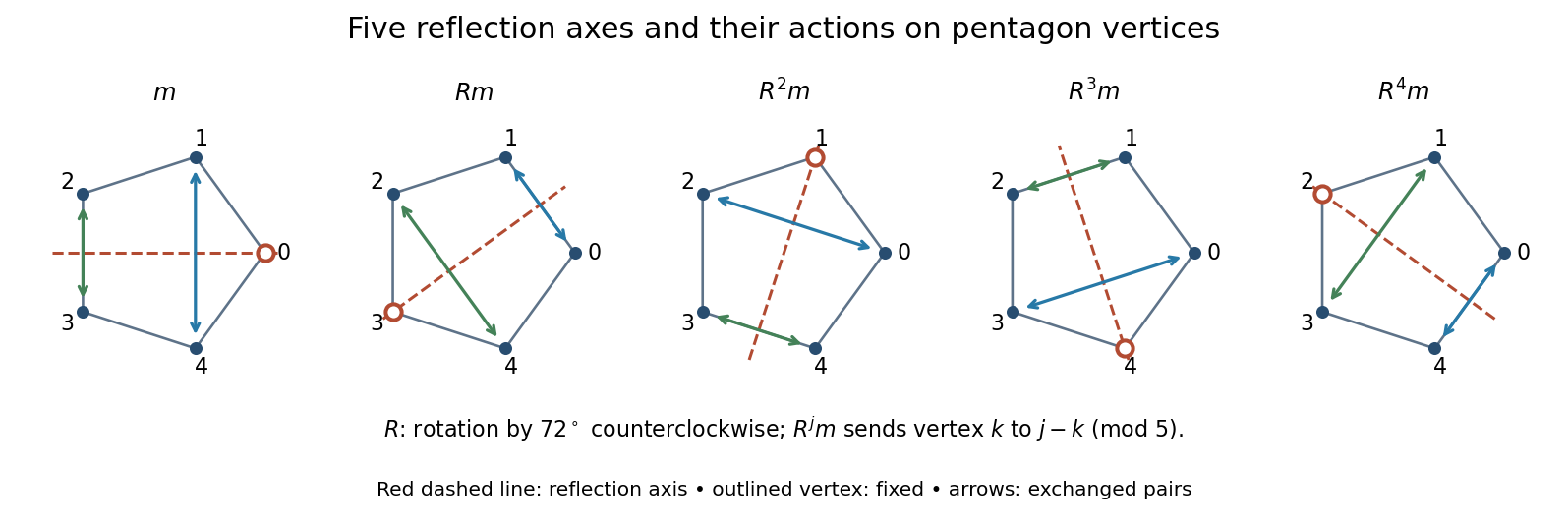
The conjugacy class of is . Rotations commute with one another, while conjugation by a reflection changes to . Thus the rotation classes are , and .
For reflections,Because multiplication by two permutes the residues modulo five, these conjugates exhaust all five reflections. Consequently the complete class partition isTheir sizes account for every element, as in the conjugacy classes of a finite dihedral group.
A normal subgroup is a union of complete conjugacy classes. The trivial subgroup is normal, and the rotation subgroup is normal because conjugation preserves it; equivalently it has index two. None of the five order-two subgroups is normal, because it contains just one member of the five-element reflection class. Thus the proper normal subgroups are exactly
Since , Lagrange's theorem permits proper subgroup orders only . The complete list isTo show completeness, an order-two subgroup must be generated by its unique nonidentity element, necessarily one of the five reflections. An order-five subgroup is cyclic, since its order is prime; its generator cannot be a reflection, and every nonidentity rotation generates the same rotation subgroup. There is only one order-one subgroup.
Thus there are seven proper subgroups when the trivial subgroup is included, or six nontrivial proper subgroups. These are the prime-sided case of the classification of subgroups of a dihedral group.
For a regular pentagon, take as rotation through and as reflection in the horizontal axis through vertex zero. The distinct elements areEvery nonidentity rotation has order five. The reflections are the five order-two elements, since .
Reflect to . The method of images gives the Dirichlet image kernel for the three-dimensional Helmholtz equation:The two distances coincide on the plane, so its boundary value is zero; the image source is outside the domain. It therefore has the required positive delta source inside and the selected outgoing behaviour.
Let . At a boundary point , the distances to the real and reflected sources have derivatives and . ThusThe outward unit normal of the upper half-space is , and . HenceUsing the decay assumption to discard the distant hemisphere in the boundary representation givesThe qualification at infinity concerns the whole Green boundary term, not just the pointwise limit of . Sufficient decay of the field and its derivatives, as assumed, makes it vanish; compatible radiation conditions can also do so. As a sign check, taking in the kernel gives , the positive Poisson kernel for the upper half-space.
Impose a homogeneous Dirichlet boundary condition on the Green function in its first variable, for . The second boundary term then vanishes, givingIn a bounded domain, a Dirichlet Green function requires not to be a Dirichlet eigenvalue of ; otherwise a resonance can obstruct its existence. The representation assumes such a Green function exists.
In all space, put and try . For , direct differentiation gives , so the Helmholtz equation holds away from the source. Integrate its inhomogeneous version over a small source-centred ball. The volume integral tends to zero, while the flux isIt must equal the integrated delta, one. ThereforeThis is the negative of the convention used in the outgoing Green function for the three-dimensional Helmholtz equation, where the source is . The sign here follows the present convention. The factor chooses the outgoing solution, with time convention and the Sommerfeld radiation condition; one could add homogeneous solutions without a radiation prescription.
Expand the forcing and the solution in the normalized eigenfunctions: and . Their coefficients areSince all are nonzero, the equation gives . Hence the required Sturm-Liouville eigenfunction expansion isThis is constant forcing in a logarithmic Dirichlet Sturm-Liouville problem. The coefficients are , so the solution series converges uniformly and has zero endpoint values. Applying is justified in the weighted square-integrable sense; the forcing sine series equals one at interior points, while its endpoint sums are zero. The equation is imposed in the interior, so this does not contradict the boundary conditions.
In logarithmic coordinates the eigenvalue problem becomes . A nonzero function with zero values at both ends requires : multiplying by and integrating gives . Write . The first endpoint gives , and the second requires , .
For vector normalization, . A positive real normalization constant therefore givesThe sine orthogonality identity also gives . Completeness is the usual completeness of the Fourier sine series on under the logarithmic coordinate transformation.
Divide the eigenvalue equation by and collect the first two derivative terms into a single derivative:Thus one choice of Sturm-Liouville form isIndeed . Both and are positive and regular throughout this interval. The zero endpoint values make the boundary form vanish.
Let . By self-adjointness,Taking first shows that each eigenvalue is real: for a nonzero eigenfunction, since . ThereforeFor distinct eigenvalues this proves orthogonality of Sturm-Liouville eigenfunctions:The weight is essential: this need not be orthogonality under the unweighted integral.
The necessary boundary identity for a self-adjoint operator isAt regular endpoints, a standard full family of separated self-adjoint conditions iswith real coefficients and neither pair , zero. For example, if , both functions obey at , so there. The cases and the endpoint follow directly. These include Dirichlet boundary conditions, Neumann boundary conditions and Robin boundary conditions.
Separate vanishing at each endpoint is sufficient but not necessary. Coupled conditions such as and , with real , make the two endpoint forms equal and hence their difference zero. More generally the allowed endpoint data must be a maximal subspace on which the boundary form vanishes; this ensures that the adjoint has the same domain. Merely imposing extra endpoint restrictions until the boundary term vanishes proves symmetry, but can overrestrict the domain and fail to give self-adjointness.
The coordinate does not occur. The perpendicular cross-section isThus the surface is an elliptic cylinder extending in both directions along the zero-eigenvalue axis. Its cross-sectional semiaxes are and . It becomes a circular cylinder when the two positive eigenvalues coincide.
Let and . ThenThis is a one-sheet hyperboloid of revolution around the axis. Its circular waist has radius at , and its radius grows with . In the original coordinates the axis is the eigenvector direction belonging to the negative eigenvalue.
Writing the common positive eigenvalue as , the equation is . Hence it is a sphere withEvery orthonormal set of axes is a principal-axis set in this fully degenerate case.
Along a differentiable curve, the chain rule givesby the Euler-Lagrange equation. Thus when the Beltrami identity is
When , the Euler-Lagrange equation reduces immediately to . ThereforeThis is conservation of the generalized momentum associated with a cyclic coordinate.
For , the catenary has a positive minimum height above the road. Its derivatives areThus the light ray is symmetric about , descends towards a horizontal tangent at its minimum, and then rises. It never intersects the road. This smooth upward bending in the refractive index gradient produces an inferior mirage, without reflection at the road.
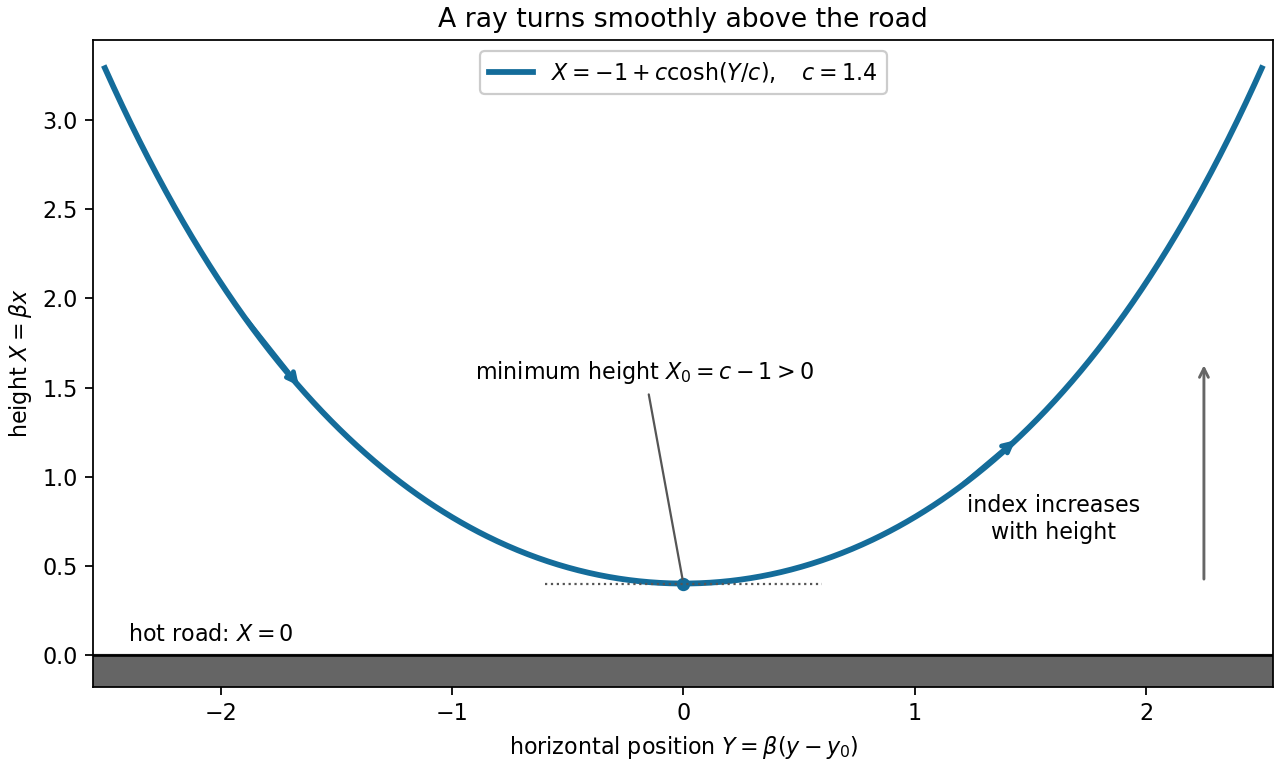


For the displayed form take and . Substitute in the first integral:Inverting the hyperbolic cosine gives the catenary light ray in a linear refractive indexThe minimum occurs at and , so the integration constant has the specified meaning. The integral above describes the graph branch; the other sign of the square root continues it smoothly to the other side of the turning point in .
The signed-constant qualification matters: for in part (a), integration reverses horizontal direction, and the positive prefactor in the full catenary is , with minimum height . The printed expression presupposes . The separate case gives constant, a vertical ray. At the turning point diverges, so is not a single regular graph across it, although is smooth.
The integrand has no explicit dependence on , so part (i) givesFor positive refractive index and a regular graph with , squaring and then restoring the sign of yieldsIt is the continuous-medium version of Snell's law, expressing conserved horizontal optical momentum. The Euler-Lagrange equation establishes stationarity; on a monotone-height segment, convexity of the integrand in also gives a minimum among graphs with fixed endpoints.
There are unlisted articles, also show them or only show them.