
The orthogonal change of coordinates preserves distance to the origin. On the required quadric surface,Thus the squared distance is at least . Equality holds precisely when , and the constraint then gives . Using from part (b), the nearest points in the original coordinates areSubstitution checks the constraint directly: . The inequality proves these are global nearest points, rather than merely stationary candidates.
In the orthonormal basis of part (b), the three quadric surfaces have the following forms. For ,a two-sheeted hyperboloid with axis , vertices , and one sheet on each side of the plane . For ,an elliptic cone with vertex at the origin and the same axis. For ,a one-sheet hyperboloid with axis and a waist ellipse at , whose semiaxes are along and along . The sections at fixed enlarge away from the waist.
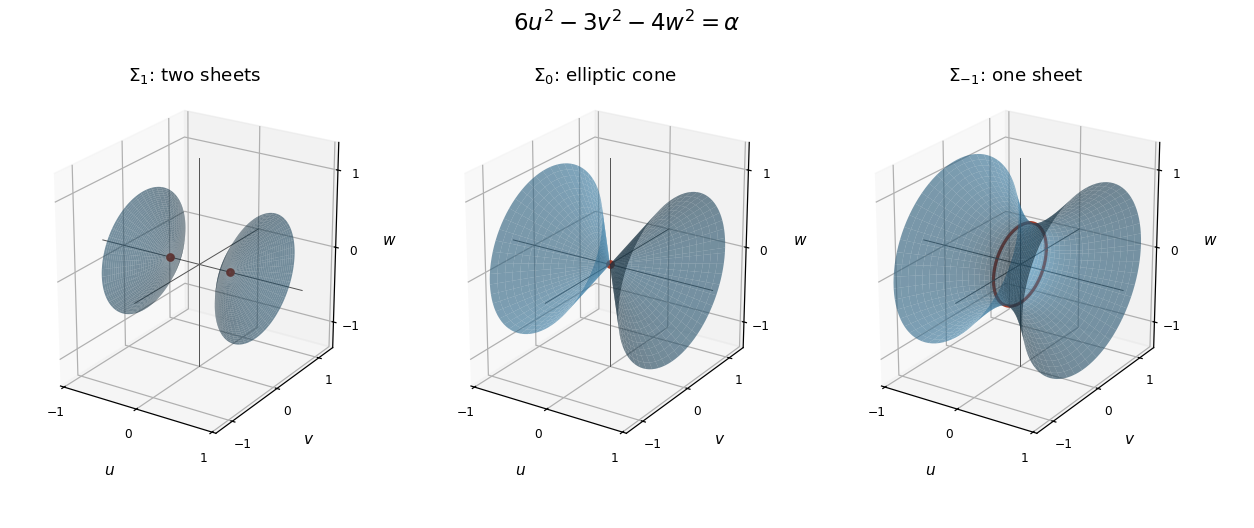
The two-sheeted hyperboloid, elliptic cone and one-sheet hyperboloid in separate orthonormal coordinate frames
. Details. 
The quadratic form is for the real symmetric matrixThe axis has eigenvalue . On the plane, the characteristic polynomial isThus the orthogonal diagonalization from part (a) yieldsFor later use, one possible orthonormal basis isThen , , . This explicit choice also confirms that the Euclidean norm is preserved: .
Choose a real unit eigenvector of the real symmetric matrix , with eigenvalue . Its orthogonal complement is an invariant subspace: for any with ,The restriction of to this -dimensional space is again real and symmetric. Applying the same argument inductively produces an orthonormal basis of real eigenvectors. The base case is immediate. This proves the spectral theorem for real symmetric matrices without assuming that distinct eigenvalues are available.
One can also check that eigenvectors with different eigenvalues are automatically orthogonal: . Within a repeated eigenspace, the Gram-Schmidt process preserves the eigenvector property. Thus repeated eigenvalues cause no obstruction, and .
Here . Splitting the matrix exponential into even and odd powers therefore givesFor the second matrix, , so . HenceBoth are real orthogonal matrices, and hence also unitary matrices.
If , then , and the matrix exponential series gives . Also , since . ThusThe assumed diagonalization ensures that these account for all eigenvalues, including multiplicities. In particular, for ,both of modulus one, in agreement with the unitary matrix property.
Taking the conjugate transpose term by term in the convergent matrix exponential givesThe matrices and commute, so the matrix exponential product law gives and likewise . Hence .
For , use the inverse and product rules for the conjugate transpose:The factors commute, as do their inverses, since they are expressions in the same matrix. Consequentlyand similarly . Therefore . This rational construction is the skew-Hermitian form of the Cayley transform of a Hermitian matrix, obtained by writing with a Hermitian matrix.
If were a singular matrix, a nonzero vector would satisfy , so . This would make an eigenvalue of the anti-Hermitian matrix, contrary to part (a). Thus . The same argument shows is an invertible matrix, which will also be used below.
Let with . Taking the Hermitian inner product with gives . For an anti-Hermitian matrix,Consequently . As , the eigenvalue satisfies , or . Zero is included as a purely imaginary eigenvalue.
The squared norm of the original function isApplying the Parseval identity to part (c), using the evenness of the squared transform, givesThus the last integral equals . Now set . Sincewe obtainThe apparent singularity at is removable: the continuous value of the integrand there is . No principal-value interpretation is needed.
The real odd function has a purely imaginary odd Fourier transform. Setting and using a product-to-sum identity,The apparent singularities are removable. Direct evaluation or limits giveIn particular, the transform stays finite where its numerator and denominator both vanish.
Insert the inverse Fourier transforms of and its complex conjugate, initially under enough decay to justify interchanging integrals:The middle step uses the stated Dirac delta distribution identity, and the last uses its sampling property. This is the Parseval identity for the chosen normalization. Approximation extends the result to square-integrable functions, including the function used below.
With the paper's Fourier transform convention, the Fourier inversion theorem givesThis holds at continuity points under the usual inversion hypotheses; at a jump with one-sided limits it gives their mean. The factor and the sign change in the exponential are part of this normalization.
The original PDF has the absolute-value hypothesis , which is missing from the local OCR. From the Green's function formula and ,Because , the upper bound tends to zero. The squeeze theorem proves .
For the zero-data initial value problem, choose a causal Green function satisfying and for . Continuity at prevents a derivative of the Dirac delta distribution, while integration across the source givesFor , part (i) gives the shifted homogeneous solutions. The zero value at the join removes the cosine term, and the unit derivative jump fixes the sine coefficient. Therefore the causal Green function of a damped oscillator isEquivalently, multiply the first expression by the Heaviside step function . The required solution isIts initial value and first derivative vanish: the interval has zero length at and the kernel vanishes at its upper limit. Differentiating twice shows that the upper-limit contribution to is precisely , while the remaining homogeneous kernel terms cancel in .
For an exponential trial , the characteristic equation isIts distinct complex roots are . Thus the general real solution of the homogeneous second-order linear differential equation isThe two displayed solutions have nonzero Wronskian and hence linear independence. The same formula permits complex solutions when are complex.
Let . The first normalized Fourier sine series coefficient isStrict positivity follows because , has positive total mass, and everywhere inside the interval. In particular, there is no cancellation that could remove the slowest term. This is the positivity of the first Dirichlet reaction-diffusion coefficient.
For finite initial mass , all coefficients satisfy . The eigenfunction expansion therefore gives the uniform boundThe positive first profile thus controls the long-time behavior. We recover exactly the threshold , with decay below it and unbounded positive growth at every interior point above it. The finite-mass condition is the usual meaning of an initial density profile here; standard positive-time smoothing gives the same conclusion in the usual broader admissible data classes.
The smallest decay-rate eigenvalue is , so the threshold isBecause , . For every fixed interior point , the first sine eigenfunction is positive and the remaining terms have strictly faster decay relative to it. HenceOne can justify the relative-error limit directly: after factoring out the first exponential, the absolute remainder is bounded by , which tends to zero. Thus , and . The boundary values stay zero. At equality the first term is stationary and the density approaches its positive sine profile.
By orthogonality and the sampling property of the Dirac delta distribution,Consequently the reaction-diffusion equation solution isFor every this eigenfunction expansion is smoothed by the Gaussian decay in . As , it recovers the specified initial condition in the sense of distributions.
There are unlisted articles, also show them or only show them.