
By the definitions of matrix multiplication, transpose and trace,Relabelling the summed indices givesthe Frobenius inner product of these real matrices.
The Kronecker delta restricts the Einstein summation convention to equal indices, giving the dot product
The determinant condition reduces to , givingAs a check, the first linear equation gives , and at this value of the second linear equation is satisfied for every such pair, including nonzero pairs.
Move the right-hand side to the left. The resulting homogeneous linear system has coefficient matrixA nonzero solution exists exactly when its determinant vanishes:Here the upper-left entry of the original matrix is , as verified in the original PDF; that entry is corrupted in the local OCR.
An antiderivative of the initial velocity is . Thus D'Alembert's formula givesThis is a positive Gaussian function moving right and a negative Gaussian function moving left. Their cancellation at gives the zero initial displacement, while direct differentiation gives .
For every , the profile is an odd function of , vanishes at , is positive for and negative for , and tends to zero at both spatial infinities. The signs follow from . The positive and negative lobes move farther apart as increases; for large separation they approach the individual unit-height Gaussian functions centred at . At finite separation the actual extrema lie slightly beyond these centres: writing , the positive global maximum occurs at the unique satisfying .
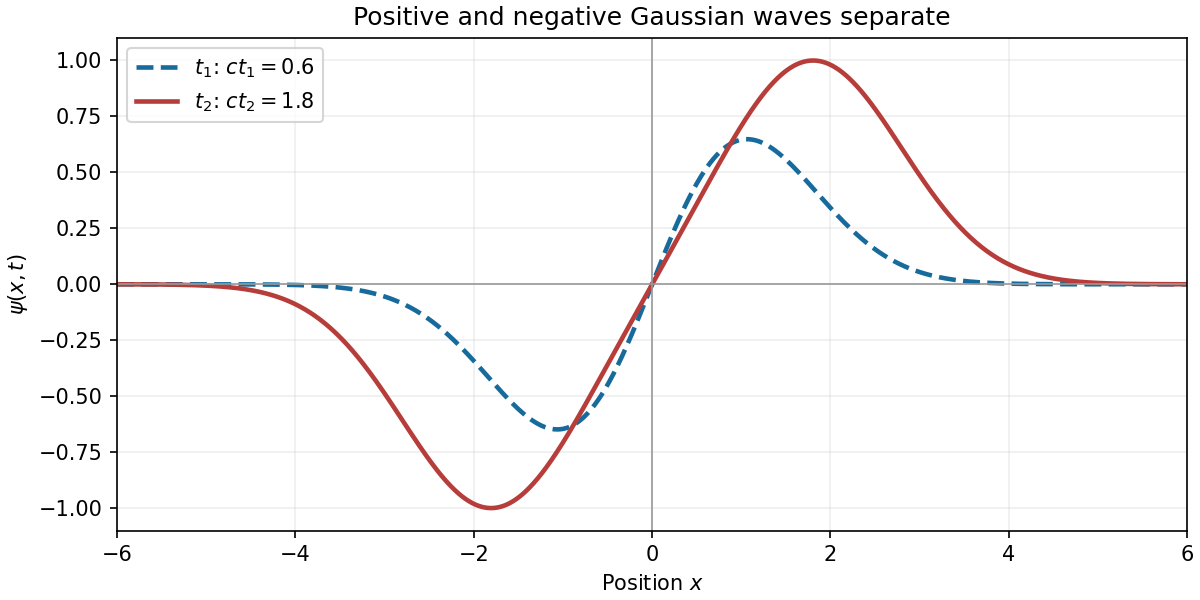

At , the initial conditions implyDifferentiate the first relation and solve for the two derivatives:Fix a reference point and set . Taking antiderivatives givesThe constants must be opposite to preserve the first initial condition; the arbitrary constant of integration does not change . Substitution yields D'Alembert's formula:The fundamental theorem of calculus verifies that its time derivative at zero is , and its value at zero is . The oriented integral also makes the formula valid for negative .
Write . The inverse coordinate formulas and are valid because . The multivariable chain rule givesApplying these operators twice and using the symmetry of second derivatives,Thus the wave equation is equivalent toFor each fixed , the partial derivative has zero derivative with respect to , so it is a function of alone. Taking an antiderivative in gives , where the integration constant may depend on . HenceConversely, direct partial differentiation verifies the wave equation for every twice differentiable pair . The two terms describe profiles moving left and right respectively at wave speed along the characteristic lines for the one-dimensional wave equation.
For positive integers , the summand is . Since , these terms are positive. Apply the limit comparison test with the convergent p-series :Each sine ratio tends to one. The limit comparison test says that two positive-term series whose term ratio tends to a finite positive number are either both convergent or both divergent. ThereforeThere is also a direct comparison test for series: , giving .
There are unlisted articles, also show them or only show them.