
Past exam of the mathematics course of the year 2 of the natural sciences course of the University of Cambridge 2004 Paper 1 7 b Solution Created 2026-10-18 Updated 2026-10-20
Divide the equation by to obtain its Sturm-Liouville form:Thus , and . For , the Lagrange identity for a Sturm-Liouville operator gives the endpoint form . A natural self-adjoint choice isUnder , these become the ordinary zero-derivative conditions at for . They therefore define the realization whose Neumann eigenfunctions of the Chebyshev differential operator are , with .
Boundedness alone does not choose these endpoint conditions: is also bounded but generally has a nonzero endpoint value of . Requiring bounded is a sufficient stronger regularity condition for the displayed zero-flux limits. Other self-adjoint endpoint choices are possible; the boundary form and the operator domain must specify which is intended.
Past exam of the mathematics course of the year 2 of the natural sciences course of the University of Cambridge 2004 Paper 1 6 ii Solution Created 2026-10-18 Updated 2026-10-20
A regular singular point is a nonordinary point for which and extend analytically across . These pole restrictions permit the Frobenius method.
Past exam of the mathematics course of the year 2 of the natural sciences course of the University of Cambridge 2004 Paper 1 6 i Solution Created 2026-10-18 Updated 2026-10-20
An ordinary point of the normalized second-order equation is a point where both coefficient functions and are analytic in a neighborhood. Ordinary continuity is enough for a local existence theorem, but analyticity is the condition used for a convergent local power series solution.
Past exam of the mathematics course of the year 2 of the natural sciences course of the University of Cambridge 2004 Paper 1 4 b Solution Created 2026-10-18 Updated 2026-10-20
For the general independence of eigenvectors for distinct eigenvalues, use induction. In a relation , applying gives . Independence of the first vectors makes each coefficient vanish. Distinctness of the eigenvalues then gives , and the original relation gives . No Hermitian assumption is required.
Past exam of the mathematics course of the year 2 of the natural sciences course of the University of Cambridge 2004 Paper 1 3 c Solution Created 2026-10-18 Updated 2026-10-20
The convolution is . In this transform convention, the convolution theorem says , and Parseval's identity saysTo match the integral's scale exactly, set and . Then and , using the value one at zero. Their convolution is the box smoothing of a two-sided exponential with both scales equal to one:Its transform is precisely . Since is even, Parseval's identity reduces the requested integral toUse , and . Simplifying givesThe apparent singularity at is removable, and the integrand decays as , so the integral converges.
Past exam of the mathematics course of the year 2 of the natural sciences course of the University of Cambridge 2004 Paper 1 3 b Solution Created 2026-10-18 Updated 2026-10-20
For the two-sided exponential, split the integral at zero:For the interval indicator, the Fourier transform of an interval indicator givesAt , the continuous limiting value is , the length of the interval. Changing the values at its two endpoints has no effect on the transform.
Past exam of the mathematics course of the year 2 of the natural sciences course of the University of Cambridge 2003 Paper 2 7 iii Solution Created 2026-10-18 Updated 2026-10-20
For the proposed vector, the first horizontal component of is . Since the corresponding component of is zero, a normal mode requires . The vertical components then give . With an arbitrary nonzero overall amplitude, choose to obtainThe analogous pattern invariant under reflection across the vertical axis isDirect multiplication confirms . The two patterns give independent eigenvectors with the same eigenvalue, as expected from the square's rotation symmetry.
Past exam of the mathematics course of the year 2 of the natural sciences course of the University of Cambridge 2003 Paper 2 7 ii Solution Created 2026-10-18 Updated 2026-10-20
In a breathing mode, each displacement is proportional to its equilibrium position. A representative vector isMultiplying by the stiffness matrix gives . ThusPositive and negative amplitudes are uniform expansion and contraction about the center.
Past exam of the mathematics course of the year 2 of the natural sciences course of the University of Cambridge 2003 Paper 2 7 i Solution Created 2026-10-18 Updated 2026-10-20
The first two vectors displace every particle identically in the horizontal or vertical direction. Every relative displacement is zero, so every spring has zero extension to first order. The third vector is evaluated at the equilibrium points, which is an infinitesimal clockwise rotation. For any edge the relative displacement is perpendicular to that edge, again giving zero extension.
These are the rigid-motion zero modes of a spring framework: two translations and one infinitesimal rotation. Each has , so . In the linearized dynamics its amplitude has the form , expressing free rigid motion rather than a restoring oscillation. Exact finite rigid rotations also preserve every spring length; the mode vector is their first-order tangent.
Past exam of the mathematics course of the year 2 of the natural sciences course of the University of Cambridge 2003 Paper 2 6 b Solution Created 2026-10-18 Updated 2026-10-20
The Cartesian tensor law is . In every complete tensor contraction, summation over a transformed index contracts a pair of factors to a Kronecker delta. In detail,Thus all three are invariant under rotations. They are , and . For a real symmetric tensor, orthogonal diagonalization givesExpanding and using Newton's identities to recover the characteristic polynomial from traces of powers yieldsComparison identifies .
Past exam of the mathematics course of the year 2 of the natural sciences course of the University of Cambridge 2003 Paper 1 5 b Solution Created 2026-10-18 Updated 2026-10-20
Let . The commutation relation gives , so preserves the eigenspace of with eigenvalue . Because it is a nondegenerate eigenvalue, the eigenspace is one-dimensional, and for some real . This includes . Thus the eigenvectors of form a common eigenbasis, andWriting the corresponding unit-modulus eigenvalue of as givesThe pairing refers to the same common eigenvector; independent reorderings of the two real spectra would lose this information. The simultaneous diagonalization can also be constructed without requiring simple eigenvalues by diagonalizing within each eigenspace of .
Past exam of the mathematics course of the year 2 of the natural sciences course of the University of Cambridge 2003 Paper 1 5 a Solution Created 2026-10-18 Updated 2026-10-20
Since and are real symmetric matrices, . Expanding the unitarity condition givesEquality of the entrywise real and imaginary parts yieldsThese are the identities for the real and imaginary parts of a symmetric unitary matrix.
Past exam of the mathematics course of the year 2 of the natural sciences course of the University of Cambridge 2003 Paper 1 2 iii Solution Created 2026-10-18 Updated 2026-10-20
For a nonzero separated solution , separation of variables gives and . The endpoint conditions require and . Thus the mixed Dirichlet-Neumann modes on an interval have , . Their squared L2 norms are , so the initial Fourier coefficients areThe integration uses and . ThereforeAt positive time the series can be differentiated termwise and satisfies both homogeneous endpoint conditions for . At time zero it recovers , so recovers the initial zero temperature. If , the prescribed derivative at is incompatible with differentiating the initial zero profile; the temperature is still continuous there, while its spatial derivative has a corner layer. At long times the decaying modes leave .
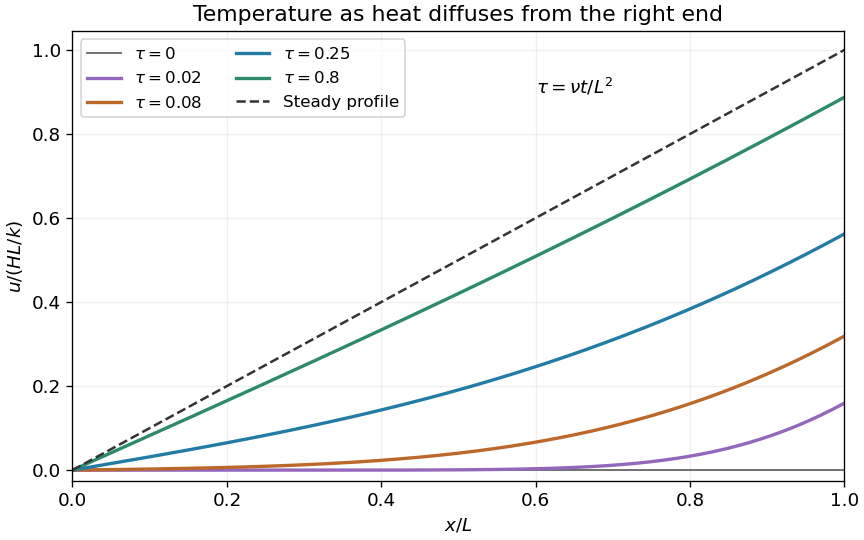
Heating a bar through one end while the other end stays at zero temperature
. Original dimensionless temperature profiles at several diffusion times. The eventual linear profile has the imposed unit derivative at the heated end. Details.
Past exam of the mathematics course of the year 2 of the natural sciences course of the University of Cambridge 2003 Paper 1 2 ii Solution Created 2026-10-18 Updated 2026-10-20
Choose the stationary solution satisfying and . Hence . Subtracting it gives the homogeneous problemThis boundary lifting leaves a Dirichlet boundary condition at one end and a Neumann boundary condition at the other, as in the fixed-temperature and fixed-flux heat equation on an interval.
Past exam of the mathematics course of the year 2 of the natural sciences course of the University of Cambridge 2003 Paper 1 2 i Solution Created 2026-10-18 Updated 2026-10-20
With temperature measured relative to the fixed-temperature end, the heat equation and its data areHere is thermal diffusivity and is thermal conductivity. The sign of the derivative condition describes incoming heat flux at : the outward conductive heat flux is .
Past exam of the mathematics course of the year 2 of the natural sciences course of the University of Cambridge 2002 Paper 2 7 iii Solution Created 2026-10-18 Updated 2026-10-20
For the normal modes of an equilateral spring triangle, the complement of the three rigid motions has dimension three. One convenient mutually orthogonal basis isThese vectors are also orthogonal to , and each has squared length . Their geometry comes from applying symmetric linear deformations to the equilibrium triangle: is uniform expansion, stretches one axis while compressing the other, and is the second independent shear pattern. Their extensions areInsert each row into the force equations. For example, gives and , with the same proportionality in every component. The other two rows similarly give force times their displacement vector. Thusand the remaining normal modes and normal frequencies areAny orthogonal pair spanning the same two-dimensional shear subspace is equally valid, because its eigenvalue is repeated. The six displayed vectors are nonzero and mutually orthogonal, so they supply all six independent normal modes without solving a characteristic polynomial.
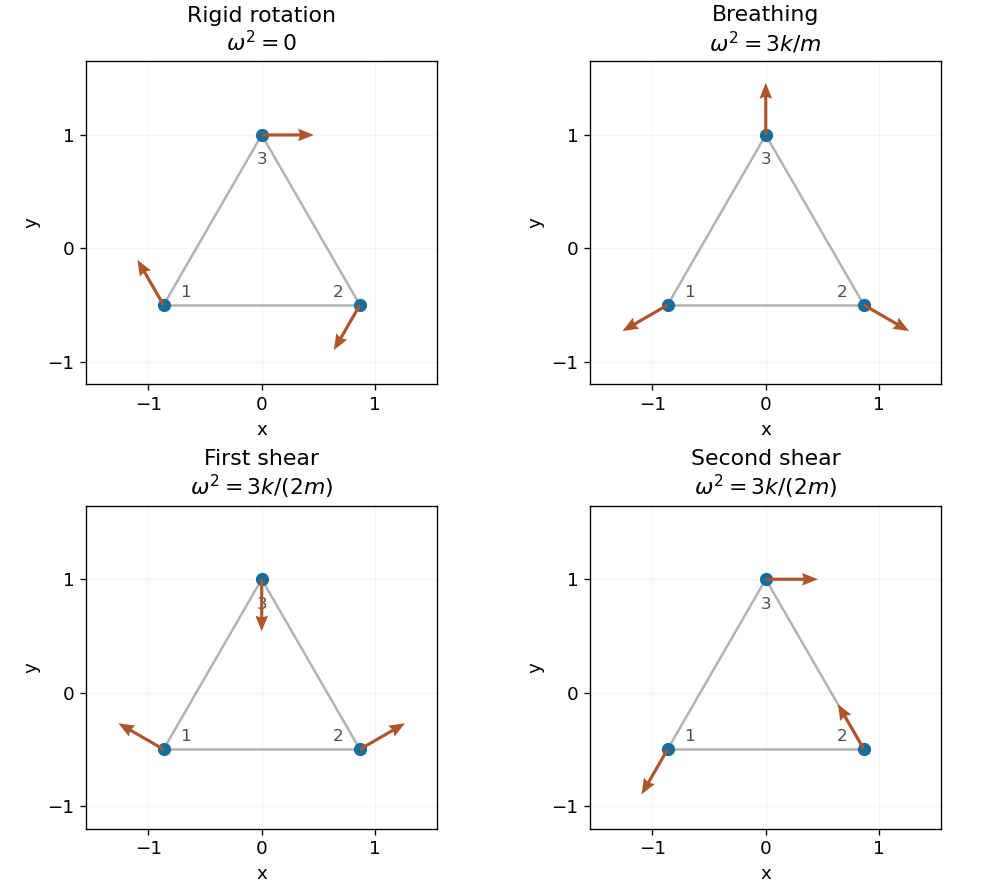

For explicit normal coordinates, normalize by and by , and write . Since all masses are equal,Positive-frequency coordinates have ; the three rigid coordinates have the linear form found above.
Past exam of the mathematics course of the year 2 of the natural sciences course of the University of Cambridge 2002 Paper 2 7 ii Solution Created 2026-10-18 Updated 2026-10-20
Order coordinates as . For either uniform displacement, or , every relative displacement and every extension vanishes. These normal modes have zero normal frequency and represent two independent planar translations.
For , substitution givesThus too. A small rigid rotation through angle moves equilibrium position by . With the specified positions this displacement is , identifying the third vector as infinitesimal rigid rotation. HenceA zero-frequency normal coordinate obeys , so . This permits a constant displacement or a uniform velocity at the level of the linearized equations. In particular, the rotational pattern preserves lengths to first order; finite-angle rotation follows a curved path outside a single linear displacement pattern.
Past exam of the mathematics course of the year 2 of the natural sciences course of the University of Cambridge 2002 Paper 2 7 i Solution Created 2026-10-18 Updated 2026-10-20
Use the equilibrium coordinates specified in the paper; their distances from the origin are one and their mutual separation is . Let be the small displacements. Each initially unstretched spring has, to first order, extension equal to the relative displacement projected along its original bond. Choose the three oriented extensionsThe kinetic energy is exact in these displacement coordinates, while the potential energy needed for small oscillations is its quadratic part:The factor in the equilibrium bond length cancels when forming the unit bond directions. Applying the Euler-Lagrange equation, or differentiating for the force on each mass, givesThe total force vanishes componentwise, as expected for three masses coupled only by internal spring forces.
Past exam of the mathematics course of the year 2 of the natural sciences course of the University of Cambridge 2002 Paper 2 6 c Solution Created 2026-10-18 Updated 2026-10-20
Contract the given isotropic fourth-rank tensor with the strain array. The stress tensor isWrite , where is symmetric and traceless. Then and . Substitution givesBy uniqueness of the scalar, symmetric-traceless and axial tensor decomposition,This is isotropic elasticity on tensor components: the three tensor sectors do not mix. If the strain is symmetric, , hence and . No equality between and is needed for that conclusion.
Past exam of the mathematics course of the year 2 of the natural sciences course of the University of Cambridge 2002 Paper 2 6 b Solution Created 2026-10-18 Updated 2026-10-20
First separate the symmetric tensor and antisymmetric tensor parts:The trace of the antisymmetric part vanishes. In three dimensions, remove one third of the trace from the symmetric part, and identify the remaining antisymmetric part with an axial vector. The scalar, symmetric-traceless and axial tensor decomposition isHere and . The contraction of two Levi-Civita symbols verifies the reconstruction:ThereforeThe pieces contain , and independent components respectively, accounting for all nine entries. Taking the trace, then the traceless symmetric part, then the antisymmetric part shows that the decomposition is unique.
There are unlisted articles, also show them or only show them.