
George E. Palade Created 2026-10-18 Updated 2026-11-05
Cell biologist whose work with James D. Jamieson traced transport of secretory proteins through pancreatic cells. Following newly synthesized material connected distinct cellular compartments into a functional secretory pathway.[ref]
James D. Jamieson Created 2026-10-18 Updated 2026-11-05
A cell biologist whose joint work with George E. Palade traced the intracellular transport of secretory proteins.[ref]
https://magazine.alumni.ubc.ca/2019/spring-2019/departments/in-memoriam/james-d-jamieson. Institutional obituary: James D. Jamieson, 1934-2018, cell-biology research
Verónica A. Segarra Created 2026-10-18 Updated 2026-11-05
Cell biologist and coauthor of an undergraduate teaching study introducing mammalian cell culture and viability measurements. The work connected direct observation of cultured cells with quantitative interpretation of cellular survival.[ref]

Portrait of Verónica A. Segarra
. External portrait linked by the institutional profile. Robert Brown Created 2026-10-18 Updated 2026-10-20
A botanist whose name is associated with Brownian motion.[ref]
https://anbg.gov.au/biography/brown-robert.html. Australian National Herbarium, biographical notes: botanist, 1773–1858, and Keeper of the Botanical Department

Portrait of Robert Brown
. External public-domain lithographic portrait; Wikimedia Commons file record. Source. Robert K. Nakamoto Created 2026-10-18 Updated 2026-11-05
Researcher in ATP-synthase biophysics. Nakamoto coauthored experiments on temperature-dependent single-molecule rotation, connecting interactions between subunits with the catalytic dwell of the motor.[ref]
Rikiya Watanabe Created 2026-10-18 Updated 2026-11-05
Researcher in molecular motors. Watanabe analyzed rotary catalysis of ATP synthase, connecting rotation, chemical steps and coupling between the enzyme’s membrane and soluble sectors.[ref]
Rotary catalysis of FoF1-ATP synthase by Rikiya Watanabe. Author list and described study
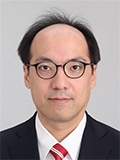
Rikiya Watanabe. Portrait from the institutional profile.
John L. Rubinstein Created 2026-10-18 Updated 2026-11-05
Researcher in structural biology. Rubinstein coauthored studies of bacterial ATP synthase, connecting cryo-electron microscopy structures with the mechanics and regulation of a rotary energy-converting complex.[ref]
Structure of a bacterial ATP synthase by Hui Guo and others. Author list and described study
Hui Guo Created 2026-10-18 Updated 2026-11-05
Researcher in structural biology. Guo and collaborators determined bacterial ATP synthase structures, connecting subunit organization with the coupling of a rotary mechanism to ATP production.[ref]
Structure of a bacterial ATP synthase by Hui Guo and others. Author list and described study
Kazuhiko Kinosita Jr. Created 2026-10-18 Updated 2026-11-05
Researcher in molecular biophysics and coauthor of direct observation of F1-ATPase rotation. The experiment connected ATP synthase activity with an observable rotary motion rather than an inferred mechanical analogy.[ref]
Direct observation of the rotation of F1-ATPase by Hiroyuki Noji and others. Author list and described study
Hiroyuki Noji Created 2026-10-18 Updated 2026-11-05
Researcher in molecular motors. Noji and collaborators directly observed rotation of the F1 sector of ATP synthase, connecting enzymatic activity with mechanical motion at the single-molecule scale.[ref]
Direct observation of the rotation of F1-ATPase by Hiroyuki Noji and others. Author list and described study
Max Delbrück Created 2026-10-18 Updated 2026-11-05
Researcher in microbial genetics. With Salvador Luria, Delbrück analyzed variation in virus resistance among bacterial cultures, connecting fluctuations in resistant-cell numbers with mutations arising before selection.[ref]
Mutations of Bacteria from Virus Sensitivity to Virus Resistance by Salvador Luria and Max Delbrück. Author list and described study

Portrait of Max Delbrück
. Jonathan Delbruck, source and rights-releasing party named in the File; original photographer not separately established. Public-domain release by the party identified on Commons as author/copyright holder; worldwide fallback permission for any purpose; VRT ticket 2008120310001036., via Wikimedia Commons. Source. Masamitsu Futai Created 2026-10-18 Updated 2026-11-05
Masamitsu Futai coauthored single-molecule studies of F1-ATPase rotation. Measurements of catalytic dwell behaviour probe how interactions among subunits influence the chemical-mechanical cycle.
Changing temperature alters transition rates and can expose different rate-limiting processes. Such measurements link kinetic observations with the architecture of ATP synthase.[ref]
A biochemist.[ref]
https://www.osaka-u.ac.jp/en/news/topics/2012/03/201203013_1. Independent institutional or self-authored biography: identity and specialization
Mayumi Nakanishi-Matsui Created 2026-10-18 Updated 2026-11-05
Mayumi Nakanishi-Matsui coauthored single-molecule measurements of F1-ATPase rotation and its temperature dependence. The work connects gamma-beta subunit interactions with the catalytic dwell.
A motor's average rotation rate can conceal distinct pauses and moving intervals. Resolving individual steps supplies mechanistic information that an average ATP-hydrolysis rate alone cannot provide.[ref]
A biochemist.[ref]
https://jglobal.jst.go.jp/detail?JGLOBAL_ID=201801002198267474. Independent institutional or self-authored biography: identity and specialization
Mizuki Sekiya Created 2026-10-18 Updated 2026-11-05
Mizuki Sekiya coauthored measurements of the temperature dependence of single-molecule F1 rotation. The study examines how interactions between gamma and beta subunits influence pauses in the catalytic cycle.
A rotation trace separates motion from dwell times. Their different temperature dependences help identify which processes control the timing of a molecular motor.[ref]
A biochemist.[ref]
https://jglobal.jst.go.jp/detail?JGLOBAL_ID=201801009145465864. Independent institutional or self-authored biography: identity and specialization
Toshiharu Suzuki Created 2026-10-18 Updated 2026-11-05
Toshiharu Suzuki coauthored structural research on bacterial ATP synthase. The structure relates the membrane sector involved in proton movement to the rotary and catalytic portions of the complex.
A static molecular structure constrains possible coupling mechanisms but does not directly record a live rotation trajectory. Combining structure with functional measurements connects molecular architecture with energy conversion.[ref]
Structure of a bacterial ATP synthase by Hui Guo and others. Introduction, Figures 1 and 4, proton-translocation analysis
A biochemist.[ref]
https://www.researchgate.net/profile/Toshiharu-Suzuki-3. Independent institutional or self-authored biography: identity and specialization
Masasuke Yoshida Created 2026-10-18 Updated 2026-11-05
Masasuke Yoshida coauthored direct observation of rotation in isolated F1-ATPase. A fluorescent filament attached to the rotary system made angular motion visible during ATP-driven activity.
This converts an inferred coupling mechanism into a mechanical readout. The isolated motor assay establishes rotation; demonstrating membrane-coupled ATP synthesis requires a different experimental configuration.[ref]
Direct observation of the rotation of F1-ATPase by Hiroyuki Noji and others. 1997, publisher abstract: fluorescent-filament observation
A biochemist.[ref]
https://www.jsps.go.jp/file/storage/grants/j-grantsinaid/12_kiban/ichiran_23/e-data/e77_yoshida.pdf. Independent biography: identity and specialization
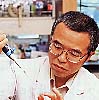
Portrait of Masasuke Yoshida
. Source. George Chaconas Created 2026-10-18 Updated 2026-11-05
George Chaconas coauthored research on maintenance functions of linear and circular plasmids in Borrelia burgdorferi. The two DNA topologies raise related questions about replication and stable inheritance.
A plasmid's shape and its maintenance machinery are distinct properties. Comparing the two forms helps ask which functions are shared and which depend on topology.[ref]
A biochemist.[ref]
https://profiles.ucalgary.ca/george-chaconas. Institutional or professional-society biography, identity and research specialization
Hans Adolf Krebs Created 2026-10-18 Updated 2026-11-05
Hans Adolf Krebs developed the cyclic account of carbon oxidation now called the citric acid cycle. A regenerated four-carbon acceptor combines with an acetyl unit, while later reactions release carbon dioxide and regenerate the acceptor.
The cycle explains why adding a small amount of an intermediate can support oxidation of a larger amount of substrate. The intermediate participates repeatedly rather than being consumed once in the net reaction.[ref]
The citric acid cycle by Hans Adolf Krebs. 1953 lecture, pages 399–404 and Table 1
A biochemist.[ref]
https://www.nobelprize.org/nomination/archive/show.php?id=11165. Nomination archive, 1951, nominee: biochemistry professorship and life dates 1900–1981

Jacques Berthet Created 2026-10-18 Updated 2026-11-05
Jacques Berthet coauthored research with Christian de Duve on the subcellular distribution and latency of acid phosphatase. The work links fractionation with measurements of enzyme accessibility.
Association with a cellular fraction does not by itself identify an enzyme's exact location. Latency and marker comparisons supply additional evidence about compartmentation.[ref]
Tissue fractionation studies. 1. The existence of a mitochondria-linked, enzymically inactive form of acid phosphatase in rat-liver tissue by Jacques Berthet and Christian de Duve. 1951, page 174: introduction and fractionation
A biochemist.[ref]
https://archives.uclouvain.be/atom/index.php/berthet-jacques. UCLouvain Archives identity record: professor of biochemistry and clinical biology; inspected indexed institutional description
Christian de Duve Created 2026-10-18 Updated 2026-11-05
Christian de Duve investigated intracellular organization using biochemical fractionation. Work with Jacques Berthet examined a latent form of acid phosphatase, connecting enzyme accessibility with its subcellular association.
An enzyme can be present but poorly detected if a membrane limits substrate access. Comparing activity before and after disruption therefore helps distinguish low enzyme abundance from biochemical latency.[ref]
Tissue fractionation studies. 1. The existence of a mitochondria-linked, enzymically inactive form of acid phosphatase in rat-liver tissue by Jacques Berthet and Christian de Duve. 1951, page 174: rationale and fractionation
A biochemist.[ref]
https://www.rockefeller.edu/our-scientists/christian-de-duve/2448-nobel-prize/. Rockefeller University, Nobel Prize in Physiology or Medicine: identifies Christian de Duve as a Belgian biochemist


There are unlisted articles, also show them or only show them.