
Magnetic order 2026-10-18
Magnetic order is a reproducible spatial organization of microscopic magnetic moments. A net magnetization describes their sum; a staggered magnetization describes an alternating pattern. These are different order parameters. For example, an alternating row of equal up and down arrows has zero sum but a definite pattern, whereas randomly oriented arrows can have a small sum without that pattern.
Magnetometer 2026-10-18
A magnetometer measures a magnetic field or a specimen's magnetic dipole moment. A vibrating-sample magnetometer determines the latter from the electromotive force induced in pickup coils by specimen motion.
Diamagnetism 2026-10-18
Diamagnetism is a magnetic response in which the induced magnetization opposes the applied magnetic field intensity. In a linear isotropic description, with negative magnetic susceptibility .
Interlayer exchange coupling Created 2026-10-18 Updated 2026-11-05
Interlayer exchange coupling is an interaction that favors particular relative orientations of magnetization in different magnetic layers. In a metallic multilayer, spacer electrons can mediate coupling even when a nonmagnetic layer separates the magnets.
A simple model writes energy per area as . Positive favors parallel alignment and negative favors antiparallel alignment. Spacer material and thickness affect the coupling; magnetic-field sweeps can reveal the field needed to overcome it. Correlated interface roughness can instead produce orange-peel coupling, so a preferred alignment alone does not uniquely establish exchange mediation. [ref]
https://www.nist.gov/publications/interlayer-exchange-coupling. NIST publication record, Interlayer Exchange Coupling: spacer-electron mediation
Magneto-optic Kerr effect Created 2026-10-18 Updated 2026-11-05
The magneto-optic Kerr effect is a change in the polarization of an electromagnetic wave upon reflection from a magnetized material. The magnetic response can change both polarization orientation and ellipticity. It differs from the Faraday effect, which is observed in transmission.
A polarizer, reflective sample, analyzer and photodetector turn a small polarization change into an intensity signal. Sweeping an applied magnetic field while recording the signal can trace changes of magnetization and switching. The probed component depends on optical and magnetic geometry, so interpreting the trace requires calibration rather than identifying arbitrary brightness with total magnetization. [ref]
https://tsapps.nist.gov/publication/get_pdf.cfm?pub_id=620499. NIST-hosted magnetic-imaging chapter: reflected Kerr versus transmitted Faraday response and geometry dependence
Magnetic shielding 2026-10-18
Magnetic shielding reduces an unwanted magnetic field in a specified region. Residual fields and fields generated inside the shield still need to be assessed in a magnetometer experiment.
Magnetic anisotropy 2026-10-18
Magnetic anisotropy is a directional dependence of a material's magnetic properties. A preferred direction must be distinguished from an externally imposed magnetic field.
Magnet Created 2026-10-18 Updated 2026-10-20
A magnet is a material object or current arrangement that produces a magnetic field. Permanent magnets retain magnetization, while electromagnets use a supplied electric current in a winding.
Coulomb-gauge vector potential of a long solenoid Created 2026-10-18 Updated 2026-10-24
For an ideal infinitely long solenoid with interior magnetic field and radius , an axisymmetric Coulomb gauge representative of the magnetic vector potential isThis follows from by Stokes theorem. The exterior has zero curl but nonzero circulation around the enclosed magnetic flux. The Coulomb gauge condition alone does not eliminate every residual gauge transformation; symmetry and regularity select this customary representative.
For , minimization of the homogeneous Landau free energy gives . The unique minimum near zero has . Therefore its first two derivatives with respect to vanish at zero, whereas its third derivative is . With the first nonzero response diverges as . This is response to the variable through a cubic source, so it differs from the conventional third-order coefficient for a linearly coupled magnetic field. The missing factor would give an incorrect susceptibility if one confused a series coefficient with a derivative.
Grand-canonical spin susceptibility of a half-filled single level Created 2026-10-18 Updated 2026-10-20
One noninteracting spatial orbital with two spin energies , in the grand canonical ensemble with mean occupation one, has chemical potential for every positive temperature. Its spin population difference is , giving total-moment response at zero field. Empty and doubly occupied orbital states are permitted. Fixing exactly one electron instead leaves only the two singly occupied states and gives . The factor of two is an ensemble effect in this small system.
Electromagnet Created 2026-10-18 Updated 2026-11-05
An electromagnet produces a magnetic field using an electric current. Winding an electrical conductor into a coil combines the fields from its turns; a long solenoid is an idealized example. Far from its ends, an air-core solenoid has approximatelywhere turns carry electric current over length . Reversing reverses the axial magnetic field. [ref]
The Feynman Lectures on Physics, Volume II by Richard Feynman and others. Section II.13–5, magnetic field of a straight wire and solenoid
A core with ferromagnetism can concentrate the magnetic flux, but its response depends on magnetic saturation and magnetic hysteresis. The constant-permeability air-core formula cannot simply be extrapolated to arbitrarily large core fields. A magnetic compass near a powered coil provides a qualitative test: switching or reversing the electric current changes the compass orientation.
Compass 2026-10-18
A magnetic compass uses the orientation of a magnetic needle to indicate the direction of a magnetic field.
Magnetic field gradient Created 2026-10-18 Updated 2026-11-05
A magnetic field gradient describes how a magnetic field varies with position. Because the field is a vector field, its complete local variation is the tensor with components ; the gradient of the field magnitude is a different, vector-valued quantity.
A fixed magnetic dipole moment in a nonuniform field experiences a force in the simple localized-dipole model. A uniform field can exert a torque without that translational force. This distinction underlies spatial separation in the Stern-Gerlach experiment and forces in magnetic tweezers. Measuring the field at neighboring positions tests a gradient; one field reading cannot determine it.
Magnetic field strength Created 2026-10-18 Updated 2026-11-05
In macroscopic electromagnetism, magnetic field strength is , where is magnetic flux density and is magnetization. In SI units is measured in , while is measured in tesla units. In a linear isotropic medium , where is magnetic permeability. The macroscopic Ampère-Maxwell equation writes its curl in terms of free current and displacement current. The electromagnetic Poynting vector is in this convention.
Lysosomal enzyme latency 2026-10-18
Lysosomal enzyme latency is the difference between the enzyme activity accessible to an added substrate before disruption of the surrounding membrane and the activity revealed after disruption. Low accessible activity can reflect separation of enzyme from substrate, rather than absence of enzyme. This is an assay-accessibility statement, not a claim that the intact lysosome is inactive in the living biological cell.[ref]
Exploring Cells with a Centrifuge by Christian de Duve. Christian de Duve, Exploring Cells with a Centrifuge (Nobel Lecture, 12 December 1974), printed pp. 157–159, enzyme-latency discussion and Figure 6
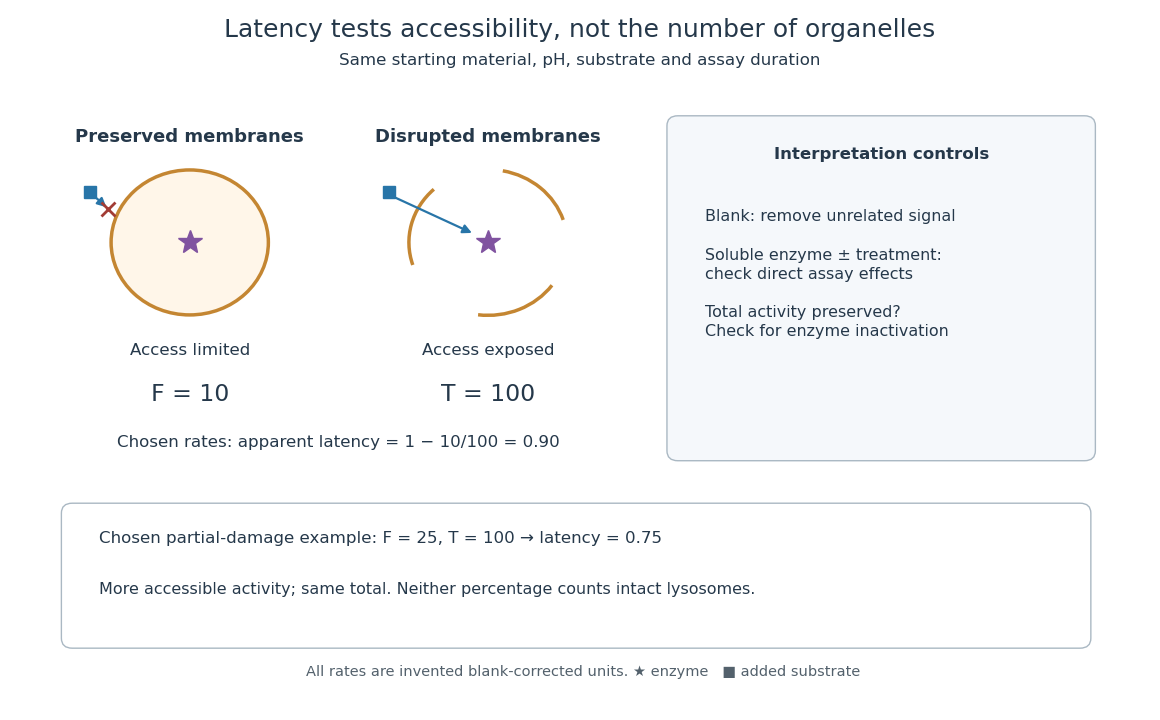
Lysosomal enzyme latency: matched assay conditions and disruption controls
. Original assay-logic diagram and explicitly chosen activity example. The values , and are arbitrary blank-corrected rate units, not historical observations. The soluble-enzyme comparison is an additional control proposed for the schematic, not an asserted measurement from the rat-liver acid-phosphatase latency experiment. Details.
Let be the blank-corrected initial rate measured with a membrane-preserving preparation and the rate after a treatment that exposes all assayable enzyme. Use matched amounts of starting material, pH, substrate and measurement time. Define the apparent latent fraction byThis definition requires more than a large treated signal. Disruption must preserve enzyme activity, and the treatment must not independently alter the readout. A soluble-enzyme comparison with and without treatment helps test direct activation or inhibition; an appropriate blank tests signal unrelated to enzyme-catalysed hydrolysis. These are controls for interpreting the constructed assay, rather than additional historical observations.
For a deliberately chosen example, take and arbitrary rate units. Then : ninety percent of the assayable activity was initially inaccessible. After hypothetical partial damage, with unchanged gives . The preparation has lost latency without gaining total assayable activity. These percentages describe activity accessibility; they do not count intact lysosomes. Unequal enzyme contents, partial leakage and mixed particle populations prevent that identification. If , the formula is negative, flagging failure of this simple accessibility interpretation rather than a negative population of hidden enzymes.
To check the logic, divide the same uniformly mixed preparation into two equal portions. If dilution halves both measured rates, , so is unchanged. In contrast, comparing an undiluted untreated portion with a diluted treated portion changes the ratio artificially. Normalization to the same amount of original material is therefore part of the definition, not an optional numerical correction.
Autophagy 2026-10-18
Autophagy delivers a biological cell's own material for digestion and recycling in lysosomes. Macroautophagy is the enclosing-carrier route illustrated here; other forms deliver cargo differently. The cargo's internal origin distinguishes this route from uptake by endocytosis.[ref]
Protein Degradation. The Cell: A Molecular Approach, 2nd edition by Geoffrey M. Cooper; Lysosomal Proteolysis, Figure 7.41 and subsequent selective-uptake paragraph: enclosed cargo and alternative uptake
Lysosomal lumen 2026-10-18
The lysosomal lumen is the aqueous interior of a lysosome, separated from cytosol by its surrounding lipid bilayer. A membrane pump couples ATP hydrolysis to inward transport of hydrogen ions, maintaining an acidic environment for acid hydrolases. Membrane transport proteins export digestion products, including amino acids and sugars, for reuse in metabolism. Compartmentalization combines restricted access with controlled exchange.[ref]
Transport from the Trans Golgi Network to Lysosomes. Molecular Biology of the Cell, 4th edition by Bruce Alberts and others; Lysosomes Are the Principal Sites of Intracellular Digestion, Figure 13-31: ATP-driven acidification and export of digestion products
Phosphor 2026-10-18
A luminescent material, for example one that converts some of a blue light-emitting diode's light into longer wavelengths. The name does not require long-lived phosphorescence.
Photoluminescence Created 2026-10-18 Updated 2026-11-05
Photoluminescence is light emission following absorption of incident photons. The excitation first puts matter into excited states; subsequent relaxation can emit at a different wavelength. Fluorescence and phosphorescence are distinct forms whose timing and transition mechanisms differ.
An excitation source, sample, rejection filter and spectrometer form a simple experiment. Place collection optics away from the directly transmitted beam and suppress excitation light before measuring the emission optical spectrum. Recording an empty holder or solvent blank helps identify background. Emission intensity alone does not determine absorption or quantum yield, because collection geometry and nonradiative relaxation also affect the signal.
There are unlisted articles, also show them or only show them.