
Electroluminescence Created 2026-10-18 Updated 2026-11-05
Electroluminescence is nonthermal light emission driven by electrical excitation. In a light-emitting diode, injected electrons and holes can undergo radiative electron-hole recombination, converting part of the supplied electrical energy into photons.
The emitted optical spectrum depends on the available transitions rather than solely on temperature, unlike an ideal blackbody. Measuring both the electric current and emitted radiant power tests conversion efficiency. Increasing electric current need not increase useful emission proportionally: nonradiative recombination, heating and extraction losses can all matter.
Work by Luisa Bonolis 2026-10-18
Work by Luis Walter Alvarez 2026-10-18
RC low-pass filter 2026-10-18
An RC low-pass filter places a resistor between input and output, with a capacitor from output to their common return. The ideal model prescribes the input electric potential difference and leaves the output unloaded. It is a first-order low-pass filter with unit eventual gain.[ref]
Lab 3: Filters by University of Colorado Boulder, Physics Undergraduate Labs. Lab 3: Filters, §5.4: RC topology and voltage transfer
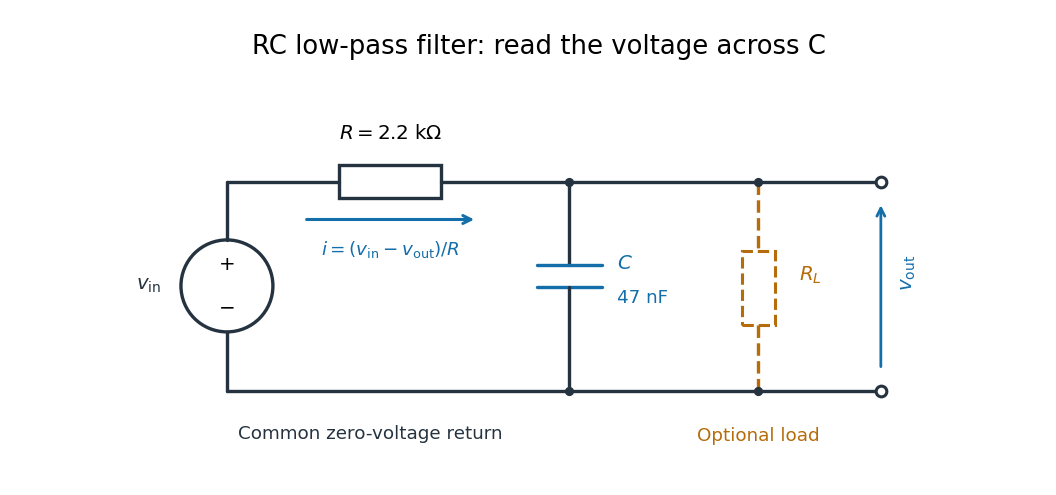
For electrical resistance and capacitance , Ohm's law gives the electric current through the resistor as . The capacitor relation gives . Equating them by Kirchhoff's current law yields the ordinary differential equationThe time constant has units of time. A rapid change in electric potential difference requires a large electric current into the capacitor; the finite electrical resistance limits that rate. A slowly maintained voltage instead lets the capacitor approach the input voltage. The same equation therefore predicts both smoothing of sustained oscillations and a rounded response to a sudden change.
RL low-pass filter Created 2026-10-18 Updated 2026-10-20
An RL circuit with the output measured across its resistor is a first-order low-pass filter. For an ideal inductor, an ideal voltage source and a high-resistance output instrument, the electrical impedances and giveThe gain approaches one at low angular frequency and at high angular frequency; at it is . The time-domain equation is and , so the time constant is . Instrument loading, source resistance and nonideal inductance can change the response.
Work by Louis Néel 2026-10-18
Work by Louis Dunoyer de Segonzac 2026-10-18
Work by Louis de Broglie 2026-10-18
Universality of an invariant speed under boost composition Created 2026-10-18 Updated 2026-10-20
Suppose standard collinear boosts have the Lorentz transformation form, but initially assign speed scales and to two successive transformations with relative velocities and . Their composition has spatial and temporal diagonal factors proportional to and , respectively. Closure within the same calibrated transformation family requires these factors to agree, forcing for generic nonzero boosts.
This argument fixes a universal reciprocal squared speed; it does not establish that it is nonzero. The common limit gives the consistent Galilean transformation family. A finite invariant speed of light is an additional empirical property of spacetime and electromagnetism, expressed by the second of the postulates of special relativity. It cannot be deduced by excluding the Galilean limit through boost composition alone.
Loop variant 2026-10-18
A decreasing measure used to prove algorithm termination. A nonnegative integer loop variant must strictly decrease after every completed body whose condition was true; the body itself must terminate.[ref]
Loop invariants. CS 2112 Fall 2019; Loop invariants, Using loop invariants to show code is correct: Termination and the decrementing function
The prefix maximum correctness example uses . It counts unread entries and is independent of whether the new entry changes the maximum. Ties therefore cannot stall progress: increases even when stays the same. An integer bounded below cannot strictly decrease indefinitely, which supplies the missing algorithm termination argument.
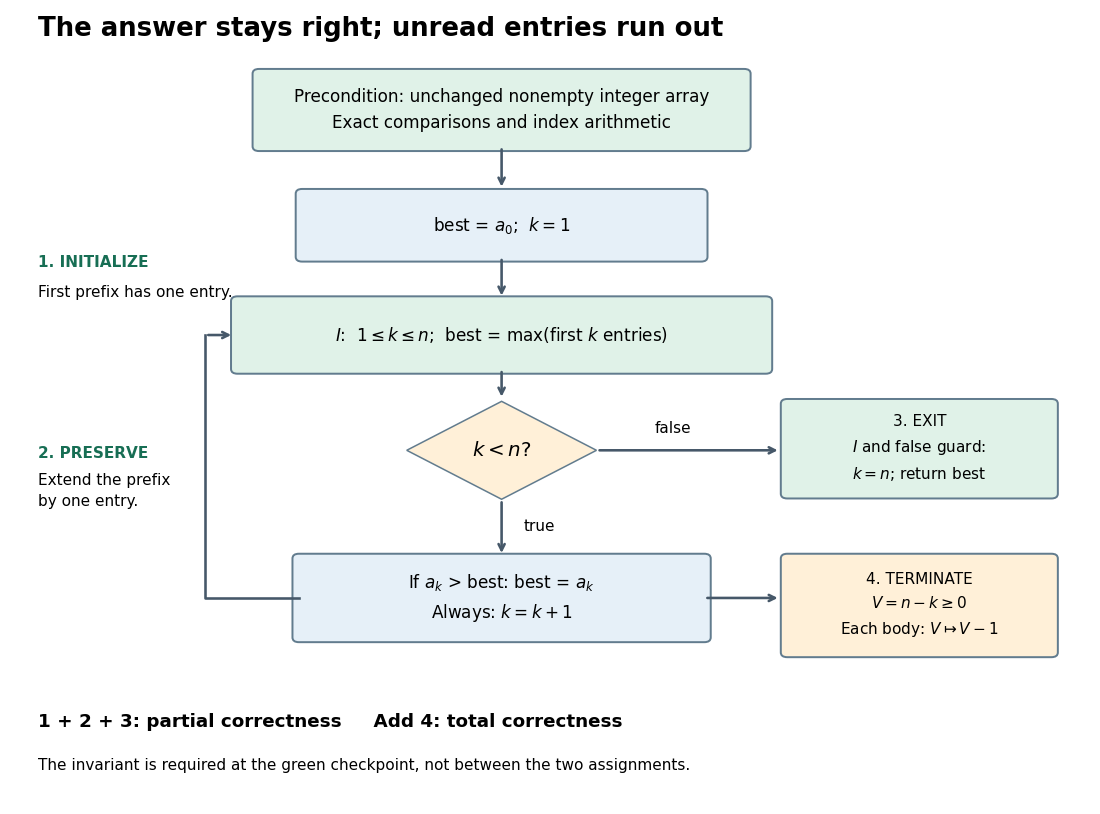
Control flow and four proof obligations for the prefix maximum correctness example
. Initialization, preservation, and exit establish partial correctness; the loop variant establishes algorithm termination and hence total correctness. The loop invariant is restored after both variable assignments. The input array stays unchanged throughout. Details. Work by Lloyd Shapley 2026-10-18
David Howells Created 2026-10-18 Updated 2026-11-05
David Howells is a software engineer who has contributed technical documentation for the Linux kernel. With Paul E. McKenney, he authored a guide to circular buffers, including the interaction between index arithmetic and synchronization.[ref]
Circular Buffers by David Howells and Paul E. McKenney. Author byline and opening summary
Their example separates the producer's insertion index from the consumer's removal index. With one producer and one consumer, memory barriers publish initialized data before an index advertises it as available. This illustrates why a correct data structure needs both an indexing convention and an account of what concurrent operations can observe.[ref]
Circular Buffers by David Howells and Paul E. McKenney. Using memory barriers with circular buffers, The producer and The Consumer
Ian R. Lanza Created 2026-10-18 Updated 2026-11-05
A researcher who coauthored methods for functional assessment of isolated mitochondria, relating respiration measurements to preparation yield and integrity.[ref]
Functional Assessment of Isolated Mitochondria In Vitro. 2009, author roster; Mitochondrial yield and integrity; Mitochondrial respiration
Andrew Huxley Created 2026-10-18 Updated 2026-11-05
A physiologist who coauthored intracellular recordings of action potentials in giant axons. Recording inside the axon against an external reference showed the membrane potential during excitation rather than only the external electrical signal.[ref]
Action Potentials Recorded from Inside a Nerve Fibre by Alan Hodgkin and Andrew Huxley. 1939, intracellular recording in giant axons

Portrait of Andrew Huxley
. Photographer unknown; Nobel Foundation archive, Nobel Prize in Physiology or Medicine 1963. Public domain in Sweden (Commons PD-Sweden); U.S. tag absent on file. Source and usage information on the linked Wikimedia file page. Source. Alan Hodgkin Created 2026-10-18 Updated 2026-11-05
A physiologist who coauthored intracellular recordings of action potentials in giant axons. Recording inside the axon against an external reference showed the membrane potential during excitation rather than only the external electrical signal.[ref]
Action Potentials Recorded from Inside a Nerve Fibre by Alan Hodgkin and Andrew Huxley. 1939, intracellular recording in giant axons
Institutional biography: www.physoc.org/blog/prize-lecture-memoria-alan-hodgkin/

Portrait of Alan Hodgkin
. Photographer unknown; Nobel Foundation archive, Nobel Prize in Physiology or Medicine 1963; existing crop. Public domain in Sweden (Commons PD-Sweden); U.S. tag absent on file. Source and usage information on the linked Wikimedia file page. Source. Ryohei Yasuda Created 2026-10-18 Updated 2026-11-05
A researcher who coauthored high-speed measurements resolving rotational substeps of F1-ATPase. The experiment connected molecular motion with steps in an enzyme’s catalytic cycle rather than treating rotation as a smooth average.[ref]
Resolution of distinct rotational substeps by submillisecond kinetic analysis of F1-ATPase by Ryohei Yasuda and others. study design and results; author roster
Bernhard Dobberstein Created 2026-10-18 Updated 2026-11-05
Molecular biologist studying transport of proteins across membranes. With Günter Blobel, Dobberstein reconstructed steps of the secretory pathway, connecting information in a nascent polypeptide with membrane-associated targeting.[ref]
Transfer of Proteins across Membranes I by Günter Blobel and Bernhard Dobberstein. Title, author list and reported study


Philip E. Stewart Created 2026-10-18 Updated 2026-11-05
Microbiologist studying bacterial genome maintenance. Stewart and collaborators compared maintenance functions of linear and circular plasmids in Borrelia burgdorferi, testing how different DNA structures can share inheritance mechanisms.[ref]
Esther Lederberg Created 2026-10-18 Updated 2026-11-05
Researcher in microbial genetics. With Joshua Lederberg, Lederberg coauthored the replica-plating study, which preserved colony patterns across growth conditions to distinguish pre-existing mutants from changes caused by selection.[ref]
Replica plating and indirect selection of bacterial mutants by Joshua Lederberg and Esther Lederberg. Title, author list and reported study

Portrait of Esther Lederberg
. Source. 
Gustaf Dalén 2026-10-18
A mechanical engineer whose work connected gas lighting to automatic operation. Chalmers records his mechanical-engineering qualification in 1896.[ref]
https://www.chalmers.se/en/about-chalmers/alumni/wall-of-fame/. Gustaf Dalén, Mechanical Engineering 1896: qualification and engineering career
After an accident left him blind in 1912, he returned to AGA in 1913 and continued leading the company.[ref]Gustaf Dalén – Beacon Lighting by Tekniska museet. The accident; Willpower and optimism: loss of sight, return and subsequent engineering work
The sun valve links radiometric absorptance, thermal expansion and mechanical motion to a useful decision: whether a beacon should receive its main gas supply. The Dalén light combines this daylight response with repeated flashes. The Nobel Prize in Physics in 1912 recognized his automatic regulators for lighthouse and buoy lighting.
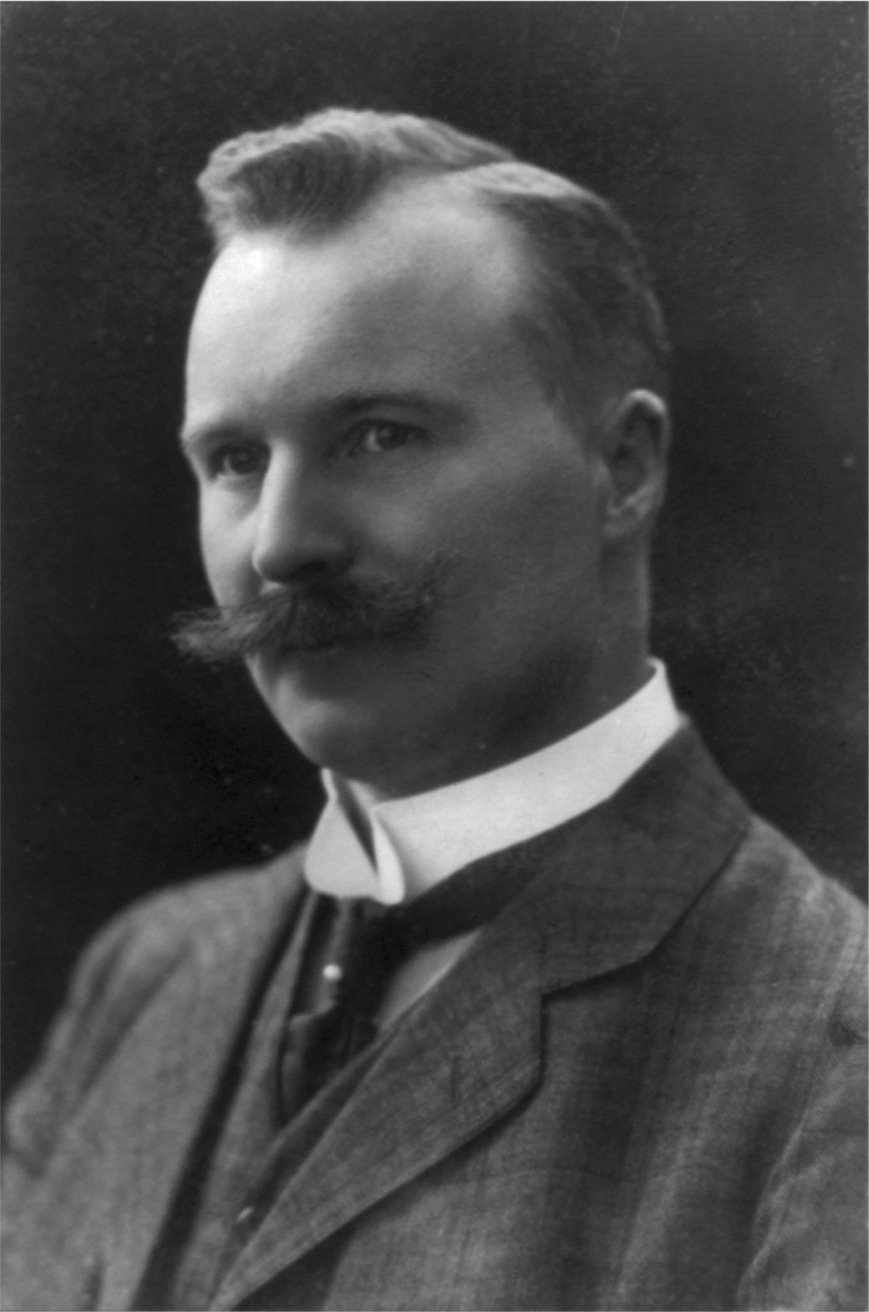
Portrait of Gustaf Dalén, via Wikimedia Commons
. Source. 
There are unlisted articles, also show them or only show them.