
Binary period invariant for a constant wind angular-momentum factor Created 2026-10-14 Updated 2026-11-05
If an escaping stellar wind carries specific orbital angular momentum with constant , then and . Combining this with circular-binary orbital angular momentum gives the displayed period invariant. It is a different prescription from donor-wind angular-momentum loss, whose specific angular momentum generally varies with mass ratio.
Nuclear-driven Roche-overfill relaxation Created 2026-10-14 Updated 2026-11-05
Let , , , and . Under the binary period invariant for a constant wind angular-momentum factor and , the restoring coefficient is . Locally freezing the masses gives an attracting overfill precisely when . If is of order one and , transfer is driven slowly by nuclear expansion. A negative gives positive feedback on the short overfill timescale; detailed outcomes then exceed this linear contact model.
Lyapunov convexity theorem 2026-10-14
The range of a finite-dimensional, finite, countably additive, atomless vector measure is compact and convex. In particular, an atomless measure restricted to a measurable set can realize every mass between zero and . This allows exact balancing by small disjoint consumer cohorts in an exchange economy.
Beckner's inequality 2026-10-14
For and , the noise operator on the Boolean hypercube satisfies for the uniform probability measure. In particular,Here are Fourier-Walsh transform coefficients. The endpoint follows by averaging. This hypercontractive inequality on the Boolean hypercube controls Fourier-Walsh transform coefficients of discrete derivatives of a Boolean function and is a principal ingredient in the Kahn-Kalai-Linial theorem.
The Noether–Lefschetz theorem makes any curve class a positive multiple of the hyperplane class, with positive self-intersection. But the smooth rational-curve self-intersection on a projective hypersurface formula makes every smooth rational curve have self-intersection at most when the surface degree is at least four. Thus none exists. The smoothness condition is essential; this does not prohibit singular curves whose normalizations are rational.
Final salt budget of a sealed mush column 2026-10-14
Assume a column is sealed to salt at both ends, diffusion occurs only in liquid, and its imposed temperature increases strictly upward. A finite-width equilibrium mushy layer cannot be stationary: its solute flux is nonzero unless its liquid fraction vanishes. The final state is pure ice below a height and uniform-composition brine above it. Their interface obeys . The displayed mass conservation equation fixes from the initial salt content. For a diffusive steadily pulled equilibrium mush, let , , and . The initial salt content is . Thus the liquid-cap depth obeys , which has one positive root. This conclusion assumes no subsequent exchange with an underlying eutectic reservoir.
Engel's theorem Created 2026-10-14 Updated 2026-11-05
A finite-dimensional Lie algebra is nilpotent if and only if every adjoint map is nilpotent. A Lie algebra of nilpotent endomorphisms can be simultaneously represented by strictly upper triangular matrices.
Upper central series of a Lie algebra 2026-10-14
Each term is the preimage of the center of a Lie algebra after quotienting by the preceding term. Equivalently, . A Lie algebra is nilpotent exactly when this series reaches the whole algebra after finitely many steps. For the Heisenberg Lie algebra, the series is .
Killing form of a nilpotent Lie algebra vanishes Created 2026-10-14 Updated 2026-11-05
Every Adjoint representation operator raises the lower central series of a Lie algebra filtration. In a basis adapted to that finite filtration, all adjoint operators are strictly triangular. Their products have zero trace, so the Killing form vanishes. Consequently its radical of the Killing form is the whole algebra. For strictly upper triangular matrices the filtration can be seen directly by the gap between the column and row indices.
// Target: algebra.bigb
For a vector field with linear part , and cubic terms , write with homogeneous cubic . The transformed cubic field is , where . Taking the coefficients of to be and those of to be eliminates every cubic term in and the terms in . The remaining normal form is , through cubic order. The invariant damping coefficient contains the contribution from differentiating the first equation.
Newform 2026-10-14
A newform is a normalized Hecke eigenform in the new subspace of cusp forms. Its weight, level and Dirichlet character are part of its specification. For a newform, its Fourier coefficients equal its eigenvalues of Hecke operators.
Distortion free energy density Created 2026-10-14 Updated 2026-10-20
For a unit nematic director, the bulk elastic density is . The three positive moduli penalize nematic splay, nematic twist, and nematic bend. Boundary elastic terms, chirality, or varying nematic order require additional contributions.
Finite-sample bias in a negative multinomial probability estimator Created 2026-10-14 Updated 2026-11-05
For independent one-stop negative multinomial distribution observations, the natural estimates are and . Their sum is with strictly concave , so Jensen's inequality makes its expectation strictly below . Conditional category proportions split this bias between both estimates. With zero observed counts of a category, that estimate lies at zero; in a parameter space requiring strict positivity the likelihood supremum is not attained.
Rigidity of a negative curve 2026-10-14
If an effective divisor is linearly equivalent to a negative curve , then . Otherwise forces to be a component of , since distinct irreducible curves have nonnegative intersection multiplicities. Write with effective and linearly equivalent to zero. An ample divisor intersects positively unless , while linear equivalence forces that intersection to vanish.
Countability of negative curves 2026-10-14
Distinct negative curves cannot have the same integral cohomology class: their mutual intersection would equal a negative self-intersection, contradicting nonnegative intersection multiplicities for distinct curves. A smooth complex projective surface has finitely generated integral cohomology groups, so its negative curves form an at most countable set. Zero-self-intersection curves need not obey this restriction: one ruling of gives an uncountable family.
Gaussian gauge fixing with an auxiliary field Created 2026-10-14 Updated 2026-11-05
Complete the square as . Translation of the Gaussian functional integral gives the displayed identity for nonzero , with the appropriate oscillatory contour prescription. At , the Nakanishi-Lautrup field is a Lagrange multiplier imposing the gauge-condition delta functional. This field has no kinetic term and no independent propagating degree of freedom.
For the unit-width symmetric box kernel for density estimation, suppose the design density is positive and differentiable at , the regression function is twice differentiable there, and the conditional variance and design density are bounded near . Write . Symmetry cancels its linear Taylor term, giving ; independence gives . The absolute error bound for a ratio estimator with a controlled denominator gives the displayed rate if the small-denominator contribution is negligible. The balance gives . Interior design positivity matters: support boundaries can prevent the linear cancellation.
Graeco-Latin square Created 2026-10-14 Updated 2026-11-05
A Graeco-Latin square is the superposition of two mutually orthogonal Latin squares of the same order. Each symbol of either square occurs once per row and column, and every cross-square pair occurs once. It permits four mutually orthogonal additive factor spaces: rows, columns, and the two symbol factors.
Polarized muon decay Created 2026-10-14 Updated 2026-11-05
For a negative muon with rest-frame spin vector , the leading massless-electron distribution is , where . Its final-spin sum is . The spin vector is axial whereas the electron direction is polar, so their scalar product reverses under parity. Its occurrence demonstrates parity violation by the left-chiral weak charged current.
Derivative along a curve Created 2026-10-14 Updated 2026-10-20
If is differentiable at the point of a differentiable parametric curve, the multivariable chain rule givesThe gradient supplies the local spatial rates; the velocity vector supplies the direction and rate of movement. Their dot product is the change in the sampled scalar field per unit parameter. If the parameter is time, this is a rate per unit time; a directional derivative per unit distance instead uses a unit vector.
Take and the unit circle path . Along the path,At , the gradient is , the velocity vector is , and their dot product is . The sampled value is and increases at rate one, even though one coordinate is decreasing. This is why a moving observation must combine every coordinate's contribution.
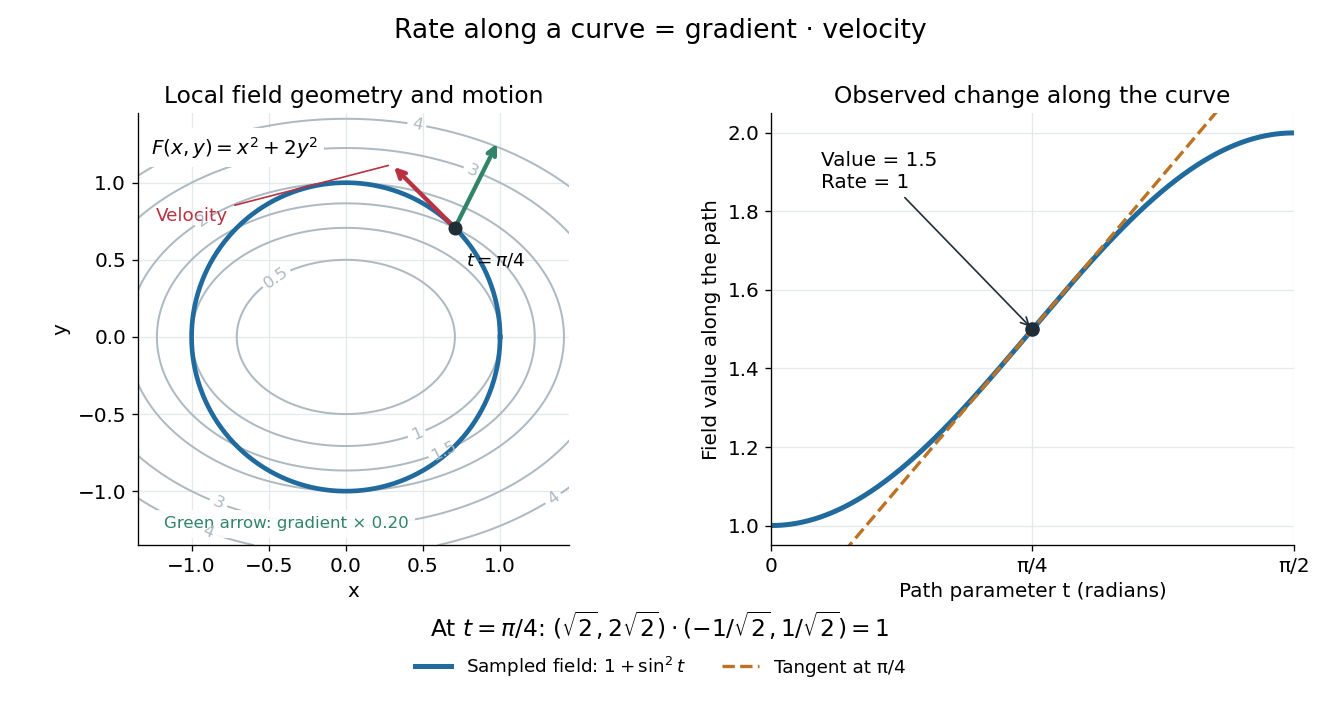

For a level curve, is constant, so the derivative along a curve is zero and its velocity vector is orthogonal to the gradient. Along other paths, the same formula combines a field's geometry with the observer's motion. [ref].
There are unlisted articles, also show them or only show them.