
Highest-weight classification of finite-dimensional semisimple Lie algebra modules Created 2026-10-14 Updated 2026-11-05
For a complex semisimple Lie algebra and a choice of positive roots, every finite-dimensional Irreducible Lie algebra representation has a unique highest weight, which is a dominant integral weight. Conversely each dominant integral weight labels exactly one such irreducible module up to isomorphism. Its highest-weight vector spans the highest-weight space and generates the module. This classification and Weyl complete reducibility theorem reduce decomposing any finite-dimensional module to its irreducible highest-weight summands.
Pseudocomplement 2026-10-14
The pseudocomplement of is the greatest element disjoint from . It need not satisfy . In a frame, double pseudocomplementation defines the Booleanization of a locale; its fixed elements are regular open elements.
Hermitian part of a matrix 2026-10-14
The Hermitian part of a square matrix is half its sum with its conjugate transpose. It is a Hermitian matrix and satisfies . Its largest eigenvalue is the numerical abscissa, controlling instantaneous growth of the Euclidean norm under .
Hermitian quadratic form 2026-10-14
A bounded Hermitian operator determines a Hermitian form and its real-valued diagonal expression . On a complex Hilbert space,Thus it is a quadratic form on the underlying real vector space; it is generally not a quadratic form over the complex field, whose scaling rule would involve . This distinction explains why replacing by loses the geometry of a complex inner product.
For a finite-dimensional Hermitian operator with an orthonormal basis of eigenvectors and corresponding eigenvalues , the spectral theorem givesFor a unit vector, this is an average of the eigenvalues with nonnegative weights summing to one. It is also the Rayleigh quotient, so its minimum and maximum are the smallest and largest eigenvalues.
In the Hermitian operator diagram, take for , and for . The computed curves areThese paths illustrate the extremal values; the spectral theorem supplies the bounds for every complex unit vector, including those outside the plotted paths.
Trace form on scalar-plus-skew-Hermitian two-by-two matrices Created 2026-10-14 Updated 2026-10-20
The real matrix space defined by consists exactly of , with and the three components of real. The Pauli matrices have , giving the displayed real symmetric bilinear form of signature . The real isomorphism to Hermitian matrices preserves this form when the latter have the polarized negative-determinant form .
Bending wave of a Keplerian disk Created 2026-10-14 Updated 2026-11-05
For the , Hermite vertical mode of an isothermal disk, the local dispersion relation is . Its low inertial-frame frequency branches satisfy . These waves transport a changing tilt of successive annuli, or a warp, with group velocity . The vertical velocity is approximately independent of height. A rigid tilt is the zero-wavenumber, zero-pattern-frequency limit; the gas still executes vertical orbital motion at frequency in its rotating frame.
Center quotient of the real Heisenberg group Created 2026-10-14 Updated 2026-10-18
In coordinates , the Heisenberg group law is . Commutation for every forces , hence . The center of a group is therefore the -axis. The surjective group homomorphism has exactly this kernel of a group homomorphism, giving the stated quotient group by the first isomorphism theorem.
Heegaard Floer chain complex 2026-10-14
For an admissible pointed Heegaard diagram, is a free chain complex with one generator for each point of . Each generator is an unordered selection containing exactly one intersection on each alpha circle and exactly one on each beta circle. After choosing coherent orientations,Here is the moduli space modulo strip translation, is the Maslov index, and is multiplicity at the basepoint. Holomorphic representatives have nonnegative domain multiplicities. The differential lowers grading by one and lowers it by two. Boundary strata of one-dimensional moduli spaces give the cancellation proving . Its homology is .
Variants of Heegaard Floer homology 2026-10-14
Use the convention that is generated by with , and . The chain complexes areThe last complex is generated by . Equivalently it is with its absolute grading shifted up by two. The short exact sequence gives the fundamental long exact sequence. For a rational homology sphere in each Spin-c structure, . The plus tower is , with bottom degree ; its corresponding minus tower is a free module with top degree .
Heegaard Floer cobordism map 2026-10-14
A smooth oriented cobordism with a Spin-c structure induces -equivariant maps on the corresponding Heegaard Floer homology groups. A handle decomposition defines the maps using generator selection for one- and three-handles and holomorphic triangle counts for two-handles. Composition sums over extensions of the prescribed Spin-c structures. When the boundary determinant classes are torsion, the absolute grading shift isThe square is defined using the rational relative lift. If , the infinity map vanishes. Between rational homology spheres, when , the infinity map is an isomorphism of Laurent towers.
For a knot in an integral homology three-sphere and , fix a Spin-c structure on the -surgery. Write for structures on zero-surgery with , using a capped Seifert surface. In compatible labels the completed-minus triangle isOne can equally use the plus theory without completing. The first map is the congruence-restricted zero-surgery trace map; the last is the sum of reverse, orientation-reversed -surgery trace maps. The middle map uses a Heegaard triple with an auxiliary lens-space generator. For that lens space is , giving the usual three two-ended cobordism maps. For it is important to retain the auxiliary boundary and its fixed Spin-c structure. The U-adic completion of Heegaard Floer homology makes the sums of maps well-defined.
Mixed Heegaard Floer invariant 2026-10-14
For a closed smooth oriented four-manifold with , remove two balls to obtain , and choose an Admissible cut for a Heegaard Floer mixed map. Positivity and naturality show that the minus map of lands in , while the plus map of descends from . ThusThe coefficient of the bottom plus generator in this map, applied to , defines , up to the orientation sign, with . It vanishes unless . The construction is independent of the admissible cut by the cobordism composition and associativity laws. Two positive pieces explain the condition .
Oja's rule 2026-10-14
For a linear output , the second term limits the growth produced by the Hebbian term. On the averaged dynamics with , . For , positive-eigenvalue equilibria have norm and align with eigenvectors of . If inputs are centered, is their covariance matrix.
Quartic norm stabilization of Hebbian learning Created 2026-10-14 Updated 2026-10-25
With , the squared weight norm satisfies . It moves monotonically toward without crossing it. Explicitly equals its initial value times . Persistent excitation therefore drives to ; without excitation it can remain stationary. This nonlinear normalization avoids the unbounded amplification of unmodified Hebbian learning.
For in geodesic normal coordinates, the Gauss lemma gives . Substituting into therefore yields , with . Integration along radial rays gives the displayed formula. Every coefficient is smooth at the centre. Any smooth solution of is zero for , since is constant and tends to zero at . This proves uniqueness. In this special divergence-form case , so every for is zero: the Gaussian itself solves the equation exactly on the coordinate ball. The positive Laplace-Beltrami operator instead has a metric volume-density term and a nonconstant leading amplitude.
For on scalar functions, the leading coefficient of the heat parametrix in normal coordinates is the inverse square root of the metric volume density: . The heat-kernel transport equations give . This gives the displayed diagonal expansion. The coefficient is specific to the minimally coupled scalar operator; a bundle connection or a curvature-dependent potential changes the general Laplace-type coefficients.
Heat invariants 2026-10-14
For the positive scalar Laplace-Beltrami operator on a compact manifold without boundary, the heat invariants are the integrated coefficients in the short-time heat kernel expansion. In particular and , with the scalar curvature. They are determined by the heat trace, hence by the spectrum with multiplicities. The leading positive coefficient recovers the dimension from .
Hausdorff dimension of a connected set 2026-10-14
A connected subset of Euclidean space containing distinct points has Hausdorff dimension at least one. The Lipschitz map maps onto a set containing , since continuous images of connected spaces are connected. A Lipschitz map cannot increase Hausdorff dimension, whereas an interval has Hausdorff dimension one. Consequently any set of Hausdorff dimension less than one is totally disconnected.
Pressure upper bound for Hausdorff dimension 2026-10-14
Suppose shrinking interval covers of have length-power sums with logarithmic growth rate , and is strictly decreasing with zero . For every those sums tend to zero exponentially. The definition of Hausdorff measure then gives , hence the displayed upper bound. A matching lower bound requires additional information and does not follow from this covering argument alone.
Hausdorff dimension of the Cantor set 2026-10-14
The middle-third Cantor set has Hausdorff dimensionIts Lebesgue measure is zero, yet . These assertions measure different aspects of size: interval length is too coarse to distinguish this set from a null set, while the critical fractional measuring rule captures its remaining structure.
At level , the construction covers by intervals of diameter . Their total -cost isFor it tends to zero, proving the upper dimension bound. At it equals one, giving . For this particular cover's cost grows, but that alone would not prove a lower bound on Hausdorff measure.
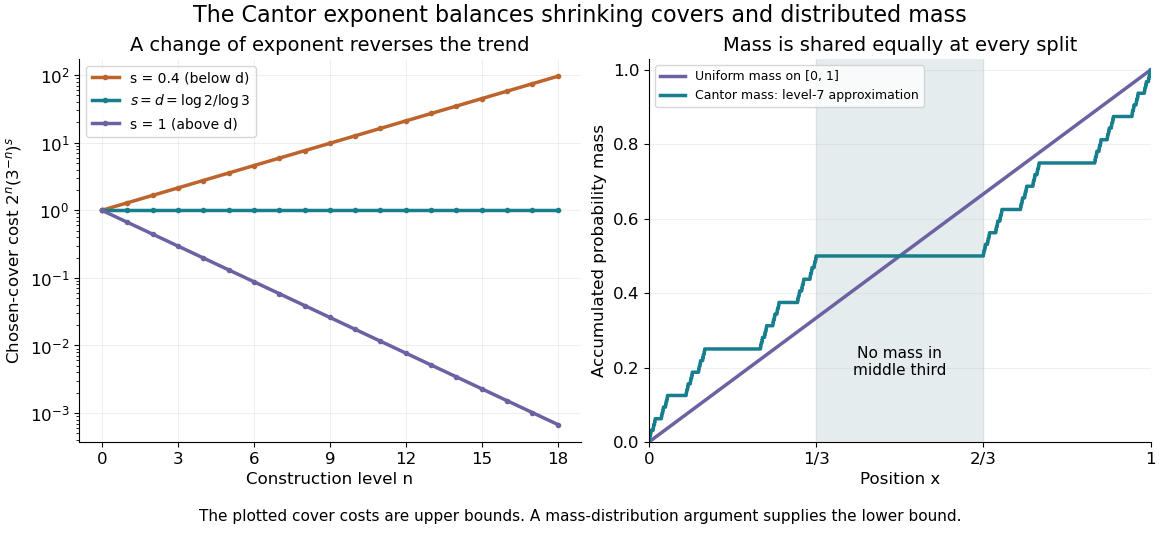
Cantor cover costs change trend at the critical exponent, and distributed mass supplies the lower bound
. Details. 
For the matching lower bound, use the Cantor distribution, which assigns mass to each level- Cantor cylinder. An interval of length with meets at most two level- construction intervals, since their gaps are at least . Its mass is therefore at mostEvery covering set of diameter in the line lies in an interval of length , so any small cover must have total -cost at least . This is the mass distribution principle in its interval form: , sufficient to prove the claimed dimension. The constants are convenient bounds, rather than an assertion of the exact critical Hausdorff measure. In the diagram, the right panel is a finite-stage approximation to the Cantor function, showing how probability is shared while the middle third receives none.
The reusable pattern is to obtain an upper bound by constructing covers and a lower bound by distributing mass. The same strategy underlies Cartesian powers of the Cantor set and the dimension formula for a finite similarity iterated function system satisfying the open set condition.
There are unlisted articles, also show them or only show them.