
Statistical hypothesis Created 2026-10-14 Updated 2026-10-18
A statistical hypothesis is a specified set of possible data-generating probability distributions, usually expressed as a restriction on model parameters. A simple statistical hypothesis specifies one distribution; a composite statistical hypothesis permits several. A hypothesis test compares a null hypothesis with an alternative hypothesis using a statistic calibrated under the null.
Richardson iteration 2026-10-14
Semiconvergence of cyclic Poisson iterations Created 2026-10-14 Updated 2026-10-25
The periodic second-difference circulant matrix has constant null space, so solvability requires . Its Jacobi method has eigenvalues : for odd it converges to some solution, while for even an alternating mode oscillates unless absent from the error. Lexicographic Gauss-Seidel iteration converges to some solution for every compatible right-hand side and every initial vector. For , a coordinate sweep decreases the energy by the sum of squared coordinate changes. This excludes all nonconstant unit-modulus eigenmodes. The constant unit eigenvalue is simple, since the invariant left vector has . Neither method is a strict contraction to a unique solution without fixing the constant nullspace.
For a primary operator, . Taking the residue against gives the weight for , the derivative descendant for , and zero for every . Conversely the absence of positive-mode actions excludes higher poles in this operator product and gives the primary transformation law. The antiholomorphic argument is identical. Thus primary states and primary operators correspond under radial quantization.
Star-subalgebra 2026-10-14
A linear subalgebra closed under the involution. In bounded operators, this means closure under the adjoint operator; neither norm closure nor operator-topology closure is part of the definition. These distinctions matter in the Von Neumann double commutant theorem and the Kaplansky density theorem.
Hermitian element of a star algebra 2026-10-14
A Hermitian algebra element of a star-algebra is an element fixed by its algebra involution. The identity and zero are Hermitian algebra elements. For every , both and are Hermitian algebra elements. A real spectrum for all such elements is an extra condition in a general Banach algebra, rather than a consequence of the involution identities alone.
Quark doublet 2026-10-14
In one Standard Model generation, the left-handed up and down quark fields form a weak doublet of hypercharge . Each weak component has three colours. The same field therefore counts as three doublets for weak gauge-loop contributions and two colour fundamentals for strong gauge-loop contributions. Right-handed up and down quarks are separate weak singlets.
Stamen filament 2026-10-14
The stalk supporting an anther.
Anther 2026-10-14
Gale-Shapley algorithm Created 2026-10-14 Updated 2026-10-18
The Gale-Shapley algorithm constructs a stable matching by letting one side propose and the other hold its best offer so far. The word "deferred" is essential: a held proposal is tentative and can be replaced. David Gale and Lloyd Shapley presented this construction in their 1962 paper, College Admissions and the Stability of Marriage, §3, printed pp. 12–13; §4 extends it to college quotas and unacceptable pairs.
For the one-partner bipartite graph model, designate as proposers and as receivers:
- Start with the empty matching in a graph. Each proposer keeps a pointer to its first untried acceptable partner.
- Choose an unmatched vertex in a matching whose list is not exhausted. It proposes to its highest-ranked untried neighbour of a vertex and advances its pointer permanently.
- If holds nobody, it holds . Otherwise compares with its currently held proposer, keeps the one it prefers, and rejects the other. A displaced proposer becomes unmatched and may propose again later.
- Stop when every unmatched proposer has exhausted its list. The held pairs are the output matching in a graph.
Held proposers wait; only unmatched proposers act. A receiver can replace its held partner, whereas a proposer never tries the same edge twice. Isolated vertices simply remain unmatched. These rules also describe incomplete acceptable lists and unequal sides without adding fictitious acceptable partners.
For the preference lists under stable matching, choose available proposers in queue data structure order, initially , adding rejected proposers at the end. The proposals are , , , , . At the fourth proposal, replaces its held by because . This frees to try , producing .
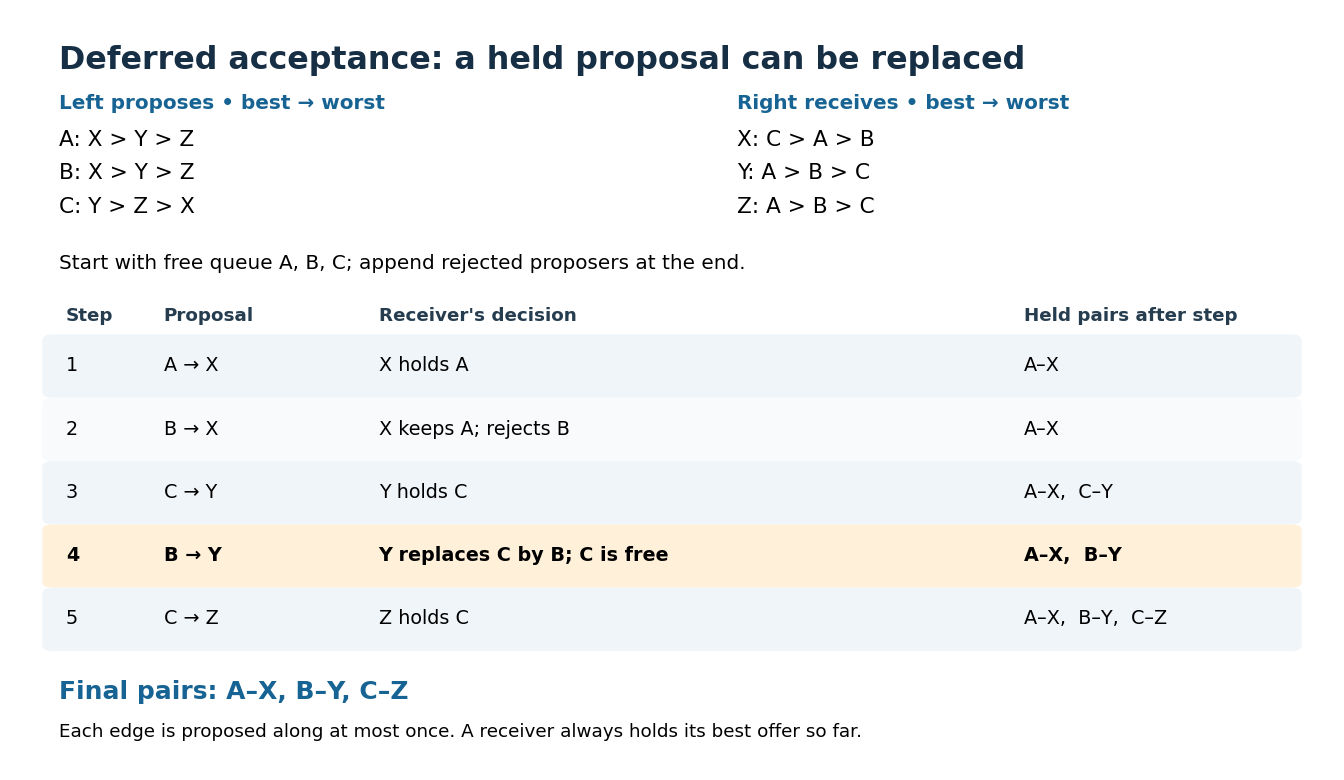
Five proposals in the Gale-Shapley algorithm: Y replaces a tentative partner before the final stable matching
. Details. 
Reverse the proposing side. Starting in the order , the proposals are , , , . Now rejects because it already holds . The result is . Thus the choice of proposing side can change the output even with strict preferences and complete lists.
Why does the procedure work? Each edge receives at most one proposal, so at most proposals occur. At all times, the held edges form a matching in a graph, and each receiver holds its favourite proposer among all proposals received. A receiver's held partner can only improve according to its strict preference. If a proposer prefers to its final partner, or ends unmatched while is acceptable, it must already have proposed to . A rejection means then held someone better, and its final partner is at least as good. Such an edge cannot be a blocking pair in stable matching. This covers every possible blocking pair in stable matching, proving stability at termination.
With a queue data structure of unmatched proposers, a next-choice pointer for each list, and constant-time receiver-rank lookups, each proposal takes constant work. Using Big O notation, the time complexity is including initialization, provided list construction and rank preprocessing also take . Edge-indexed ranks with cross-referenced list entries, or expected constant-time hash lookups, allow sparse storage proportional to . Repeatedly scanning a receiver's preference list to compare offers would lose this bound. For complete lists with vertices per side, and the bound is . Initializing full rank tables itself costs time and space, even when only a sparse set of pairs is acceptable.
The Gale-Shapley algorithm does more than establish existence: with strict preferences, its output is a proposer-optimal stable matching.[ref]
College Admissions and the Stability of Marriage by David Gale and Lloyd Shapley. §5, printed p. 14, Theorem 2: applicant optimality and the rejection induction
It is also a receiver-pessimal stable matching, as proved below. Both qualifications compare partners across stable matchings. Mutual-worst edge in stable matchings 2026-10-14
If the endpoints of an edge rank one another last and one stable matching in a bipartite graph contains that edge, every stable matching contains it. In the symmetric difference of two stable matchings, preference comparisons propagate along alternating paths: if a vertex prefers its new partner, that partner must prefer its old partner to avoid blocking the old matching. An alternating path cannot end unmatched on the preferred side, so the component is an alternating cycle, on which the two parts prefer opposite matchings. A mutual-worst edge absent from the new matching would make both its endpoints prefer the new matching, contradicting this propagation.
Stable equivalence of spectra 2026-10-14
A map of topological spectra inducing isomorphisms on every stable homotopy group is a stable equivalence of spectra.
Stable elementary subgroup Created 2026-10-14 Updated 2026-11-05
The subgroup generated by elementary transvections in finite matrix sizes, with identity stabilization. A third distinct index expresses each transvection as a commutator; stable block identities show that this subgroup is normal and that its quotient in the stable general linear group is abelian. Thus it is precisely the commutator subgroup.
Axial subgroup Created 2026-10-14 Updated 2026-11-05
For a steady-state equivariant dynamical system, an axial subgroup is a stabilizer subgroup whose real fixed-point subspace of a group action has dimension one. Requiring an actual stabilizer subgroup matters: a smaller subgroup can have the same fixed line without being the full symmetry of any point on that line. The fixed line reduces the steady-state bifurcation equation to one real amplitude.
In an equivariant Hopf bifurcation, a complex axial isotropy subgroup is instead a stabilizer subgroup for the spatial symmetry group combined with the common phase circle action, with one-dimensional complex fixed-point subspace of a group action. Distinct conjugacy classes of such subgroups can describe distinct types of bifurcating branches.
Pointwise stabilizer 2026-10-14
For a group action, the pointwise stabilizer of a set is the subgroup fixing each of its points individually. It is the intersection of their stabilizer subgroups. This is stronger than merely mapping the set to itself.
Balanced spectrum of a nonidentity stabilizer Created 2026-10-14 Updated 2026-11-05
A stabilizer group excludes , so each element squares to and is Hermitian; an imaginary-phase Pauli element would square to . A nonidentity stabilizer contains at least one nonidentity local Pauli matrix and has zero trace, since the trace of a tensor product is the product of local traces. Its eigenvalues are therefore with equal multiplicities. This trace fact also gives from the stabilizer-projector formula.
Squire transformation 2026-10-14
For positive streamwise wavenumber , replace a three-dimensional Orr-Sommerfeld equation by a two-dimensional one with the displayed parameters. Both the transverse operator and the coefficient remain unchanged, preserving the eigenfunction and phase-speed eigenvalue. This proves the modal comparison in Squire's theorem.
Nicomachus's theorem 2026-10-14
For every nonnegative integer ,For example, . A short proof uses the triangular number recurrence and the triangular number square-complement identity:Summing this difference of squares identity gives a telescoping sum; all intermediate squared triangular numbers cancel. Nicomachus describes a related grouping of the odd integers: take one, then the next two, then the next three, producing , which are . This historical grouping is recorded in Introduction to Arithmetic by Nicomachus (Hahn teacher edition) (Book II, Chapter 20, §5, printed p. 75).
Split link diagram 2026-10-14
A split diagram has two nonempty parts separated by a simple closed curve disjoint from the diagram. For a two-component link, this is equivalent to disconnectedness of its projection graph. An alternating link diagram representing a split link cannot have a connected projection graph, as its Jones value at minus one detects a nonzero spanning-tree count.
Quadratic spline 2026-10-14
A quadratic spline with simple knots is a continuously differentiable function that is a polynomial of degree at most two between successive knots. Its first derivative is continuous and piecewise linear, while its second derivative is piecewise constant and can jump at knots. Constant tails impose vanishing first derivatives at the outermost knots. Such a spline arises from first-derivative roughness penalization when observations are interval averages, as in the quadratic smoothing spline for interval averages.
There are unlisted articles, also show them or only show them.