
Dense subspace Created 2026-10-14 Updated 2026-11-05
A dense subspace of a topological vector space is a linear subspace with . For a normed vector space, every vector of is a limit of a sequence from . A continuous linear operator into a Hausdorff target is uniquely determined by its values on .
Existence of an extension needs additional hypotheses. A bounded linear operator from into a Banach space extends uniquely to by taking limits, as in extension of a bounded linear operator from a dense subspace. An incomplete target can obstruct this construction, as the failure of dense-subspace extension into an incomplete codomain shows.
Untwisted band 2026-10-14
An untwisted band is the topological surface obtained from a rectangle by identifying with . It is the Cartesian product of a circle and a closed interval, and is homeomorphic to a closed annulus. A finite portion of the lateral surface of a circular cylinder realizes it in three-dimensional space. Its two boundary circles are and , and the matching seam directions make it an orientable surface. The Möbius band changes just one identification sign and loses both this two-component boundary and its orientability.
Thrice-punctured sphere 2026-10-14
The sphere with three points removed is an orientable noncompact surface of genus zero with three ends. It can be realized by pairing the two sides at each of two opposite ideal vertices of an ideal hyperbolic quadrilateral in the hyperbolic disk. The four ideal vertices fall into three equivalence classes; after adding these three points the cell structure has one face, two edges and three vertices, hence Euler characteristic two. Removing these added vertices recovers the original quotient.
Classification of compact surfaces Created 2026-10-14 Updated 2026-10-25
A connected compact surface is determined by its orientability, number of boundary circles and genus. An orientable surface of genus has Euler characteristic ; a surface which is not orientable with crosscaps has Euler characteristic . In particular, a closed connected surface with vanishing first mod-two homology is a sphere, and a connected closed orientable surface of Euler characteristic zero is a torus.
Alexandroff extension 2026-10-14
The one-point compactification of a locally compact noncompact Hausdorff space adjoins one point whose neighbourhoods are complements of compact subsets. The result is compact Hausdorff.
Kolmogorov space 2026-10-14
A topological space is when every pair of distinct points is distinguished by an open set containing exactly one of them.
Net (mathematics) 2026-10-14
A net is a family indexed by a directed ordered set: every pair of indices has a common upper bound. It converges to when it is eventually in every neighbourhood of . Unlike sequences, nets characterize closure in every topological space: a point is in the closure of a set precisely when some net in that set converges to it.
Sober space 2026-10-14
A topological space is sober when every nonempty irreducible closed subset is the closure of a unique point. Every Hausdorff space is sober. In contrast, an infinite set with the cofinite topology has the whole space irreducible and closed, while every singleton is closed, so it is not sober.
Sigma-compact space 2026-10-14
A space is sigma-compact if it is a countable union of compact subsets. A locally compact, sigma-compact metrizable space is second countable: each compact metrizable subset has a countable dense set, their union is countable and dense, and a separable metric space has a countable basis.
Give the topology whose nonempty open sets are and the finite initial segments. Every nonempty open set contains , so any two nonempty open sets intersect. A continuous map from this topological space into a Hausdorff space is constant: distinct image points would have disjoint open neighbourhoods, whose inverse images would be disjoint nonempty open sets. This includes continuous real-valued maps.
Stratified space 2026-10-14
Open and closed maps Created 2026-10-14 Updated 2026-10-14
An open map sends each open set to an open set; a closed map sends each closed set to a closed set. These properties concern images, whereas continuity concerns inverse images of open sets. Neither openness nor closedness alone implies continuity.
Kahn's algorithm 2026-10-14
Kahn's algorithm maintains each remaining vertex's indegree, the number of its unfinished incoming directed edges, and a FIFO queue of ready vertices. Initialize the counts by scanning all directed edges and enqueue every vertex of indegree zero. Repeatedly dequeue a vertex , append it to the output, and decrement the count of each destination in 's adjacency list. Enqueue exactly when its count becomes zero. When the FIFO queue empties, accept the output if it contains all vertices; otherwise report a directed cycle. [ref]
https://raw.githubusercontent.com/kevin-wayne/algs4/master/src/main/java/edu/princeton/cs/algs4/TopologicalX.java. Sedgewick and Wayne, TopologicalX: queue-based topological sorting
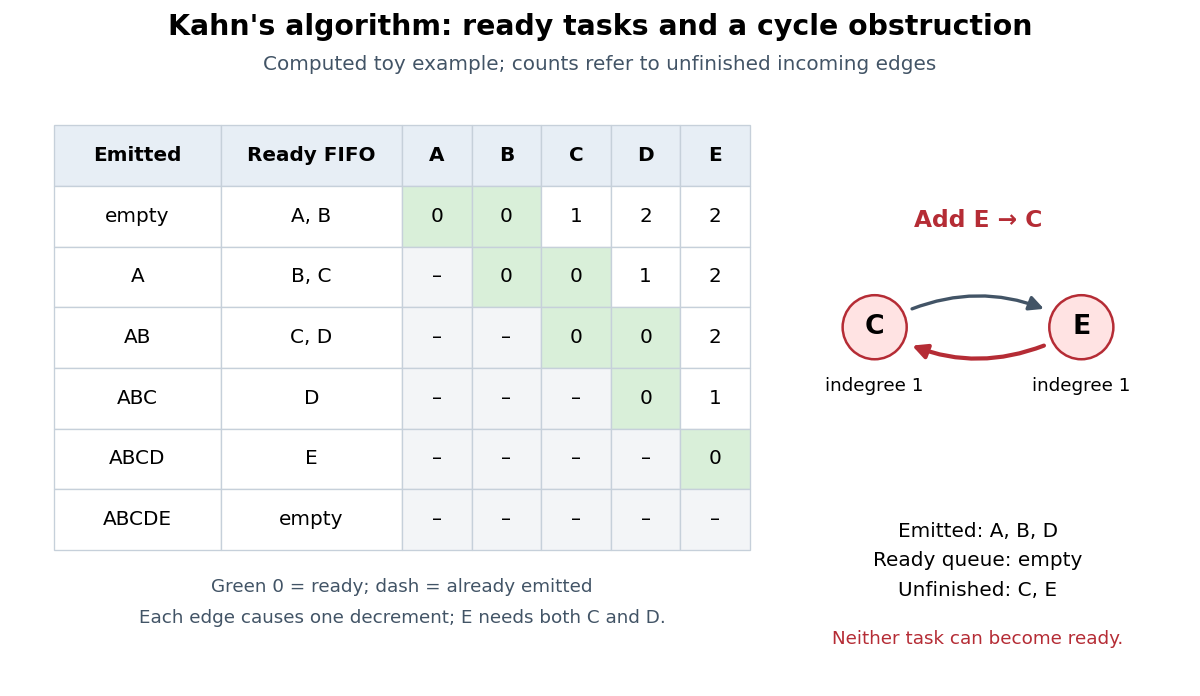
Computed ready-queue trace and the obstruction caused by a reverse dependency
. Details. 
In the displayed run, initialize the FIFO queue as and visit 's destinations in the order . Removing makes ready but leaves waiting for . Removing then makes ready. Publication becomes ready only after both and are removed. The output is ; choosing ready vertices differently can produce the other topological orders. For the modified directed graph with , the same procedure emits and then stops with still waiting on each other.
The invariant is that each stored indegree counts incoming directed edges from unprocessed vertices. A ready vertex therefore has every prerequisite already in the output. If the FIFO queue empties with vertices left, every remaining vertex has a predecessor in the remaining directed graph; the predecessor argument gives a directed cycle. The unprocessed vertices can also include tasks blocked downstream of a directed cycle, so the leftover list alone is not a list of exactly the cyclic vertices.
With adjacency lists, constant-time array access and counter updates, and constant-time FIFO queue operations, the time complexity is in Big O notation. Initialization scans all vertices and directed edges; each vertex is then enqueued at most once and each outgoing directed edge processed at most once. Counts, ready FIFO queue, and output need storage beyond the adjacency lists. Shifting an array on every dequeue invalidates this bound. [ref]
https://raw.githubusercontent.com/kevin-wayne/algs4/master/src/main/java/edu/princeton/cs/algs4/TopologicalX.java. Sedgewick and Wayne, TopologicalX: time and extra-space bounds
[ref]https://raw.githubusercontent.com/kevin-wayne/algs4/master/src/main/java/edu/princeton/cs/algs4/Digraph.java. Sedgewick and Wayne, Digraph: adjacency lists and outgoing-edge iteration
The name refers to A. B. Kahn's 1962 paper "Topological sorting of large networks", published in Communications of the ACM, volume 5, issue 11, pages 558–562. Its abstract motivates topological sorting through network analysis and project planning. [ref]
https://doi.org/10.1145/368996.369025. Kahn, Topological sorting of large networks (1962): publisher's record and abstract
// Target: foundations-of-mathematics.bigb
Topological order Created 2026-10-14 Updated 2026-11-05
A topological order of a finite directed graph is a sequence containing every vertex exactly once, withThus every directed edge points forward in the list. Equivalently, a bijection assigning positions satisfies for every directed edge . A topological ordering names the same kind of list. [ref]
The toy directed acyclic graph has exactly five topological orders: , , , , and . These lists were checked by enumerating all permutations and retaining precisely those satisfying all five directed edge inequalities. Every list ends with , since all other tasks have a directed path to publication. A topological order need not put adjacent entries next to one another in the directed graph: and are consecutive in without a directed edge between them.
A directed cycle would force the impossible chain of position inequalities . In the toy example, adding requires review before publication and publication before review, so there are no topological orders. Together with the construction in topological sorting, this proves that a finite directed graph admits a topological order if and only if it is a directed acyclic graph. The empty directed graph has the empty sequence as its topological order.
There is also a useful connection to partial orders: define when or there is a directed path from to . For a directed acyclic graph, this reachability relation is a partial order, and its linear extensions are exactly the topological orders. The directed acyclic graph specifies which pairs must be ordered; a topological order chooses positions for all the remaining pairs.
3-manifold 2026-10-14
4-manifold Created 2026-10-14 Updated 2026-11-05
A 4-manifold is a topological manifold locally modeled on , with a half-space model if a boundary is allowed. Examples include the four-sphere, the Complex projective plane and the product of two spheres . Its middle-dimensional intersection form pairs degree-two homology classes. Dimension four is special because an embedded two-dimensional surface has the same dimension as its complementary normal directions; intersections and their removal become particularly subtle. A smooth four-manifold carries additional differentiable structure, which is not determined merely by its local topological model.
Piecewise linear ball Created 2026-10-14 Updated 2026-10-14
A piecewise linear ball is a simplicial complex admitting a homeomorphism to an -simplex that is linear on the simplexes of suitable finite simplicial subdivisions. Its boundary is a piecewise linear sphere.
Odd topological K-theory Created 2026-10-14 Updated 2026-11-05
For compact metric , odd topological K-theory is the homotopy set of norm-continuous maps into unitaries equal to the identity modulo compact operators on a fixed separable infinite-dimensional Hilbert space. Uniform finite-rank approximation over and over homotopies gives the equivalent stable model . Block sum gives an abelian group: a finite-dimensional unitary path swaps blocks, and a two-block rotation contracts to the identity. On the circle the determinant winding identifies with ; Bott periodicity gives in odd dimensions and zero in even dimensions.
Discrete subgroup 2026-10-14
A subgroup of a topological group is discrete when the identity has a neighbourhood containing no other element of . Translation then isolates every group element. In a Hausdorff topological group, such a subgroup is closed: any accumulation at a point would make differences of distinct nearby group elements approach the identity. Consequently its intersection with a compact set is finite. For isometries of hyperbolic space, this converts compactness of the set of isometries moving one point a bounded distance into a properly discontinuous group action.
For example, isolates the identity element of the additive discrete subgroup . Its induced subspace topology is the discrete topology, while the surrounding real numbers retain their usual topology; see closed subgroup for why this subgroup is closed but not open.
A topology on a group makes it a topological group precisely when its neighbourhood bases satisfy two local tests: every neighbourhood of contains for some neighbourhoods of and of , and every neighbourhood of contains for some neighbourhood of . These are exactly continuity of multiplication in the product topology and continuity of inversion. Equivalently, bases can be chosen as left translates of a basis at the identity, with arbitrarily small squares, inverses and conjugates inside each prescribed identity neighbourhood.
There are unlisted articles, also show them or only show them.