
Hilbert tensor product 2026-10-14
The Hilbert tensor product is the completion of the algebraic tensor product of Hilbert spaces with , extended sesquilinearly. Orthonormal bases identify this inner product with the Euclidean inner product on coefficient arrays, proving positivity. In particular, and . These identities turn scalar power series into vector embeddings, as in the proof of the Grothendieck inequality.
Reducing subspace of a Hilbert-space operator Created 2026-10-14 Updated 2026-10-31
A closed subspace of a Hilbert space reduces a bounded operator when both the operator and its adjoint leave the subspace invariant. Equivalently, the orthogonal projection onto it commutes with the operator: the adjoint invariance makes its orthogonal complement invariant too. For a star-closed algebra of operators, the closed span of the orbit of any vector is reducing for the whole algebra. This enables an orthogonal direct-sum decomposition into cyclic actions when constructing Borel functional calculus for a normal operator.
Fano scheme 2026-10-14
The closed subscheme of the Grassmannian parametrizing projective -planes contained in an embedded projective variety .
Hilbert functor 2026-10-14
For a projective scheme over a field , the Hilbert functor assigns to a -scheme the set of closed subschemes which are of finite presentation, proper and flat over . Pullback of families makes it a contravariant functor. After choosing a very ample line bundle, requiring a fixed fibre Hilbert polynomial gives the subfunctor represented by . The unrestricted functor is represented by the disjoint union of these Hilbert schemes.
For a finitely generated algebra over an algebraically closed field , radical ideals correspond, with inclusion reversed, to closed subsets of the maximal spectrum. If , the nonzero algebra is still finitely generated over . Its maximal residue field is by the Zariski lemma, so contracting a maximal ideal gives a maximal ideal of containing and avoiding . Hence the intersection of all maximal ideals containing is . This proves the inverse correspondence, including the empty closed set and unit ideal.
For an ideal in , let contain the coefficients of in its elements of degree at most . These are ideals of and form an ascending chain, since multiplying by embeds one into the next. If is a Noetherian ring, the chain stabilizes at , and each for has finitely many generators. Choose corresponding polynomials in . Their union generates : for an element of degree , subtract a combination of the chosen polynomials for if , or the polynomials for multiplied by otherwise. This cancels its leading coefficient and lowers its degree. Induction completes the proof without assuming that is an integral domain.
Dark radiation on a cosmological brane 2026-10-14
Projected bulk Weyl tensor can contribute a radiation-scaling term to the brane Friedmann equation, even without ordinary brane photons. For an anti-de Sitter black-hole bulk the integration constant is related to its mass. This dark radiation on a cosmological brane changes the expansion rate tested by Big Bang nucleosynthesis and Cosmic microwave background anisotropy; it should not automatically be identified with a freely specifiable thermal particle species.
Catalysed peroxide comparison Created 2026-10-14 Updated 2026-10-18
A simple motivating comparison is visible gas evolution from hydrogen peroxide, whose net chemical equation isThe products are water and oxygen. The Royal Society of Chemistry's teaching resource uses small test tubes and droppers, hydrogen peroxide labelled 5–10 volumes, solutions of metal salts including copper(II) sulfate, and approximately sodium hydroxide. Its qualitative procedure tests additions singly and in pairs to tubes containing about depth of hydrogen peroxide. It reports the expected classroom result that the additions individually are not effective under those conditions, whereas the solids produced by mixing metal-salt solution with sodium hydroxide give effective heterogeneous catalysis. This is the resource's expected observation, not a newly measured ranking.[ref]
The best catalyst to decompose hydrogen peroxide by Royal Society of Chemistry. Resources and Results: small test tubes, droppers, peroxide strength, single versus paired additions, visual readout and expected precipitate effect
A focused adaptation compares four matched tubes: no addition, copper(II) sulfate alone, sodium hydroxide alone, and the pair. Use equal initial hydrogen peroxide amounts, identical tubes and the same starting temperature. Record stock concentrations and added volumes; add water to the other tubes to match the total added liquid. Additions can first be checked without hydrogen peroxide to distinguish precipitation from gas evolution. Start a timer at contact, mix consistently, and observe gas evolution over the same interval. These matching controls are proposed improvements to the qualitative resource, not claimed details of its original trials. Follow its supervised chemical-handling requirements; the stated strengths describe its teaching protocol rather than an unrestricted recipe.
The immediate readout is relative bubbling, together with whether a solid appears. More vigorous bubbling in the paired tube supports faster conversion under the comparison conditions; it does not identify the solid's exact composition or establish a unique reaction mechanism. Bubble counts are not a calibrated reaction rate: bubble sizes, gas retention and warming can differ. For a quantitative extension, use a freely moving gas syringe to record collected volume and compare early slopes at matched temperature and pressure; check for leaks and repeat runs. This extension is a measurement proposal, not source-reported gas traces.
The paired treatment also changes pH and produces a surface, so the four tubes alone cannot assign the whole effect to one microscopic catalytic step. A filtered-liquid comparison and a separated, washed-solid comparison would help distinguish dissolved and solid contributions, although washing itself can change the active material. More gas at one time establishes neither a changed equilibrium constant nor indefinite catalyst reuse. The open gas-evolution experiment is especially unsuitable as a demonstration that two closed mixtures reach the same chemical equilibrium: the escaping oxygen changes the constraints. The reversible model above supplies that separate explanation. No numerical experimental rate constants, barrier heights or gas volumes are asserted here.
For the Hénon map with , fixed points exist at . Their multipliers satisfy . The Jury stability criterion gives asymptotic stability only for the upper branch, with and . The two-cycle has alternating values satisfying and . Its second-iterate trace is and determinant , so it is attracting for until . The fixed-point fold and first flip are nondegenerate away from endpoints and persist under small smooth perturbations.
Conservative Hénon stability boundary 2026-10-14
At the Hénon map has unit Jacobian determinant. The upper fixed point is linearly elliptic for , and its newborn two-cycle is elliptic for . These are neutral multiplier statements, not attraction. The endpoints have double multipliers and . Constant-area scaling also excludes a simple invariant closed curve enclosing positive area when and : invariance of its interior would require both and . Thus the elliptic stability boundary is a conservative degeneracy, not a generic dissipative Neimark-Sacker bifurcation. Arbitrary non-area-preserving perturbations can change this behavior even though generic fold and flip curves persist.
Discrete Helmholtz resonance 2026-10-14
On a square Dirichlet grid with spacing and interior indices , the five-point Laplacian is diagonalized by products of the sine modes used in the discrete sine transform. The discrete equation is nonsingular exactly when is not one of the displayed positive eigenvalues of , with . Values below the first resonance are sufficient but not necessary for invertibility.
Helmholtz Green-function reciprocity Created 2026-10-14 Updated 2026-10-18
Two Green functions of the same Helmholtz equation with the same homogeneous Robin boundary condition satisfy the displayed reciprocity by Green's second identity. It is a bilinear identity without complex conjugation, so it concerns the transpose rather than the Hermitian adjoint. In an exterior problem both kernels use the same radiation convention.
Weil height machine 2026-10-14
On a projective variety over a number field, a very ample line bundle gives a logarithmic projective height by an embedding. Tensor products correspond to sums by the Segre embedding, and a sufficiently ample twist expresses any line bundle as a difference of very ample ones. This defines its height modulo bounded functions. It is additive and functorial under morphism pullback. An ample bundle has the Northcott theorem finiteness property for bounded height and bounded point degree; a trivial bundle need not. The product formula makes these absolute heights independent of scalar coordinates and of the number field used to compute them.
Néron–Tate height 2026-10-14
For a symmetric ample line bundle on an abelian variety, the canonical height is . It is quadratic and differs from the associated logarithmic Weil height by a bounded function. The canonical height of an elliptic curve specializes this construction to a one-dimensional abelian variety.
Infinity type of a Hecke character Created 2026-10-14 Updated 2026-11-05
For an algebraic Hecke character, the character on archimedean ideles is a product of integral powers of embeddings and their complex conjugates. In the convention for primary over an imaginary quadratic field, the ideal character has type and the idele character has archimedean component . Distinguishing these conventions avoids inverse errors in CM Galois representations.
Hecke character of a CM elliptic curve Created 2026-10-14 Updated 2026-11-05
Suppose contains the CM field and all CM endomorphisms are defined over . CM reciprocity compares the torus with its idele-transformed lattice and gives for finite ideles. Then . On principal ideles, , so the character descends to the idèle class group. At a good prime its ideal value reduces to the Frobenius isogeny. If the original field omits , construct the character over and induce the corresponding representation down to the original field.
Heat-pump calorimetry 2026-10-14
A motivating bench experiment asks whether a hot bath receives more heat than the electrical work supplied to a heat pump. PHYWE's authored operating instructions, section 4, describe a sealed vapor-compression refrigeration apparatus with its cold and hot coils immersed in separate water vessels. The quantitative procedure calls for insulated vessels, stirring to reduce temperature gradients, timed temperature readings, and a wattmeter for the input. It waits about five minutes for operating conditions to settle before measurements and explicitly includes the glass vessel and immersed copper pipe when calculating the heated body's heat capacity. One bath cooling while the other warms makes the origin of the delivered energy observable. [ref]
The following analysis extends that procedure to simultaneous measurements of both finite baths. Weigh the water in each vessel; determine the effective heat capacities and , including immersed hardware, by a separate known electrical-input calibration over the working temperature range. A matched pair of calibrated thermometers placed in stirred water measures bulk and ; keeping probes away from the coils avoids mistaking a local contact temperature for the whole bath. Record the room temperature and synchronise the electrical meter and thermometry. Use short intervals after startup, with no boiling or freezing and small enough temperature changes that constant effective heat capacities are a reasonable approximation. These are proposed measurement controls, rather than reported results from the manual.
Over a common interval , the uncorrected bath estimates and measured electrical input areHere the wattmeter records real electrical power . The integral handles changing input, and the signs make both estimated useful heat quantities positive during heating and cooling. The effective heat capacity includes water mass times its specific heat capacity plus the response of the vessel and immersed hardware. Without that correction, equal temperature changes need not imply equal heat transfers.
Insulation reduces heat leaks but does not establish an isolated system. A warmer bath can lose heat to the room while a colder bath gains it. As a proposed control, measure pump-off drift at matched bath and room temperatures, with the same stirring and insulation. Writing for outward hot-bath leak power and for inward cold-bath leak power, the bath balances giveIntegrate these rates over the same interval before dividing by . For example, in a pump-off hot-bath control, ; in the cold-bath control, . Check that a stopped machine does not create a different leak path from the running one; otherwise use an independent bath calibration and keep that discrepancy as an uncertainty. Repeat at the same starting temperatures to distinguish drift from a change in COP as the baths separate.
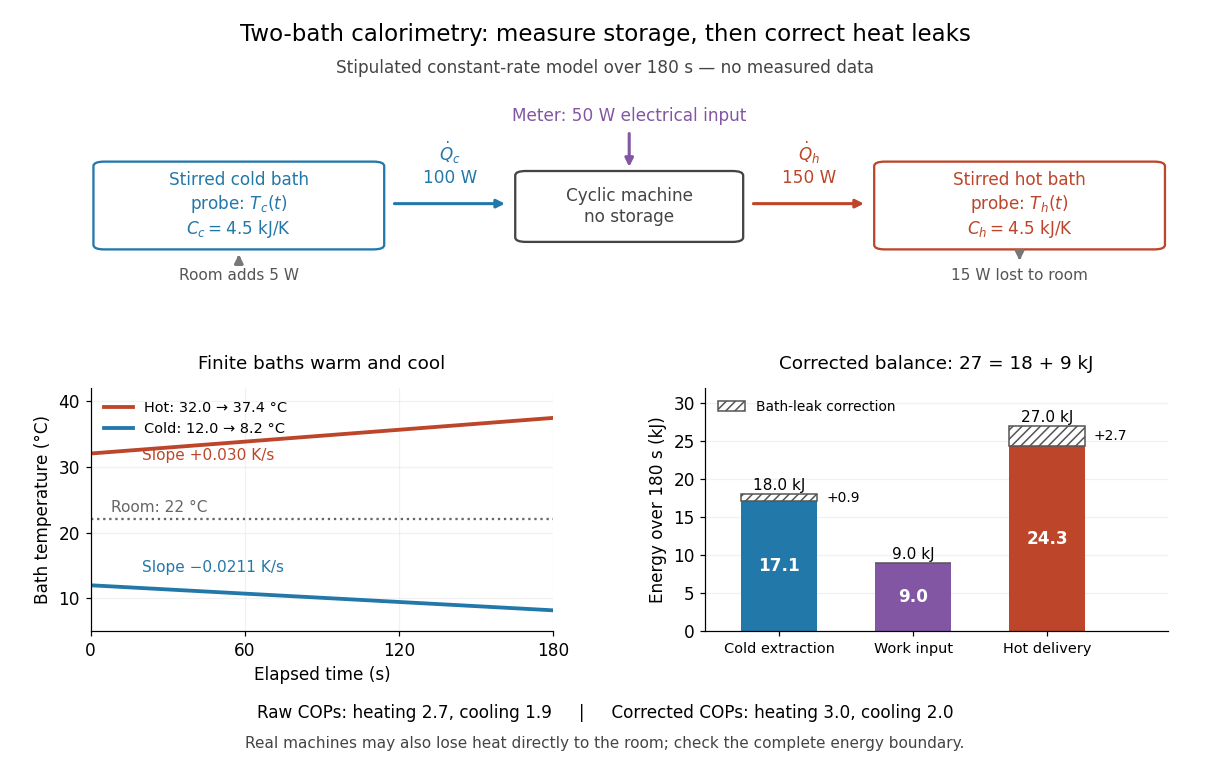

In the illustrated toy model, , , , , , and are stipulated constants for . The slopes are and . Consequently,The raw heating and cooling ratios are and , whose difference is . Correcting the bath leaks gives and , whose difference is one. The apparent failure of was incomplete measurement of heat, not a violation of the first law of thermodynamics.
Real apparatus can also release motor heat and pipe heat directly to the room, and store internal energy during startup. For a machine boundary that receives electrical work, an additional outward heat transfer gives . The residual therefore tests the boundary and corrections; do not force it to zero. Include any auxiliary electrical work in the input if quoting whole-apparatus COP, and account separately for stirring work deposited in a bath. Ignoring vessel heat capacity, sensor lag or room leaks can bias the inferred result. These limitations follow from extending the measured energy budget, and the manual's explicit hardware correction illustrates why such boundaries matter.
Finally, these vessels are finite bodies whose temperatures change; they are not fixed thermal reservoirs. Their ratio of integrated useful heat to integrated input work is an interval COP. A Carnot's theorem comparison using simultaneous bath temperatures is a local approximation only when the machine settles much faster than the baths change. An exact reversible comparison for changing bath temperatures instead uses the bath entropy changes, for example for constant heat capacities, negligible net machine entropy change and no room leaks. The experiment's beauty is that two thermometers, known heat capacities and an electrical-energy measurement expose both conservation of energy and the practical gap from reversibility.
Coefficient of performance Created 2026-10-14 Updated 2026-10-18
For the cyclic two-side energy balance in refrigerator, define the dimensionless cooling and heating coefficients byThis identity applies even to irreversible machines, provided both coefficients refer to the same operating point, work input and boundary with no additional energy transfer or storage. It does not compare two separately operated appliances. Unlike thermal efficiency of a heat engine, a COP can exceed one: its numerator counts heat moved, including energy taken from another region. [ref]
https://labs.phys.utk.edu/mbreinig/phys136core/modules/m3/refrigerators.html. University of Tennessee, Refrigerators, air conditioners, and heat pumps: the two performance ratios
To obtain temperature-only bounds, impose stronger assumptions: a cyclic machine exchanges heat only with two ideal thermal reservoirs maintained at uniform, fixed absolute thermodynamic temperatures , and receives work through an ideal input carrying no entropy. Include the machine and the heat transfer interfaces in the entropy production accounting. Because its own entropy returns to its initial value each cycle, the Second law of thermodynamics givesCombining this inequality with givesEquality requires a reversible thermodynamic process for the entire cycle and its contacts, as in a reversed Carnot cycle. These are Carnot's theorem bounds independent of the working substance. Use kelvin values, not degree Celsius readings, in the numerators; the temperature difference can be expressed in either unit. [ref]
https://web.mit.edu/16.unified/www/FALL/thermodynamics/notes/node25.html. MIT, Refrigerators and heat pumps: reversed Carnot cycle and absolute-temperature cooling bound
[ref]https://openstax.org/books/university-physics-volume-2/pages/4-5-the-carnot-cycle. Ling, Moebs and Sanny, University Physics Volume 2, §4.5: reversible reservoir entropy balance
The diagram fixes and sets , so the reversible bounds are and . The stipulated machine with and satisfies both. Its reservoir entropy production per cycle is . Increasing the temperature lift at fixed lowers both bounds. Equivalently, delivering fixed needs at leastThese expressions reveal why a small temperature lift is attractive. Their divergence as is an ideal reversible limit, not a promise of infinite heating or cooling power. For finite heat transfer rates, the working fluid must be colder than the cold bath and hotter than the hot bath; these contact differences produce entropy and increase the internal temperature lift. Dissipative compression and the pressure-reducing restriction of vapor-compression refrigeration supply further departures from reversibility. Thus bath temperatures set an outer bound, not a prediction of real COP. [ref]
https://web.mit.edu/16.unified/www/FALL/thermodynamics/notes/node25.html. MIT, Refrigerator hardware: working-fluid temperatures on either side of the baths
Heat-engine calorimetry 2026-10-14
Heat-engine calorimetry measures heat transfers so that observed work can be compared with the correct energy input. Measuring motion alone cannot supply the denominator of thermal efficiency.
The institutional Laboratory 16: Stirling Engine describes a modern teaching arrangement: an ethanol lamp drives a Stirling engine coupled to an electrical output device, which supplies a resistor immersed in water in a calorimeter. The prescribed readouts include fuel mass consumed, the pressure-volume loop, electrical readings, and water temperature. The sequence separates fuel input, gas-cycle work, electrical output, and Joule heating of the water. Warming of the water is the final useful output; it is not the engine's rejected . The handout distinguishes warm-up from steady operation and asks students to compare the final warming with direct heating by the lamp. It gives a procedure, not a table of measured efficiencies. Its pp. 1–3 therefore establish an apparatus and measurement design without supplying a new experimental result.
For a proposed calibration, use a known input of electrical work to determine the effective heat capacity of the water, vessel and immersed parts; stir to make the measured temperature representative. A matched run with no input estimates exchange with the room. For constant and no phase transition, the resulting model iswhere is the signed net heat lost to the room during the measurement. Here is supplied electrical work when the resistor lies inside the calibration boundary; for a separate external heat input it is the received heat. These are proposed controls, not controls reported in that handout. Slow cooling, changing material properties and imperfectly matched room exchange limit this inference; the approach to thermal equilibrium and heat capacity matter as much as the thermometer reading.
To measure the actual engine-input , one must instrument its hot-side transfer separately, or close a calibrated energy balance around a specified heater boundary. A heater's electrical work includes changes in its stored internal energy and heat transfer that bypasses the engine. At periodic operation a cold-side flowing-water measurement can instead estimate , if mass flow rate and specific heat capacity at constant pressure are known, with negligible storage and other heat exchange in that measurement boundary. It measures only the rejection captured by that stream. Include all remaining transfers before using the residual to infer . This measurement discipline makes a comparison with Carnot's theorem meaningful.
Stirling engine Created 2026-10-14 Updated 2026-10-20
A Stirling engine repeatedly heats and cools a confined gas, whose expansion and compression drive a moving mechanical load. This makes it a particularly accessible example of a heat engine: both the repeating motion and the two regions exchanging heat can be observed.
In the published Demonstration experiments with a Stirling engine by Christopher G Deacon and others, an electrical heater warms one end of a cylinder and flowing water cools the other at . A moving displacer shuttles gas through copper wool that temporarily stores and returns internal energy. A laser spot traces a closed pressure-volume path on a screen: mechanical motion controls one coordinate, pressure the other. Calibrating both scales converts the enclosed area to work per thermodynamic cycle; multiplying by rotation frequency gives gas-cycle power. At heater input, the paper reports gas-cycle power, while a separate Prony brake measures shaft output. The cold-side temperature is controlled and two higher heater settings are compared. The gas has a nonuniform temperature, and heater energy also escapes to the room: neither output/input ratio measures for an ideal two-thermal reservoir engine. These observations demonstrate work production and losses, not a direct measurement of the bound in Carnot's theorem. The inspected apparatus, readouts and results are on pp. 180–182, Figures 1–3 and Table 1.
There are unlisted articles, also show them or only show them.