
Kramers--Wannier duality Created 2026-09-24 Updated 2026-09-28
Kramers--Wannier duality exchanges order variables with domain-wall or disorder variables. In multiple dimensions it naturally appears as a tensor-network map with a nontrivial symmetry-sector kernel.
Symmetry-protected topological phase Created 2026-09-24 Updated 2026-09-24
Topological equivalence of gapped Hamiltonians Created 2026-09-24 Updated 2026-10-03
Two local gapped Hamiltonians are topologically equivalent when they are connected by a continuous path of local Hamiltonians with a nonzero bulk gap, equivalently when their ground spaces are related by quasi-local evolution.
Topological superconductor Created 2026-09-24 Updated 2026-09-24
A topological superconductor is a gapped paired-fermion phase supporting protected boundary Majorana modes.
Anyon Created 2026-09-24 Updated 2026-09-24
An anyon is a two-dimensional quasiparticle whose exchange or braiding statistics can differ from bosonic and fermionic statistics.
Abelian Chern--Simons theory Created 2026-09-24 Updated 2026-10-06
An Abelian Chern--Simons theory with integer symmetric invertible matrix describes Abelian anyons whose braiding phases are determined by .
Metric space Created 2026-09-24 Updated 2026-10-14
A metric space is a set together with a metric measuring how far apart its elements are. The elements can be positions, functions, or other objects: what matters is that the metric obeys the same basic rules. This lets one discuss convergence in a metric space, continuous maps, and Cauchy sequences without first assigning Cartesian coordinates. The useful abstraction is that many arguments require only comparisons of distances, rather than the particular objects being compared.
Even the same set can support several informative metrics. On the plane with Cartesian coordinates, write and . Three standard choices are Manhattan distance, Euclidean distance, and Chebyshev distance:They come from the L1 norm, Euclidean norm, and maximum norm, respectively, through . For and , Manhattan distance is , Euclidean distance is , and Chebyshev distance is . All three answers are correct for their respective metrics.
The choice encodes the question being asked. Manhattan distance models travel along a rectangular street grid. Euclidean distance measures unrestricted travel along a line segment. Chebyshev distance measures the time needed when two Cartesian coordinates can change simultaneously, each at speed at most one. Thus choosing a metric is part of modelling, rather than a consequence of knowing the endpoints. These examples have the same metric topology, but different metric path lengths and different collections of metric geodesics.
A historical reference for the general study of metric spaces is Maurice Fréchet's 1906 paper Sur quelques points du calcul fonctionnel, published in volume 22 of the Rendiconti del Circolo Matematico di Palermo. [ref]
https://link.springer.com/article/10.1007/BF03018603. Fréchet, Sur quelques points du calcul fonctionnel, 1906
No-retraction theorem Created 2026-09-24 Updated 2026-09-24
No closed disc retracts continuously onto its boundary. This is equivalent to Brouwer fixed-point theorem by the standard ray construction and the antipodal map.
Brouwer fixed-point theorem Created 2026-09-24 Updated 2026-10-14
The Brouwer fixed-point theorem says that every continuous map has a fixed point when is a nonempty compact set and a convex set in a finite-dimensional vector space over the real numbers. Equivalently, take for a finite , with the usual Euclidean space structure: there is some such that . The conclusion guarantees at least one fixed point, without asserting uniqueness or telling us how quickly to find one. [ref]
https://courses.csail.mit.edu/6.5440/fall23/lectures/L23_images.pdf. MIT lecture slides on Brouwer's theorem
The standard pictures are a closed ball, including a closed unit ball, and a simplex. A filled disk qualifies; its bounding circle alone does not. A probability simplex also qualifies even though its dimension is smaller than that of its ambient Euclidean space. The hypotheses have concrete meanings: being a convex set keeps every line segment between allowed points inside , and compactness prevents escape or loss of a limiting point. In Euclidean space, the Heine-Borel theorem identifies compact sets with closed sets that are bounded sets. Crucially, every output must belong to the same as the input.
For a fully computable example, let be the filled unit disk. Apply a counterclockwise quarter-turn rotation, shrink by , and add a translation:This affine map is a continuous map. Because the rotation preserves the Euclidean norm, the triangle inequality gives, for every ,Thus the whole image lies strictly inside . More precisely, it is a disk of radius centred at . This containment check is what makes the Brouwer fixed-point theorem applicable; a formula being a continuous map by itself would not suffice.
The fixed point can now be found by a system of linear equations:Indeed, substitution gives . Its Euclidean norm is , safely inside . The figure shows arrows from sample inputs to their outputs; an arrow disappears at the fixed point because the displacement vanishes there.
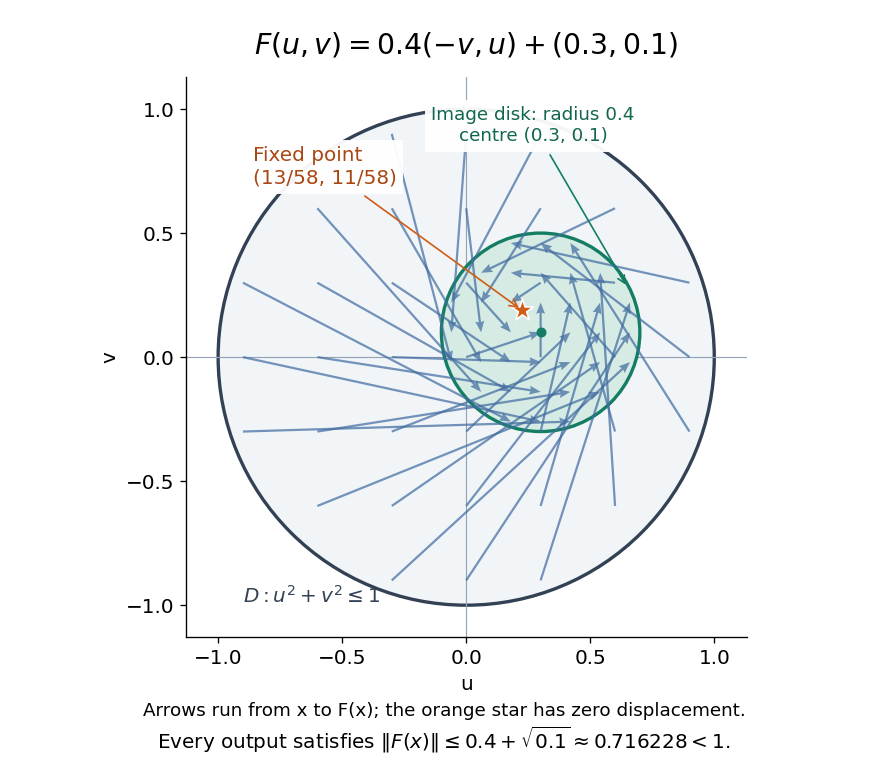
Repeated iterations of a map happen to succeed for this example. Starting at and setting gives , , and . Subtracting the fixed point equation yields , so the Euclidean distance to shrinks by exactly each step. This extra fact follows from the contraction mapping property and the Banach fixed-point theorem. It is additional information beyond the Brouwer fixed-point theorem.
The distinction becomes visible with two simpler continuous maps of the same disk. The pure rotation has exactly one fixed point, , since and force both to vanish. Yet iterations of a map starting at here cycle through , , and forever. Their Euclidean distance from stays one, so there is no convergence in a metric space. The reflection has an entire line segment of fixed points, namely . Starting off that line segment produces an alternating pair. Existence, uniqueness, and convergence of iterations of a map are separate questions.
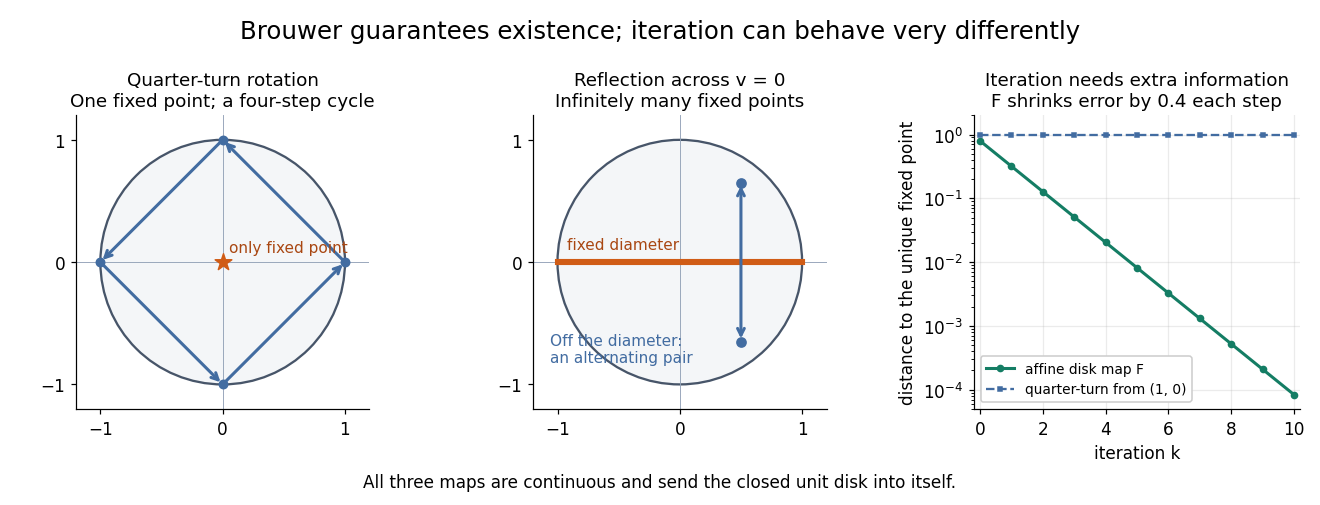


Removing hypotheses changes the answer. Restrict the same quarter-turn rotation to the circle . It remains a continuous map into that compact set, but its only possible fixed point, , has been removed. The circle is not a convex set. Conversely, on the unbounded convex set , the translation has no fixed point; on the open interval , also has none. Neither domain is a compact set. The finite-dimensional closed ball statement should likewise not be extended to arbitrary infinite-dimensional vector spaces, where a closed ball need not be a compact set.
The one-dimensional version explains the connection to the intermediate value theorem. For a continuous map , put . Then and , so the intermediate value theorem gives for some . In higher dimensions, the Brouwer fixed-point theorem supplies a corresponding existence principle when this scalar sign argument is unavailable. Its practical value is ensuring that a proposed equation has a solution once a suitable domain is found; it supplies no general promise of a fast algorithm.
A useful application is positive matrix eigenvector from simplex normalization: rescale the output of a strictly positive matrix to make its entries sum to one. For example, takeOn this probability simplex, has entry sum , so the normalized continuous map is . Both entries are positive and sum to one, keeping the image inside the probability simplex. Its fixed point equation is , hence . Consequently satisfies : a strictly positive eigenvector with eigenvalue . In larger dimensions, the Brouwer fixed-point theorem guarantees the corresponding positive eigenvector without requiring us to solve a system of linear equations in advance. The fixed point expresses preservation of relative weights, rather than preservation of their unnormalized size.
Proofs can be approached through the no-retraction theorem or Sperner's lemma. In the latter approach, increasingly fine triangulations locate approximate fixed points; compactness supplies a convergent subsequence, and continuous maps turn its limit into an exact fixed point. [ref]
https://www.mit.edu/~6.7980/brouwer.html. Daskalakis and Farina, Brouwer and Sperner
A primary historical reference is L. E. J. Brouwer's 1911 paper Über Abbildung von Mannigfaltigkeiten, whose digitized original is hosted by Zenodo under DOI 10.1007/BF01456812. This gives a direct route to the early literature behind the Brouwer fixed-point theorem. [ref]
https://zenodo.org/records/1428286. Brouwer, Über Abbildung von Mannigfaltigkeiten, 1911
Effective potential for timelike Schwarzschild geodesics Created 2026-09-24 Updated 2026-09-24
For equatorial timelike motion with specific angular momentum ,A circular orbit has and therefore requires .
Effective-potential stability of a circular orbit Created 2026-09-24 Updated 2026-09-24
A circular orbit at a strict local minimum of the radial effective potential is stable under small radial perturbations.
Bound-state quantization condition Created 2026-09-24 Updated 2026-10-03
Matching a wavefunction and its derivative across finite potential discontinuities, together with decay or wall conditions, permits only discrete bound-state energies.
Imaginary-coupled two-level Hamiltonian Created 2026-09-24 Updated 2026-09-24
Second-order nondegenerate perturbation theory Created 2026-09-24 Updated 2026-09-24
For a normalized nondegenerate eigenstate ,For a ground state, every denominator is negative, so the correction is nonpositive.
First-order nondegenerate perturbation theory Created 2026-09-24 Updated 2026-09-24
Nondegenerate energy eigenvalue Created 2026-09-24 Updated 2026-09-24
An energy eigenvalue is nondegenerate when its eigenspace is one-dimensional. Its normalized eigenstate is then unique up to a complex phase.
First-order energy correction Created 2026-09-24 Updated 2026-10-07
The first-order energy correction is the coefficient of the perturbation parameter in the expansion of an energy eigenvalue.
Continuum transition probability at long times Created 2026-09-24 Updated 2026-10-03
For a harmonic perturbation and continuum detuning , first-order amplitudes containThe distributional limitselects energy-conserving continuum states and produces a transition probability linear in time.
Thermodynamic cycle Created 2026-09-24 Updated 2026-09-24
A thermodynamic cycle returns a working substance to its initial state. Its net internal-energy change is zero, so the net work output equals net heat input.
Constant-pressure heating of an ideal gas Created 2026-09-24 Updated 2026-09-24
There are unlisted articles, also show them or only show them.